Saudi Arabia Titanium Market Summary
The saudi arabia titanium market was estimated at USD 332 Million in 2025 and is projected to reach USD 425 Million by 2032, growing at a CAGR of 4.9% from 2026 to 2032.
Saudi Arabia Titanium Market Year-wise Growth Rate and Key Drivers
This graph highlights how the Saudi Arabia Titanium Market has steadily grown over the past five years, supported by major growth factors.
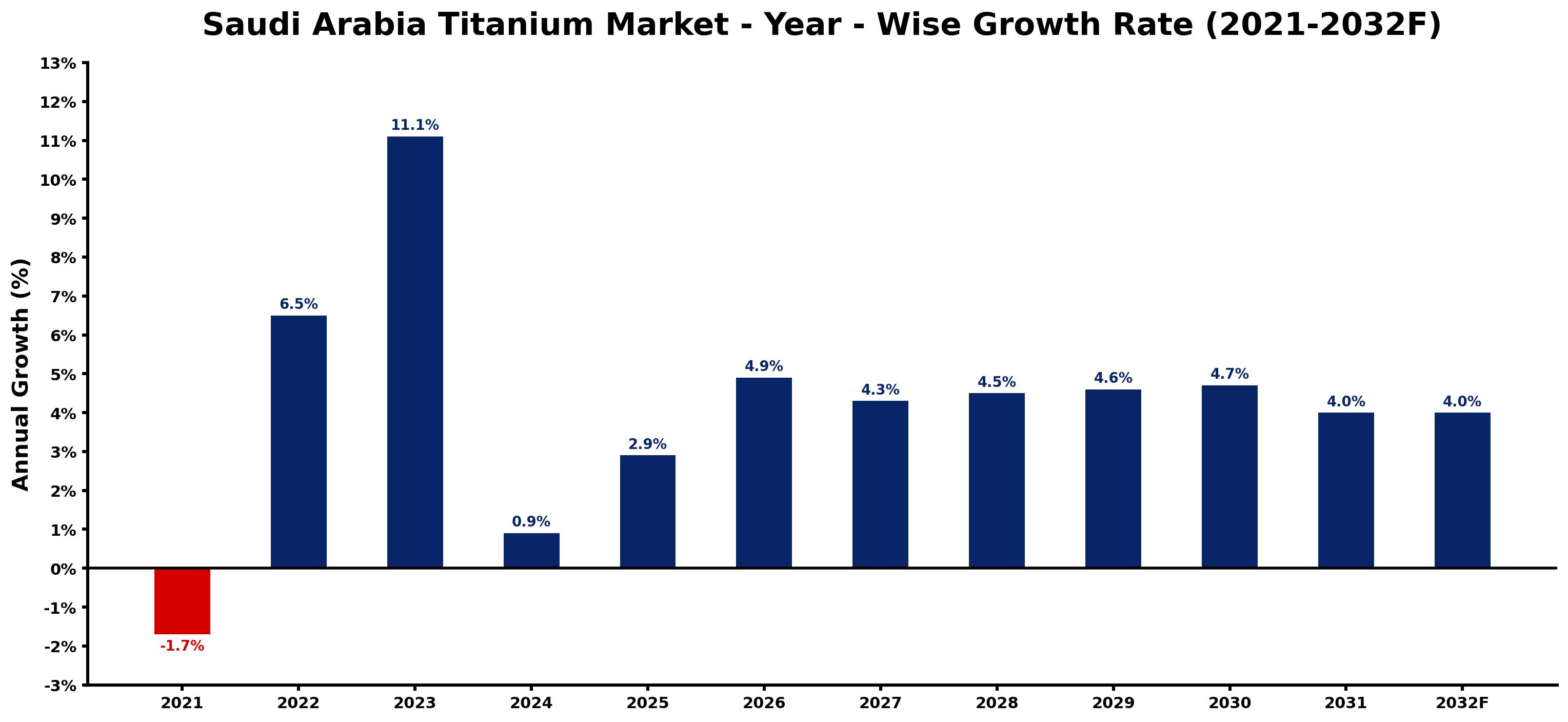
The table below presents the year wise growth rates along with the key drivers influencing the market
| Year | Growth Rate | Major Drivers |
| 2021 | -1.7% | The pandemic's impact on construction projects significantly reduced titanium demand in various industries. |
| 2022 | 6.5% | Investment in tourism infrastructure emphasizes the need for durable construction materials. |
| 2023 | 11.1% | International partnerships are forming, fostering knowledge transfer in titanium applications. |
| 2024 | 0.9% | Local manufacturing capabilities expand, reducing reliance on imported titanium products. |
| 2025 | 2.9% | Government plans for NEOM encourage innovative uses of titanium in eco-friendly projects. |
| 2026 | 4.9% | Increased collaboration with global firms elevates standards for quality and design. |
| 2027 | 4.3% | Shifts towards sustainable building materials spur higher titanium market integration. |
| 2028 | 4.5% | Advancements in 3D printing technology enhance titanium's role in customized applications. |
| 2029 | 4.6% | Strong oil prices lead to increased spending on advanced material solutions. |
| 2030 | 4.7% | Emerging aerospace projects require high-performance materials, spotlighting titanium's advantages. |
| 2031 | 4.0% | Focus on renewable energy drives demand for titanium in solar and wind applications. |
| 2032 | 4.0% | The automotive sector's shift towards lightweight materials opens new titanium market avenues. |
Note - Market size estimations and growth projections presented in this report are based on 6Wresearch's advanced forecasting approach, validated with industry datasets as of June 2026.
Saudi Arabia Titanium Market Synopsis
The Saudi Arabia Titanium Market is projected to reach 4.9% and witness significant growth during the forecast period (2026-2032). Driven by an increasing demand for lightweight materials from the aerospace and defence sectors, the market is expected to see a compound annual growth rate (CAGR) of over 6%. This growth is further supported by the rising application of titanium alloys in medical implants and dental products, alongside a surge in foreign direct investments (FDI) in industries such as petrochemicals and oil gas exploration. The growth in disposable income and increased tourism spending on infrastructure will also contribute to the expansion of the automotive sector, further driving the demand for titanium materials across various industries.
Saudi Arabia Titanium Market Growth Drivers
The growth of the Saudi Arabia Titanium Market is underpinned by several key drivers:
- The aerospace and defence industries are increasingly prioritising lightweight materials to enhance fuel efficiency and overall performance, creating a robust demand for titanium.
- There is a notable rise in the use of titanium alloys in the medical field, particularly for implants that require biocompatibility and strength, leading to greater consumption of titanium products.
- Foreign direct investments are accelerating in manufacturing sectors, particularly in petrochemicals and oil & gas exploration, which increases the need for titanium in various industrial applications.
- Infrastructure development linked to the burgeoning tourism sector is facilitating the growth of the automotive market, thus raising the demand for titanium materials.
- Growing awareness of titanium's advantageous properties, including its resistance to corrosion and high strength-to-weight ratio, is driving its adoption across diverse applications.
Saudi Arabia Titanium Market Trends and Opportunities
The advancement of the Saudi Arabia Titanium Market is closely aligned with emerging trends and opportunities:
- Innovations in titanium processing technologies are paving the way for enhanced production efficiency and lower costs, thus broadening market access for various industries.
- The demand for sustainable and high-performance materials is gaining traction, presenting opportunities for titanium to replace traditional metals in numerous applications.
- As the medical industry continues to grow, the need for customised titanium products tailored for specific medical applications is expected to rise.
- The government's focus on diversifying the economy beyond oil is nurturing growth in non-oil sectors that require titanium for manufacturing and construction.
- Collaboration between research institutions and industries is driving innovations in titanium applications, particularly in high-performance segments such as aerospace and automotive.
Saudi Arabia Titanium Market Challenges and Restraints
While the Saudi Arabia Titanium Market is poised for growth, several challenges and restraints can affect its trajectory:
- The global supply chain disruptions and fluctuations in raw material prices can significantly impact production costs and market stability.
- The high cost of titanium extraction and processing can deter new entrants and limit market competition.
- There is a need for skilled labour and advanced technologies to maintain quality in titanium production, which may pose challenges in certain regions.
- Market fluctuations in demand from key industries, like aerospace and automotive, can lead to uncertainty in titanium prices.
- Trade regulations and tariffs can affect the import and export of titanium products, influencing market dynamics.
Saudi Arabia Titanium Market Government Investment and Initiatives
The Saudi government plays a critical role in the growth of the titanium market through various investments and initiatives:
- Public spending on infrastructure projects is substantially increasing, which in turn drives demand for high-strength materials like titanium.
- Programs aimed at boosting the manufacturing sector, particularly those related to non-oil industries, are providing supportive frameworks for titanium production.
- The government is actively promoting foreign investments through incentives that encourage businesses to establish manufacturing facilities in the region.
- Development plans targeting advanced technologies and sustainable practices are being rolled out, aligning with the global push for green materials.
- Collaboration with international firms and research institutions is encouraged to advance local capabilities in titanium production and processing.
Saudi Arabia Titanium Market Latest Developments (May 2025 - June 2026)
Recent developments in the Saudi Arabia Titanium Market from May 2025 to June 2026 reflect a significant shift towards innovation and expansion:
- Industry players are focusing on developing new titanium alloys that meet specific requirements for various applications, enhancing their competitive edge.
- Initiatives aimed at improving the sustainability of titanium production processes are gaining momentum, driven by both regulatory and consumer demands.
- Collaborative efforts between technology firms and manufacturers are fostering advancements in titanium manufacturing techniques, which are anticipated to lower production costs.
- There is an observable trend of companies investing in research and development to innovate titanium applications beyond traditional sectors.
- The government is expected to launch new incentives to promote domestic titanium production and reduce reliance on imports, further shaping market dynamics.
Saudi Arabia Titanium Market - Key Attractiveness of the Report
- 10 Years of Market Numbers
- Historical Data Starting from 2022 to 2025
- Base Year: 2025
- Forecast Data until 2032
- Key Performance Indicators Impacting the Market
- Major Upcoming Developments and Projects
Key Highlights of the Report:
- Saudi Arabia Titanium Market Outlook
- Market Size of Saudi Arabia Titanium Market, 2025
- Forecast of Saudi Arabia Titanium Market, 2032F
- Historical Data and Forecast of Saudi Arabia Titanium Revenues & Volume for the Period 2022-2032F
- Saudi Arabia Titanium Market Trend Evolution
- Saudi Arabia Titanium Market Drivers and Challenges
- Saudi Arabia Titanium Price Trends
- Saudi Arabia Titanium Porter's Five Forces
- Saudi Arabia Titanium Industry Life Cycle
- Historical Data and Forecast of Saudi Arabia Titanium Market Revenues & Volume By Product Types for the Period 2022-2032F
- Historical Data and Forecast of Saudi Arabia Titanium Market Revenues & Volume By Titanium Concentrate for the Period 2022-2032F
- Historical Data and Forecast of Saudi Arabia Titanium Market Revenues & Volume By Titanium tetrachloride for the Period 2022-2032F
- Historical Data and Forecast of Saudi Arabia Titanium Market Revenues & Volume By Titanium Sponge for the Period 2022-2032F
- Historical Data and Forecast of Saudi Arabia Titanium Market Revenues & Volume By Ferrotitanium for the Period 2022-2032F
- Historical Data and Forecast of Saudi Arabia Titanium Market Revenues & Volume By Titanium pigment for the Period 2022-2032F
- Historical Data and Forecast of Saudi Arabia Titanium Market Revenues & Volume By Others for the Period 2022-2032F
- Historical Data and Forecast of Saudi Arabia Titanium Market Revenues & Volume By Applications for the Period 2022-2032F
- Historical Data and Forecast of Saudi Arabia Titanium Market Revenues & Volume By Aerospace & Marine for the Period 2022-2032F
- Historical Data and Forecast of Saudi Arabia Titanium Market Revenues & Volume By Industrial for the Period 2022-2032F
- Historical Data and Forecast of Saudi Arabia Titanium Market Revenues & Volume By Medical for the Period 2022-2032F
- Historical Data and Forecast of Saudi Arabia Titanium Market Revenues & Volume By Energy for the Period 2022-2032F
- Historical Data and Forecast of Saudi Arabia Titanium Market Revenues & Volume By Pigments, Additives & Coatings for the Period 2022-2032F
- Historical Data and Forecast of Saudi Arabia Titanium Market Revenues & Volume By Papers & Plastics for the Period 2022-2032F
- Historical Data and Forecast of Saudi Arabia Titanium Market Revenues & Volume By Others for the Period 2022-2032F
- Saudi Arabia Titanium Import Export Trade Statistics
- Market Opportunity Assessment By Product Types
- Market Opportunity Assessment By Applications
- Saudi Arabia Titanium Top Companies Market Share
- Saudi Arabia Titanium Competitive Benchmarking By Technical and Operational Parameters
- Saudi Arabia Titanium Company Profiles
- Saudi Arabia Titanium Key Strategic Recommendations






































