Saudi Arabia Toys and Hobby Goods Market Summary
The saudi arabia toys and hobby goods market was estimated at USD 311 Million in 2025 and is projected to reach USD 400 Million by 2032, growing at a CAGR of 5.0% from 2026 to 2032.
Saudi Arabia Toys and Hobby Goods Market Year-wise Growth Rate and Key Drivers
This graph highlights how the Saudi Arabia Toys and Hobby Goods Market has steadily grown over the past five years, supported by major growth factors.
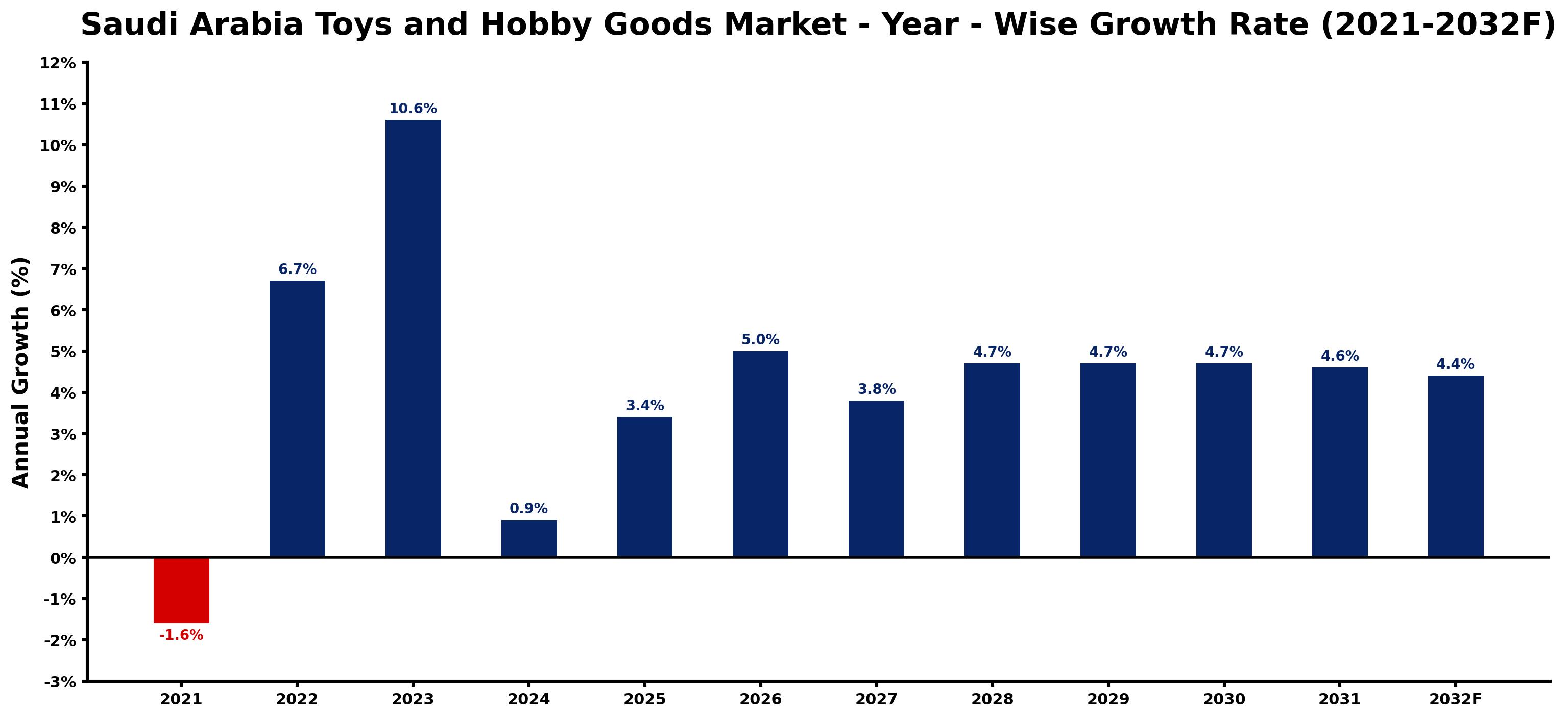
The table below presents the year wise growth rates along with the key drivers influencing the market
| Year | Growth Rate | Major Drivers |
| 2021 | -1.6% | Pandemicrelated disruptions hindered supply chains, limiting product availability and dampening consumer purchases in the toys sector. |
| 2022 | 6.7% | E-commerce platforms gained traction, enhancing toy accessibility for parents and children. |
| 2023 | 10.6% | Cultural shifts promote educational toys, emphasizing learning through play among families. |
| 2024 | 0.9% | Local manufacturers focus on sustainable materials, appealing to eco-conscious consumers. |
| 2025 | 3.4% | Urbanization trends drive demand for outdoor toys suitable for city living. |
| 2026 | 5.0% | Technological integration in toys sparks interest from tech-savvy younger generations. |
| 2027 | 3.8% | Social media influencers impact toy marketing strategies, shaping consumer preferences. |
| 2028 | 4.7% | Expansion of entertainment parks boosts demand for licensed merchandise and collectibles. |
| 2029 | 4.7% | Increased disposable incomes lead to premium toy purchases, enhancing market revenue. |
| 2030 | 4.7% | Growing interest in STEM toys aligns with educational reforms in Saudi schools. |
| 2031 | 4.6% | Localized toy production reduces import costs, fostering regional market growth. |
| 2032 | 4.4% | Participation in global toy fairs strengthens international partnerships and market visibility. |
Note - Market size estimations and growth projections presented in this report are based on 6Wresearch's advanced forecasting approach, validated with industry datasets as of June 2026.
Saudi Arabia Toys and Hobby Goods Market Synopsis
The Saudi Arabia Toys and Hobby Goods Market is projected to reach 5.0% and witness significant growth during the forecast period (2026-2032). This burgeoning market is anticipated to reach a valuation of approximately US$ 1.9 billion by 2031, supported by a compound annual growth rate (CAGR) of 5.1%. The increase in disposable income among families, coupled with a rising demand for innovative and technologically advanced toys, is paving the way for market expansion. Moreover, the growing awareness among consumers regarding the benefits of engaging in creative play is further propelling growth in this sector.
Saudi Arabia Toys and Hobby Goods Market Growth Drivers
Several key factors are driving the growth of the Saudi Arabia Toys and Hobby Goods Market. First and foremost, the rising disposable incomes enable families to allocate more resources toward educational and leisure pursuits, which includes purchasing toys and hobby products. Furthermore, this increased expenditure is often redirected towards high-end toys that offer advanced features and capabilities compared to traditional options.
- Technological advancements have become a significant driver in this market, with consumers increasingly favoring entertainment products that incorporate modern technology, such as interactive toys and drones. These high-tech options deliver an enhanced user experience, particularly in the realms of augmented reality and artificial intelligence.
- The growing trend toward educational toys is also apparent, as parents seek products that contribute constructively to their children's learning and development. This shift is resulting in heightened demand for products that combine fun with educational value.
- The impact of social media and online communities should not be underestimated. As parents increasingly share their experiences and recommendations, new trends emerge that influence purchasing decisions, creating a ripple effect throughout the market.
- Developments in e-commerce platforms are reshaping how consumers access the toys and hobby goods market. The convenience of online shopping, paired with specialized offerings and promotions, has made it easier for consumers to explore and purchase products that meet their interests.
- Lastly, the resurgence of in-person activities post-COVID-19 is re-energizing demand for traditional toys and board games, as families look for ways to engage in social play both at home and outside, further stimulating market growth.
Saudi Arabia Toys and Hobby Goods Market Challenges and Restraints
Despite the promising prospects for growth, the Saudi Arabia Toys and Hobby Goods Market faces several challenges. One of the most significant factors is the volatility of oil prices, which influences the nation's economy and, consequently, consumer purchasing power. Fluctuations in oil revenue can lead to reduced spending on non-essential items, including toys and hobby goods, thereby hampering market potential.
- Economic uncertainty poses a challenge for many families, as budget constraints often result in prioritizing essential expenditures over recreational purchases.
- In addition to economic factors, supply chain disruptions, exacerbated by the COVID-19 pandemic, have impacted inventory levels and product availability, leading to inflationary pressures on costs and ultimately affecting sales performance.
- The competitive landscape in the toy industry is intense, with numerous players vying for market share. This competition may lead to price wars, which could further pressure profit margins and limit investment in innovation.
- Consumer preferences are also rapidly changing, leading to a constant need for adaptability and innovation among manufacturers. Failure to keep pace with these trends can jeopardize market positions and revenue streams.
- Lastly, concerns regarding product safety and regulatory compliance are paramount. The need for adherence to safety standards can increase operational costs and affect the speed at which new products can be brought to market.
Saudi Arabia Toys and Hobby Goods Market Government Investment and Initiatives
The government of Saudi Arabia has made strides to stimulate the Toys and Hobby Goods Market through various investment initiatives and supportive policies. Efforts to diversify the economy under visions such as Vision 2030 aim to foster sectors beyond oil, including entertainment and recreation, which naturally encompasses toys and hobbies.
Public investment in improving infrastructure and retail opportunities also serves to enhance the consumer experience and accessibility of toys and hobby products. Moreover, government programs that support small and medium enterprises (SMEs) have the potential to foster innovation within the sector, enabling new entrants to compete effectively against established players.
By promoting educational initiatives and recreational activities through public programs, the government is directly influencing consumer behavior, encouraging families to participate in activities that involve toys and hobbies, thereby driving demand in the market.
Saudi Arabia Toys and Hobby Goods Market Latest Developments (May 2025 - June 2026)
The period from May 2025 to June 2026 has been marked by notable developments within the Saudi Arabia Toys and Hobby Goods Market. As the economy recovers from the repercussions of the COVID-19 pandemic, consumer confidence has gradually returned, resulting in increased spending in the market.
Emerging trends have been noted in areas such as eco-friendly toys and sustainable production practices, as consumers become more environmentally conscious. Market players are increasingly adopting these principles to align with consumer expectations while also addressing regulatory pressures.
The integration of technology in toys continues to be a focal point, with innovations in augmented reality and smart devices gaining traction. Manufacturers are incorporating these technologies to enhance user engagement and provide interactive experiences.
Collaborations between local and international brands have also become more common, facilitating knowledge transfer and enhancing product offerings in the market.
Furthermore, as online shopping continues to gain popularity, companies have invested in improving their digital presence and expanding e-commerce capabilities, enabling them to reach a broader consumer base effectively.
Saudi Arabia Toys and Hobby Goods Market - Key Attractiveness of the Report
- 10 Years of Market Numbers
- Historical Data Starting from 2022 to 2025
- Base Year: 2025
- Forecast Data until 2032
- Key Performance Indicators Impacting the Market
- Major Upcoming Developments and Projects
Key Highlights of the Report:
- Saudi Arabia Toys and Hobby Goods Market Outlook
- Market Size of Saudi Arabia Toys and Hobby Goods Market, 2025
- Forecast of Saudi Arabia Toys and Hobby Goods Market, 2032
- Historical Data and Forecast of Saudi Arabia Toys and Hobby Goods Revenues & Volume for the Period 2022-2032F
- Saudi Arabia Toys and Hobby Goods Market Trend Evolution
- Saudi Arabia Toys and Hobby Goods Market Drivers and Challenges
- Saudi Arabia Toys and Hobby Goods Price Trends
- Saudi Arabia Toys and Hobby Goods Porter's Five Forces
- Saudi Arabia Toys and Hobby Goods Industry Life Cycle
- Historical Data and Forecast of Saudi Arabia Toys and Hobby Goods Market Revenues & Volume By Type for the Period 2022-2032F
- Historical Data and Forecast of Saudi Arabia Toys and Hobby Goods Market Revenues & Volume By Sports Toys for the Period 2022-2032F
- Historical Data and Forecast of Saudi Arabia Toys and Hobby Goods Market Revenues & Volume By Intellectual Toys for the Period 2022-2032F
- Historical Data and Forecast of Saudi Arabia Toys and Hobby Goods Market Revenues & Volume By Education Toys for the Period 2022-2032F
- Historical Data and Forecast of Saudi Arabia Toys and Hobby Goods Market Revenues & Volume By Decorative Toys for the Period 2022-2032F
- Historical Data and Forecast of Saudi Arabia Toys and Hobby Goods Market Revenues & Volume By Other for the Period 2022-2032F
- Historical Data and Forecast of Saudi Arabia Toys and Hobby Goods Market Revenues & Volume By Application for the Period 2022-2032F
- Historical Data and Forecast of Saudi Arabia Toys and Hobby Goods Market Revenues & Volume By Online Sales for the Period 2022-2032F
- Historical Data and Forecast of Saudi Arabia Toys and Hobby Goods Market Revenues & Volume By Offline Sales for the Period 2022-2032F
- Historical Data and Forecast of Saudi Arabia Toys and Hobby Goods Market Revenues & Volume By Others for the Period 2022-2032F
- Saudi Arabia Toys and Hobby Goods Import Export Trade Statistics
- Market Opportunity Assessment By Type
- Market Opportunity Assessment By Application
- Saudi Arabia Toys and Hobby Goods Top Companies Market Share
- Saudi Arabia Toys and Hobby Goods Competitive Benchmarking By Technical and Operational Parameters
- Saudi Arabia Toys and Hobby Goods Company Profiles
- Saudi Arabia Toys and Hobby Goods Key Strategic Recommendations






































