Saudi Arabia Tung Oil Market Size, Share & Growth Rate
The Saudi Arabia Tung Oil Market was estimated at USD 361 Million in 2025 and is projected to reach USD 460 Million by 2032, growing at a CAGR of 3.5% from 2026 to 2032. This growth trajectory is largely driven by the rising awareness of eco-friendly materials within construction and manufacturing industries, leading to heightened demand for sustainable wood finishing products. Additionally, the growing trend toward biodiesel production is poised to further enhance the market landscape.
Saudi Arabia Tung Oil Market Year-wise Growth Rate and Key Drivers
This graph highlights how the Saudi Arabia Tung Oil Market has steadily grown over the years, supported by major growth factors.
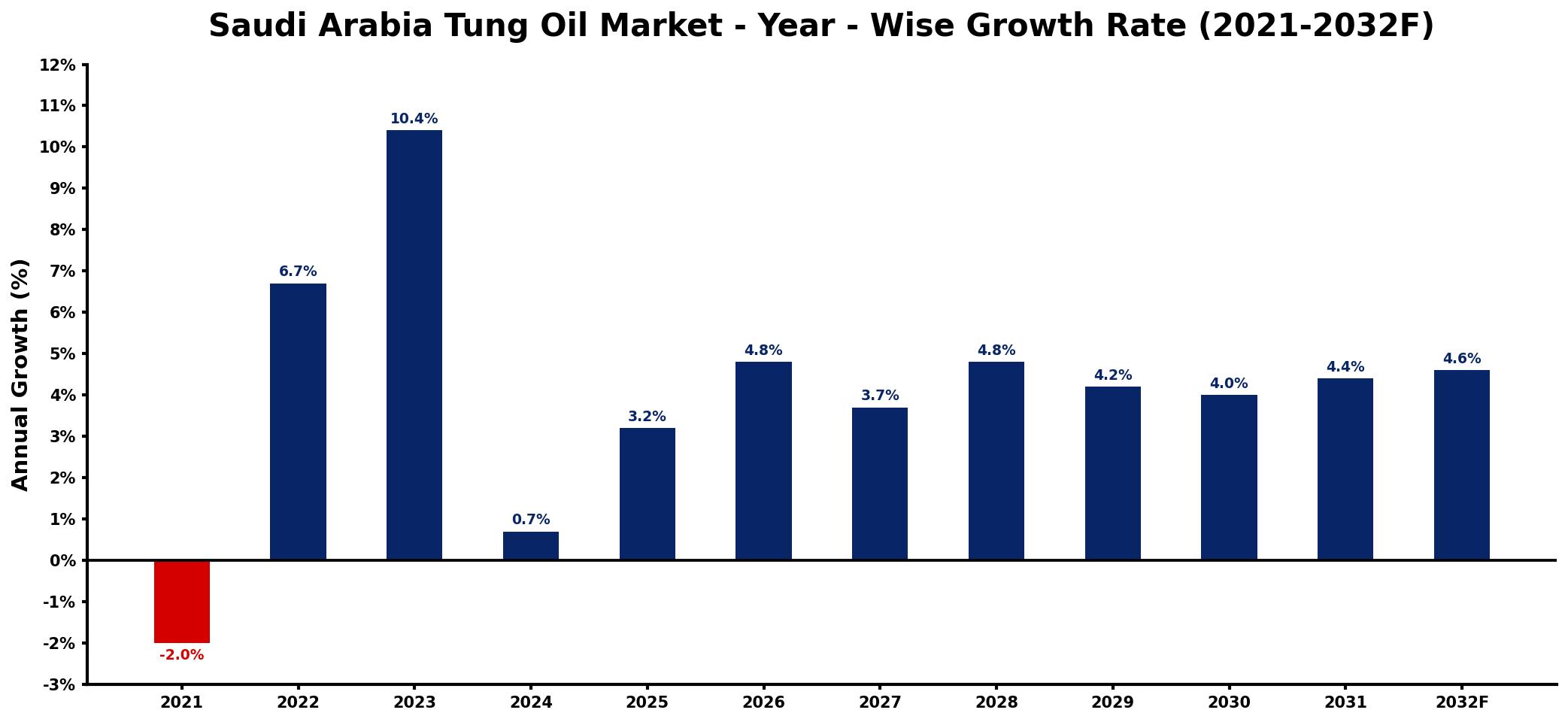
The table below presents the year‑wise growth rates along with the key drivers influencing the market
| Year | Growth Rate | Major Drivers |
| 2021 | -2.0% | Decreased industrial production output |
| 2022 | 6.7% | Rising demand from furniture sector |
| 2023 | 10.4% | Growth in eco-friendly coatings |
| 2024 | 0.7% | Increased investments in agriculture |
| 2025 | 3.2% | Expansion of construction activities |
| 2026 | 4.8% | Boost in automotive manufacturing needs |
| 2027 | 3.7% | Surge in home improvement projects |
| 2028 | 4.8% | Growing popularity of natural products |
| 2029 | 4.2% | Strengthened partnerships with suppliers |
| 2030 | 4.0% | Enhanced focus on sustainable practices |
| 2031 | 4.4% | Development of new application techniques |
| 2032 | 4.6% | Increased consumer awareness of benefits |
Note: Market size estimations and growth projections presented in this report are based on 6Wresearch's proprietary forecasting methodology, utilizing the latest available industry data, government publications, and primary research inputs.
Saudi Arabia Tung Oil Market Synopsis
A pivotal force driving the Saudi Arabia Tung Oil Market is its versatile application across various sectors, particularly in wood finishing and protective coatings. As industries increasingly shift toward sustainable alternatives, tung oil's natural properties make it an attractive option for manufacturers aiming for eco-friendliness.
The surge in construction and renovation projects further boosts the demand for high-quality finishes, creating robust opportunities for tung oil producers. Government initiatives to strengthen local manufacturing also enhance the growth environment, making it an opportune time for stakeholders in this market.
Saudi Arabia Tung Oil Market Key Takeaways
- Significant growth is observed as sustainable attributes of tung oil gain popularity.
- The construction sector is a primary driver for increased wood finishing applications.
- Innovative industrial applications, including biodiesel, are expanding tung oil usage.
- Local government policies are fostering domestic production capabilities.
- Market dynamics are shifting as producers adapt to competitive pressures from alternative oils.
Evaluation of Restraints in Saudi Arabia Tung Oil Market
Despite its growth potential, the Saudi Arabia Tung Oil Market faces specific constraints, particularly related to agricultural production. The tung tree, integral to tung oil extraction, has distinct cultivation needs that may not be readily met in the region's climate. As such, significant investment in agricultural research and innovative farming practices is essential. Moreover, competition from other vegetable oils threatens market share, compelling producers to effectively communicate the unique advantages of tung oil.
Saudi Arabia Tung Oil Market Trends
Current trends reveal an increasing consumer preference for natural and biodegradable products. In the coatings industry, there is a marked shift towards products with low volatile organic compounds (VOCs), which aligns perfectly with tung oil's eco-friendly profile. Additionally, the rise in home renovation activities post-COVID-19 has amplified demand for quality wood finishes, as homeowners prioritize aesthetic and sustainable solutions.
Saudi Arabia Tung Oil Market Opportunities
The market presents genuine growth opportunities, particularly in the development of innovative applications that leverage tung oil's unique properties. The expanding automotive sector's need for high-performance coatings signifies a potential avenue for increased tung oil utilization. Additionally, as the global shift towards renewable energy continues, opportunities in biodiesel production are likely to emerge, benefiting producers in Saudi Arabia.
Government Initiatives in the Saudi Arabia Tung Oil Market
The Saudi government is actively promoting domestic industries through policies aimed at reducing reliance on imports. Initiatives focused on sustainable agriculture and local production are critical to nurturing the tung oil market. Programs designed to incentivize the adoption of eco-friendly materials in construction and manufacturing sectors further illustrate the government's commitment to fostering a conducive environment for market growth.
Future Insights of the Saudi Arabia Tung Oil Market
Looking ahead to the period from 2026 to 2032, the Saudi Arabia Tung Oil Market is expected to experience steady growth driven by a continued emphasis on sustainability. The construction sector's expansion, coupled with rising consumer awareness of eco-friendly products, will significantly contribute to demand. As production methodologies improve and the market adapts to emerging trends, stakeholders should anticipate promising opportunities for growth and innovation.
Saudi Arabia Tung Oil Market Latest Developments (2025 - 2026)
In recent months, the market has seen a shift towards more sustainable production methods, as key players innovate to reduce environmental impact. New partnerships focused on research and development are emerging, aimed at enhancing the quality and efficiency of tung oil extraction processes. Additionally, awareness campaigns are being launched to educate consumers about the benefits of using tung oil, reinforcing its position as a premier eco-friendly choice in various applications.
Saudi Arabia Tung Oil Market - Key Attractiveness of the Report
- 10 Years of Market Numbers
- Historical Data Starting from 2022 to 2025
- Base Year: 2025
- Forecast Data until 2032
- Key Performance Indicators Impacting the Market
- Major Upcoming Developments and Projects
Key Highlights of the Report:
- Saudi Arabia Tung Oil Market Outlook
- Market Size of Saudi Arabia Tung Oil Market, 2025
- Forecast of Saudi Arabia Tung Oil Market, 2032
- Historical Data and Forecast of Saudi Arabia Tung Oil Revenues & Volume for the Period 2022-2032F
- Saudi Arabia Tung Oil Market Trend Evolution
- Saudi Arabia Tung Oil Market Drivers and Challenges
- Saudi Arabia Tung Oil Price Trends
- Saudi Arabia Tung Oil Porter's Five Forces
- Saudi Arabia Tung Oil Industry Life Cycle
- Historical Data and Forecast of Saudi Arabia Tung Oil Market Revenues & Volume By Product Type for the Period 2022-2032F
- Historical Data and Forecast of Saudi Arabia Tung Oil Market Revenues & Volume By Raw Tung Oil for the Period 2022-2032F
- Historical Data and Forecast of Saudi Arabia Tung Oil Market Revenues & Volume By Boiled Tung Oil for the Period 2022-2032F
- Historical Data and Forecast of Saudi Arabia Tung Oil Market Revenues & Volume By Application for the Period 2022-2032F
- Historical Data and Forecast of Saudi Arabia Tung Oil Market Revenues & Volume By Wood Finishing for the Period 2022-2032F
- Historical Data and Forecast of Saudi Arabia Tung Oil Market Revenues & Volume By Food and Beverage for the Period 2022-2032F
- Historical Data and Forecast of Saudi Arabia Tung Oil Market Revenues & Volume By Medicines for the Period 2022-2032F
- Historical Data and Forecast of Saudi Arabia Tung Oil Market Revenues & Volume By Others for the Period 2022-2032F
- Saudi Arabia Tung Oil Import Export Trade Statistics
- Market Opportunity Assessment By Product Type
- Market Opportunity Assessment By Application
- Saudi Arabia Tung Oil Top Companies Market Share
- Saudi Arabia Tung Oil Competitive Benchmarking By Technical and Operational Parameters
- Saudi Arabia Tung Oil Company Profiles
- Saudi Arabia Tung Oil Key Strategic Recommendations






































