Saudi Arabia Wardrobes Market Summary
The saudi arabia wardrobes market was estimated at USD 425 Million in 2025 and is projected to reach USD 541 Million by 2032, growing at a CAGR of 5.2% from 2026 to 2032.
Saudi Arabia Wardrobes Market Year-wise Growth Rate and Key Drivers
This graph highlights how the Saudi Arabia Wardrobes Market has steadily grown over the past five years, supported by major growth factors.
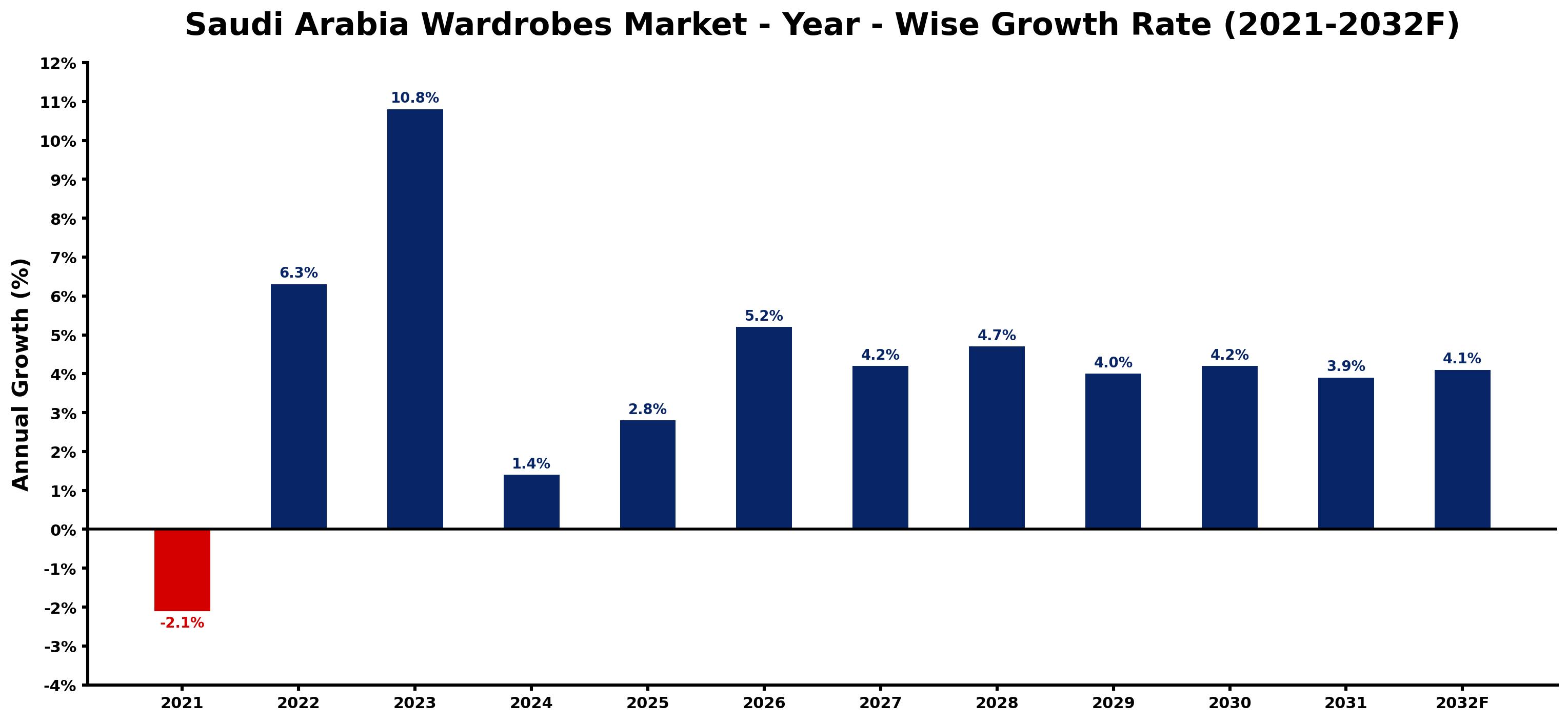
The table below presents the year wise growth rates along with the key drivers influencing the market
| Year | Growth Rate | Major Drivers |
| 2021 | -2.1% | Supply chain disruptions due to the pandemic limited the availability of essential materials for wardrobe production. |
| 2022 | 6.3% | Increased urbanization trends led to higher demand for functional wardrobe solutions. |
| 2023 | 10.8% | Luxury brands entered the market, catering to affluent consumers seeking exclusivity. |
| 2024 | 1.4% | Focus on sustainable materials aligned with global eco-conscious consumer preferences. |
| 2025 | 2.8% | Technological integrations in furniture design enhanced consumer engagement and customization. |
| 2026 | 5.2% | The influx of expatriates created diverse demands for various wardrobe styles. |
| 2027 | 4.2% | Retailers intensified online sales channels, meeting customer preferences for convenience. |
| 2028 | 4.7% | Mega-projects in NEOM attracted significant investments, driving local manufacturing capabilities. |
| 2029 | 4.0% | Shifts in lifestyle trends encouraged multifunctional furniture solutions, appealing to smaller spaces. |
| 2030 | 4.2% | Consumer education on design trends expanded, influencing informed purchasing decisions. |
| 2031 | 3.9% | Emergence of smart wardrobes integrated with home automation systems captured interest. |
| 2032 | 4.1% | Economic diversification strategies fostered a competitive market encouraging innovative design solutions. |
Note - Market size estimations and growth projections presented in this report are based on 6Wresearch's advanced forecasting approach, validated with industry datasets as of June 2026.
Saudi Arabia Wardrobes Market Synopsis
The Saudi Arabia Wardrobes Market is projected to reach 5.2% and witness significant growth during the forecast period (2026-2032). This growth trajectory is mainly driven by increasing demand for home furniture products, an upward trend in disposable income, and evolving consumer lifestyles. The emergence of nuclear families and a heightened focus on quality and aesthetically pleasing wardrobe solutions are also pivotal factors contributing to market expansion. Technological innovations, such as integrated smart systems and enhanced storage features, further augment the market's potential, presenting numerous opportunities for stakeholders.
Saudi Arabia Wardrobes Market Growth Drivers
The primary drivers of the Saudi Arabia Wardrobes Market can be attributed to several interrelated factors:
- The increasing consumer awareness regarding interior décor is compelling homeowners to invest in quality furniture, including wardrobes that blend functionality with aesthetics.
- A rise in disposable incomes has enabled consumers to prioritize quality over cost, thereby influencing their purchasing behaviors toward premium wardrobe solutions.
- The shift towards nuclear families is generating a demand for specialized storage solutions designed to accommodate compact living spaces effectively, enhancing the market's appeal.
- Vendors are launching innovative wardrobe designs that feature advanced storage functionalities, responding to the growing consumer preference for customized storage options.
- Technological advancements such as smart lighting, built-in speakers, and automated compartments are attracting tech-savvy consumers, further driving market growth.
Saudi Arabia Wardrobes Market Challenges and Restraints
Despite its promising growth, the Saudi Arabia Wardrobes Market faces several challenges:
- High installation costs, particularly for luxury wardrobe solutions, may deter end-users, leading to reduced adoption rates among budget-conscious consumers.
- Intense competition within the furniture sector may pressure profit margins, compelling vendors to frequently innovate while maintaining affordable pricing.
- The fluctuations in raw material prices can affect production costs, compelling manufacturers to reconsider their pricing strategies in response to market dynamics.
- Customer preferences are continually evolving, requiring vendors to remain agile and adaptive in their product offerings to meet changing market demands.
- Supply chain disruptions, exacerbated by global events, can lead to delays in product availability, affecting sales and customer satisfaction.
Saudi Arabia Wardrobes Market COVID-19 Impact
The COVID-19 pandemic has undeniably impacted various sectors, including the wardrobes market in Saudi Arabia. Initial disruptions caused by governmental lockdowns and travel restrictions resulted in a decline in consumer footfall at retail stores, leading to a stark drop in sales. Manufacturers faced operational challenges, with many factories either shutting down or functioning at limited capacity, which exacerbated supply chain issues and increased production costs. As the market began to recuperate, shifts in consumer behavior towards online shopping emerged, driving a change in how vendors engage with customers.
Saudi Arabia Wardrobes Market Government Investment and Initiatives
The government of Saudi Arabia is actively fostering the development of the furniture sector, including the wardrobes market, through various initiatives and policies aimed at enhancing the local manufacturing landscape. Investments in infrastructure and programs designed to support local enterprises are aimed at boosting production capabilities and fostering innovation within the sector. Public spending initiatives focused on urban development and housing projects are anticipated to escalate the demand for home furniture, underscoring the government's commitment to enhancing living standards and overall quality of life. Additionally, policies promoting sustainable manufacturing practices are likely to shape the future dynamics of this market.
Saudi Arabia Wardrobes Market Latest Developments (May 2025 - June 2026)
Recent trends in the Saudi Arabia Wardrobes Market indicate a growing emphasis on sustainability and eco-friendly production processes. Manufacturers are increasingly adopting green practices in response to consumer demand for environmentally responsible products. Technological integration has seen an uptick, with vendors releasing smart wardrobes that incorporate home automation features. Additionally, numerous regional trade shows and exhibitions aimed at showcasing innovations in furniture design have been organized, further stimulating market interest and consumer engagement. This period also experienced strategic collaborations between manufacturers and technology firms to develop advanced wardrobe solutions, enriching customer experiences.
Saudi Arabia Wardrobes Market - Key Attractiveness of the Report
- 10 Years of Market Numbers
- Historical Data Starting from 2022 to 2025
- Base Year: 2025
- Forecast Data until 2032
- Key Performance Indicators Impacting the Market
- Major Upcoming Developments and Projects
Key Highlights of the Report:
- Saudi Arabia Wardrobes Market Outlook
- Market Size of Saudi Arabia Wardrobes Market, 2025
- Forecast of Saudi Arabia Wardrobes Market, 2032
- Historical Data and Forecast of Saudi Arabia Wardrobes Revenues & Volume for the Period 2022-2032F
- Saudi Arabia Wardrobes Market Trend Evolution
- Saudi Arabia Wardrobes Market Drivers and Challenges
- Saudi Arabia Wardrobes Price Trends
- Saudi Arabia Wardrobes Porter's Five Forces
- Saudi Arabia Wardrobes Industry Life Cycle
- Historical Data and Forecast of Saudi Arabia Wardrobes Market Revenues & Volume By Type for the Period 2022-2032F
- Historical Data and Forecast of Saudi Arabia Wardrobes Market Revenues & Volume By Finished Wardrobes for the Period 2022-2032F
- Historical Data and Forecast of Saudi Arabia Wardrobes Market Revenues & Volume By Customized Wardrobes for the Period 2022-2032F
- Historical Data and Forecast of Saudi Arabia Wardrobes Market Revenues & Volume By Application for the Period 2022-2032F
- Historical Data and Forecast of Saudi Arabia Wardrobes Market Revenues & Volume By Residential Use for the Period 2022-2032F
- Historical Data and Forecast of Saudi Arabia Wardrobes Market Revenues & Volume By Commercial Use for the Period 2022-2032F
- Saudi Arabia Wardrobes Import Export Trade Statistics
- Market Opportunity Assessment By Type
- Market Opportunity Assessment By Application
- Saudi Arabia Wardrobes Top Companies Market Share
- Saudi Arabia Wardrobes Competitive Benchmarking By Technical and Operational Parameters
- Saudi Arabia Wardrobes Company Profiles
- Saudi Arabia Wardrobes Key Strategic Recommendations






































