Saudi Arabia Website Builder Market Size, Share & Growth Rate
The Saudi Arabia Website Builder Market was estimated at USD 255 Million in 2025 and is projected to reach USD 324 Million by 2032, growing at a CAGR of 3.5% from 2026 to 2032. This growth trajectory is being fueled by the increasing digitalization of businesses and the rapid expansion of e-commerce in the region. The surging need for cost-effective and user-friendly website creation tools reflects the broader entrepreneurial spirit taking root within the Saudi economy.
Saudi Arabia Website Builder Market Year-wise Growth Rate and Key Drivers
This graph highlights how the Saudi Arabia Website Builder Market has steadily grown over the years, supported by major growth factors.
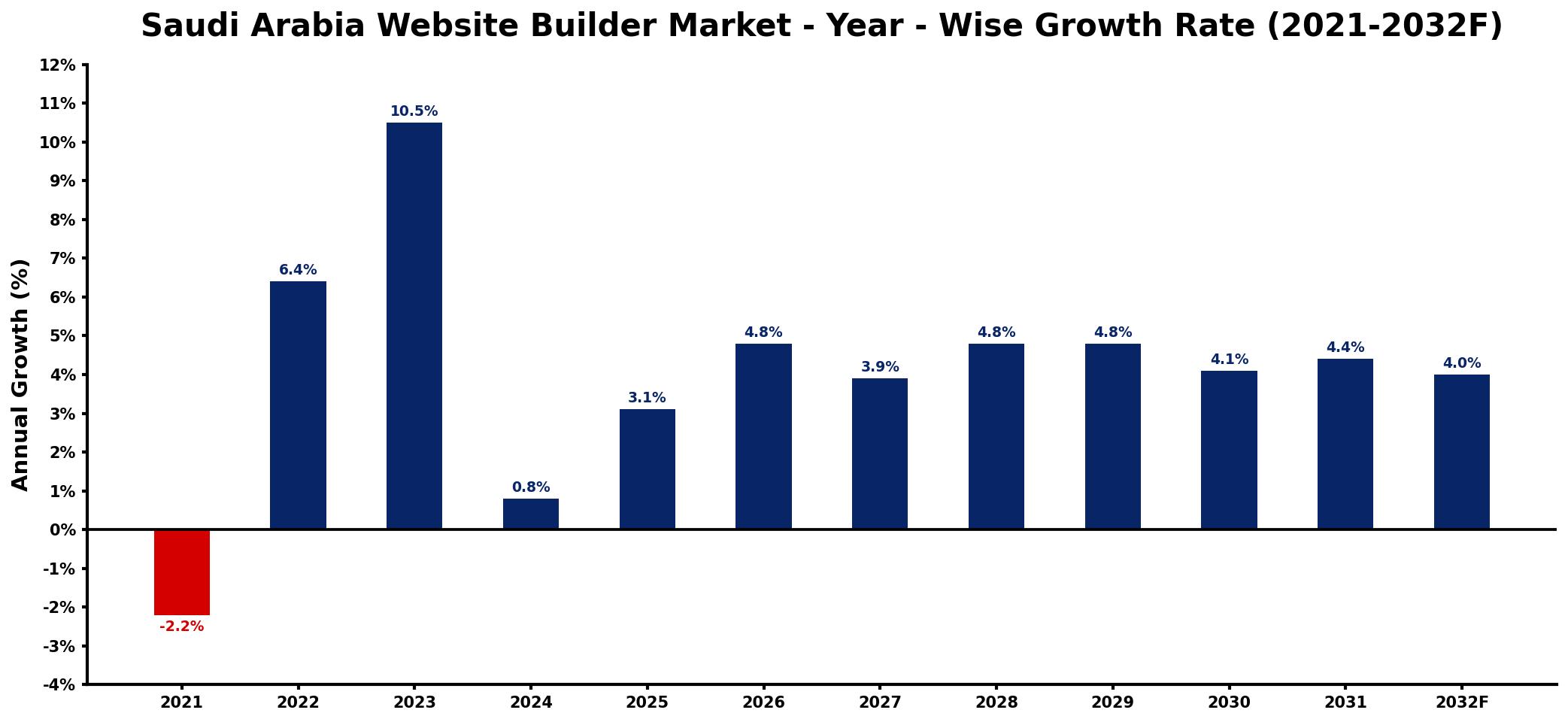
The table below presents the year‑wise growth rates along with the key drivers influencing the market
| Year | Growth Rate | Major Drivers |
| 2021 | -2.2% | shift towards digital solutions |
| 2022 | 6.4% | increased demand for online presence |
| 2023 | 10.5% | expansion of e-commerce platforms |
| 2024 | 0.8% | growth in small business startups |
| 2025 | 3.1% | rising investment in digital marketing |
| 2026 | 4.8% | increased focus on user experience |
| 2027 | 3.9% | adoption of mobile optimization trends |
| 2028 | 4.8% | enhanced integration with social media |
| 2029 | 4.8% | growing popularity of DIY solutions |
| 2030 | 4.1% | emphasis on local business visibility |
| 2031 | 4.4% | development of innovative design tools |
| 2032 | 4.0% | rising procurement volume requirements |
Note: Market size estimations and growth projections presented in this report are based on 6Wresearch's proprietary forecasting methodology, utilizing the latest available industry data, government publications, and primary research inputs.
Saudi Arabia Website Builder Market Synopsis
The driving force in the Saudi Arabia website builder market is undoubtedly the escalating demand for a robust online presence among businesses and individuals. As digital transformation becomes a priority for many, the accessibility of website builders has empowered a diverse range of users to establish their online footprint without extensive technical expertise.
This market is characterized by a focus on intuitive design, customizable features, and responsive templates. As a result, it attracts not only established businesses but also a burgeoning number of startups eager to leverage the digital landscape for growth and engagement.
Saudi Arabia Website Builder Market Key Takeaways
- Substantial growth driven by increasing digitalization and e-commerce expansion.
- User-friendly platforms are crucial in attracting diverse clientele.
- The demand for culturally sensitive designs is influencing product offerings.
- Startups and small businesses are key contributors to market growth.
- COVID-19 accelerated the shift towards digital solutions across various sectors.
Evaluation of Restraints in Saudi Arabia Website Builder Market
Despite the promising growth trajectory, the Saudi Arabia website builder market faces notable restraints. A significant barrier is the varying levels of digital literacy among potential users, with many individuals and small businesses lacking the technical skills necessary to utilize these platforms effectively. Furthermore, the competitive landscape is dense, challenging providers to distinguish themselves amidst numerous alternatives. Cultural nuances also play a critical role; ensuring content and design resonate appropriately with local audiences requires careful consideration. Lastly, the urgent need for robust cybersecurity measures has become increasingly important, as users seek assurance regarding data protection.
Saudi Arabia Website Builder Market Trends
Several trends are currently shaping the Saudi Arabia website builder market. The integration of AI-driven tools is on the rise, offering users enhanced functionalities like automated design suggestions and personalized content recommendations. Additionally, mobile optimization is becoming a necessity, as users prioritize accessible website experiences across devices. The demand for e-commerce functionalities, such as payment gateways and inventory management, is also growing, with website builders increasingly catering to online retailers. Finally, sustainability and social responsibility are influencing content strategies, urging businesses to align their online presence with values that resonate with their target audiences.
Saudi Arabia Website Builder Market Opportunities
Opportunities abound in the Saudi Arabia website builder market, particularly for providers who can offer localized solutions tailored to the unique cultural and economic environment of the kingdom. The surge in startups presents a considerable market segment seeking affordable, effective tools to launch their online presence. Moreover, as the government continues to promote digitalization initiatives, partnerships and collaborations between website builder companies and public sector initiatives could enhance visibility and user adoption. Additionally, extending features to accommodate multi-language support can significantly widen the target audience.
Government Initiatives in the Saudi Arabia Website Builder Market
The Saudi government is actively promoting a digital economy, recognizing the critical role that digital solutions play in economic diversification. Initiatives aimed at enhancing e-commerce capabilities and expanding internet access are pivotal. Policies designed to support small and medium enterprises (SMEs) also foster a conducive environment for the website builder market, encouraging entrepreneurship and innovation. Ongoing public investments in infrastructure and digital literacy programs further reinforce this commitment, providing a solid foundation for market growth.
Future Insights of the Saudi Arabia Website Builder Market
Looking ahead to 2026-2032, the Saudi Arabia website builder market is poised for continued expansion. The sustained emphasis on digital transformation, coupled with an increasing acceptance of online commerce, will drive further adoption of these platforms. As businesses increasingly recognize the importance of a strong online presence, website builders will likely evolve to incorporate advanced functionalities, improving user experience and engagement. Furthermore, partnerships between technology providers and local businesses may emerge, leading to innovative solutions that address specific market needs.
Saudi Arabia Website Builder Market Latest Developments (2025 - 2026)
Recent developments in the Saudi Arabia website builder market indicate a trend towards enhanced integration of e-commerce tools within platforms. In response to rising online retail demands, many providers are rolling out features that facilitate seamless online transactions. Additionally, a growing focus on user data analytics is empowering businesses to tailor their services more effectively. Collaborative initiatives with educational institutions are also emerging, aimed at improving digital literacy and ensuring that more potential users can successfully leverage website builders.
Saudi Arabia Website Builder Market - Key Attractiveness of the Report
- 10 Years of Market Numbers
- Historical Data Starting from 2022 to 2025
- Base Year: 2025
- Forecast Data until 2032
- Key Performance Indicators Impacting the Market
- Major Upcoming Developments and Projects
Key Highlights of the Report:
- Saudi Arabia Website Builder Market Outlook
- Market Size of Saudi Arabia Website Builder Market, 2025
- Forecast of Saudi Arabia Website Builder Market, 2032
- Historical Data and Forecast of Saudi Arabia Website Builder Revenues & Volume for the Period 2022-2032F
- Saudi Arabia Website Builder Market Trend Evolution
- Saudi Arabia Website Builder Market Drivers and Challenges
- Saudi Arabia Website Builder Price Trends
- Saudi Arabia Website Builder Porter's Five Forces
- Saudi Arabia Website Builder Industry Life Cycle
- Historical Data and Forecast of Saudi Arabia Website Builder Market Revenues & Volume By Deployment Type for the Period 2022-2032F
- Historical Data and Forecast of Saudi Arabia Website Builder Market Revenues & Volume By Cloud-Based for the Period 2022-2032F
- Historical Data and Forecast of Saudi Arabia Website Builder Market Revenues & Volume By On-Premise for the Period 2022-2032F
- Historical Data and Forecast of Saudi Arabia Website Builder Market Revenues & Volume By Type for the Period 2022-2032F
- Historical Data and Forecast of Saudi Arabia Website Builder Market Revenues & Volume By Mobile Website Builders for the Period 2022-2032F
- Historical Data and Forecast of Saudi Arabia Website Builder Market Revenues & Volume By PC Website Builders for the Period 2022-2032F
- Historical Data and Forecast of Saudi Arabia Website Builder Market Revenues & Volume By End Users for the Period 2022-2032F
- Historical Data and Forecast of Saudi Arabia Website Builder Market Revenues & Volume By Individuals for the Period 2022-2032F
- Historical Data and Forecast of Saudi Arabia Website Builder Market Revenues & Volume By SMEs for the Period 2022-2032F
- Historical Data and Forecast of Saudi Arabia Website Builder Market Revenues & Volume By Large Enterprises for the Period 2022-2032F
- Saudi Arabia Website Builder Import Export Trade Statistics
- Market Opportunity Assessment By Deployment Type
- Market Opportunity Assessment By Type
- Market Opportunity Assessment By End Users
- Saudi Arabia Website Builder Top Companies Market Share
- Saudi Arabia Website Builder Competitive Benchmarking By Technical and Operational Parameters
- Saudi Arabia Website Builder Company Profiles
- Saudi Arabia Website Builder Key Strategic Recommendations






































