Saudi Arabia Workplace Safety Market Size & Growth Rate (2026-2032)
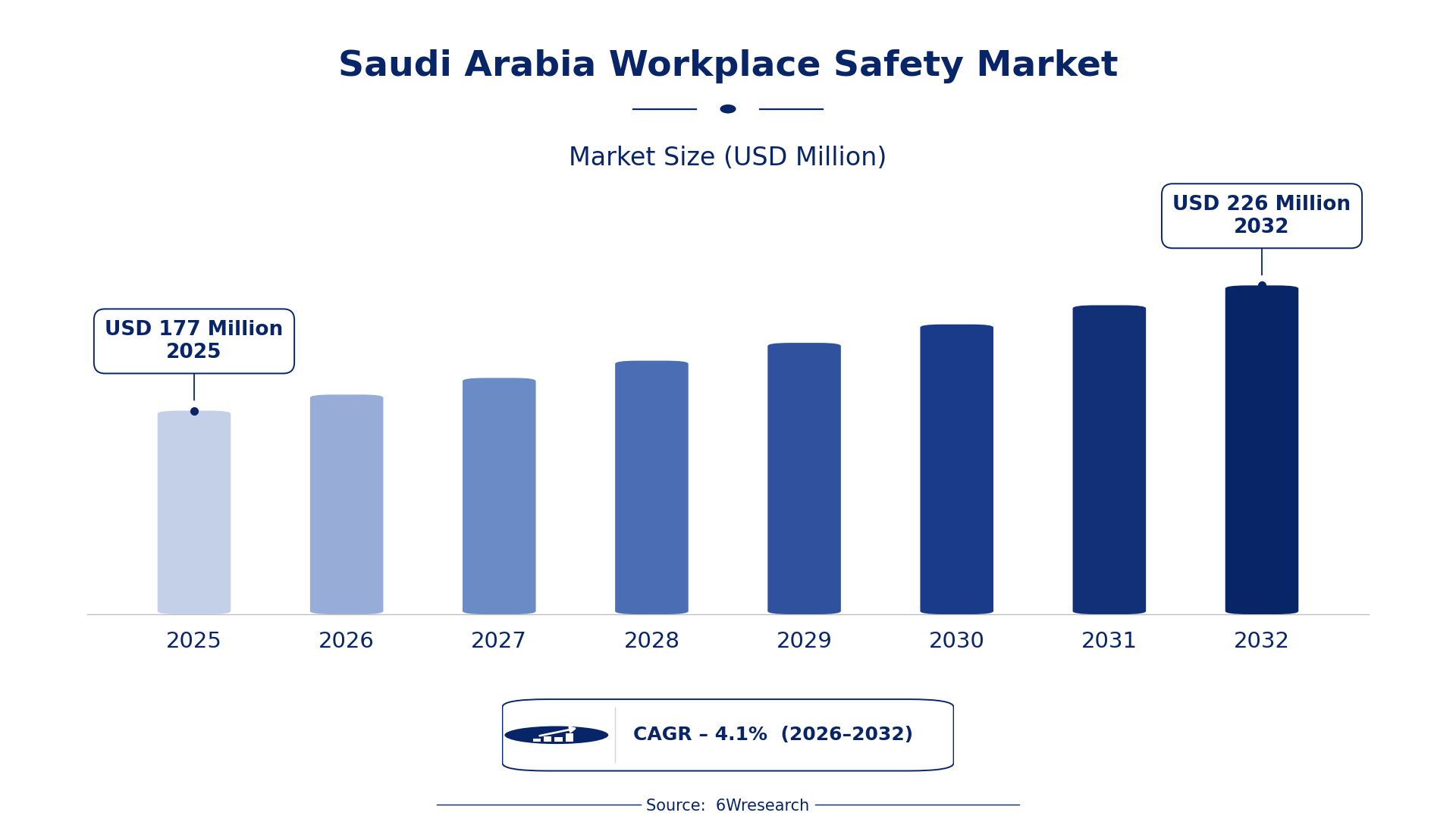
The Saudi Arabia Workplace Safety Market was estimated at USD 177 Million in 2025 and is projected to reach USD 226 Million by 2032, growing at a CAGR of 4.1% from 2026 to 2032.
Saudi Arabia Workplace Safety Market Synopsis
The driving force behind the Saudi Arabia Workplace Safety Market is the robust commitment from businesses to enhance employee safety and health standards. This proactive stance, propelled by governmental regulations and societal awareness, is reshaping how workplace environments are designed and managed.
In recent years, the urgency for adopting advanced safety measures has intensified, especially in sectors like construction and manufacturing. With the ongoing emphasis on compliance, organizations are investing significantly in innovative technologies and training programs to cultivate a culture of safety.
Saudi Arabia Workplace Safety Market Year-wise Growth Rate and Key Drivers
This graph illustrates the annual growth rates of the Saudi Arabia Workplace Safety Market from 2021 to 2032, highlighting a steady upward trajectory and projected expansion over the forecast period.
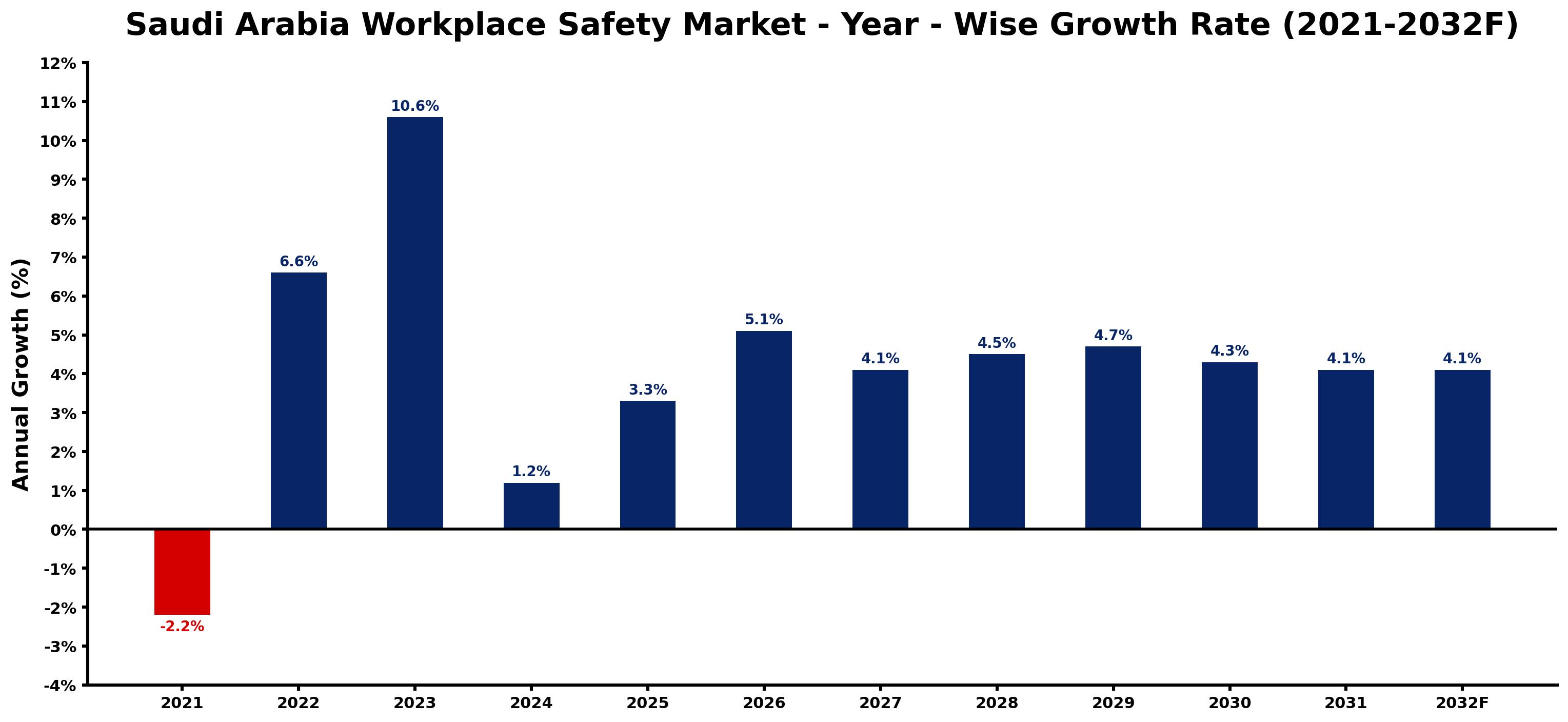
The table below presents the year‑wise growth rates along with the key drivers influencing the market
| Year | Growth Rate | Major Drivers |
| 2021 | -2.2% | Restrictive COVID-19 protocols limited workplace safety investments. |
| 2022 | 6.6% | Implementation of Saudi Vision 2030 safety initiatives. |
| 2023 | 10.6% | Increased OSHA training compliance among local businesses. |
| 2024 | 1.2% | Adoption of advanced safety technologies in construction. |
| 2025 | 3.3% | Regulatory emphasis on worker safety inspections by GOSI. |
| 2026 | 5.1% | Rise in health and safety training program enrollments. |
| 2027 | 4.1% | Government incentives for safety equipment purchases. |
| 2028 | 4.5% | Local manufacturing of safety gear to meet demand. |
| 2029 | 4.7% | Growing awareness of occupational health hazards in industries. |
| 2030 | 4.3% | Enhanced focus on safety during NEOM project development. |
| 2031 | 4.1% | Development of safety management systems in oil sector. |
| 2032 | 4.1% | Increased investment in hazard prevention mechanisms. |
Note: Market size estimations and growth projections presented in this report are based on 6Wresearch's proprietary forecasting methodology, utilizing the latest available industry data, government publications, and primary research inputs.
Saudi Arabia Workplace Safety Market Key Takeaways
Below are some of the specific key takeaways from the market, including:
- The market is witnessing substantial growth fueled by increased investments in safety solutions.
- Compliance with evolving regulatory frameworks is a top priority for organizations.
- Businesses are increasingly adopting technology-driven safety solutions.
- Heightened awareness of occupational health is reshaping market dynamics.
- Key sectors driving demand include construction, manufacturing, and oil & gas.
Evaluation of Restraints in Saudi Arabia Workplace Safety Market
Despite the positive outlook, the Saudi Arabia Workplace Safety Market faces notable constraints. A primary challenge is the cultural shift required to embed a safety-first mentality across organizations. Many companies struggle with compliance due to a lack of clear guidelines and the dynamic nature of regulations. Additionally, adapting safety measures to meet the diverse risks present in different sectors, such as construction and manufacturing, poses a significant hurdle. As companies navigate these challenges, the need for comprehensive training and robust safety protocols becomes ever more critical.
Saudi Arabia Workplace Safety Market Trends
The current trends in the Saudi Arabia Workplace Safety Market illustrate a clear shift toward digitization and data-driven safety measures. Organizations are increasingly relying on real-time monitoring tools and analytics to assess workplace hazards. Furthermore, there's a growing trend towards implementing mental health and well-being programs as part of overall workplace safety initiatives. This holistic approach is reshaping safety protocols, emphasizing a broader definition of employee health that extends beyond physical safety.
Saudi Arabia Workplace Safety Market Opportunities
Several key opportunities are emerging within the Saudi Arabia Workplace Safety Market. As organizations prioritize employee welfare, there is significant room for investment in advanced safety technologies, such as artificial intelligence and automation solutions. Additionally, companies that offer comprehensive training programs and consultancy services tailored to specific industries can carve out a niche in this expanding market. The ongoing government initiatives aimed at enhancing workplace safety also provide a fertile ground for businesses to explore partnerships and collaborative efforts.
Government Initiatives in the Saudi Arabia Workplace Safety Market
The Saudi government plays a critical role in shaping workplace safety through stringent regulations and initiatives focused on enhancing employee well-being. With a clear agenda to improve occupational health standards, the government is setting the stage for businesses to adopt more effective safety practices. Policies encouraging compliance and innovation are at the forefront, reflecting the nation's commitment to maintaining safe working environments.
- A recently completed regulatory framework introduced in 2025 aimed at standardizing safety practices across industries.
- A currently ongoing initiative focusing on training programs for safety personnel in high-risk sectors.
- Plans for a public-private partnership expected to enhance safety protocols in the construction industry by 2028.
- A government-led campaign launched in 2024 to raise awareness of workplace safety standards among employees and employers.
- Upcoming assessments of workplace safety compliance slated to begin in mid-2026, with new standards expected to be rolled out.
Future Insights of the Saudi Arabia Workplace Safety Market
Looking ahead to 2026-2032, the Saudi Arabia Workplace Safety Market is set to evolve significantly. As regulatory frameworks become more stringent, companies will need to adapt their safety strategies accordingly. The integration of advanced technologies, including IoT and AI, will likely redefine safety management practices, allowing for more efficient monitoring and response to workplace hazards. Furthermore, as the workforce continues to prioritize health and safety, organizations that proactively adopt comprehensive safety solutions will be better positioned to attract and retain talent.
Saudi Arabia Workplace Safety Market Latest Developments
Over the past 12-14 months, the Saudi Arabia Workplace Safety Market has experienced notable developments. Companies are increasingly aligning their strategies with government initiatives aimed at enhancing workplace safety. The emphasis on technology and training has fostered a competitive environment where innovation is crucial for success.
- A leading regional operator launched a new digital platform in early 2025 to streamline safety compliance tracking.
- A major technology vendor rolled out an advanced monitoring system for construction sites in Q3 2025, enhancing real-time hazard detection.
- An ongoing initiative began in early 2025 to provide safety training workshops specifically tailored for the manufacturing sector.
- A service upgrade was announced in late 2025, introducing AI-driven analytics to improve workplace safety assessments.
- Upcoming plans for a national safety certification program expected to start in 2026 will aim to standardize safety training across sectors.
Saudi Arabia Workplace Safety Market - Key Attractiveness of the Report
- 10 Years of Market Numbers
- Historical Data Starting from 2022 to 2025
- Base Year: 2025
- Forecast Data until 2032
- Key Performance Indicators Impacting the Market
- Major Upcoming Developments and Projects
Key Highlights of the Report:
- Saudi Arabia Workplace Safety Market Outlook
- Market Size of Saudi Arabia Workplace Safety Market, 2025
- Forecast of Saudi Arabia Workplace Safety Market, 2032
- Historical Data and Forecast of Saudi Arabia Workplace Safety Revenues & Volume for the Period 2022-2032F
- Saudi Arabia Workplace Safety Market Trend Evolution
- Saudi Arabia Workplace Safety Market Drivers and Challenges
- Saudi Arabia Workplace Safety Price Trends
- Saudi Arabia Workplace Safety Porter's Five Forces
- Saudi Arabia Workplace Safety Industry Life Cycle
- Historical Data and Forecast of Saudi Arabia Workplace Safety Market Revenues & Volume By Component for the Period 2022-2032F
- Historical Data and Forecast of Saudi Arabia Workplace Safety Market Revenues & Volume By Hardware for the Period 2022-2032F
- Historical Data and Forecast of Saudi Arabia Workplace Safety Market Revenues & Volume By Software for the Period 2022-2032F
- Historical Data and Forecast of Saudi Arabia Workplace Safety Market Revenues & Volume By Services for the Period 2022-2032F
- Historical Data and Forecast of Saudi Arabia Workplace Safety Market Revenues & Volume By Application for the Period 2022-2032F
- Historical Data and Forecast of Saudi Arabia Workplace Safety Market Revenues & Volume By Incident for the Period 2022-2032F
- Historical Data and Forecast of Saudi Arabia Workplace Safety Market Revenues & Volume By Emergency Management for the Period 2022-2032F
- Historical Data and Forecast of Saudi Arabia Workplace Safety Market Revenues & Volume By Asset Tracking for the Period 2022-2032F
- Historical Data and Forecast of Saudi Arabia Workplace Safety Market Revenues & Volume By PPE Detection for the Period 2022-2032F
- Historical Data and Forecast of Saudi Arabia Workplace Safety Market Revenues & Volume By System for the Period 2022-2032F
- Historical Data and Forecast of Saudi Arabia Workplace Safety Market Revenues & Volume By Environmental Health and Safety for the Period 2022-2032F
- Historical Data and Forecast of Saudi Arabia Workplace Safety Market Revenues & Volume By Access Control and Surveillance System for the Period 2022-2032F
- Historical Data and Forecast of Saudi Arabia Workplace Safety Market Revenues & Volume By Real Time Location Monitoring for the Period 2022-2032F
- Historical Data and Forecast of Saudi Arabia Workplace Safety Market Revenues & Volume By Others for the Period 2022-2032F
- Historical Data and Forecast of Saudi Arabia Workplace Safety Market Revenues & Volume By Deployment Mode for the Period 2022-2032F
- Historical Data and Forecast of Saudi Arabia Workplace Safety Market Revenues & Volume By On-premise for the Period 2022-2032F
- Historical Data and Forecast of Saudi Arabia Workplace Safety Market Revenues & Volume By Cloud for the Period 2022-2032F
- Historical Data and Forecast of Saudi Arabia Workplace Safety Market Revenues & Volume By End User for the Period 2022-2032F
- Historical Data and Forecast of Saudi Arabia Workplace Safety Market Revenues & Volume By Energy and Utilities for the Period 2022-2032F
- Historical Data and Forecast of Saudi Arabia Workplace Safety Market Revenues & Volume By Construction and Engineering for the Period 2022-2032F
- Historical Data and Forecast of Saudi Arabia Workplace Safety Market Revenues & Volume By Chemical and Materials for the Period 2022-2032F
- Historical Data and Forecast of Saudi Arabia Workplace Safety Market Revenues & Volume By Government and Defense for the Period 2022-2032F
- Historical Data and Forecast of Saudi Arabia Workplace Safety Market Revenues & Volume By Healthcare for the Period 2022-2032F
- Historical Data and Forecast of Saudi Arabia Workplace Safety Market Revenues & Volume By Food and Beverages for the Period 2022-2032F
- Historical Data and Forecast of Saudi Arabia Workplace Safety Market Revenues & Volume By Others for the Period 2022-2032F
- Saudi Arabia Workplace Safety Import Export Trade Statistics
- Market Opportunity Assessment By Component
- Market Opportunity Assessment By Application
- Market Opportunity Assessment By System
- Market Opportunity Assessment By Deployment Mode
- Market Opportunity Assessment By End User
- Saudi Arabia Workplace Safety Top Companies Market Share
- Saudi Arabia Workplace Safety Competitive Benchmarking By Technical and Operational Parameters
- Saudi Arabia Workplace Safety Company Profiles
- Saudi Arabia Workplace Safety Key Strategic Recommendations






































