Saudi Arabia Workspace as a Service Market Size & Growth Rate (2026-2032)
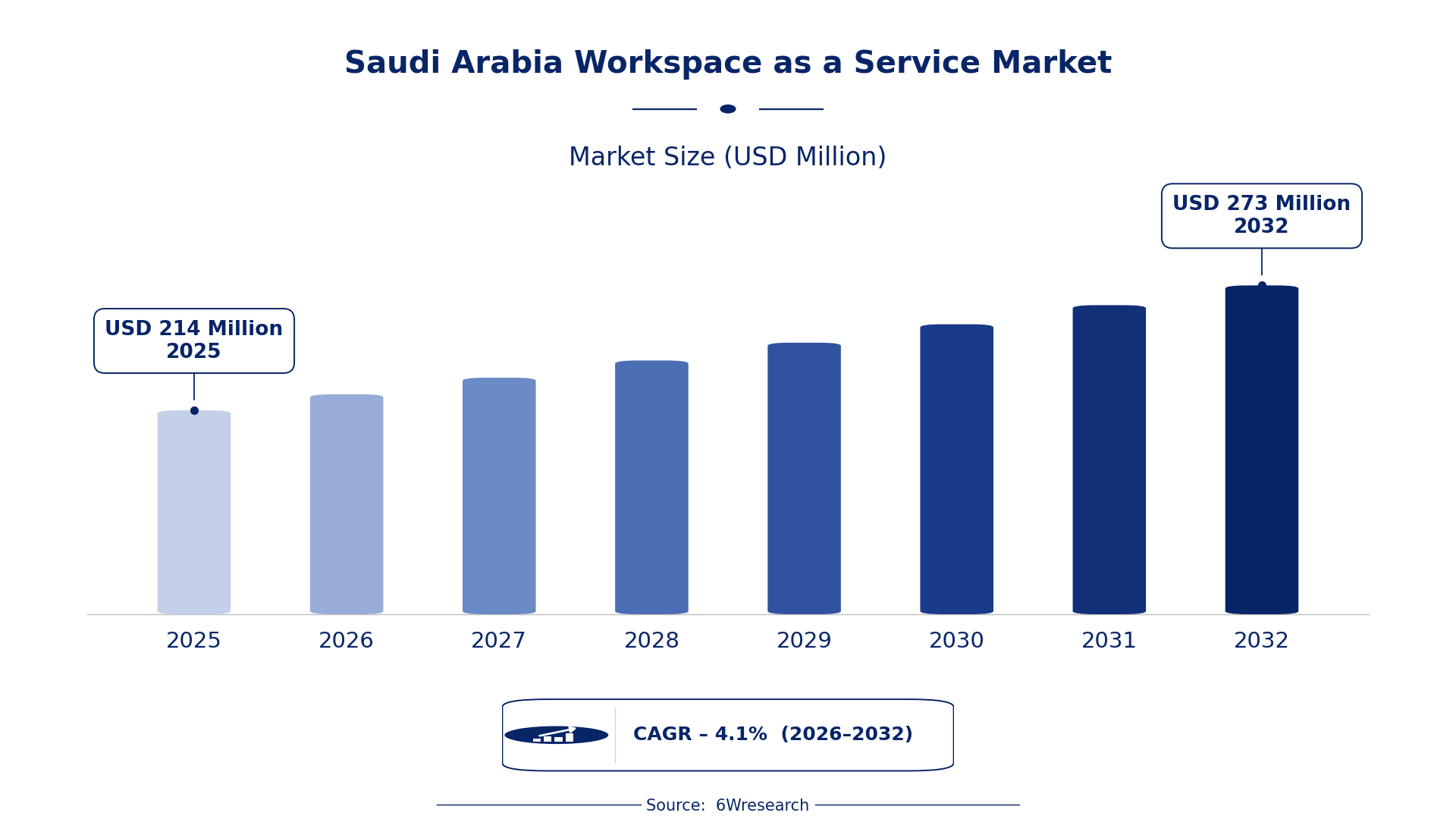
The Saudi Arabia Workspace as a Service Market was estimated at USD 214 Million in 2025 and is projected to reach USD 273 Million by 2032, growing at a CAGR of 4.1% from 2026 to 2032.
Saudi Arabia Workspace as a Service Market Synopsis
The demand for Workspace as a Service (WaaS) in Saudi Arabia is on the rise as organizations recognize the advantages of flexible work environments. Businesses are increasingly looking to provide their employees with secure access to virtual workspaces, ensuring productivity regardless of location.
This shift is significantly influenced by the growing trend of remote and hybrid work models, which have been accelerated by recent global events. Companies are prioritizing WaaS solutions to simplify IT management and enhance employee satisfaction, making it a critical component of modern workforce strategies.
Saudi Arabia Workspace as a Service Market Year-wise Growth Rate and Key Drivers
This graph illustrates the annual growth rates of the Saudi Arabia Workspace as a Service Market from 2021 to 2032, highlighting a steady upward trajectory and projected expansion over the forecast period.
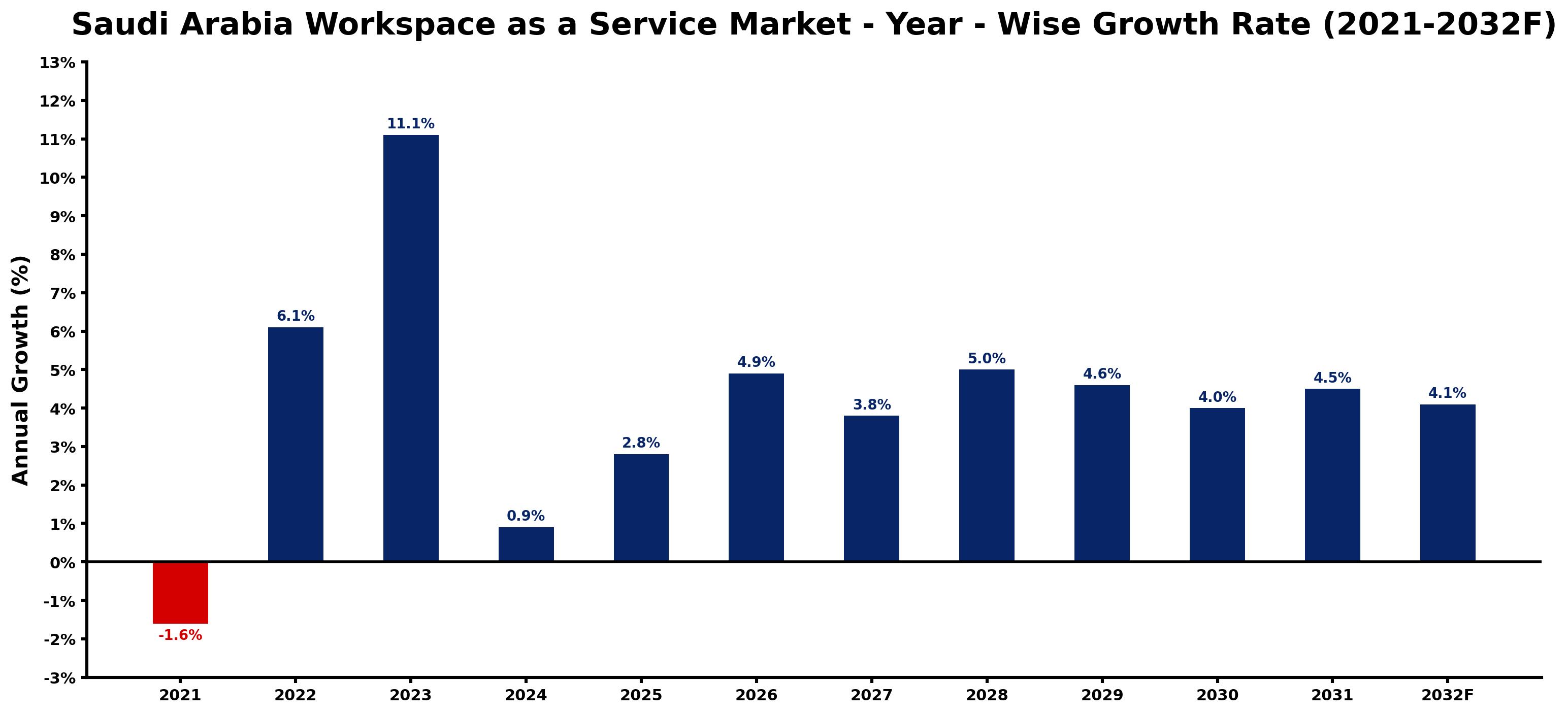
The table below presents the year‑wise growth rates along with the key drivers influencing the market
| Year | Growth Rate | Major Drivers |
| 2021 | -1.6% | Delayed digital transformation due to conservative business culture. |
| 2022 | 6.1% | Saudi Vision 2030 boosting remote work initiatives. |
| 2023 | 11.1% | Government incentives for startup workspace solutions enhancing adoption. |
| 2024 | 0.9% | Increased demand for affordable co-working spaces in Riyadh. |
| 2025 | 2.8% | Merging of traditional businesses with digital workspace solutions. |
| 2026 | 4.9% | Rise of hybrid work models among Saudi corporations. |
| 2027 | 3.8% | Investment in local technology hubs driving workspace services. |
| 2028 | 5.0% | Government policies promoting innovation in workspace design. |
| 2029 | 4.6% | Growth in expatriate workforce needing flexible office arrangements. |
| 2030 | 4.0% | Increased digital transformation investments by oil companies. |
| 2031 | 4.5% | Supportive regulatory environment for workspace service providers. |
| 2032 | 4.1% | Urban development projects emphasizing modern workspace solutions. |
Note: Market size estimations and growth projections presented in this report are based on 6Wresearch's proprietary forecasting methodology, utilizing the latest available industry data, government publications, and primary research inputs.
Saudi Arabia Workspace as a Service Market Key Takeaways
Below are some of the specific key takeaways from the market, including:
- The market is experiencing increasing adoption rates due to the need for remote work solutions.
- Investment in WaaS technology is essential for organizations aiming to enhance employee productivity.
- Data security and compliance remain significant considerations for businesses utilizing WaaS.
- Ongoing advancements in cloud computing technologies are shaping the future of WaaS offerings.
- Saudi Arabia's focus on digital transformation is driving demand for flexible workspace solutions.
Evaluation of Restraints in Saudi Arabia Workspace as a Service Market
Despite its growth potential, the Saudi Arabia Workspace as a Service market faces constraints that hinder widespread adoption. Key among these is the challenge of ensuring robust data privacy and compliance with local regulations. Organizations must balance the need for flexibility with the imperative to protect sensitive information.
on top of that, companies are tasked with meeting diverse workspace requirements without compromising on security. As a result, many businesses hesitate to fully commit to WaaS solutions, fearing potential vulnerabilities that could jeopardize their operations.
Saudi Arabia Workspace as a Service Market Trends
Several trends are shaping the WaaS market in Saudi Arabia. The integration of advanced technologies, such as artificial intelligence and machine learning, is enhancing the capabilities of virtual workspace solutions. These technologies enable better user experiences and optimized resource management.
Another prominent trend is the increasing emphasis on employee well-being. Companies are recognizing that flexible work arrangements can lead to higher job satisfaction and retention rates. Consequently, investment in WaaS is seen as a strategic move to attract and maintain top talent in a competitive job market.
Saudi Arabia Workspace as a Service Market Opportunities
The opportunities within the Saudi Arabia Workspace as a Service market are numerous. With the government's push towards digital transformation, there is ample room for innovation and investment in WaaS technologies. Organizations that prioritize cloud migration and security will find themselves at a competitive advantage.
on top of that, there is potential for growth in specialized WaaS offerings tailored to specific industries, such as healthcare and finance. These sectors have unique compliance requirements and will benefit from customized solutions that address their particular challenges.
Government Initiatives in the Saudi Arabia Workspace as a Service Market
The Saudi government is actively promoting the adoption of digital technologies, which significantly impacts the Workspace as a Service market. Regulatory frameworks are evolving to support businesses in their digital transformation journeys. Such initiatives are crucial for fostering a conducive environment for WaaS solutions.
- A national digital infrastructure upgrade programme is currently underway, aiming to enhance connectivity and accessibility for businesses across the kingdom.
- The introduction of a regulatory framework in 2025 focused on cloud service transparency and data protection is set to boost confidence in WaaS adoption.
- A public-private partnership initiative, expected to launch in 2026, aims to develop specialized training programs to equip the workforce with necessary digital skills.
- Recently completed pilot projects assessing the effectiveness of WaaS in government operations have demonstrated the model's potential for broader application.
Future Insights of the Saudi Arabia Workspace as a Service Market
Looking ahead to 2026-2032, the Saudi Arabia Workspace as a Service market is expected to expand significantly. As businesses continue to adapt to flexible work arrangements, investment in WaaS solutions will become a standard practice rather than an exception. The focus on data security will drive further enhancements in technology, ensuring that organizations can confidently embrace remote work.
Additionally, the ongoing support from the government for digital initiatives will create a favorable environment for WaaS providers, encouraging innovation and competition. This trajectory indicates that the market will not only grow but also evolve in response to the changing needs of the workforce.
Saudi Arabia Workspace as a Service Market Latest Developments
In the past year, the Saudi Arabia Workspace as a Service market has seen several noteworthy developments. As organizations adapt to new work models, industry players are responding with innovative solutions designed to enhance remote work capabilities and security.
- A major technology vendor launched an advanced WaaS platform in Q1 2025, featuring enhanced security protocols and user-friendly interfaces.
- Several regional operators have begun partnerships to integrate AI-driven analytics into their WaaS offerings, currently underway and expected to roll out by mid-2026.
- In early 2025, a prominent service provider expanded its data center capabilities to support growing WaaS demands, ensuring improved service delivery.
- Upcoming initiatives focused on customer feedback integration into WaaS development are set to begin in late 2025, aiming to refine service offerings based on real user experiences.
Saudi Arabia Workspace as a Service Market - Key Attractiveness of the Report
- 10 Years of Market Numbers
- Historical Data Starting from 2022 to 2025
- Base Year: 2025
- Forecast Data until 2032
- Key Performance Indicators Impacting the Market
- Major Upcoming Developments and Projects
Key Highlights of the Report:
- Saudi Arabia Workspace as a Service Market Outlook
- Market Size of Saudi Arabia Workspace as a Service Market, 2025
- Forecast of Saudi Arabia Workspace as a Service Market, 2032
- Historical Data and Forecast of Saudi Arabia Workspace as a Service Revenues & Volume for the Period 2022-2032F
- Saudi Arabia Workspace as a Service Market Trend Evolution
- Saudi Arabia Workspace as a Service Market Drivers and Challenges
- Saudi Arabia Workspace as a Service Price Trends
- Saudi Arabia Workspace as a Service Porter's Five Forces
- Saudi Arabia Workspace as a Service Industry Life Cycle
- Historical Data and Forecast of Saudi Arabia Workspace as a Service Market Revenues & Volume By Solutions for the Period 2022-2032F
- Historical Data and Forecast of Saudi Arabia Workspace as a Service Market Revenues & Volume By VDI and Applications for the Period 2022-2032F
- Historical Data and Forecast of Saudi Arabia Workspace as a Service Market Revenues & Volume By Desktop as a Service for the Period 2022-2032F
- Historical Data and Forecast of Saudi Arabia Workspace as a Service Market Revenues & Volume By Hosted Applications (Unified Communication Applications) for the Period 2022-2032F
- Historical Data and Forecast of Saudi Arabia Workspace as a Service Market Revenues & Volume By Security Solutions for the Period 2022-2032F
- Historical Data and Forecast of Saudi Arabia Workspace as a Service Market Revenues & Volume By Others (Browser-based WaaS solutions) for the Period 2022-2032F
- Historical Data and Forecast of Saudi Arabia Workspace as a Service Market Revenues & Volume By Services for the Period 2022-2032F
- Historical Data and Forecast of Saudi Arabia Workspace as a Service Market Revenues & Volume By System Integration for the Period 2022-2032F
- Historical Data and Forecast of Saudi Arabia Workspace as a Service Market Revenues & Volume By Consulting services for the Period 2022-2032F
- Historical Data and Forecast of Saudi Arabia Workspace as a Service Market Revenues & Volume By Managed services for the Period 2022-2032F
- Historical Data and Forecast of Saudi Arabia Workspace as a Service Market Revenues & Volume By Deployment Type for the Period 2022-2032F
- Historical Data and Forecast of Saudi Arabia Workspace as a Service Market Revenues & Volume By Public for the Period 2022-2032F
- Historical Data and Forecast of Saudi Arabia Workspace as a Service Market Revenues & Volume By Private for the Period 2022-2032F
- Historical Data and Forecast of Saudi Arabia Workspace as a Service Market Revenues & Volume By Hybrid for the Period 2022-2032F
- Historical Data and Forecast of Saudi Arabia Workspace as a Service Market Revenues & Volume By End-Users for the Period 2022-2032F
- Historical Data and Forecast of Saudi Arabia Workspace as a Service Market Revenues & Volume By Enterprises for the Period 2022-2032F
- Historical Data and Forecast of Saudi Arabia Workspace as a Service Market Revenues & Volume By Small and medium businesses(SMB) for the Period 2022-2032F
- Historical Data and Forecast of Saudi Arabia Workspace as a Service Market Revenues & Volume By Verticals for the Period 2022-2032F
- Historical Data and Forecast of Saudi Arabia Workspace as a Service Market Revenues & Volume By Banking, Financial Services and Insurance (BFSI) for the Period 2022-2032F
- Historical Data and Forecast of Saudi Arabia Workspace as a Service Market Revenues & Volume By Retail for the Period 2022-2032F
- Historical Data and Forecast of Saudi Arabia Workspace as a Service Market Revenues & Volume By Government for the Period 2022-2032F
- Historical Data and Forecast of Saudi Arabia Workspace as a Service Market Revenues & Volume By Healthcare for the Period 2022-2032F
- Historical Data and Forecast of Saudi Arabia Workspace as a Service Market Revenues & Volume By Manufacturing for the Period 2022-2032F
- Historical Data and Forecast of Saudi Arabia Workspace as a Service Market Revenues & Volume By Telecom and IT for the Period 2022-2032F
- Historical Data and Forecast of Saudi Arabia Workspace as a Service Market Revenues & Volume By Utilities for the Period 2022-2032F
- Historical Data and Forecast of Saudi Arabia Workspace as a Service Market Revenues & Volume By Travel and Hospitality for the Period 2022-2032F
- Saudi Arabia Workspace as a Service Import Export Trade Statistics
- Market Opportunity Assessment By Solutions
- Market Opportunity Assessment By Services
- Market Opportunity Assessment By Deployment Type
- Market Opportunity Assessment By End-Users
- Market Opportunity Assessment By Verticals
- Saudi Arabia Workspace as a Service Top Companies Market Share
- Saudi Arabia Workspace as a Service Competitive Benchmarking By Technical and Operational Parameters
- Saudi Arabia Workspace as a Service Company Profiles
- Saudi Arabia Workspace as a Service Key Strategic Recommendations






































