Senegal Electric Forklift Market: Top 5 Importing Countries and Market Competition (HHI) Analysis
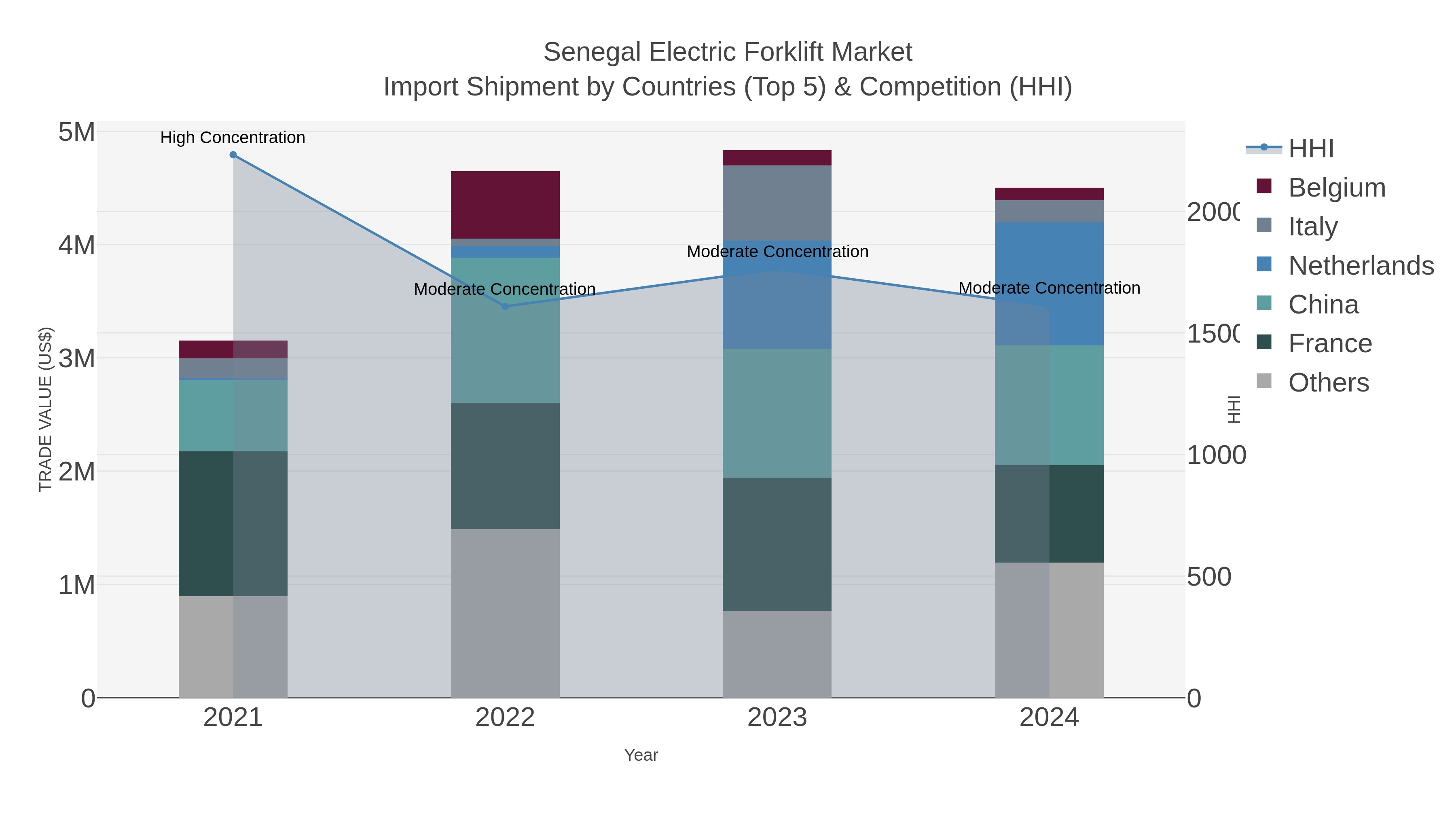
Senegal electric forklift import market in 2024 saw significant contributions from top exporters such as the Netherlands, China, France, the United Kingdom, and Italy. Despite moderate market concentration based on the HHI index, the industry exhibited promising growth with a compound annual growth rate (CAGR) of 12.59%. However, the growth rate dipped slightly to -6.86% in the same year, indicating some fluctuations in market dynamics. Overall, Senegal import sector for electric forklifts remains active and dynamic, with diverse contributions from key exporting countries.
Senegal Electric Forklift Market Overview
The Senegal Electric Forklift Market is experiencing steady growth driven by increasing industrial activities across sectors such as manufacturing, logistics, and construction. The shift towards eco-friendly and sustainable practices is boosting the adoption of electric forklifts in the country. Key players in the market are focusing on improving product efficiency, battery technology, and operator safety features to meet the growing demand. Government initiatives promoting clean energy usage and the rising awareness about carbon emissions reduction are further driving the market growth. However, challenges such as high initial costs and limited charging infrastructure pose obstacles to market expansion. Overall, the Senegal Electric Forklift Market is poised for continued growth fueled by technological advancements and the increasing emphasis on environmental sustainability.
Senegal Electric Forklift Market Trends and Opportunities
The Senegal Electric Forklift Market is experiencing growth driven by the increasing focus on sustainable and eco-friendly solutions in the industrial sector. The demand for electric forklifts is rising due to their lower operational costs, reduced emissions, and improved efficiency compared to traditional diesel-powered forklifts. Additionally, the government initiatives promoting the adoption of electric vehicles and equipment are further driving the market growth. Opportunities exist for manufacturers and suppliers to capitalize on this trend by offering innovative and technologically advanced electric forklifts tailored to the specific needs of the Senegalese market. Partnerships with local distributors and service providers can also help companies establish a strong presence in the market and gain a competitive edge.
Senegal Electric Forklift Market Challenges
In the Senegal Electric Forklift Market, some key challenges include a lack of adequate infrastructure for electric forklift charging stations, limited awareness and adoption of electric forklift technology among businesses, and high initial investment costs associated with purchasing electric forklifts compared to traditional diesel or LPG forklifts. Additionally, the availability of skilled technicians for maintenance and repair of electric forklifts may be limited, leading to potential downtime and higher service costs for businesses. Furthermore, the intermittent power supply in certain regions of Senegal may pose challenges for the consistent operation of electric forklifts. Addressing these challenges will require investment in infrastructure development, education and training programs for businesses, and potential government incentives to promote the transition to electric forklifts in Senegal.
Senegal Electric Forklift Market Drivers
The Senegal Electric Forklift Market is primarily driven by a growing emphasis on sustainable and eco-friendly material handling solutions. As companies in Senegal are increasingly focused on reducing carbon emissions and operational costs, electric forklifts are becoming a popular choice due to their lower maintenance requirements, quieter operation, and zero emissions. Additionally, government initiatives promoting the adoption of electric vehicles and forklifts are further driving the market growth. The rising awareness about the environmental impact of traditional fuel-powered forklifts and the long-term cost savings associated with electric forklifts are key factors influencing the shift towards electric solutions in Senegal`s material handling industry.
Senegal Electric Forklift Market Government Policy
The Senegal government has implemented policies focused on promoting the use of electric forklifts to reduce carbon emissions and foster sustainable development in the country. These policies include providing incentives such as tax credits or subsidies for businesses and organizations that invest in electric forklifts, as well as setting regulations for the gradual phase-out of diesel forklifts. Additionally, the government is working on improving the infrastructure for electric vehicle charging stations to support the growth of the electric forklift market. These initiatives aim to create a more eco-friendly and efficient logistics industry in Senegal, aligning with the country`s commitment to environmental sustainability and reducing reliance on fossil fuels.
Senegal Electric Forklift Market Future Outlook
The Senegal Electric Forklift Market is poised for steady growth in the coming years due to increasing awareness about the benefits of electric forklifts in terms of efficiency, cost savings, and environmental sustainability. Government initiatives promoting clean energy and stricter regulations on emissions are driving the demand for electric forklifts in Senegal. The market is expected to witness a rise in adoption among various industries such as logistics, manufacturing, and agriculture, as businesses prioritize eco-friendly solutions. Additionally, advancements in battery technology leading to longer operating hours and faster charging times will further boost the market. Overall, the Senegal Electric Forklift Market is anticipated to experience robust growth and present opportunities for manufacturers, suppliers, and service providers in the near future.
Key Highlights of the Report:
- Senegal Electric Forklift Market Outlook
- Market Size of Senegal Electric Forklift Market, 2024
- Forecast of Senegal Electric Forklift Market, 2031
- Historical Data and Forecast of Senegal Electric Forklift Revenues & Volume for the Period 2021- 2031
- Senegal Electric Forklift Market Trend Evolution
- Senegal Electric Forklift Market Drivers and Challenges
- Senegal Electric Forklift Price Trends
- Senegal Electric Forklift Porter's Five Forces
- Senegal Electric Forklift Industry Life Cycle
- Historical Data and Forecast of Senegal Electric Forklift Market Revenues & Volume By Product for the Period 2021- 2031
- Historical Data and Forecast of Senegal Electric Forklift Market Revenues & Volume By Counterbalanced for the Period 2021- 2031
- Historical Data and Forecast of Senegal Electric Forklift Market Revenues & Volume By Pallet Trucks for the Period 2021- 2031
- Historical Data and Forecast of Senegal Electric Forklift Market Revenues & Volume By Reach Trucks for the Period 2021- 2031
- Historical Data and Forecast of Senegal Electric Forklift Market Revenues & Volume By Pallet Stackers for the Period 2021- 2031
- Historical Data and Forecast of Senegal Electric Forklift Market Revenues & Volume By Battery Type for the Period 2021- 2031
- Historical Data and Forecast of Senegal Electric Forklift Market Revenues & Volume By Lithium-Ion for the Period 2021- 2031
- Historical Data and Forecast of Senegal Electric Forklift Market Revenues & Volume By Lead Acid for the Period 2021- 2031
- Historical Data and Forecast of Senegal Electric Forklift Market Revenues & Volume By Hydrogen Fuel-Cell for the Period 2021- 2031
- Historical Data and Forecast of Senegal Electric Forklift Market Revenues & Volume By End Use for the Period 2021- 2031
- Historical Data and Forecast of Senegal Electric Forklift Market Revenues & Volume By Chemical for the Period 2021- 2031
- Historical Data and Forecast of Senegal Electric Forklift Market Revenues & Volume By Food & Beverage for the Period 2021- 2031
- Historical Data and Forecast of Senegal Electric Forklift Market Revenues & Volume By Industrial for the Period 2021- 2031
- Historical Data and Forecast of Senegal Electric Forklift Market Revenues & Volume By Logistics for the Period 2021- 2031
- Historical Data and Forecast of Senegal Electric Forklift Market Revenues & Volume By Retail & E-Commerce for the Period 2021- 2031
- Senegal Electric Forklift Import Export Trade Statistics
- Market Opportunity Assessment By Product
- Market Opportunity Assessment By Battery Type
- Market Opportunity Assessment By End Use
- Senegal Electric Forklift Top Companies Market Share
- Senegal Electric Forklift Competitive Benchmarking By Technical and Operational Parameters
- Senegal Electric Forklift Company Profiles
- Senegal Electric Forklift Key Strategic Recommendations






































