Senegal Oscillator Market: Top 5 Importing Countries and Market Competition (HHI) Analysis
Senegal saw a significant shift in the oscillator import market in 2024, with top exporters being China, France, Turkey, USA, and Australia. The market concentration, as measured by HHI, increased from low to high concentration levels. The compound annual growth rate (CAGR) stood at a healthy 11.22%, while the growth rate for the year was an impressive 47.53%. This data indicates a dynamic and competitive market landscape, with key players vying for a larger share of Senegal oscillator import market.
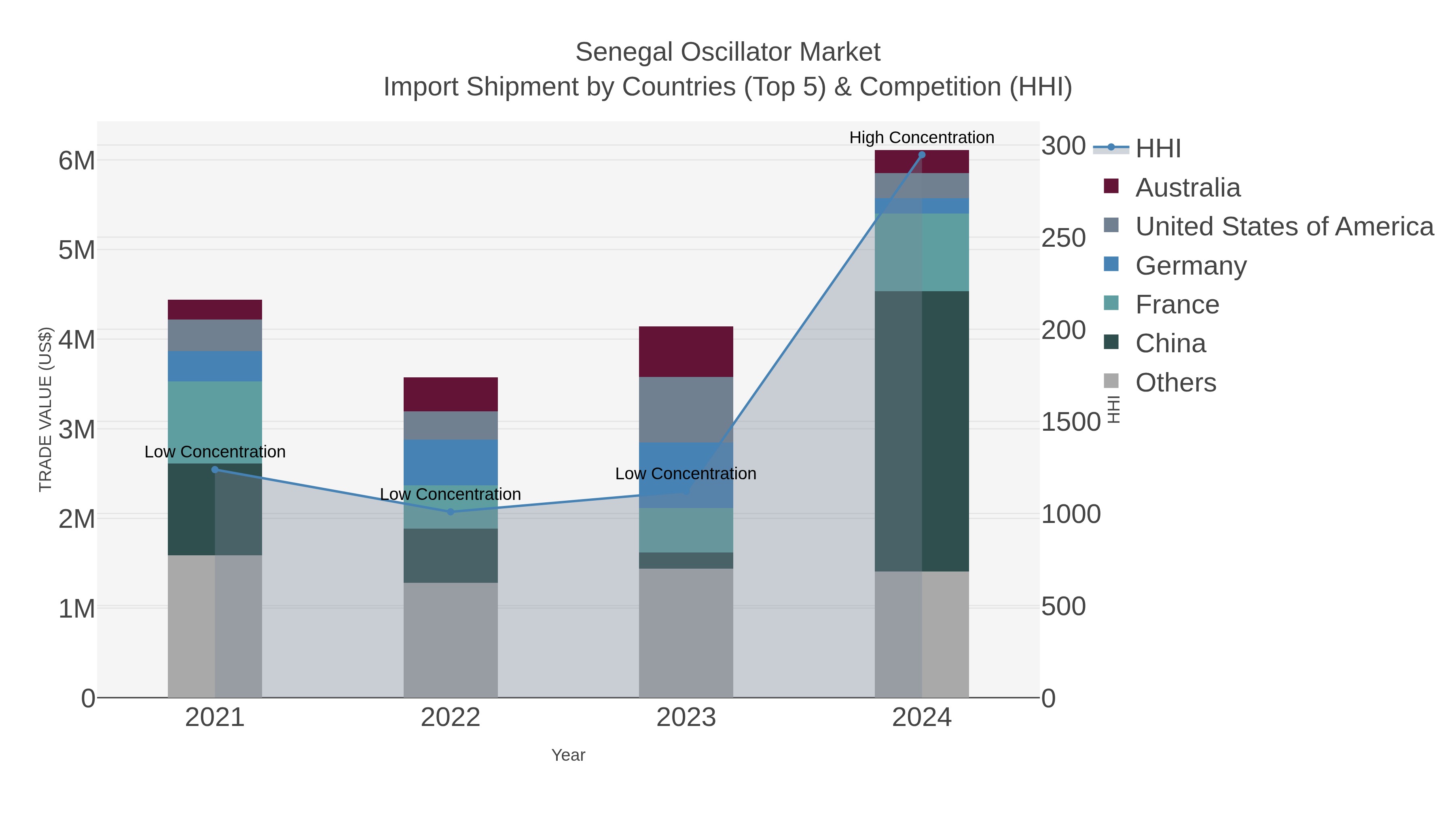
Senegal Oscillator Market Overview
The Senegal Oscillator Market is witnessing steady growth driven by increasing demand for electronic components in various industries such as telecommunications, automotive, and healthcare. Oscillators are essential for generating and maintaining precise frequencies in electronic devices, making them crucial for the functioning of modern technology. Key players in the market are focusing on developing advanced oscillator technologies to meet the evolving needs of customers for higher frequency stability, lower power consumption, and smaller form factors. The market is also benefiting from the growing adoption of wireless communication technologies and IoT devices, which require oscillators for synchronization and timing purposes. With a strong emphasis on innovation and product development, the Senegal Oscillator Market is expected to continue its growth trajectory in the coming years.
Senegal Oscillator Market Trends and Opportunities
The Senegal Oscillator Market is currently experiencing growth due to increasing demand for electronic devices such as smartphones, tablets, and wearables. Rapid technological advancements have led to the development of new and improved oscillators with higher precision and stability. The market is also benefiting from the expansion of the telecommunications and automotive industries in Senegal. Opportunities in the market include the rising adoption of 5G technology, which requires high-performance oscillators for seamless connectivity. Additionally, the growing focus on IoT devices and smart infrastructure is driving the demand for oscillators in various applications. To succeed in this market, companies can focus on innovation to develop compact, low-power, and cost-effective oscillators to meet the evolving needs of customers in Senegal and beyond.
Senegal Oscillator Market Challenges
In the Senegal Oscillator Market, challenges primarily stem from the limited access to advanced technology and resources, which hinders the development of high-quality oscillators. Additionally, the market faces constraints related to unstable economic conditions and fluctuating exchange rates, impacting the affordability and demand for oscillators. Limited awareness and understanding of the benefits of oscillators among consumers and businesses also pose a challenge in driving market growth. Furthermore, competition from imported oscillators, often of superior quality and lower cost, presents a significant hurdle for local oscillator manufacturers to establish a strong market presence. Overcoming these challenges would require investments in technological infrastructure, targeted marketing efforts to educate potential customers, and strategic partnerships to enhance product competitiveness and market reach.
Senegal Oscillator Market Drivers
The Senegal Oscillator Market is primarily driven by the increasing demand for precision timekeeping in various industries such as telecommunications, aerospace, and defense. The growing adoption of advanced technologies that require accurate frequency and time synchronization, coupled with the rising need for efficient communication systems, is fueling the market growth. Additionally, the expanding use of oscillators in applications like radar systems, GPS devices, and electronic instruments is contributing to the market`s expansion. Furthermore, the ongoing advancements in oscillator technology, such as the development of miniature and high-performance oscillators, are attracting market players to innovate and introduce new products, further boosting market growth in Senegal.
Senegal Oscillator Market Government Policies
The Senegal government has implemented policies to support the growth of the oscillator market. These policies include providing incentives for local manufacturing of oscillators to reduce dependency on imports, fostering collaboration between universities and industry for research and development in oscillator technology, and offering tax breaks or subsidies for companies investing in innovative oscillator products. Additionally, the government is focusing on creating a favorable regulatory environment by streamlining approval processes for oscillator products and promoting standards compliance to ensure quality and safety. These initiatives aim to boost domestic production, enhance technological capabilities, and stimulate economic growth in the Senegal oscillator market.
Senegal Oscillator Market Future Outlook
The Senegal Oscillator Market is expected to experience steady growth in the coming years, driven by factors such as increasing demand for precision timing devices in various industries including telecommunications, automotive, and aerospace. The market is likely to benefit from technological advancements leading to the development of more accurate and reliable oscillators. Additionally, the growing adoption of IoT devices and the need for synchronization in wireless communication networks are anticipated to further boost market growth. With the increasing focus on improving efficiency and performance in electronic systems, the Senegal Oscillator Market is poised for expansion, providing opportunities for key players to innovate and capitalize on emerging trends.
Key Highlights of the Report:
- Senegal Oscillator Market Outlook
- Market Size of Senegal Oscillator Market, 2024
- Forecast of Senegal Oscillator Market, 2031
- Historical Data and Forecast of Senegal Oscillator Revenues & Volume for the Period 2021- 2031
- Senegal Oscillator Market Trend Evolution
- Senegal Oscillator Market Drivers and Challenges
- Senegal Oscillator Price Trends
- Senegal Oscillator Porter's Five Forces
- Senegal Oscillator Industry Life Cycle
- Historical Data and Forecast of Senegal Oscillator Market Revenues & Volume By Type for the Period 2021- 2031
- Historical Data and Forecast of Senegal Oscillator Market Revenues & Volume By Temperature Compensated Crystal Oscillator (TCXO) for the Period 2021- 2031
- Historical Data and Forecast of Senegal Oscillator Market Revenues & Volume By Voltage-controlled Crystal Oscillator (VCXO) for the Period 2021- 2031
- Historical Data and Forecast of Senegal Oscillator Market Revenues & Volume By Oven-controlled Crystal Oscillator (OCXO) for the Period 2021- 2031
- Historical Data and Forecast of Senegal Oscillator Market Revenues & Volume By MEMS Oscillators for the Period 2021- 2031
- Historical Data and Forecast of Senegal Oscillator Market Revenues & Volume By Mounting Type for the Period 2021- 2031
- Historical Data and Forecast of Senegal Oscillator Market Revenues & Volume By Surface Mount for the Period 2021- 2031
- Historical Data and Forecast of Senegal Oscillator Market Revenues & Volume By Thru-hole for the Period 2021- 2031
- Historical Data and Forecast of Senegal Oscillator Market Revenues & Volume By Others for the Period 2021- 2031
- Historical Data and Forecast of Senegal Oscillator Market Revenues & Volume By End-user Industry for the Period 2021- 2031
- Historical Data and Forecast of Senegal Oscillator Market Revenues & Volume By Consumer Electronics for the Period 2021- 2031
- Historical Data and Forecast of Senegal Oscillator Market Revenues & Volume By Automotive for the Period 2021- 2031
- Historical Data and Forecast of Senegal Oscillator Market Revenues & Volume By Telecom and Networking for the Period 2021- 2031
- Historical Data and Forecast of Senegal Oscillator Market Revenues & Volume By Aerospace and Defense for the Period 2021- 2031
- Historical Data and Forecast of Senegal Oscillator Market Revenues & Volume By Research and Medical for the Period 2021- 2031
- Historical Data and Forecast of Senegal Oscillator Market Revenues & Volume By Industrial for the Period 2021- 2031
- Senegal Oscillator Import Export Trade Statistics
- Market Opportunity Assessment By Type
- Market Opportunity Assessment By Mounting Type
- Market Opportunity Assessment By End-user Industry
- Senegal Oscillator Top Companies Market Share
- Senegal Oscillator Competitive Benchmarking By Technical and Operational Parameters
- Senegal Oscillator Company Profiles
- Senegal Oscillator Key Strategic Recommendations






































