Serbia Oil Refining Market: Import Trend Analysis
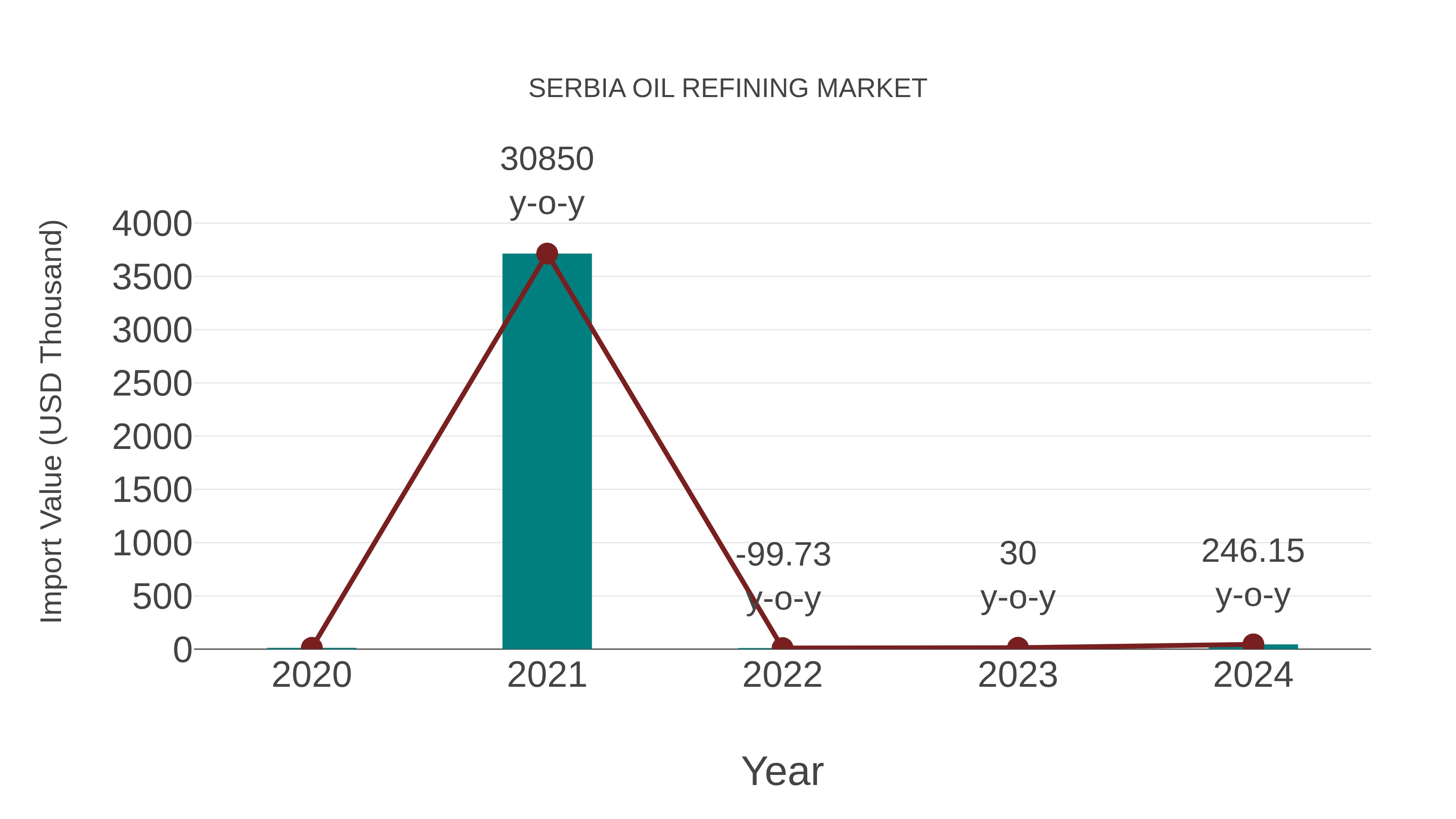
Serbia`s import trend for the oil refining market showed significant growth from 2023 to 2024, with a growth rate of 246.15%. The compound annual growth rate (CAGR) for the period 2020-2024 stood at 39.16%. This substantial increase in imports can be attributed to shifts in demand dynamics and evolving trade policies affecting the market during this period.
Serbia Oil Refining Market Synopsis
The Serbia Oil Refining Market is a significant sector in the country`s economy, with a few key players dominating the industry. The largest refinery in Serbia is the Pancevo Refinery, operated by NIS (Naftna Industrija Srbije), which is majority-owned by Gazprom Neft. The refinery plays a crucial role in meeting the domestic demand for refined petroleum products, including gasoline, diesel, and jet fuel. Additionally, Serbia also imports refined oil products to meet its consumption needs. The market faces challenges such as aging infrastructure, environmental regulations, and fluctuating global oil prices. However, there are opportunities for growth and investment in upgrading existing refineries and exploring renewable energy sources to ensure sustainability in the long run.
Serbia Oil Refining Market Trends
The Serbia Oil Refining Market is experiencing several notable trends. One major trend is the increasing focus on environmental sustainability and energy efficiency in oil refining processes. Companies in the market are investing in technologies and practices that reduce emissions and improve overall efficiency. Additionally, there is a growing interest in biofuels and renewable energy sources as alternative options in the refining industry. Another trend is the shift towards digitalization and automation in refining operations to enhance productivity and reduce costs. Furthermore, there is a rising demand for high-quality refined products, driving companies to upgrade their refining facilities and adopt advanced processing techniques. Overall, these trends reflect a dynamic and evolving landscape in the Serbia Oil Refining Market.
Serbia Oil Refining Market Challenges
One of the main challenges faced in the Serbia Oil Refining Market is the aging infrastructure of existing refineries, leading to inefficiencies, higher operating costs, and difficulties in meeting environmental regulations. Another challenge is the limited capacity of existing refineries to meet the growing demand for petroleum products in the country, which requires significant investment in expanding and modernizing facilities. Additionally, fluctuating global oil prices and geopolitical tensions can impact the profitability and stability of the market. Finally, increasing competition from newer and more efficient refineries in neighboring countries poses a threat to the competitiveness of Serbian refineries. Addressing these challenges will require strategic investments, technological upgrades, and regulatory reforms to ensure the long-term sustainability and growth of the oil refining industry in Serbia.
Serbia Oil Refining Market Investment Opportunities
Investment opportunities in the Serbia Oil Refining Market include modernizing existing refineries to increase efficiency and output, as well as constructing new refineries to meet growing demand in the country and the region. With Serbia`s strategic location providing access to major European markets, investing in infrastructure improvements such as transportation and storage facilities can enhance the overall supply chain and distribution network. Additionally, there is potential for investment in technologies aimed at reducing environmental impact and meeting stringent regulatory requirements. Collaborating with local partners and leveraging government incentives for foreign investment can also be advantageous in navigating the market. Overall, the Serbia Oil Refining Market presents opportunities for investors to participate in the country`s energy sector growth and contribute to its economic development.
Jordan Agar Market Government Policies
The Serbian government has implemented various policies to regulate and support the oil refining market. Key policies include the Energy Law, which aims to promote energy efficiency and renewable energy sources while ensuring a stable and competitive energy market. Additionally, the government has introduced measures to promote environmental protection and sustainable development in the oil refining sector. This includes regulations on emissions, waste management, and safety standards to mitigate environmental impact. Furthermore, the government has encouraged investment and innovation in the sector through incentives and support programs. Overall, these policies aim to balance economic growth with environmental sustainability in the Serbia Oil Refining Market.
Serbia Oil Refining Market Future Outlook
The future outlook for the Serbia Oil Refining Market is expected to be positive, driven by factors such as increasing demand for petroleum products, ongoing investments in upgrading existing refineries, and potential new entrants in the market. The country`s strategic location as a transit hub for oil and gas supplies in the region further enhances its attractiveness for oil refining activities. However, challenges such as environmental regulations, competition from neighboring countries, and global market volatility may pose some risks to the market`s growth. Overall, with continued investments in technology and infrastructure, the Serbia Oil Refining Market is likely to experience steady growth in the coming years, catering to both domestic demand and potentially expanding its export capabilities.
Key Highlights of the Report:
- Serbia Oil Refining Market Outlook
- Market Size of Serbia Oil Refining Market, 2025
- Forecast of Serbia Oil Refining Market, 2032
- Historical Data and Forecast of Serbia Oil Refining Revenues & Volume for the Period 2022 - 2032F
- Serbia Oil Refining Market Trend Evolution
- Serbia Oil Refining Market Drivers and Challenges
- Serbia Oil Refining Price Trends
- Serbia Oil Refining Porter's Five Forces
- Serbia Oil Refining Industry Life Cycle
- Historical Data and Forecast of Serbia Oil Refining Market Revenues & Volume By Product for the Period 2022 - 2032F
- Historical Data and Forecast of Serbia Oil Refining Market Revenues & Volume By Gasoline for the Period 2022 - 2032F
- Historical Data and Forecast of Serbia Oil Refining Market Revenues & Volume By Gasoil for the Period 2022 - 2032F
- Historical Data and Forecast of Serbia Oil Refining Market Revenues & Volume By Kerosene for the Period 2022 - 2032F
- Historical Data and Forecast of Serbia Oil Refining Market Revenues & Volume By LPG for the Period 2022 - 2032F
- Historical Data and Forecast of Serbia Oil Refining Market Revenues & Volume By Others for the Period 2022 - 2032F
- Historical Data and Forecast of Serbia Oil Refining Market Revenues & Volume By End-user for the Period 2022 - 2032F
- Historical Data and Forecast of Serbia Oil Refining Market Revenues & Volume By Transportation for the Period 2022 - 2032F
- Historical Data and Forecast of Serbia Oil Refining Market Revenues & Volume By Aviation for the Period 2022 - 2032F
- Historical Data and Forecast of Serbia Oil Refining Market Revenues & Volume By Marine Bunker for the Period 2022 - 2032F
- Historical Data and Forecast of Serbia Oil Refining Market Revenues & Volume By Petrochemical for the Period 2022 - 2032F
- Historical Data and Forecast of Serbia Oil Refining Market Revenues & Volume By Agriculture for the Period 2022 - 2032F
- Historical Data and Forecast of Serbia Oil Refining Market Revenues & Volume By Others for the Period 2022 - 2032F
- Serbia Oil Refining Import Export Trade Statistics
- Market Opportunity Assessment By Product
- Market Opportunity Assessment By End-user
- Serbia Oil Refining Top Companies Market Share
- Serbia Oil Refining Competitive Benchmarking By Technical and Operational Parameters
- Serbia Oil Refining Company Profiles
- Serbia Oil Refining Key Strategic Recommendations






































