Singapore 1-decanol Market: Import Trend Analysis
In the Singapore 1-decanol market, import trends showed a growth rate of 3.11% from 2023 to 2024, with a compound annual growth rate (CAGR) of 18.97% for the period 2020-2024. This upward import momentum can be attributed to increasing demand for raw materials in the chemical industry, indicating market stability and sustained demand.
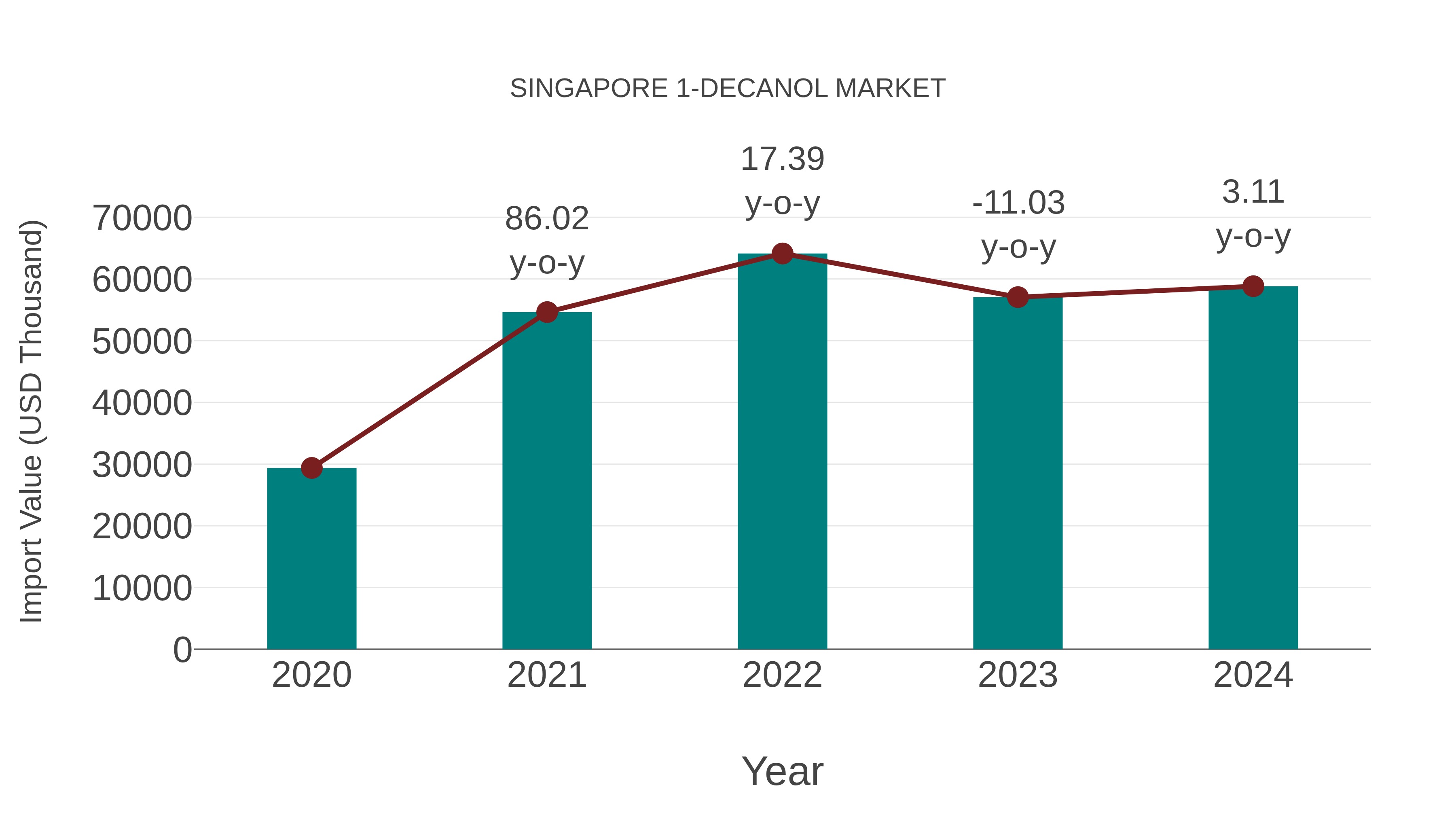
Singapore 1 Decanol Market Overview
1-Decanol, an important chemical intermediate, is widely used in diverse applications, including the production of plasticizers, fragrances, and surfactants. The Singapore 1-decanol market caters to the chemical and industrial sectors, where the demand for such intermediates remains relatively consistent. The growth in these end-user industries and the development of new applications could lead to a sustained demand for 1-decanol in the Singaporean market.
Drivers of the Market
The Singapore 1-Decanol market is primarily driven by its applications in the chemical and industrial sectors. 1-Decanol serves as a solvent and intermediate in various chemical processes. As chemical manufacturing and industrial processes continue to evolve, the demand for 1-Decanol is expected to increase, driven by its role in the synthesis of various chemicals and compounds.
Challenges of the Market
The Singapore 1-Decanol Market faces challenges related to raw material availability, sustainability, and demand fluctuations. 1-decanol, a chemical intermediate, is used in various applications, including the production of plasticizers and surfactants. Market players need to secure a stable supply of raw materials, which can be influenced by factors like feedstock availability and pricing. Sustainability concerns drive the demand for bio-based 1-decanol, presenting challenges related to sourcing and production methods. Additionally, market players must adapt to changing demand patterns influenced by various end-use industries.
Covid-19 impact of the Market
The COVID-19 pandemic influenced the Singapore 1-decanol market as changes in industrial activity and supply chain disruptions impacted demand. While some applications, such as surfactants and cleaning products, experienced consistent demand, others, like paints and coatings, faced fluctuations. The market adapted by exploring new applications for 1-decanol, including its use in sanitizers and disinfectants. As Singapore navigated the pandemic, the market showed resilience and flexibility in response to changing industry dynamics.
Leading Players of the Market
Key players in the Singapore 1-decanol market include Sasol, Evonik, and Oxiteno, supplying 1-decanol for applications in chemical synthesis, flavors, fragrances, and surfactants.
Key Highlights of the Report:
- Singapore 1-Decanol Market Outlook
- Market Size of Singapore 1-Decanol Market, 2025
- Forecast of Singapore 1-Decanol Market, 2032
- Historical Data and Forecast of Singapore 1-Decanol Revenues & Volume for the Period 2022-2032F
- Singapore 1-Decanol Market Trend Evolution
- Singapore 1-Decanol Market Drivers and Challenges
- Singapore 1-Decanol Price Trends
- Singapore 1-Decanol Porter's Five Forces
- Singapore 1-Decanol Industry Life Cycle
- Historical Data and Forecast of Singapore 1-Decanol Market Revenues & Volume By Source for the Period 2022-2032F
- Historical Data and Forecast of Singapore 1-Decanol Market Revenues & Volume By Petrochemical Based for the Period 2022-2032F
- Historical Data and Forecast of Singapore 1-Decanol Market Revenues & Volume By Oleochemical Based for the Period 2022-2032F
- Historical Data and Forecast of Singapore 1-Decanol Market Revenues & Volume By Application for the Period 2022-2032F
- Historical Data and Forecast of Singapore 1-Decanol Market Revenues & Volume By Plasticizers for the Period 2022-2032F
- Historical Data and Forecast of Singapore 1-Decanol Market Revenues & Volume By Lubricants for the Period 2022-2032F
- Historical Data and Forecast of Singapore 1-Decanol Market Revenues & Volume By Detergents & Cleaners for the Period 2022-2032F
- Historical Data and Forecast of Singapore 1-Decanol Market Revenues & Volume By Cosmetics & Personal Care for the Period 2022-2032F
- Historical Data and Forecast of Singapore 1-Decanol Market Revenues & Volume By Pharmaceuticals for the Period 2022-2032F
- Historical Data and Forecast of Singapore 1-Decanol Market Revenues & Volume By Flavors & Fragrance for the Period 2022-2032F
- Singapore 1-Decanol Import Export Trade Statistics
- Market Opportunity Assessment By Source
- Market Opportunity Assessment By Application
- Singapore 1-Decanol Top Companies Market Share
- Singapore 1-Decanol Competitive Benchmarking By Technical and Operational Parameters
- Singapore 1-Decanol Company Profiles
- Singapore 1-Decanol Key Strategic Recommendations






































