Singapore 3D Holographic Display and Services Market Size, Share & Growth Rate
The Singapore 3D Holographic Display and Services Market was estimated at USD 412 Million in 2025 and is projected to reach USD 576 Million by 2032, growing at a CAGR of 4.9% from 2026 to 2032. This growth trajectory is fueled by the increasing demand for innovative and engaging visual content across diverse sectors such as advertising, entertainment, and healthcare. The continuous advancements in holographic technologies and the shift towards digital solutions have further reinforced the market's potential.
Singapore 3D Holographic Display and Services Market Year-wise Growth Rate and Key Drivers
This graph highlights how the Singapore 3D Holographic Display and Services Market has steadily grown over the years, supported by major growth factors.
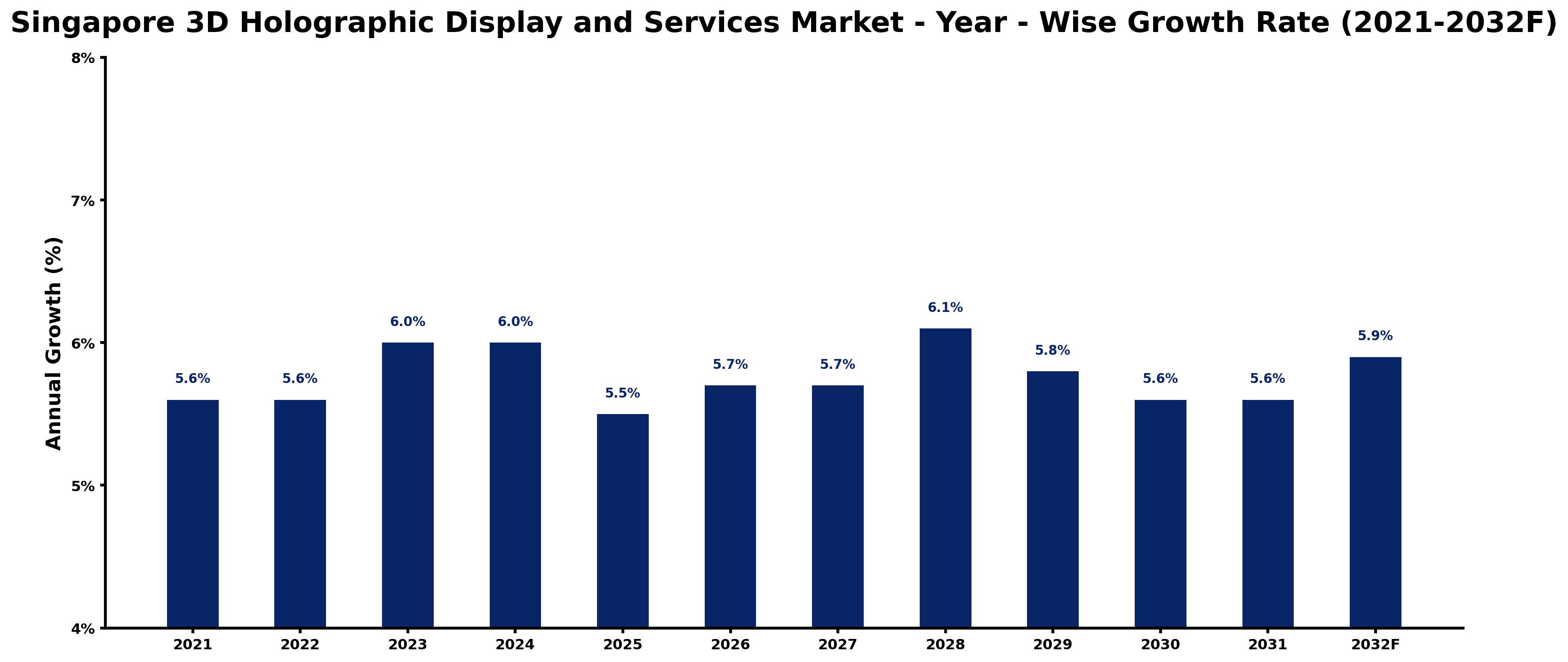
The table below presents the year‑wise growth rates along with the key drivers influencing the market
| Year | Growth Rate | Major Drivers |
| 2021 | 5.6% | Growing urbanization and commercial development |
| 2022 | 5.6% | Government infrastructure modernization initiatives |
| 2023 | 6.0% | Rising electricity demand across industries |
| 2024 | 6.0% | Growing urbanization and commercial development |
| 2025 | 5.5% | Rapid growth in telecom and data center sectors |
| 2026 | 5.7% | Expansion of transportation and logistics networks |
| 2027 | 5.7% | Growing renewable energy integration projects |
| 2028 | 6.1% | Increasing smart city development projects |
| 2029 | 5.8% | Expansion of manufacturing activities |
| 2030 | 5.6% | Rapid growth in telecom and data center sectors |
| 2031 | 5.6% | Growing urbanization and commercial development |
| 2032 | 5.9% | Expansion of commercial construction activities |
Note - Market size estimations and growth projections presented in this report are based on 6Wresearch’s advanced forecasting approach, validated with industry datasets as of June 2026.
Singapore 3D Holographic Display and Services Market Synopsis
In Singapore, the application of 3D holographic displays is rapidly gaining traction, particularly within the realms of retail and healthcare. Retailers leverage these displays for interactive product showcases, enhancing customer engagement and driving sales. Meanwhile, healthcare providers are integrating holography into medical training and patient education, reflecting a broadening scope of usage in this vibrant market.
The market's potential is further underscored by an increasing number of events and exhibitions utilizing 3D holographic solutions to create memorable experiences. As industries recognize the value of immersive technology for branding and educational purposes, the demand for high-quality holographic services is anticipated to rise, solidifying Singapore's position as a hub for innovation in this field.
Singapore 3D Holographic Display and Services Market Key Takeaways
- Engaging visual experiences are a primary driver of market growth, enhancing audience engagement significantly.
- Brands are increasingly adopting holographic displays for unique advertising strategies that distinguish them from competitors.
- Technological advancements are vital, with improvements in image quality and interactivity fueling adoption across various sectors.
- High initial costs and content compatibility issues present challenges to widespread implementation.
- The pandemic has accelerated the trend towards virtual events, increasing interest in holographic solutions for online presentations.
Evaluation of Restraints in Singapore 3D Holographic Display and Services Market
Despite the promising growth outlook for the Singapore 3D Holographic Display and Services Market, several restraints hinder its full potential. The significant initial investment required for both hardware and ongoing maintenance can deter many businesses, especially SMEs. Additionally, there remains a challenge in content creation specifically tailored for these displays, which demands a higher level of technical expertise and creativity. Not all existing content is compatible with holographic formats, leading to limitations in the range of effective showcases. These factors can restrict the market's expansion if not adequately addressed.
Singapore 3D Holographic Display and Services Market Trends
Current trends indicate a surge in the demand for interactive and immersive experiences, with 3D holographic technology at the forefront. Notable advancements include the integration of augmented reality (AR) capabilities, enhancing the interactivity of displays. Furthermore, industries are increasingly recognizing the significance of storytelling through holography, transforming marketing strategies. Events and trade shows are beginning to prioritize these displays, aiming to provide attendees with unforgettable experiences that leverage visual immersion.
Singapore 3D Holographic Display and Services Market Opportunities
The future is bright for the Singapore 3D Holographic Display and Services Market, presenting numerous investment opportunities. The increasing interest in virtual events has sparked a demand for innovative presentation formats, allowing companies to explore new revenue streams. Additionally, as advancements continue in both software and hardware, opportunities will arise for businesses to develop specialized content that caters to diverse audience needs. The integration of 3D displays in education and training sectors also offers significant growth potential, paving the way for novel applications across various fields.
Government Initiatives in the Singapore 3D Holographic Display and Services Market
The Singaporean government has been proactive in fostering the growth of technology-driven industries, including the 3D holographic display market. Initiatives aimed at promoting digital innovation and enhancing the tech ecosystem are evident through funding programs and support for research and development. Furthermore, public spending on educational and healthcare advancements encourages the adoption of cutting-edge technologies like holography, facilitating their incorporation into various public and private sector applications.
Future Insights of the Singapore 3D Holographic Display and Services Market
Looking ahead to 2026-2032, the Singapore 3D Holographic Display and Services Market is poised for substantial evolution. As companies continue to seek competitive advantages through innovative marketing strategies, the adoption of holographic displays is likely to intensify. Additionally, collaboration between technology developers and content creators will be crucial to overcoming content compatibility challenges and enhancing user experiences. This period will also witness a strengthening of the ecosystem surrounding holographic technology, driving further advancements and applications across diverse sectors.
Singapore 3D Holographic Display and Services Market Latest Developments (May 2025 - June 2026)
Recent developments in the Singapore 3D Holographic Display and Services Market indicate a shift towards enhanced user engagement through more interactive displays. Companies are exploring new collaborative opportunities with content creators to develop unique experiences tailored to specific industries. Additionally, advancements in software are streamlining the content creation process, making it easier for businesses to adapt existing materials for holographic platforms. This evolution is expected to further integrate 3D holography into everyday business practices and entertainment.
Singapore 3D Holographic Display and Services Market - Key Attractiveness of the Report
- 10 Years of Market Numbers
- Historical Data Starting from 2022 to 2025
- Base Year: 2025
- Forecast Data until 2032
- Key Performance Indicators Impacting the Market
- Major Upcoming Developments and Projects
Key Highlights of the Report:
- Singapore 3D Holographic Display and Services Market Outlook
- Market Size of Singapore 3D Holographic Display and Services Market, 2025
- Forecast of Singapore 3D Holographic Display and Services Market, 2032F
- Historical Data and Forecast of Singapore 3D Holographic Display and Services Revenues & Volume for the Period 2022-2032F
- Singapore 3D Holographic Display and Services Market Trend Evolution
- Singapore 3D Holographic Display and Services Market Drivers and Challenges
- Singapore 3D Holographic Display and Services Price Trends
- Singapore 3D Holographic Display and Services Porter's Five Forces
- Singapore 3D Holographic Display and Services Industry Life Cycle
- Historical Data and Forecast of Singapore 3D Holographic Display and Services Market Revenues & Volume By End-users for the Period 2022-2032F
- Historical Data and Forecast of Singapore 3D Holographic Display and Services Market Revenues & Volume By Media and Entertainment for the Period 2022-2032F
- Historical Data and Forecast of Singapore 3D Holographic Display and Services Market Revenues & Volume By Consumer Electronics for the Period 2022-2032F
- Historical Data and Forecast of Singapore 3D Holographic Display and Services Market Revenues & Volume By Healthcare for the Period 2022-2032F
- Historical Data and Forecast of Singapore 3D Holographic Display and Services Market Revenues & Volume By Automotive for the Period 2022-2032F
- Historical Data and Forecast of Singapore 3D Holographic Display and Services Market Revenues & Volume By Retail for the Period 2022-2032F
- Historical Data and Forecast of Singapore 3D Holographic Display and Services Market Revenues & Volume By Others for the Period 2022-2032F
- Singapore 3D Holographic Display and Services Import Export Trade Statistics
- Market Opportunity Assessment By End-users
- Singapore 3D Holographic Display and Services Top Companies Market Share
- Singapore 3D Holographic Display and Services Competitive Benchmarking By Technical and Operational Parameters
- Singapore 3D Holographic Display and Services Company Profiles
- Singapore 3D Holographic Display and Services Key Strategic Recommendations






































