Singapore Acoustic Guitar Market Size, Share & Growth Rate
The Singapore Acoustic Guitar Market was estimated at USD 249 Million in 2025 and is projected to reach USD 273 Million by 2032, growing at a CAGR of 1.3% from 2026 to 2032. This growth is underpinned by the country's rich music culture and the increasing popularity of guitar education programs, which together foster a vibrant community of musicians and hobbyists. Furthermore, the ongoing resurgence of live music performances post-pandemic is expected to further stimulate demand for acoustic guitars.
Singapore Acoustic Guitar Market Year-wise Growth Rate and Key Drivers
This graph highlights how the Singapore Acoustic Guitar Market has steadily grown over the years, supported by major growth factors.
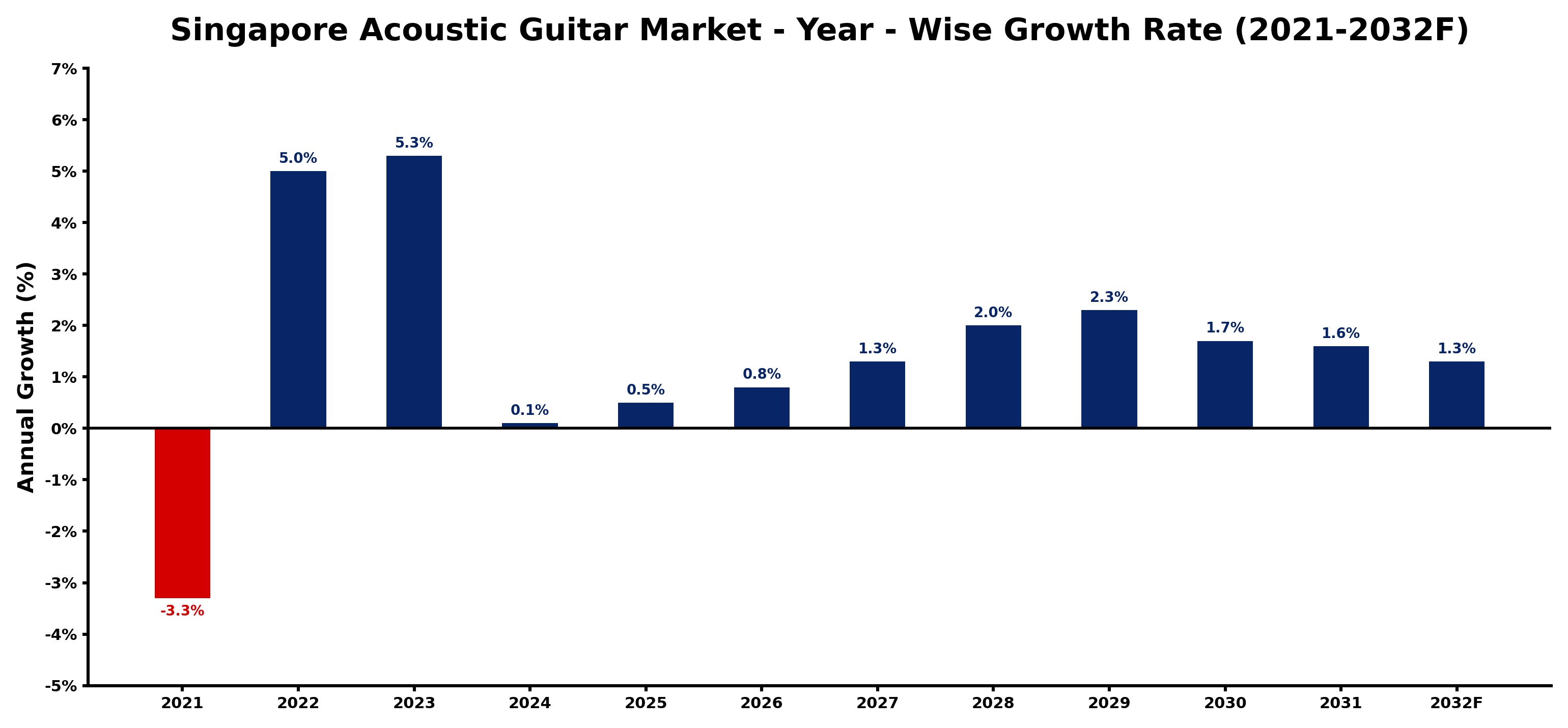
The table below presents the year‑wise growth rates along with the key drivers influencing the market
| Year | Growth Rate | Major Drivers |
| 2021 | -3.3% | Currency fluctuations decreased acoustic guitar export profitability and demand |
| 2022 | 5.0% | Domestic craftsmanship events boosted local acoustic guitar production orders |
| 2023 | 5.3% | Export driven demand for handcrafted guitars spurred local manufacturing investments |
| 2024 | 0.1% | Manufacturing investments enhanced acoustic guitar production capabilities in Singapore |
| 2025 | 0.5% | Improved factory throughput enhanced Singapore’s acoustic guitar production capacity |
| 2026 | 0.8% | Digital manufacturing adoption enhanced precision in acoustic guitar production |
| 2027 | 1.3% | Domestic demand for music education boosts acoustic guitar production |
| 2028 | 2.0% | Optimized supply chains boost efficiency in guitar component production |
| 2029 | 2.3% | Sustainable material sourcing drives eco friendly acoustic guitar production |
| 2030 | 1.7% | Smart manufacturing tools optimize acoustic guitar production workflows |
| 2031 | 1.6% | Manufacturing investments in local guitar production boost export capabilities |
| 2032 | 1.3% | New manufacturing facilities enhance acoustic guitar production capacity |
Note - Market size estimations and growth projections presented in this report are based on 6Wresearch’s advanced forecasting approach, validated with industry datasets as of June 2026.
Singapore Acoustic Guitar Market Synopsis
The strongest force currently shaping the Singapore Acoustic Guitar Market is the country's thriving music culture, which has created a rich tapestry of opportunities for guitar enthusiasts. This music-centric environment not only promotes acoustic guitars as instruments of choice for amateurs and professionals alike but also drives a demand for high-quality products from both local and international manufacturers.
Additionally, the increasing interest in music education has bolstered the appeal of acoustic guitars among younger generations. As more music schools open and community workshops emerge, the accessibility and appreciation of acoustic guitars continue to expand, contributing to the overall growth of the market.
Singapore Acoustic Guitar Market Key Takeaways
- The market is projected to reach USD 273 Million by 2032, reflecting steady growth driven by musical education.
- Live music performances are set to rebound, further increasing demand for acoustic guitars among musicians.
- Growing interest in recreational music activities encourages sales among hobbyists and casual players.
- The competition landscape includes both local manufacturers and imported brands, ensuring diversity in offerings.
- Innovations in guitar technology and online retail channels are crucial for market revitalization post-pandemic.
Evaluation of Restraints in Singapore Acoustic Guitar Market
Despite a favorable environment for growth, several constraints persist in the Singapore Acoustic Guitar Market. Competition from other musical instruments can divert consumer interest, while shifting trends within the music industry also pose challenges. Additionally, economic fluctuations could impact consumer spending on leisure items, including acoustic guitars. Local manufacturers face pressures from imports, which can provide more competitive pricing or niche products that appeal to specific consumer segments.
Singapore Acoustic Guitar Market Trends
The acoustic guitar market is currently witnessing several trends that are reshaping consumer preferences. Firstly, there is an increasing inclination toward eco-friendly materials and sustainable production methods, appealing to environmentally conscious consumers. Secondly, the rise of social media platforms as channels for music promotion has transformed how musicians engage with audiences, influencing their choice of instruments. Lastly, online sales platforms are gaining traction, with more retailers providing digital experiences that replicate the in-store purchasing process.
Singapore Acoustic Guitar Market Opportunities
Opportunities for growth in the Singapore Acoustic Guitar Market are abundant, particularly in the realm of music education and community engagement. Music schools can leverage partnerships with guitar manufacturers to enhance their curricula while introducing students to quality instruments. Furthermore, the growing trend of online music lessons presents an avenue for manufacturers to target consumers in new and innovative ways. Collaborations with local artists and musicians can also bolster brand visibility and foster a sense of community around acoustic guitar use.
Government Initiatives in the Singapore Acoustic Guitar Market
The Singaporean government has actively promoted the arts and music through various initiatives, including funding for arts education and grants for music-related projects. Such policies aim to enhance the local music ecosystem, which indirectly supports the acoustic guitar market. Public programs that encourage youth engagement with music create a fertile ground for future musicians and enthusiasts, ultimately driving demand for acoustic guitars.
Future Insights of the Singapore Acoustic Guitar Market
Looking ahead to 2026-2032, the Singapore Acoustic Guitar Market is expected to grow as the interplay between technology and music continues to evolve. Innovations in guitar design and manufacturing will enhance product offerings, making them more appealing to a diverse range of consumers. Moreover, as the music industry adapts to digital trends, acoustic guitars will likely remain essential for live performances and recordings, ensuring their relevance in the broader musical landscape.
Singapore Acoustic Guitar Market Latest Developments (May 2025 - June 2026)
In recent months, the acoustic guitar market has seen significant developments as retailers adapt to changing consumer behaviors. Many are enhancing their online platforms to cater to growing demand for digital purchasing experiences. Concurrently, collaborations between local artists and music schools are gaining popularity, driving community-focused initiatives that promote acoustic guitar playing. Such developments indicate a proactive approach in addressing market dynamics post-pandemic.
Singapore Acoustic Guitar Market - Key Attractiveness of the Report
- 10 Years of Market Numbers
- Historical Data Starting from 2022 to 2025
- Base Year: 2025
- Forecast Data until 2032
- Key Performance Indicators Impacting the Market
- Major Upcoming Developments and Projects
Key Highlights of the Report:
- Singapore Acoustic Guitar Market Outlook
- Market Size of Singapore Acoustic Guitar Market, 2025
- Forecast of Singapore Acoustic Guitar Market, 2032
- Historical Data and Forecast of Singapore Acoustic Guitar Revenues & Volume for the Period 2022-2032F
- Singapore Acoustic Guitar Market Trend Evolution
- Singapore Acoustic Guitar Market Drivers and Challenges
- Singapore Acoustic Guitar Price Trends
- Singapore Acoustic Guitar Porter's Five Forces
- Singapore Acoustic Guitar Industry Life Cycle
- Historical Data and Forecast of Singapore Acoustic Guitar Market Revenues & Volume By Product for the Period 2022-2032F
- Historical Data and Forecast of Singapore Acoustic Guitar Market Revenues & Volume By Nylon/gut Stringed Guitars for the Period 2022-2032F
- Historical Data and Forecast of Singapore Acoustic Guitar Market Revenues & Volume By Steel Stringed Guitars for the Period 2022-2032F
- Historical Data and Forecast of Singapore Acoustic Guitar Market Revenues & Volume By Other for the Period 2022-2032F
- Historical Data and Forecast of Singapore Acoustic Guitar Market Revenues & Volume By Application for the Period 2022-2032F
- Historical Data and Forecast of Singapore Acoustic Guitar Market Revenues & Volume By Perform for the Period 2022-2032F
- Historical Data and Forecast of Singapore Acoustic Guitar Market Revenues & Volume By Teaching for the Period 2022-2032F
- Historical Data and Forecast of Singapore Acoustic Guitar Market Revenues & Volume By Other for the Period 2022-2032F
- Singapore Acoustic Guitar Import Export Trade Statistics
- Market Opportunity Assessment By Product
- Market Opportunity Assessment By Application
- Singapore Acoustic Guitar Top Companies Market Share
- Singapore Acoustic Guitar Competitive Benchmarking By Technical and Operational Parameters
- Singapore Acoustic Guitar Company Profiles
- Singapore Acoustic Guitar Key Strategic Recommendations






































