Singapore Agriculture Market Size, Share & Growth Rate
The Singapore Agriculture Market was estimated at USD 422 Million in 2025 and is projected to reach USD 608 Million by 2032, growing at a CAGR of 5.4% from 2026 to 2032. This promising trajectory is fueled by a growing emphasis on food security and a shift toward sustainable, locally sourced agricultural practices. As urban farming and innovative cultivation technologies take root, local producers are well-positioned to meet the demands of a discerning consumer base seeking fresh and sustainable food options.
Singapore Agriculture Market Year-wise Growth Rate and Key Drivers
This graph highlights how the Singapore Agriculture Market has steadily grown over the years, supported by major growth factors.
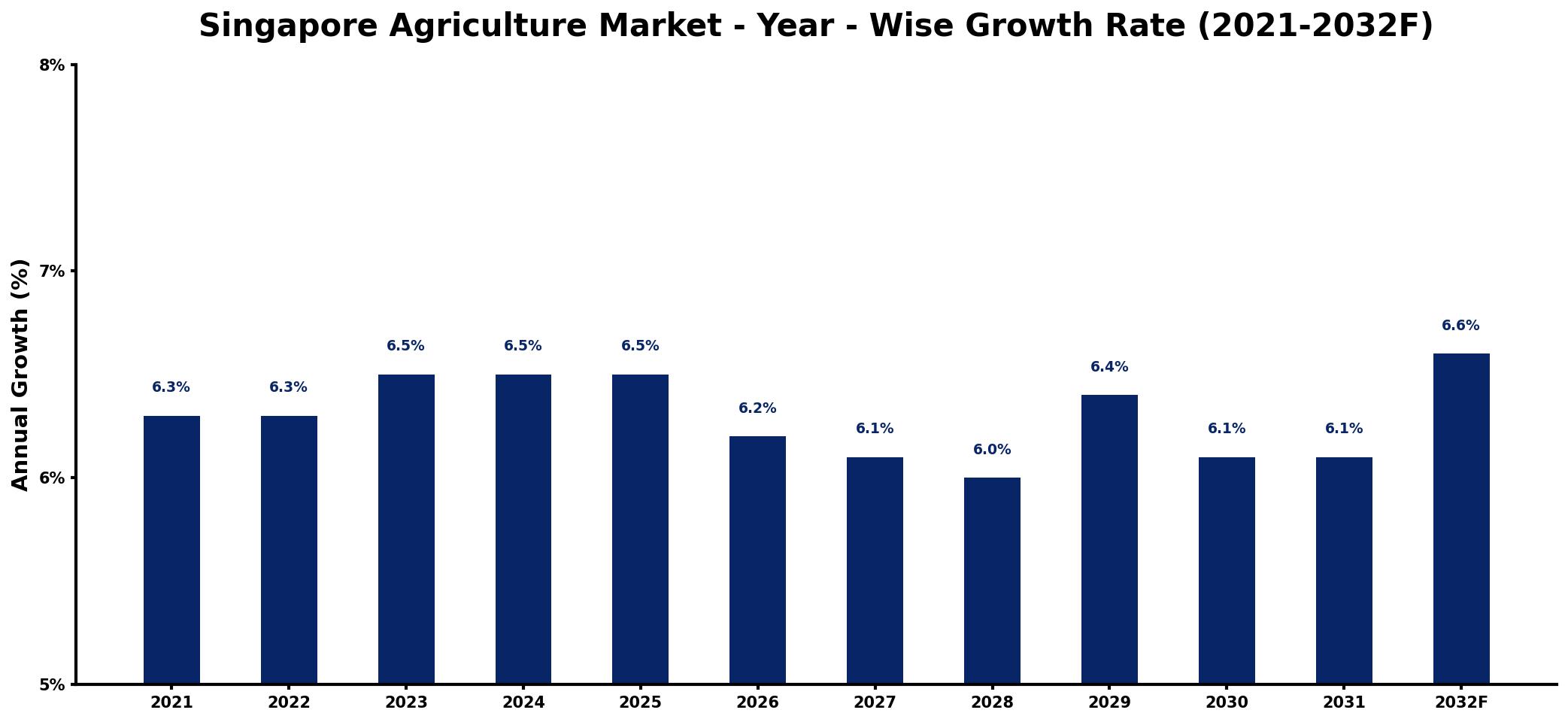
The table below presents the year‑wise growth rates along with the key drivers influencing the market
| Year | Growth Rate | Major Drivers |
| 2021 | 6.3% | Rising consumer health consciousness |
| 2022 | 6.3% | Increased urban farming initiatives |
| 2023 | 6.5% | Technological advancements in farming |
| 2024 | 6.5% | Growing renewable energy investments |
| 2025 | 6.5% | Expansion of local food systems |
| 2026 | 6.2% | Enhanced supply chain efficiencies |
| 2027 | 6.1% | Increase in sustainable practices |
| 2028 | 6.0% | Boost in agricultural research funding |
| 2029 | 6.4% | Adoption of precision farming techniques |
| 2030 | 6.1% | Demand for organic produce rises |
| 2031 | 6.1% | Strengthening local food security |
| 2032 | 6.6% | Integration of smart farming technologies |
Note: Market size estimations and growth projections presented in this report are based on 6Wresearch's proprietary forecasting methodology, utilizing the latest available industry data, government publications, and primary research inputs.
Singapore Agriculture Market Synopsis
The Singapore agriculture market has recently gained momentum, driven by heightened consumer awareness surrounding food security and sustainability. Urban farming initiatives are redefining traditional agricultural practices, enabling local producers to cultivate fresh produce right in the heart of the city.
Looking ahead, the market is poised for growth as government initiatives support local farming. With the demand for organic and sustainably sourced products on the rise, Singapore's agriculture landscape is evolving to meet both urbanization challenges and consumer expectations.
Singapore Agriculture Market Key Takeaways
- The Singapore agriculture market is set for significant growth, with a projected CAGR of 5.4% from 2026 to 2032.
- Urban farming and innovative agricultural technologies are key factors driving market expansion.
- Government initiatives and policies aimed at bolstering local agriculture are crucial for future development.
- Challenges such as land scarcity and competition from imported products will require strategic navigation.
- Consumer preferences are increasingly leaning toward sustainable and locally sourced food options.
Evaluation of Restraints in Singapore Agriculture Market
Despite the positive outlook, the Singapore agriculture market encounters several restraints that may hinder its development. Limited land availability presents a significant challenge, as the city-state's urban landscape leaves little room for traditional farming. Additionally, the intense competition posed by imported agricultural products further complicates the situation. Consequently, local farmers must innovate and implement sustainable practices effectively to meet the growing consumer demand for fresh produce while grappling with these constraints.
Singapore Agriculture Market Trends
Current trends highlight a robust movement towards urban agriculture, where vertical farming, hydroponics, and aquaponics are gaining traction. As these innovative farming techniques prove successful, they are reshaping perceptions of agricultural feasibility in urban settings. Furthermore, sustainability remains at the forefront, with consumers increasingly prioritizing organic and ethically produced food. This shift in consumer preferences is steering agricultural practices toward eco-friendliness, thus driving demand for local produce.
Singapore Agriculture Market Opportunities
The Singapore agriculture market presents a wealth of growth and investment opportunities. Urban farming initiatives are likely to flourish, particularly as local authorities continue to invest in green spaces and community gardens. Additionally, advancements in agricultural technology, such as precision agriculture and data analytics, can enhance yield efficiency and resource management. These innovations not only appeal to eco-conscious consumers but also foster a resilient local food system capable of weathering market fluctuations.
Government Initiatives in the Singapore Agriculture Market
The Singaporean government actively supports the agriculture sector through various initiatives designed to enhance food security and promote sustainable practices. Programs aimed at encouraging urban farming and supporting local growers are becoming more prevalent. Additionally, investments in research and development are being prioritized to foster innovation within the sector. The government's commitment to sustainability is further emphasized through policies that promote environmentally friendly farming practices and local sourcing of agricultural products.
Future Insights of the Singapore Agriculture Market
From 2026 to 2032, the Singapore agriculture market is expected to evolve in response to ongoing urbanization and rising consumer demand for sustainability. As local producers adapt to new technologies and practices, the landscape of agriculture in Singapore will likely shift toward a more integrated model that emphasizes food security, environmental responsibility, and urban resilience. This transformation will not only enhance the local supply chain but also position Singapore as a leader in urban agricultural innovation.
Singapore Agriculture Market Latest Developments (2025 - 2026)
Recent developments within the Singapore agriculture market indicate a robust direction toward enhancing urban farming capabilities. Innovations in vertical farming and hydroponics are increasingly showcased through community initiatives aimed at educating the public about local food sources. Moreover, collaborations between government bodies and local startups are gaining momentum, reflecting a collective effort to streamline the supply chain and bolster local produce availability. These initiatives are creating a thriving ecosystem for agriculture in Singapore, setting the stage for a sustainable future.
Singapore Agriculture Market - Key Attractiveness of the Report
- 10 Years of Market Numbers
- Historical Data Starting from 2022 to 2025
- Base Year: 2025
- Forecast Data until 2032
- Key Performance Indicators Impacting the Market
- Major Upcoming Developments and Projects
Key Highlights of the Report:
- Singapore Agriculture Market Outlook
- Market Size of Singapore Agriculture Market, 2025
- Forecast of Singapore Agriculture Market, 2032
- Historical Data and Forecast of Singapore Agriculture Revenues & Volume for the Period 2022-2032F
- Singapore Agriculture Market Trend Evolution
- Singapore Agriculture Market Drivers and Challenges
- Singapore Agriculture Price Trends
- Singapore Agriculture Porter's Five Forces
- Singapore Agriculture Industry Life Cycle
- Historical Data and Forecast of Singapore Agriculture Market Revenues & Volume By Type for the Period 2022-2032F
- Historical Data and Forecast of Singapore Agriculture Market Revenues & Volume By Animal Produce for the Period 2022-2032F
- Historical Data and Forecast of Singapore Agriculture Market Revenues & Volume By Crop Production for the Period 2022-2032F
- Historical Data and Forecast of Singapore Agriculture Market Revenues & Volume By Distribution Channel for the Period 2022-2032F
- Historical Data and Forecast of Singapore Agriculture Market Revenues & Volume By Supermarkets/Hypermarkets for the Period 2022-2032F
- Historical Data and Forecast of Singapore Agriculture Market Revenues & Volume By Convenience Stores for the Period 2022-2032F
- Historical Data and Forecast of Singapore Agriculture Market Revenues & Volume By E-Commerce for the Period 2022-2032F
- Historical Data and Forecast of Singapore Agriculture Market Revenues & Volume By Others for the Period 2022-2032F
- Historical Data and Forecast of Singapore Agriculture Market Revenues & Volume By Nature for the Period 2022-2032F
- Historical Data and Forecast of Singapore Agriculture Market Revenues & Volume By Organic for the Period 2022-2032F
- Historical Data and Forecast of Singapore Agriculture Market Revenues & Volume By Conventional for the Period 2022-2032F
- Singapore Agriculture Import Export Trade Statistics
- Market Opportunity Assessment By Type
- Market Opportunity Assessment By Distribution Channel
- Market Opportunity Assessment By Nature
- Singapore Agriculture Top Companies Market Share
- Singapore Agriculture Competitive Benchmarking By Technical and Operational Parameters
- Singapore Agriculture Company Profiles
- Singapore Agriculture Key Strategic Recommendations






































