Singapore AI in IoT Market Size & Growth Rate (2026-2032)
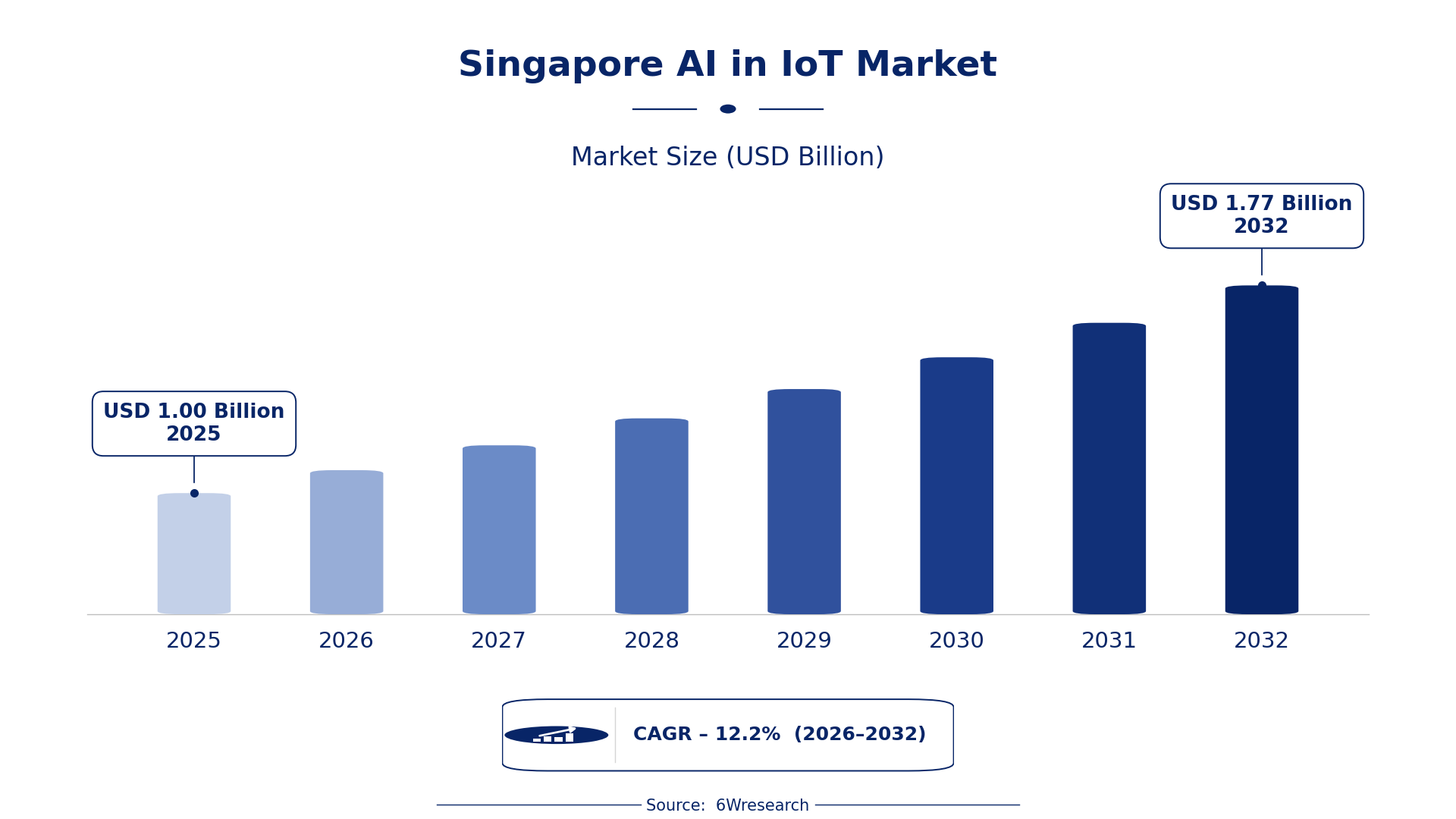
The Singapore AI in IoT Market was estimated at USD 1002 Million in 2025 and is projected to reach USD 1775 Million by 2032, growing at a CAGR of 12.2% from 2026 to 2032.
Singapore AI in IoT Market Synopsis
The Singapore AI in IoT market is currently on a remarkable growth trajectory, driven by increasing investment in smart technologies and the push towards digital transformation. As companies recognize the value of integrating AI into IoT frameworks, they are unlocking new operational efficiencies and innovative applications.
Looking ahead, the market is set to experience accelerated growth as businesses continue to adopt AI-enabled IoT solutions. The focus on sustainability and smart city initiatives will further bolster demand, making Singapore a hotspot for cutting-edge IoT advancements.
Singapore AI in IoT Market Year-wise Growth Rate and Key Drivers
This graph illustrates the annual growth rates of the Singapore AI in IoT Market from 2021 to 2032, highlighting a steady upward trajectory and projected expansion over the forecast period.
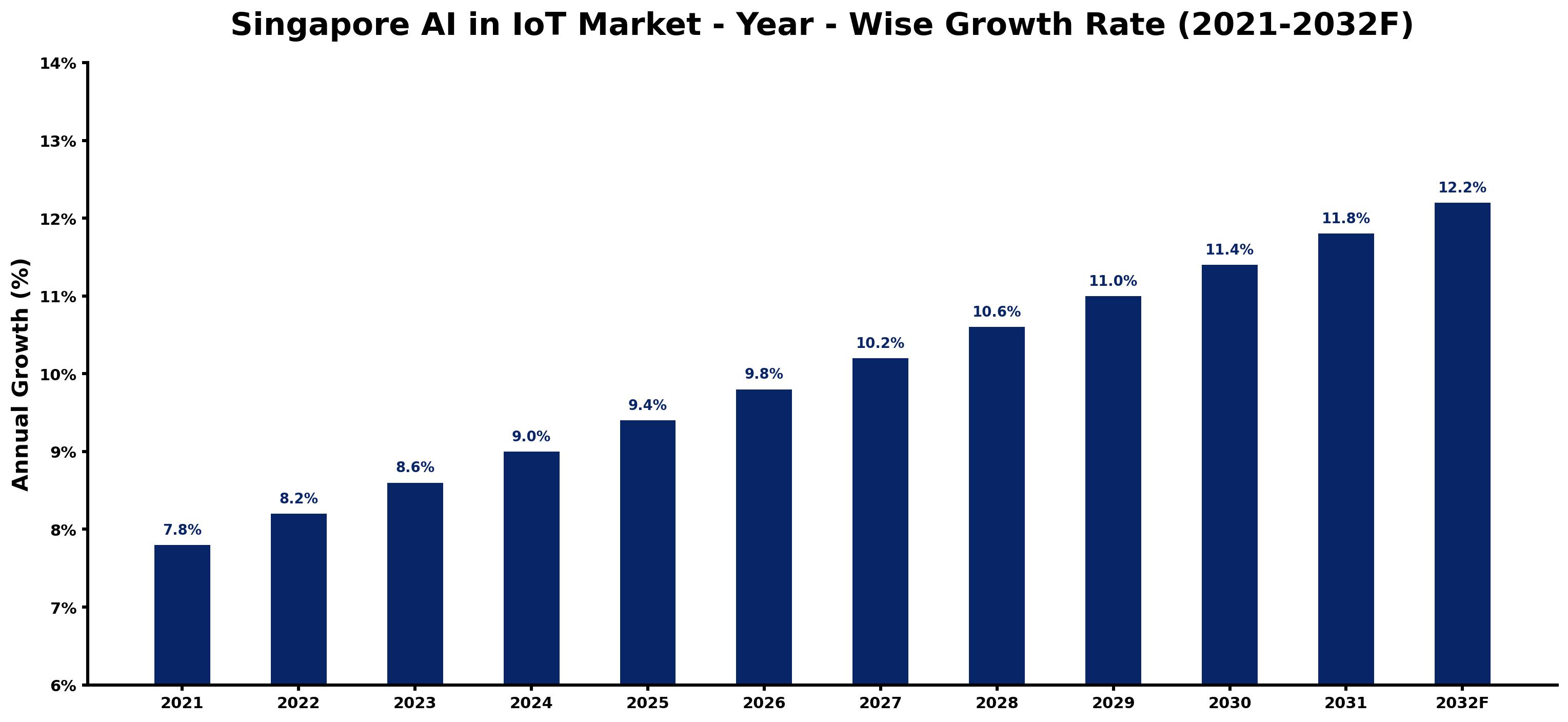
The table below presents the year‑wise growth rates along with the key drivers influencing the market
| Year | Growth Rate | Major Drivers |
| 2021 | 7.8% | Smart Nation initiative boosting IoT adoption in Singapore. |
| 2022 | 8.2% | Rise in AI talent through local educational collaborations. |
| 2023 | 8.6% | Government push for AI ethics frameworks encouraging innovation. |
| 2024 | 9.0% | Strong demand for smart buildings improving energy efficiency. |
| 2025 | 9.4% | Collaboration with tech giants on IoT-AI integration projects. |
| 2026 | 9.8% | Local startups advancing AI solutions tailored for retail sector. |
| 2027 | 10.2% | Adoption of predictive maintenance across urban infrastructure. |
| 2028 | 10.6% | Increase in IoT sensors for urban mobility solutions. |
| 2029 | 11.0% | Growing consumer electronics market driving IoT AI solutions. |
| 2030 | 11.4% | Increased focus on sustainable smart cities driving IoT tech. |
| 2031 | 11.8% | Emergence of AI-driven predictive analytics in logistics sectors. |
| 2032 | 12.2% | Regulatory frameworks supporting IoT security standards implementation. |
Note: Market size estimations and growth projections presented in this report are based on 6Wresearch's proprietary forecasting methodology, utilizing the latest available industry data, government publications, and primary research inputs.
Singapore AI in IoT Market Key Takeaways
Below are some of the specific key takeaways from the market, including:
- AI integration is enhancing data processing capabilities for IoT applications.
- Increased government initiatives are promoting smart city projects across Singapore.
- The demand for predictive maintenance solutions is rising across various sectors.
- Cybersecurity remains a critical concern for IoT implementations using AI.
- Partnerships between tech companies and industries are fueling innovation.
Evaluation of Restraints in Singapore AI in IoT Market
Despite the positive momentum, the Singapore AI in IoT market faces real limitations. The integration of AI with IoT requires overcoming technical challenges related to data management. Organizations often struggle with extracting actionable insights from the vast amounts of data generated by connected devices. Additionally, concerns surrounding data security and privacy create hurdles in deploying AI-driven IoT solutions. The variability in industry-specific requirements complicates the adaptation of AI technologies, thereby hindering broader adoption.
Singapore AI in IoT Market Trends
Several key trends are shaping the Singapore AI in IoT market. The rise of edge computing is facilitating real-time data processing, enabling faster decision-making. on top of that, machine learning algorithms are increasingly being utilized to enhance predictive analytics in IoT applications, driving smarter resource management. Sustainability initiatives are also influencing IoT strategies, with businesses seeking to optimize energy consumption and reduce waste through intelligent automation.
Singapore AI in IoT Market Opportunities
The market presents numerous growth opportunities, particularly in sectors such as healthcare, logistics, and manufacturing. The demand for AI-driven analytics for predictive maintenance is expected to expand, allowing companies to minimize downtime and optimize operations. Additionally, the ongoing development of smart city infrastructure offers a fertile ground for innovative IoT applications, as urban planners increasingly integrate AI for enhanced public services and resource management.
Government Initiatives in the Singapore AI in IoT Market
Government support is crucial in shaping the future of the AI in IoT market in Singapore. The regulatory framework is increasingly focused on fostering innovation while ensuring data privacy and security. Public-sector priorities emphasize the importance of smart technology in driving economic growth and improving urban living standards.
- A national digital infrastructure upgrade programme was recently completed to enhance connectivity across urban areas.
- Current initiatives include a smart mobility framework aimed at integrating AI into transportation systems to improve efficiency.
- A planned public-private partnership is expected to focus on developing AI capabilities in IoT applications by 2027.
- The government is currently working on a regulatory framework to ensure data transparency and security in IoT deployments.
- Ongoing training and skills development programmes are being implemented to support the workforce in adapting to AI technologies.
Future Insights of the Singapore AI in IoT Market
From 2026 to 2032, the Singapore AI in IoT market is set to evolve significantly. As AI technologies mature, expect to see more sophisticated applications that leverage real-time data for critical decision-making. The integration of AI with IoT will likely lead to the emergence of new business models, particularly in sectors that have traditionally lagged in technology adoption. on top of that, as sustainability becomes a core priority, AI-driven IoT solutions will play a vital role in shaping resource-efficient practices and enhancing urban living standards.
Singapore AI in IoT Market Latest Developments
Recent activities in the Singapore AI in IoT market indicate a surge in innovation and collaboration among key stakeholders. Companies are actively pursuing advanced AI solutions to enhance their IoT offerings, reflecting a strong commitment to staying competitive in a rapidly changing environment.
- A major technology vendor launched a new AI-based analytics platform in early 2025, designed to improve IoT data insights for businesses.
- An initiative that began in mid-2025 aims to integrate AI capabilities into public healthcare systems to enhance patient monitoring.
- A comprehensive service upgrade is expected to roll out in the second half of 2026, focusing on enhancing AI-driven automation in logistics.
- A partnership was formed in Q1 2025 between regional operators to develop AI-enabled smart city applications, currently underway.
- Plans are in place for a pilot project in early 2027 to test AI applications in environmental monitoring and sustainability efforts.
Singapore AI in IoT Market - Key Attractiveness of the Report
- 10 Years of Market Numbers
- Historical Data Starting from 2022 to 2025
- Base Year: 2025
- Forecast Data until 2032
- Key Performance Indicators Impacting the Market
- Major Upcoming Developments and Projects
Key Highlights of the Report:
- Singapore AI in IoT Market Outlook
- Market Size of Singapore AI in IoT Market, 2025
- Forecast of Singapore AI in IoT Market, 2032
- Historical Data and Forecast of Singapore AI in IoT Revenues & Volume for the Period 2022-2032F
- Singapore AI in IoT Market Trend Evolution
- Singapore AI in IoT Market Drivers and Challenges
- Singapore AI in IoT Price Trends
- Singapore AI in IoT Porter's Five Forces
- Singapore AI in IoT Industry Life Cycle
- Historical Data and Forecast of Singapore AI in IoT Market Revenues & Volume By Component for the Period 2022-2032F
- Historical Data and Forecast of Singapore AI in IoT Market Revenues & Volume By Platforms for the Period 2022-2032F
- Historical Data and Forecast of Singapore AI in IoT Market Revenues & Volume By Software Solutions for the Period 2022-2032F
- Historical Data and Forecast of Singapore AI in IoT Market Revenues & Volume By Services for the Period 2022-2032F
- Historical Data and Forecast of Singapore AI in IoT Market Revenues & Volume By Vertical for the Period 2022-2032F
- Historical Data and Forecast of Singapore AI in IoT Market Revenues & Volume By Manufacturing for the Period 2022-2032F
- Historical Data and Forecast of Singapore AI in IoT Market Revenues & Volume By Energy and Utilities for the Period 2022-2032F
- Historical Data and Forecast of Singapore AI in IoT Market Revenues & Volume By Transportation and Mobility for the Period 2022-2032F
- Historical Data and Forecast of Singapore AI in IoT Market Revenues & Volume By BFSI for the Period 2022-2032F
- Historical Data and Forecast of Singapore AI in IoT Market Revenues & Volume By Government and Defense for the Period 2022-2032F
- Historical Data and Forecast of Singapore AI in IoT Market Revenues & Volume By Retail for the Period 2022-2032F
- Historical Data and Forecast of Singapore AI in IoT Market Revenues & Volume By Healthcare and Life Sciences for the Period 2022-2032F
- Historical Data and Forecast of Singapore AI in IoT Market Revenues & Volume By Telecom for the Period 2022-2032F
- Historical Data and Forecast of Singapore AI in IoT Market Revenues & Volume By Technology for the Period 2022-2032F
- Historical Data and Forecast of Singapore AI in IoT Market Revenues & Volume By ML and Deep Learning for the Period 2022-2032F
- Historical Data and Forecast of Singapore AI in IoT Market Revenues & Volume By NLP for the Period 2022-2032F
- Singapore AI in IoT Import Export Trade Statistics
- Market Opportunity Assessment By Component
- Market Opportunity Assessment By Vertical
- Market Opportunity Assessment By Technology
- Singapore AI in IoT Top Companies Market Share
- Singapore AI in IoT Competitive Benchmarking By Technical and Operational Parameters
- Singapore AI in IoT Company Profiles
- Singapore AI in IoT Key Strategic Recommendations






































