Singapore Air Traffic Control (ATC) Equipment Market Size, Share & Growth Rate
The Singapore Air Traffic Control (ATC) Equipment Market was estimated at USD 490 Million in 2025 and is projected to reach USD 872 Million by 2032, growing at a CAGR of 8.6% from 2026 to 2032. This growth trajectory is primarily driven by the increasing volume of air traffic and the pressing need for sophisticated airspace management solutions. As Singapore continues to position itself as a leading aviation hub, the demand for innovative ATC systems becomes imperative to maintain safety and efficiency in its airspace.
Singapore Air Traffic Control (ATC) Equipment Market Year-wise Growth Rate and Key Drivers
This graph highlights how the Singapore Air Traffic Control (ATC) Equipment Market has steadily grown over the years, supported by major growth factors.
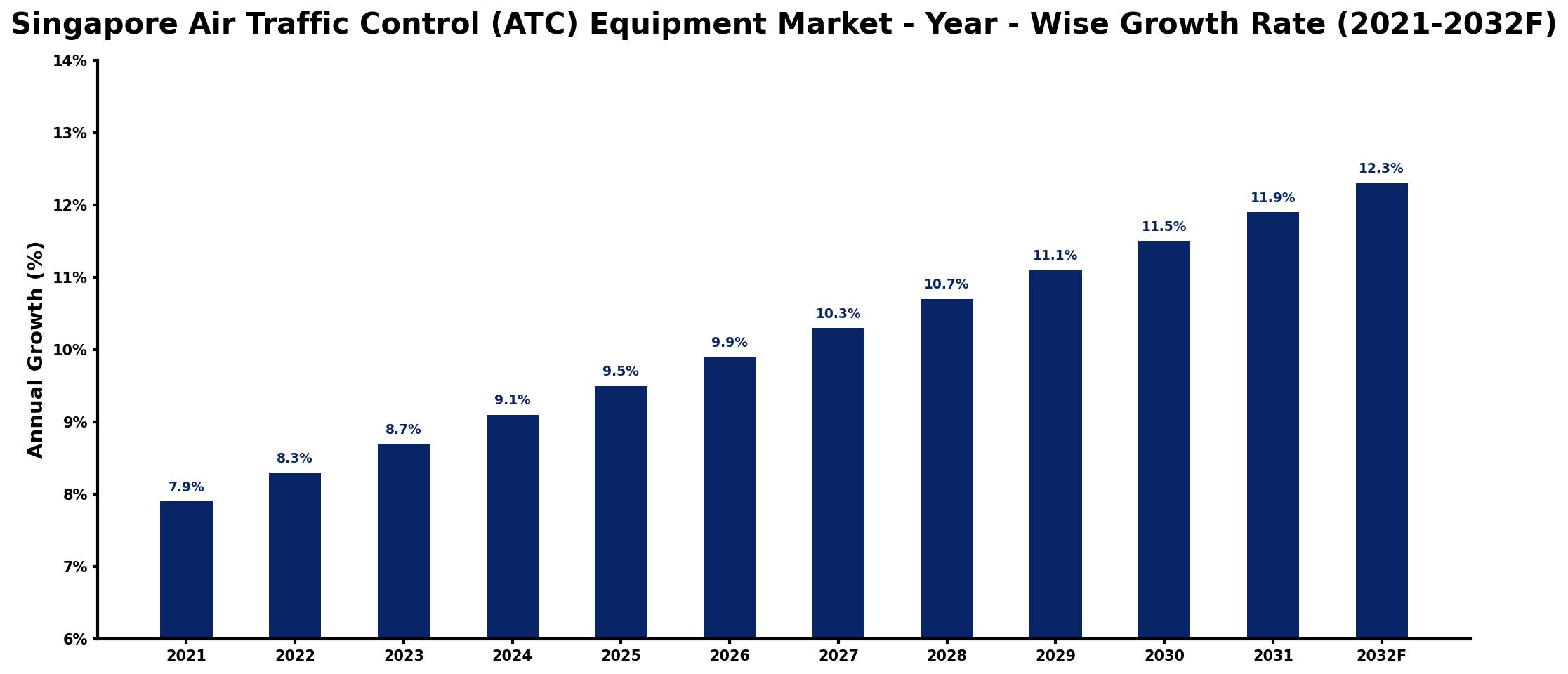
The table below presents the year‑wise growth rates along with the key drivers influencing the market
| Year | Growth Rate | Major Drivers |
| 2021 | 7.9% | Rising passenger travel demand |
| 2022 | 8.3% | Government infrastructure investment increase |
| 2023 | 8.7% | Technological advancements in navigation |
| 2024 | 9.1% | growing emerging market penetration |
| 2025 | 9.5% | Increased safety regulation compliance |
| 2026 | 9.9% | improved raw material availability |
| 2027 | 10.3% | Surge in cargo transport needs |
| 2028 | 10.7% | Investment in smart technologies |
| 2029 | 11.1% | Development of urban mobility solutions |
| 2030 | 11.5% | Enhanced international collaboration efforts |
| 2031 | 11.9% | Emergence of sustainable practices |
| 2032 | 12.3% | Focus on digital transformation initiatives |
Note: Market size estimations and growth projections presented in this report are based on 6Wresearch's proprietary forecasting methodology, utilizing the latest available industry data, government publications, and primary research inputs.
Singapore Air Traffic Control (ATC) Equipment Market Synopsis
The Singapore ATC equipment market is witnessing a pivotal transformation as advancements in radar systems and communication technologies take center stage. With a dense air traffic landscape, the market plays a crucial role in ensuring the safety and efficiency of flights navigating the region's airways.
Investments in air traffic control technology are increasingly seen as essential in meeting stringent safety requirements. The integration of state-of-the-art systems not only enhances air traffic management but also supports Singapores ambitions to lead in aviation innovation.
Singapore Air Traffic Control (ATC) Equipment Market Key Takeaways
- The market is projected to experience robust growth due to increasing air traffic and advanced technology integration.
- Investment in new radar systems and communication solutions is pivotal for enhancing aviation safety.
- Singapores strategic position in the global aviation sector drives demand for cutting-edge ATC equipment.
- Regulatory frameworks will shape market dynamics, influencing equipment development and deployment.
- The post-COVID recovery in air travel is expected to significantly boost market growth.
Evaluation of Restraints in Singapore Air Traffic Control (ATC) Equipment Market
While the Singapore ATC equipment market is poised for growth, several restraints could impact its trajectory. The challenge of outdated aviation infrastructure necessitates significant investments to meet modern standards. Additionally, stringent safety regulations can complicate the introduction of new technologies, resulting in slower adoption rates. Moreover, competition from global ATC equipment providers may pressure local manufacturers to innovate continuously or risk losing market share. Ensuring compliance with these regulations while delivering advanced solutions is vital for sustained growth in this sector.
Singapore Air Traffic Control (ATC) Equipment Market Trends
Current trends indicate a strong shift toward automated systems and artificial intelligence integration within ATC operations. These technologies promise to streamline air traffic management, reducing human error and improving response times. Furthermore, the emphasis on sustainability is driving developments in eco-friendly ATC solutions, reflecting broader industry goals of reducing carbon emissions in aviation. Such advancements not only enhance operational efficiency but also align with global sustainability targets.
Singapore Air Traffic Control (ATC) Equipment Market Opportunities
The market presents significant growth opportunities, particularly in the development of next-generation radar technologies and enhanced communication platforms. As air traffic volumes rise, there is a compelling need for systems that can efficiently manage complex airspace scenarios. Additionally, investment in digital solutions offers promising avenues for cost savings and improved operational efficiency. The ongoing recovery from the COVID-19 pandemic positions the market favorably for increased spending on infrastructure and technology enhancements.
Government Initiatives in the Singapore Air Traffic Control (ATC) Equipment Market
The Singapore government actively supports the air traffic control sector through various policies and initiatives aimed at enhancing aviation infrastructure. Investment in public projects focused on upgrading existing ATC systems is a priority, along with funding for research and development in new technologies. Collaborative efforts with international aviation bodies also help Singapore remain at the forefront of regulatory advancements and innovation, further strengthening its aviation safety and efficiency standards.
Future Insights of the Singapore Air Traffic Control (ATC) Equipment Market
Looking forward to the period between 2026 and 2032, the Singapore ATC equipment market is set to evolve significantly. The integration of advanced technologies, such as machine learning and IoT, will likely reshape operational paradigms, enhancing the safety and efficiency of air traffic management. Additionally, as Singapore strengthens its position as a regional aviation hub, demand for modern ATC solutions will continue to rise, driven by both domestic and international air traffic growth. The emphasis on safety and efficiency will be paramount as the sector adapts to changing global dynamics.
Singapore Air Traffic Control (ATC) Equipment Market Latest Developments (2025 - 2026)
Recent developments in the Singapore ATC equipment market highlight a focus on modernization efforts. Stakeholders are investing in upgrading radar systems and communication infrastructure to enhance the overall efficiency of air traffic management. New partnerships are emerging, aimed at leveraging innovative technologies that support real-time data sharing and improved situational awareness for air traffic controllers. This strategic direction reflects the industry's commitment to meet the evolving demands of air travel in a post-pandemic landscape.
Singapore Air Traffic Control (ATC) Equipment Market - Key Attractiveness of the Report
- 10 Years of Market Numbers
- Historical Data Starting from 2022 to 2025
- Base Year: 2025
- Forecast Data until 2032
- Key Performance Indicators Impacting the Market
- Major Upcoming Developments and Projects
Key Highlights of the Report:
- Singapore Air Traffic Control (ATC) Equipment Market Outlook
- Market Size of Singapore Air Traffic Control (ATC) Equipment Market, 2025
- Forecast of Singapore Air Traffic Control (ATC) Equipment Market, 2032
- Historical Data and Forecast of Singapore Air Traffic Control (ATC) Equipment Revenues & Volume for the Period 2022-2032F
- Singapore Air Traffic Control (ATC) Equipment Market Trend Evolution
- Singapore Air Traffic Control (ATC) Equipment Market Drivers and Challenges
- Singapore Air Traffic Control (ATC) Equipment Price Trends
- Singapore Air Traffic Control (ATC) Equipment Porter's Five Forces
- Singapore Air Traffic Control (ATC) Equipment Industry Life Cycle
- Historical Data and Forecast of Singapore Air Traffic Control (ATC) Equipment Market Revenues & Volume By Product for the Period 2022-2032F
- Historical Data and Forecast of Singapore Air Traffic Control (ATC) Equipment Market Revenues & Volume By Communications Equipment for the Period 2022-2032F
- Historical Data and Forecast of Singapore Air Traffic Control (ATC) Equipment Market Revenues & Volume By Navigation Equipment for the Period 2022-2032F
- Historical Data and Forecast of Singapore Air Traffic Control (ATC) Equipment Market Revenues & Volume By Surveillance Equipment for the Period 2022-2032F
- Historical Data and Forecast of Singapore Air Traffic Control (ATC) Equipment Market Revenues & Volume By Air Traffic Control Equipment Application Outlook (USD Million, 2023-2032) for the Period 2022-2032F
- Historical Data and Forecast of Singapore Air Traffic Control (ATC) Equipment Market Revenues & Volume By Commercial Aircraft for the Period 2022-2032F
- Historical Data and Forecast of Singapore Air Traffic Control (ATC) Equipment Market Revenues & Volume By Private Aircraft for the Period 2022-2032F
- Historical Data and Forecast of Singapore Air Traffic Control (ATC) Equipment Market Revenues & Volume By Military Aircraft for the Period 2022-2032F
- Singapore Air Traffic Control (ATC) Equipment Import Export Trade Statistics
- Market Opportunity Assessment By Product
- Singapore Air Traffic Control (ATC) Equipment Top Companies Market Share
- Singapore Air Traffic Control (ATC) Equipment Competitive Benchmarking By Technical and Operational Parameters
- Singapore Air Traffic Control (ATC) Equipment Company Profiles
- Singapore Air Traffic Control (ATC) Equipment Key Strategic Recommendations






































