Singapore Aircraft Cabin Interior Market Size, Share & Growth Rate
The Singapore Aircraft Cabin Interior Market was estimated at USD 559 Million in 2025 and is projected to reach USD 958 Million by 2032, growing at a CAGR of 8.0% from 2026 to 2032. This robust growth trajectory is driven by an increasing emphasis on passenger comfort and the need for airlines to distinguish themselves through innovative cabin designs. The aviation sector's recovery and the rising preference for sustainable and smart cabin solutions further solidify the market's optimistic outlook.
Singapore Aircraft Cabin Interior Market Year-wise Growth Rate and Key Drivers
This graph highlights how the Singapore Aircraft Cabin Interior Market has steadily grown over the years, supported by major growth factors.
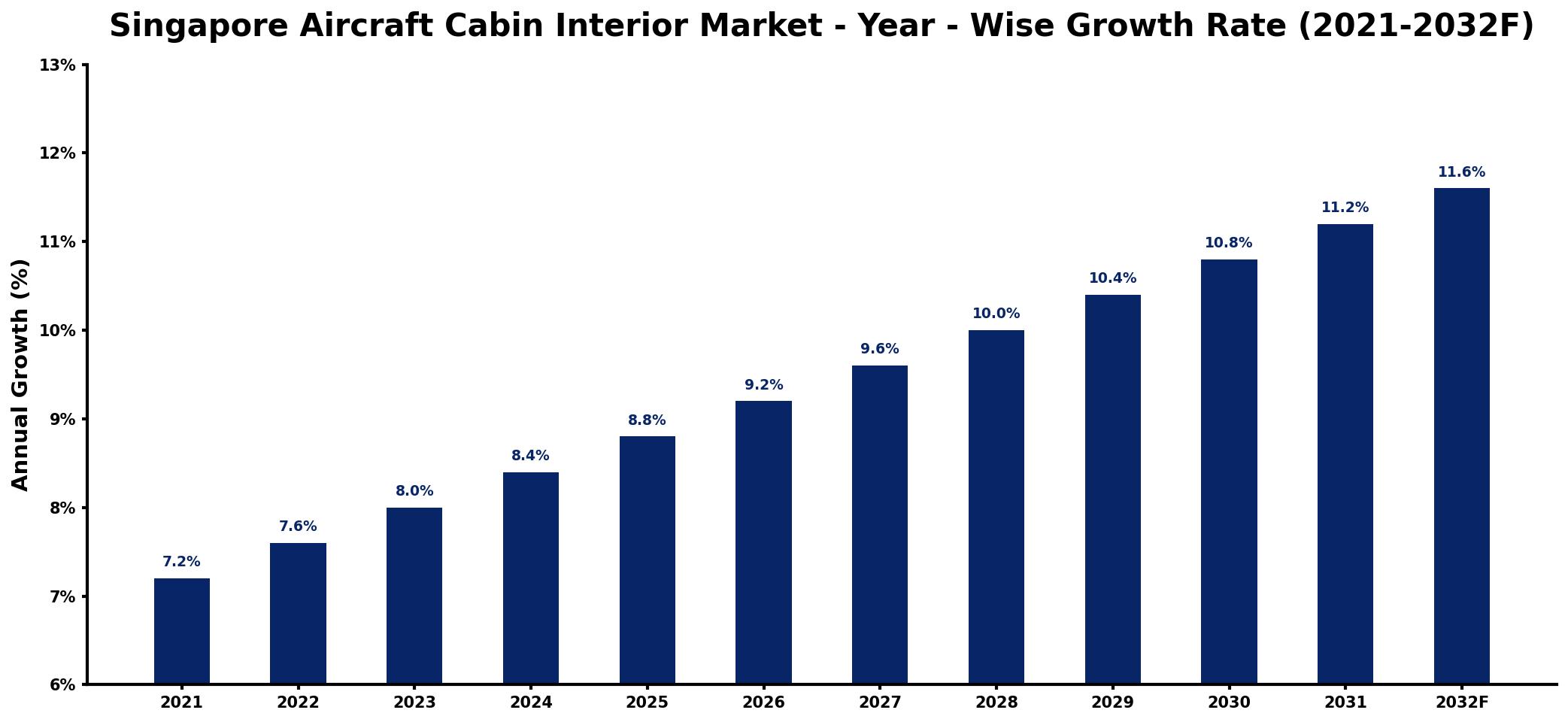
The table below presents the year‑wise growth rates along with the key drivers influencing the market
| Year | Growth Rate | Major Drivers |
| 2021 | 7.2% | Rising passenger travel demand |
| 2022 | 7.6% | Increased airline fleet modernization |
| 2023 | 8.0% | Growth in luxury travel segment |
| 2024 | 8.4% | Technological advancements in design |
| 2025 | 8.8% | Sustainability initiatives gaining traction |
| 2026 | 9.2% | Expansion of regional airlines market |
| 2027 | 9.6% | Emergence of new travel routes |
| 2028 | 10.0% | Investment in airport infrastructure |
| 2029 | 10.4% | Focus on passenger comfort enhancements |
| 2030 | 10.8% | rising procurement volume requirements |
| 2031 | 11.2% | Increase in airline profitability rates |
| 2032 | 11.6% | Rising demand for customization options |
Note: Market size estimations and growth projections presented in this report are based on 6Wresearch's proprietary forecasting methodology, utilizing the latest available industry data, government publications, and primary research inputs.
Singapore Aircraft Cabin Interior Market Synopsis
The Singapore aircraft cabin interior market is currently witnessing a transformative phase, characterized by a strong push towards enhancing the passenger experience. Airlines are increasingly investing in modern, aesthetically pleasing interiors that not only elevate comfort but also create memorable in-flight experiences.
Local manufacturers are at the forefront of this evolution, producing high-quality cabin elements like seating, lighting, and in-flight entertainment systems. The integration of advanced technologies and sustainable materials aligns with global trends, positioning Singapore as a key player in the regions aviation landscape.
Singapore Aircraft Cabin Interior Market Key Takeaways
- Strong growth anticipated due to rising demand for passenger-focused cabin designs.
- Increased focus on sustainable materials and smart technologies in cabin interiors.
- Singapore's strategic location bolsters its role as a regional aviation hub.
- Retrofitting existing aircraft remains a significant trend amidst market challenges.
- Health and safety features are gaining prominence in cabin design considerations.
Evaluation of Restraints in Singapore Aircraft Cabin Interior Market
Despite the favorable market dynamics, several factors pose constraints to growth. The impact of the COVID-19 pandemic significantly curtailed air travel, resulting in airlines prioritizing cost-cutting measures. This shift caused many to defer new cabin interior installations in favor of retrofitting existing aircraft to meet current safety standards. Additionally, the ongoing challenge lies in sourcing lightweight materials that meet both durability and design expectations, hampering innovation in the sector.
Singapore Aircraft Cabin Interior Market Trends
Current trends in the Singapore aircraft cabin interior market emphasize the importance of passenger well-being. The adoption of smart technologies, such as improved connectivity and personalized in-flight entertainment, is reshaping how airlines interact with travelers. Simultaneously, the incorporation of sustainable materials is becoming crucial, as airlines strive to meet environmental standards and cater to eco-conscious passengers. Ergonomic designs that enhance comfort are also gaining traction, underscoring the sector's commitment to improving the overall travel experience.
Singapore Aircraft Cabin Interior Market Opportunities
There exists significant potential for growth within the Singapore aircraft cabin interior market, particularly in the realms of technological innovation and sustainable practices. Companies that invest in developing lightweight, durable materials will find new avenues for expansion. Additionally, as airlines continue to seek differentiation, opportunities abound for manufacturers to create customized solutions that reflect the unique brand identities of various carriers. The ongoing evolution of in-flight services also opens doors for firms willing to adapt and innovate in response to changing passenger expectations.
Government Initiatives in the Singapore Aircraft Cabin Interior Market
The Singaporean government is actively promoting the aviation sector through various initiatives, aimed at enhancing the countrys status as a premier aviation hub. Supportive policies for research and development in aviation technology, as well as investments in infrastructure, bolster the growth potential of the aircraft cabin interior market. Incentives focused on sustainability and innovation in manufacturing practices further encourage local businesses to explore advanced solutions that align with global trends.
Future Insights of the Singapore Aircraft Cabin Interior Market
Looking ahead to 2026-2032, the Singapore aircraft cabin interior market is poised for significant evolution. With a continued recovery in air travel anticipated, the demand for both new interiors and retrofitting projects will grow. The focus on passenger experience, combined with technological advancements in materials and designs, will drive innovations. Sustainability will remain at the forefront, shaping how products are developed and marketed, ensuring that the market remains competitive and aligned with global expectations.
Singapore Aircraft Cabin Interior Market Latest Developments (2025 - 2026)
Recent developments in the Singapore aircraft cabin interior market indicate a shift toward prioritizing health and safety features within cabin designs. Companies are increasingly incorporating antimicrobial materials and enhancing ventilation systems as part of the cabin environment. Additionally, there is a noticeable trend of airlines revisiting their interior strategies to incorporate elements that cater to evolving passenger preferences, reflecting a growing emphasis on comfort and connectivity.
Singapore Aircraft Cabin Interior Market - Key Attractiveness of the Report
- 10 Years of Market Numbers
- Historical Data Starting from 2022 to 2025
- Base Year: 2025
- Forecast Data until 2032
- Key Performance Indicators Impacting the Market
- Major Upcoming Developments and Projects
Key Highlights of the Report:
- Singapore Aircraft Cabin Interior Market Outlook
- Market Size of Singapore Aircraft Cabin Interior Market, 2025
- Forecast of Singapore Aircraft Cabin Interior Market, 2032
- Historical Data and Forecast of Singapore Aircraft Cabin Interior Revenues & Volume for the Period 2022-2032F
- Singapore Aircraft Cabin Interior Market Trend Evolution
- Singapore Aircraft Cabin Interior Market Drivers and Challenges
- Singapore Aircraft Cabin Interior Price Trends
- Singapore Aircraft Cabin Interior Porter's Five Forces
- Singapore Aircraft Cabin Interior Industry Life Cycle
- Historical Data and Forecast of Singapore Aircraft Cabin Interior Market Revenues & Volume By Type for the Period 2022-2032F
- Historical Data and Forecast of Singapore Aircraft Cabin Interior Market Revenues & Volume By Seats for the Period 2022-2032F
- Historical Data and Forecast of Singapore Aircraft Cabin Interior Market Revenues & Volume By Cabin Lightening for the Period 2022-2032F
- Historical Data and Forecast of Singapore Aircraft Cabin Interior Market Revenues & Volume By Windows and Windshields for the Period 2022-2032F
- Historical Data and Forecast of Singapore Aircraft Cabin Interior Market Revenues & Volume By Galley and Lavatory for the Period 2022-2032F
- Historical Data and Forecast of Singapore Aircraft Cabin Interior Market Revenues & Volume By In-Flight Entertainment & Connectivity for the Period 2022-2032F
- Historical Data and Forecast of Singapore Aircraft Cabin Interior Market Revenues & Volume By Others for the Period 2022-2032F
- Historical Data and Forecast of Singapore Aircraft Cabin Interior Market Revenues & Volume By Class for the Period 2022-2032F
- Historical Data and Forecast of Singapore Aircraft Cabin Interior Market Revenues & Volume By First Class for the Period 2022-2032F
- Historical Data and Forecast of Singapore Aircraft Cabin Interior Market Revenues & Volume By Business Class for the Period 2022-2032F
- Historical Data and Forecast of Singapore Aircraft Cabin Interior Market Revenues & Volume By Premium Economy Class for the Period 2022-2032F
- Historical Data and Forecast of Singapore Aircraft Cabin Interior Market Revenues & Volume By Economy Class for the Period 2022-2032F
- Historical Data and Forecast of Singapore Aircraft Cabin Interior Market Revenues & Volume By Aircraft Type for the Period 2022-2032F
- Historical Data and Forecast of Singapore Aircraft Cabin Interior Market Revenues & Volume By Narrow Body Aircraft for the Period 2022-2032F
- Historical Data and Forecast of Singapore Aircraft Cabin Interior Market Revenues & Volume By Wide-Body Aircraft for the Period 2022-2032F
- Historical Data and Forecast of Singapore Aircraft Cabin Interior Market Revenues & Volume By Business Jets for the Period 2022-2032F
- Historical Data and Forecast of Singapore Aircraft Cabin Interior Market Revenues & Volume By Regional Transport Aircraft for the Period 2022-2032F
- Historical Data and Forecast of Singapore Aircraft Cabin Interior Market Revenues & Volume By End User for the Period 2022-2032F
- Historical Data and Forecast of Singapore Aircraft Cabin Interior Market Revenues & Volume By OEM for the Period 2022-2032F
- Historical Data and Forecast of Singapore Aircraft Cabin Interior Market Revenues & Volume By Aftermarket for the Period 2022-2032F
- Singapore Aircraft Cabin Interior Import Export Trade Statistics
- Market Opportunity Assessment By Type
- Market Opportunity Assessment By Class
- Market Opportunity Assessment By Aircraft Type
- Market Opportunity Assessment By End User
- Singapore Aircraft Cabin Interior Top Companies Market Share
- Singapore Aircraft Cabin Interior Competitive Benchmarking By Technical and Operational Parameters
- Singapore Aircraft Cabin Interior Company Profiles
- Singapore Aircraft Cabin Interior Key Strategic Recommendations






































