Singapore Aircraft Seat Upholstery Market Size, Share & Growth Rate
The Singapore Aircraft Seat Upholstery Market was estimated at USD 1306 Million in 2025 and is projected to reach USD 2339 Million by 2032, growing at a CAGR of 8.7% from 2026 to 2032. This growth trajectory is underpinned by a robust expansion in the aviation industry, which increasingly prioritizes passenger comfort and cabin aesthetics. The rising demand for lightweight, durable materials that meet stringent safety standards further fuels the need for high-quality upholstery solutions.
Singapore Aircraft Seat Upholstery Market Year-wise Growth Rate and Key Drivers
This graph highlights how the Singapore Aircraft Seat Upholstery Market has steadily grown over the years, supported by major growth factors.
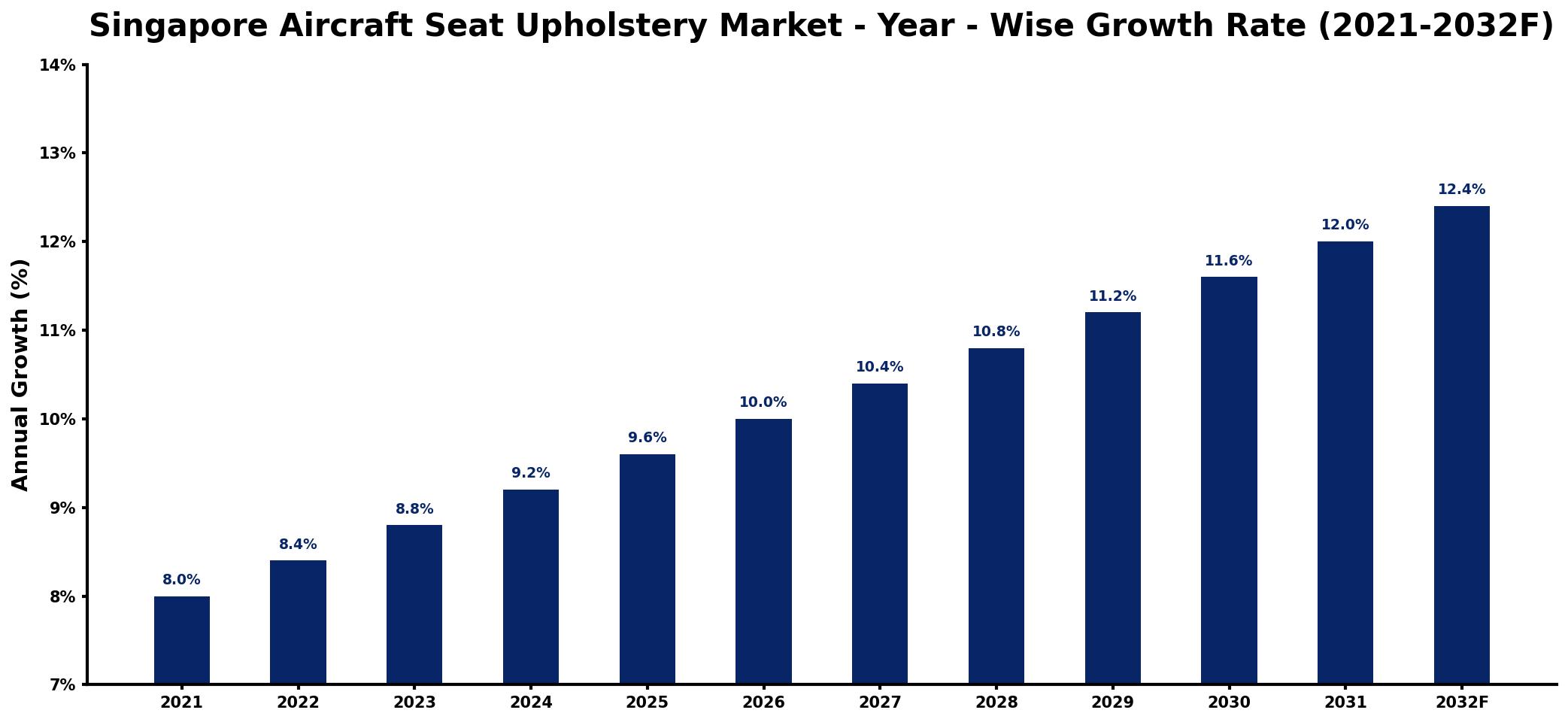
The table below presents the year‑wise growth rates along with the key drivers influencing the market
| Year | Growth Rate | Major Drivers |
| 2021 | 8.0% | Rising travel demand post pandemic |
| 2022 | 8.4% | Increased investments in aviation infrastructure |
| 2023 | 8.8% | Growing focus on passenger comfort |
| 2024 | 9.2% | Expansion of regional airline networks |
| 2025 | 9.6% | Innovations in sustainable materials |
| 2026 | 10.0% | Strengthening of aviation regulations |
| 2027 | 10.4% | Surge in premium cabin offerings |
| 2028 | 10.8% | Growth in international tourism markets |
| 2029 | 11.2% | Emerging technologies in design |
| 2030 | 11.6% | Increased collaborations with designers |
| 2031 | 12.0% | Demand for custom solutions rises |
| 2032 | 12.4% | growing commercial sector adoption |
Note: Market size estimations and growth projections presented in this report are based on 6Wresearch's proprietary forecasting methodology, utilizing the latest available industry data, government publications, and primary research inputs.
Singapore Aircraft Seat Upholstery Market Synopsis
Recent momentum in the Singapore Aircraft Seat Upholstery Market has been shaped by a renewed focus on passenger experience, particularly as air travel recovers post-pandemic. Airlines are investing in advanced materials that not only enhance comfort but also incorporate safety features such as fire-resistance and antimicrobial properties.
Looking ahead, the market is poised for significant growth driven by technological innovations in upholstery design. As airlines seek to differentiate their offerings, the integration of visually appealing and functional materials will likely play a pivotal role in reshaping the aviation interior landscape.
Singapore Aircraft Seat Upholstery Market Key Takeaways
- The market is set to experience substantial growth, with an anticipated CAGR of 8.7% from 2026 to 2032.
- Passenger comfort and safety are primary drivers behind demand for advanced upholstery materials.
- Stringent aviation regulations necessitate a focus on fire-resistance and durability in seat upholstery.
- Post-COVID recovery has prompted airlines to optimize their cabin interiors with cost-effective and resilient upholstery solutions.
- Technological advancements are leading to innovative upholstery designs that enhance both comfort and aesthetics.
Evaluation of Restraints in Singapore Aircraft Seat Upholstery Market
Despite its promising growth, the Singapore Aircraft Seat Upholstery Market is not without challenges. Stringent aviation regulations regarding material safety can delay product development and increase costs for manufacturers. Furthermore, the necessity of selecting materials that are not only aesthetically pleasing but also able to withstand the rigors of aviation use adds another layer of complexity. The need to balance cost-effectiveness with quality can deter some manufacturers from innovating, potentially stalling the market's forward momentum.
Singapore Aircraft Seat Upholstery Market Trends
Several key trends are shaping the Singapore Aircraft Seat Upholstery Market. One prominent trend is the increasing adoption of eco-friendly materials, reflecting a growing emphasis on sustainability in aviation. Additionally, there is a notable shift towards customizable upholstery solutions, allowing airlines to create unique seating experiences. Innovations in fabric technology, such as the development of lightweight yet durable materials, are also becoming more prevalent, enhancing overall passenger comfort.
Singapore Aircraft Seat Upholstery Market Opportunities
Genuine growth opportunities lie in the expanding mid-to-low-cost carrier segment, where airlines are eager to enhance cabin aesthetics without compromising on safety. Furthermore, as technology advances, manufacturers have the potential to explore new materials that address both durability and eco-friendliness. Collaborations with design firms and textile innovators can lead to groundbreaking upholstery solutions, capturing a broader market share.
Government Initiatives in the Singapore Aircraft Seat Upholstery Market
The Singapore government has been proactive in supporting the aviation sector through various initiatives aimed at enhancing operational efficiency and safety. Investments in infrastructure upgrades and incentives for research and development in sustainable materials are particularly relevant to the aircraft upholstery market. Public spending directed towards improving the passenger experience in airports and airlines further creates a conducive environment for growth in this sector.
Future Insights of the Singapore Aircraft Seat Upholstery Market
As we move towards 2032, the Singapore Aircraft Seat Upholstery Market is likely to undergo a transformation characterized by increased integration of technology in upholstery design. The focus will remain on passenger comfort, with a growing expectation for airlines to offer not just seating, but a unique travel experience. Innovations in material science, such as the use of smart fabrics that can adapt to environmental conditions, will be key to staying competitive in this evolving market.
Singapore Aircraft Seat Upholstery Market Latest Developments (2025 - 2026)
Recent developments in the Singapore Aircraft Seat Upholstery Market indicate a strong push towards innovative upholstery solutions that incorporate both functionality and style. Manufacturers are increasingly focusing on research and development to create materials that meet the latest safety regulations while providing enhanced comfort. Additionally, there has been a notable shift towards partnerships with airlines to co-develop bespoke upholstery solutions tailored to specific branding requirements.
Singapore Aircraft Seat Upholstery Market - Key Attractiveness of the Report
- 10 Years of Market Numbers
- Historical Data Starting from 2022 to 2025
- Base Year: 2025
- Forecast Data until 2032
- Key Performance Indicators Impacting the Market
- Major Upcoming Developments and Projects
Key Highlights of the Report:
- Singapore Aircraft Seat Upholstery Market Outlook
- Market Size of Singapore Aircraft Seat Upholstery Market, 2025
- Forecast of Singapore Aircraft Seat Upholstery Market, 2032
- Historical Data and Forecast of Singapore Aircraft Seat Upholstery Revenues & Volume for the Period 2022-2032F
- Singapore Aircraft Seat Upholstery Market Trend Evolution
- Singapore Aircraft Seat Upholstery Market Drivers and Challenges
- Singapore Aircraft Seat Upholstery Price Trends
- Singapore Aircraft Seat Upholstery Porter's Five Forces
- Singapore Aircraft Seat Upholstery Industry Life Cycle
- Historical Data and Forecast of Singapore Aircraft Seat Upholstery Market Revenues & Volume By Material Type for the Period 2022-2032F
- Historical Data and Forecast of Singapore Aircraft Seat Upholstery Market Revenues & Volume By Fabric for the Period 2022-2032F
- Historical Data and Forecast of Singapore Aircraft Seat Upholstery Market Revenues & Volume By Leather for the Period 2022-2032F
- Historical Data and Forecast of Singapore Aircraft Seat Upholstery Market Revenues & Volume By Vinyl for the Period 2022-2032F
- Historical Data and Forecast of Singapore Aircraft Seat Upholstery Market Revenues & Volume By Seat Cover Type for the Period 2022-2032F
- Historical Data and Forecast of Singapore Aircraft Seat Upholstery Market Revenues & Volume By Bottom Covers for the Period 2022-2032F
- Historical Data and Forecast of Singapore Aircraft Seat Upholstery Market Revenues & Volume By Back Rest for the Period 2022-2032F
- Historical Data and Forecast of Singapore Aircraft Seat Upholstery Market Revenues & Volume By Armrests for the Period 2022-2032F
- Historical Data and Forecast of Singapore Aircraft Seat Upholstery Market Revenues & Volume By Headrests for the Period 2022-2032F
- Historical Data and Forecast of Singapore Aircraft Seat Upholstery Market Revenues & Volume By Seat Rear Pockets for the Period 2022-2032F
- Historical Data and Forecast of Singapore Aircraft Seat Upholstery Market Revenues & Volume By Seat Type for the Period 2022-2032F
- Historical Data and Forecast of Singapore Aircraft Seat Upholstery Market Revenues & Volume By First Class for the Period 2022-2032F
- Historical Data and Forecast of Singapore Aircraft Seat Upholstery Market Revenues & Volume By Business Class for the Period 2022-2032F
- Historical Data and Forecast of Singapore Aircraft Seat Upholstery Market Revenues & Volume By Premium Economy Class for the Period 2022-2032F
- Historical Data and Forecast of Singapore Aircraft Seat Upholstery Market Revenues & Volume By Economy Class for the Period 2022-2032F
- Historical Data and Forecast of Singapore Aircraft Seat Upholstery Market Revenues & Volume By Aircraft Type for the Period 2022-2032F
- Historical Data and Forecast of Singapore Aircraft Seat Upholstery Market Revenues & Volume By Narrow-body Aircraft for the Period 2022-2032F
- Historical Data and Forecast of Singapore Aircraft Seat Upholstery Market Revenues & Volume By Wide-body Aircraft for the Period 2022-2032F
- Historical Data and Forecast of Singapore Aircraft Seat Upholstery Market Revenues & Volume By Very Large Aircraft for the Period 2022-2032F
- Historical Data and Forecast of Singapore Aircraft Seat Upholstery Market Revenues & Volume By Regional Transport Aircraft for the Period 2022-2032F
- Historical Data and Forecast of Singapore Aircraft Seat Upholstery Market Revenues & Volume By Business Jets for the Period 2022-2032F
- Historical Data and Forecast of Singapore Aircraft Seat Upholstery Market Revenues & Volume By General Aviation Aircraft for the Period 2022-2032F
- Historical Data and Forecast of Singapore Aircraft Seat Upholstery Market Revenues & Volume By Helicopters for the Period 2022-2032F
- Singapore Aircraft Seat Upholstery Import Export Trade Statistics
- Market Opportunity Assessment By Material Type
- Market Opportunity Assessment By Seat Cover Type
- Market Opportunity Assessment By Seat Type
- Market Opportunity Assessment By Aircraft Type
- Singapore Aircraft Seat Upholstery Top Companies Market Share
- Singapore Aircraft Seat Upholstery Competitive Benchmarking By Technical and Operational Parameters
- Singapore Aircraft Seat Upholstery Company Profiles
- Singapore Aircraft Seat Upholstery Key Strategic Recommendations






































