Singapore Aluminium chloride Market Size, Share & Growth Rate
The Singapore Aluminium chloride Market was estimated at USD 1167 Million in 2025 and is projected to reach USD 1675 Million by 2032, growing at a CAGR of 5.3% from 2026 to 2032. This trajectory is underpinned by the robust demand from the pharmaceutical and chemical sectors, which continue to thrive in Singapore. Additionally, the increasing focus on effective water treatment solutions adds significant momentum to the market, as industries and municipalities seek to meet stringent environmental standards.
Singapore Aluminium chloride Market Year-wise Growth Rate and Key Drivers
This graph highlights how the Singapore Aluminium chloride Market has steadily grown over the years, supported by major growth factors.
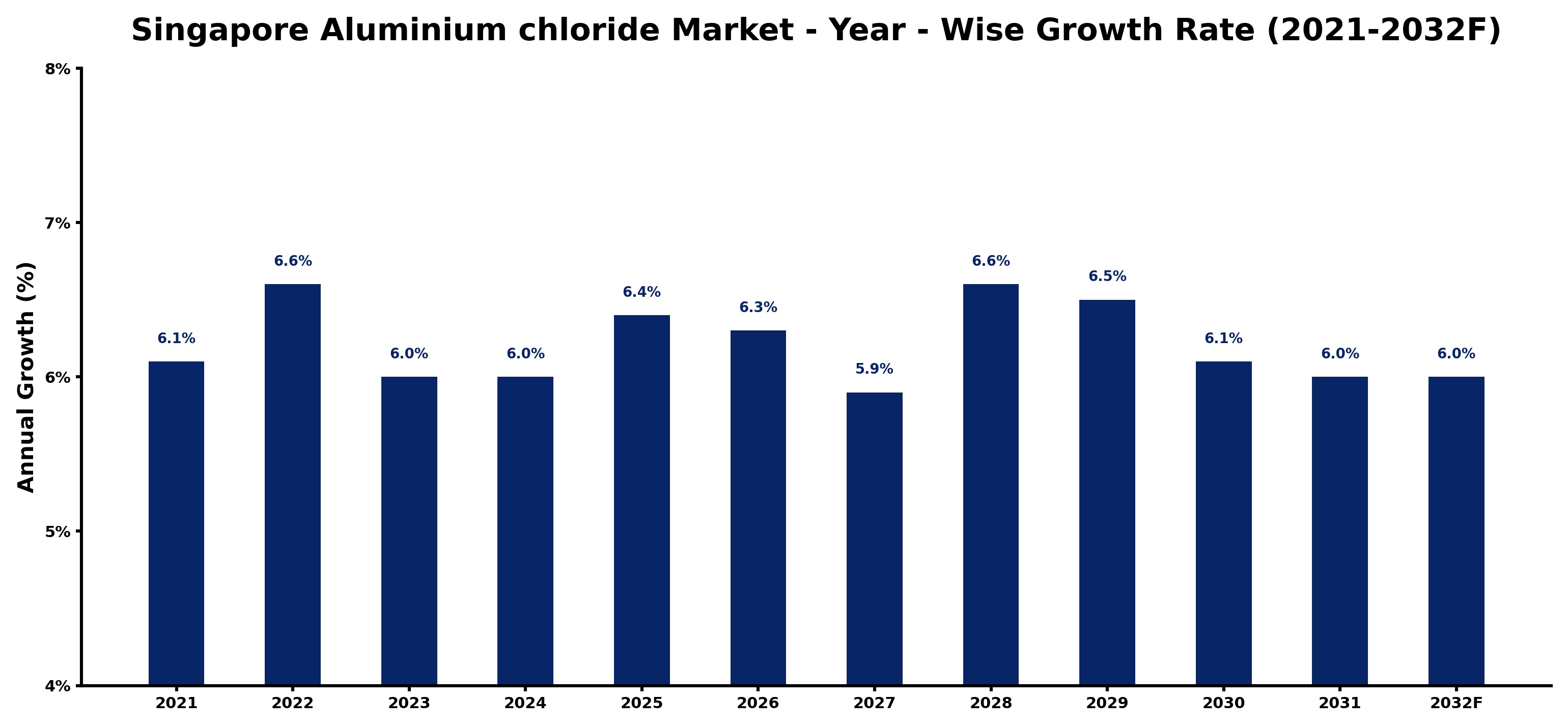
The table below presents the year‑wise growth rates along with the key drivers influencing the market
| Year | Growth Rate | Major Drivers |
| 2021 | 6.1% | Production line upgrades enhanced aluminum chloride manufacturing efficiency |
| 2022 | 6.6% | Higher construction project demand boosts aluminium chloride consumption levels |
| 2023 | 6.0% | Local demand surge drives aluminium chloride production facility upgrades |
| 2024 | 6.0% | Automation in aluminium chloride production boosts manufacturing efficiency |
| 2025 | 6.4% | Improved waste recycling methods boost aluminium chloride production efficiency |
| 2026 | 6.3% | New manufacturing plants drive aluminum chloride production capacity expansion |
| 2027 | 5.9% | Domestic demand for wastewater treatment drives aluminium chloride production |
| 2028 | 6.6% | Aluminum chloride export contracts fueled local manufacturing facility expansions |
| 2029 | 6.5% | Export driven demand for water treatment chemicals boosted production levels |
| 2030 | 6.1% | Improved regional construction projects boosted aluminium chloride procurement needs |
| 2031 | 6.0% | Aluminium chloride production capacity expansion supports regional water treatment projects |
| 2032 | 6.0% | Technology adoption streamlined aluminium chloride production processes and efficiencies |
Note - Market size estimations and growth projections presented in this report are based on 6Wresearch’s advanced forecasting approach, validated with industry datasets as of June 2026.
Singapore Aluminium chloride Market Synopsis
The Singapore Aluminium chloride market has recently experienced substantial growth, driven by its essential role in various industrial applications. As industries evolve, the demand for high-quality aluminium chloride is surging, particularly within the chemical, pharmaceutical, and water treatment sectors.
Looking ahead, the market is positioned for further expansion. Investment in research and development by manufacturers is expected to yield innovations in high-purity aluminium chloride production, thus addressing the unique needs of diverse applications in Singapore.
Singapore Aluminium chloride Market Key Takeaways
- The market is driven by strong demand from the pharmaceutical and chemical sectors, along with water treatment applications.
- Research and development investments are expected to enhance product quality and address environmental concerns.
- Stringent regulatory frameworks are influencing the adoption of aluminium chloride in water treatment processes.
- Market growth is currently shaped by recovery post-COVID-19, with industries stabilizing and evolving.
- Opportunities for sustainable practices and product diversification exist to cater to changing market dynamics.
Evaluation of Restraints in Singapore Aluminium chloride Market
Despite the promising growth prospects, several key restraints impact the Singapore Aluminium chloride market. Fluctuations in demand across the pharmaceutical, cosmetic, and chemical industries can create uncertainties for manufacturers. Economic conditions play a significant role, influencing production levels and pricing strategies. Additionally, increasing scrutiny on environmental sustainability and the ecological footprint of chemical manufacturing processes presents challenges that could limit growth potential. Companies must navigate these constraints by focusing on sustainability, innovation, and product diversification to remain competitive.
Singapore Aluminium chloride Market Trends
Current trends in the Singapore Aluminium chloride market highlight a shift towards sustainable practices and high-purity products. As industries grow increasingly aware of environmental issues, there is a rising preference for chemicals that meet rigorous safety and quality standards. Moreover, advancements in technology are paving the way for more efficient manufacturing processes, enhancing product efficacy and reducing waste. The ongoing evolution of the pharmaceutical sector is also driving demand for aluminium chloride in drug formulations, underscoring the need for continuous innovation.
Singapore Aluminium chloride Market Opportunities
The Singapore Aluminium chloride market presents a wealth of growth opportunities driven by expanding applications and increasing investments in water treatment initiatives. Companies can explore product diversification to meet the specific needs of various sectors, particularly in pharmaceuticals and cosmetics. Additionally, collaborations with governmental bodies and environmental organizations can open avenues for sustainable practices, aligning with global trends. The emphasis on high-quality, environmentally friendly products positions stakeholders to capitalize on evolving market demands.
Government Initiatives in the Singapore Aluminium chloride Market
Singapore's government plays an active role in promoting sustainable industrial practices, which positively affects the aluminium chloride market. Initiatives aimed at enhancing water treatment infrastructure and improving environmental regulations are essential for fostering responsible chemical manufacturing. Public spending on research and development in the chemicals sector aims to boost innovation and maintain competitiveness. Programs designed to reduce carbon footprints and support sustainable industry practices serve as crucial incentives for companies operating within this space.
Future Insights of the Singapore Aluminium chloride Market
As we look towards 2026-2032, the Singapore Aluminium chloride market is anticipated to experience robust growth fueled by expanding applications in diverse industries. Innovations in product formulations and manufacturing processes are likely to enhance product offerings and meet evolving customer demands. Additionally, the concerted push towards environmental sustainability will shape investment decisions and manufacturing practices. This synergy between demand growth, regulatory frameworks, and technological advancement will solidify the market's position as a vital component of Singapore's industrial landscape.
Singapore Aluminium chloride Market Latest Developments (May 2025 - June 2026)
Recent developments within the Singapore Aluminium chloride market indicate a strong momentum towards recovery and innovation. Manufacturers are focusing on enhancing production capabilities and exploring new applications in pharmaceuticals and water treatment. As industries stabilize post-pandemic, there is a noticeable increase in collaborations aimed at developing environmentally friendly aluminium chloride products. Furthermore, the ongoing emphasis on quality and safety within the chemical manufacturing process continues to drive competitive dynamics in the market.
Singapore Aluminium chloride Market - Key Attractiveness of the Report
- 10 Years of Market Numbers
- Historical Data Starting from 2022 to 2025
- Base Year: 2025
- Forecast Data until 2032
- Key Performance Indicators Impacting the Market
- Major Upcoming Developments and Projects
Key Highlights of the Report:
- Singapore Aluminium chloride Market Outlook
- Market Size of Singapore Aluminium chloride Market, 2025
- Forecast of Singapore Aluminium chloride Market, 2032
- Historical Data and Forecast of Singapore Aluminium chloride Revenues & Volume for the Period 2022-2032F
- Singapore Aluminium chloride Market Trend Evolution
- Singapore Aluminium chloride Market Drivers and Challenges
- Singapore Aluminium chloride Price Trends
- Singapore Aluminium chloride Porter's Five Forces
- Singapore Aluminium chloride Industry Life Cycle
- Historical Data and Forecast of Singapore Aluminium chloride Market Revenues & Volume By Production Method for the Period 2022-2032F
- Historical Data and Forecast of Singapore Aluminium chloride Market Revenues & Volume By Chlorination of aluminium for the Period 2022-2032F
- Historical Data and Forecast of Singapore Aluminium chloride Market Revenues & Volume By Crystallization of anhydrous aluminium chloride from solution of HCL for the Period 2022-2032F
- Historical Data and Forecast of Singapore Aluminium chloride Market Revenues & Volume By Reaction of bauxite with coke and chlorine for the Period 2022-2032F
- Historical Data and Forecast of Singapore Aluminium chloride Market Revenues & Volume By Application for the Period 2022-2032F
- Historical Data and Forecast of Singapore Aluminium chloride Market Revenues & Volume By Waste water treatment for the Period 2022-2032F
- Historical Data and Forecast of Singapore Aluminium chloride Market Revenues & Volume By Inks for the Period 2022-2032F
- Historical Data and Forecast of Singapore Aluminium chloride Market Revenues & Volume By Synthetic rubber for the Period 2022-2032F
- Historical Data and Forecast of Singapore Aluminium chloride Market Revenues & Volume By Lubricants for the Period 2022-2032F
- Historical Data and Forecast of Singapore Aluminium chloride Market Revenues & Volume By Wood Preservatives for the Period 2022-2032F
- Historical Data and Forecast of Singapore Aluminium chloride Market Revenues & Volume By Others for the Period 2022-2032F
- Historical Data and Forecast of Singapore Aluminium chloride Market Revenues & Volume By End-use Industries for the Period 2022-2032F
- Historical Data and Forecast of Singapore Aluminium chloride Market Revenues & Volume By Chemicals for the Period 2022-2032F
- Historical Data and Forecast of Singapore Aluminium chloride Market Revenues & Volume By Pharmaceuticals for the Period 2022-2032F
- Historical Data and Forecast of Singapore Aluminium chloride Market Revenues & Volume By Agrochemicals for the Period 2022-2032F
- Historical Data and Forecast of Singapore Aluminium chloride Market Revenues & Volume By Metal Production for the Period 2022-2032F
- Historical Data and Forecast of Singapore Aluminium chloride Market Revenues & Volume By Pulp & Paper for the Period 2022-2032F
- Historical Data and Forecast of Singapore Aluminium chloride Market Revenues & Volume By Others for the Period 2022-2032F
- Singapore Aluminium chloride Import Export Trade Statistics
- Market Opportunity Assessment By Production Method
- Market Opportunity Assessment By Application
- Market Opportunity Assessment By End-use Industries
- Singapore Aluminium chloride Top Companies Market Share
- Singapore Aluminium chloride Competitive Benchmarking By Technical and Operational Parameters
- Singapore Aluminium chloride Company Profiles
- Singapore Aluminium chloride Key Strategic Recommendations






































