Singapore Animal Horn Market Size, Share & Growth Rate
The Singapore Animal Horn Market was estimated at USD 236 Million in 2025 and is projected to reach USD 330 Million by 2032, growing at a CAGR of 4.9% from 2026 to 2032. This growth is driven primarily by the enduring cultural significance of animal horns in traditional medicine and artisanal craftsmanship. As consumers increasingly seek ethically sourced products and sustainable alternatives, the market is positioned to expand in response to these evolving demands.
Singapore Animal Horn Market Year-wise Growth Rate and Key Drivers
This graph highlights how the Singapore Animal Horn Market has steadily grown over the years, supported by major growth factors.
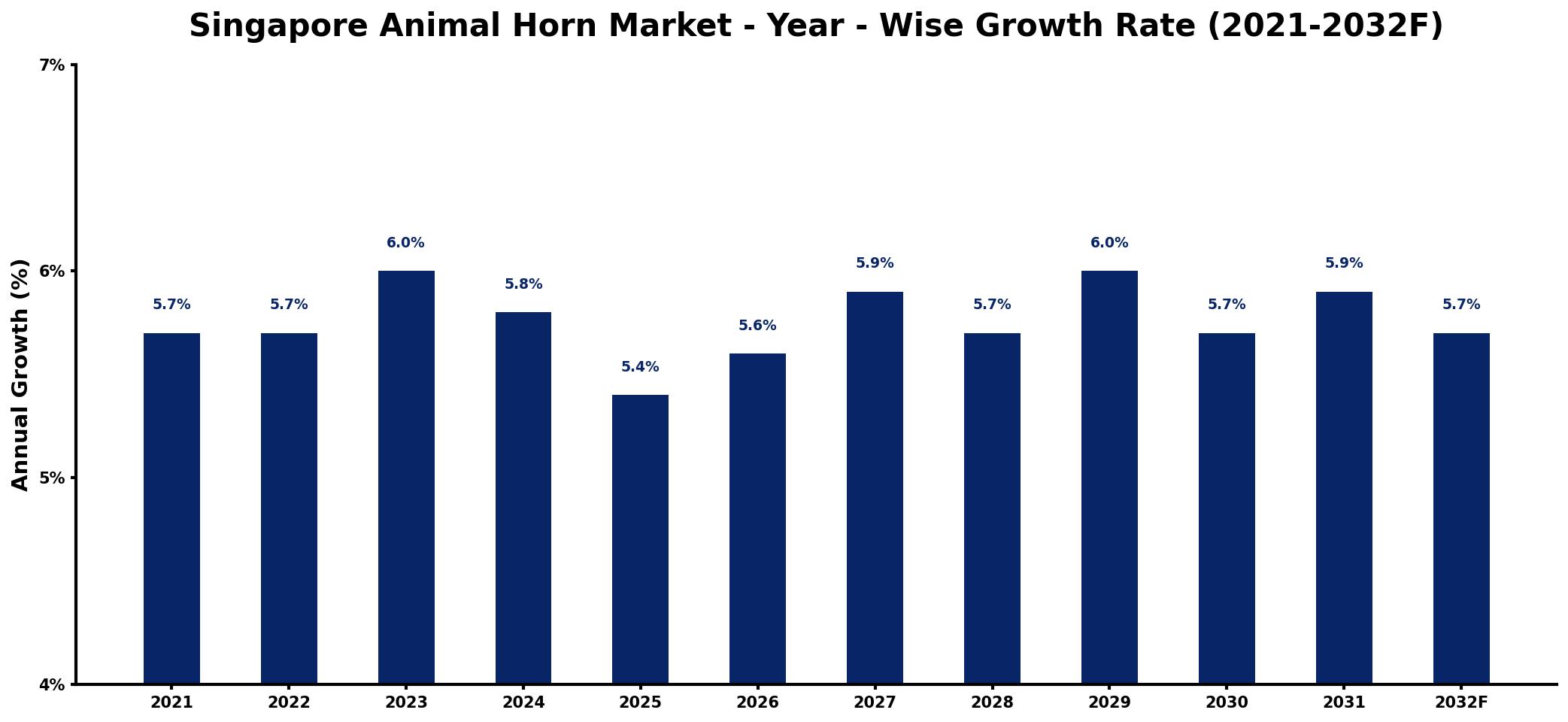
The table below presents the year‑wise growth rates along with the key drivers influencing the market
| Year | Growth Rate | Major Drivers |
| 2021 | 5.7% | Increased demand for traditional medicine |
| 2022 | 5.7% | Growth in luxury item market |
| 2023 | 6.0% | Expansion of cultural heritage products |
| 2024 | 5.8% | Rising popularity of handcrafted goods |
| 2025 | 5.4% | Investment in sustainable sourcing practices |
| 2026 | 5.6% | expanding manufacturing base activity |
| 2027 | 5.9% | Surge in alternative health therapies |
| 2028 | 5.7% | Increased interest in artisanal crafts |
| 2029 | 6.0% | increased pharmaceutical industry usage |
| 2030 | 5.7% | Rising consumer awareness of quality |
| 2031 | 5.9% | stronger distribution network expansion |
| 2032 | 5.7% | Increased collaboration with artisans |
Note: Market size estimations and growth projections presented in this report are based on 6Wresearch's proprietary forecasting methodology, utilizing the latest available industry data, government publications, and primary research inputs.
Singapore Animal Horn Market Synopsis
Recent growth in the Singapore animal horn market highlights a robust demand for traditional medicine and craftsmanship, showcasing the cultural richness that these materials embody. However, the future trajectory will be characterized by heightened awareness of ethical sourcing practices, which will reshape consumer preferences and industry standards.
As stakeholders increasingly navigate the complexities of wildlife conservation and market regulations, a shift towards sustainable practices is not only crucial but will also enhance market resilience. The increasing integration of ethical considerations into sourcing methods is likely to influence the long-term viability of this market segment.
Singapore Animal Horn Market Key Takeaways
- The market is driven by the enduring demand for traditional remedies and cultural applications.
- Ethical sourcing and sustainability are becoming crucial factors for market players.
- Increased awareness of wildlife conservation challenges influences consumer choices.
- Artisanal crafts leveraging animal horns continue to hold significant market potential.
- Adaptations made during the COVID-19 pandemic have highlighted the importance of flexibility in sourcing strategies.
Evaluation of Restraints in Singapore Animal Horn Market
The Singapore animal horn market is restrained by stringent regulations surrounding the sourcing of animal products, particularly concerning endangered species. Ethical considerations regarding animal welfare and conservation efforts significantly impact sourcing practices. Companies face pressure to demonstrate transparency in their supply chains, often leading to increased costs and potential market access challenges. Furthermore, shifting consumer preferences towards plant-based alternatives may further limit the traditional demand for animal horns, necessitating ongoing innovation and adaptation from industry players.
Singapore Animal Horn Market Trends
Emerging trends in the Singapore animal horn market include an increasing reliance on responsible sourcing and innovative crafting techniques. Artisans are blending traditional methods with modern design to create products that resonate with contemporary consumers. Additionally, the market is witnessing a surge in interest for sustainable alternatives, with some players exploring synthetic options that mimic the qualities of animal horn without ethical concerns. Furthermore, educational initiatives aimed at promoting awareness of wildlife conservation are shaping consumer perceptions, influencing purchasing behavior towards more responsible products.
Singapore Animal Horn Market Opportunities
Significant growth opportunities lie in the expansion of ethical sourcing initiatives and the development of premium artisanal products. There is also potential for collaboration between traditional craftsmen and modern designers, leveraging both expertise and market reach. Moreover, tapping into the global demand for sustainably produced traditional medicines presents an avenue for Singapore-based suppliers to enhance their market presence. The increasing interest in cultural heritage and handcrafted goods further emphasizes the potential for market growth in niche segments.
Government Initiatives in the Singapore Animal Horn Market
The Singapore government has initiated several policies aimed at enhancing wildlife conservation and promoting ethical sourcing practices. This includes strict regulations governing the import and sale of animal products, ensuring compliance with international conventions on wildlife trade. Additionally, public spending on conservation education and awareness programs aims to foster a culture of responsibility among consumers and industry players. Government incentives for sustainable practices further encourage stakeholders to adopt ethical sourcing strategies, aligning market activities with broader conservation goals.
Future Insights of the Singapore Animal Horn Market
Looking ahead to 2026-2032, the Singapore animal horn market is poised for transformation as it embraces a more sustainable and ethically responsible future. The integration of innovative sourcing practices will likely attract a new generation of environmentally conscious consumers, strengthening market demand. Additionally, technological advancements in synthetic alternatives may redefine product offerings, ultimately ensuring the continued relevance of animal horns in traditional and contemporary contexts. As awareness grows regarding the importance of wildlife conservation, stakeholder collaboration will be essential in navigating this evolving landscape.
Singapore Animal Horn Market Latest Developments (2025 - 2026)
In recent months, the Singapore animal horn market has seen a noticeable shift towards more sustainable sourcing practices. Industry stakeholders have increasingly adopted transparency measures to assure consumers of the ethical origins of their products. Various collaborations between craftsmen and environmental organizations have been initiated to promote wildlife conservation awareness. Additionally, product innovations focusing on combining traditional techniques with modern aesthetics have gained traction, capturing the interest of a broader consumer base.
Singapore Animal Horn Market - Key Attractiveness of the Report
- 10 Years of Market Numbers
- Historical Data Starting from 2022 to 2025
- Base Year: 2025
- Forecast Data until 2032
- Key Performance Indicators Impacting the Market
- Major Upcoming Developments and Projects
Key Highlights of the Report:
- Singapore Animal Horn Market Outlook
- Market Size of Singapore Animal Horn Market, 2025
- Forecast of Singapore Animal Horn Market, 2032
- Historical Data and Forecast of Singapore Animal Horn Revenues & Volume for the Period 2022-2032F
- Singapore Animal Horn Market Trend Evolution
- Singapore Animal Horn Market Drivers and Challenges
- Singapore Animal Horn Price Trends
- Singapore Animal Horn Porter's Five Forces
- Singapore Animal Horn Industry Life Cycle
- Historical Data and Forecast of Singapore Animal Horn Market Revenues & Volume By Distribution Channel for the Period 2022-2032F
- Historical Data and Forecast of Singapore Animal Horn Market Revenues & Volume By Online for the Period 2022-2032F
- Historical Data and Forecast of Singapore Animal Horn Market Revenues & Volume By Offline for the Period 2022-2032F
- Historical Data and Forecast of Singapore Animal Horn Market Revenues & Volume By Application for the Period 2022-2032F
- Historical Data and Forecast of Singapore Animal Horn Market Revenues & Volume By Commercial for the Period 2022-2032F
- Historical Data and Forecast of Singapore Animal Horn Market Revenues & Volume By Cosmetics & Personal Care for the Period 2022-2032F
- Historical Data and Forecast of Singapore Animal Horn Market Revenues & Volume By Others for the Period 2022-2032F
- Singapore Animal Horn Import Export Trade Statistics
- Market Opportunity Assessment By Distribution Channel
- Market Opportunity Assessment By Application
- Singapore Animal Horn Top Companies Market Share
- Singapore Animal Horn Competitive Benchmarking By Technical and Operational Parameters
- Singapore Animal Horn Company Profiles
- Singapore Animal Horn Key Strategic Recommendations






































