Singapore Anthracite Market: Import Trend Analysis
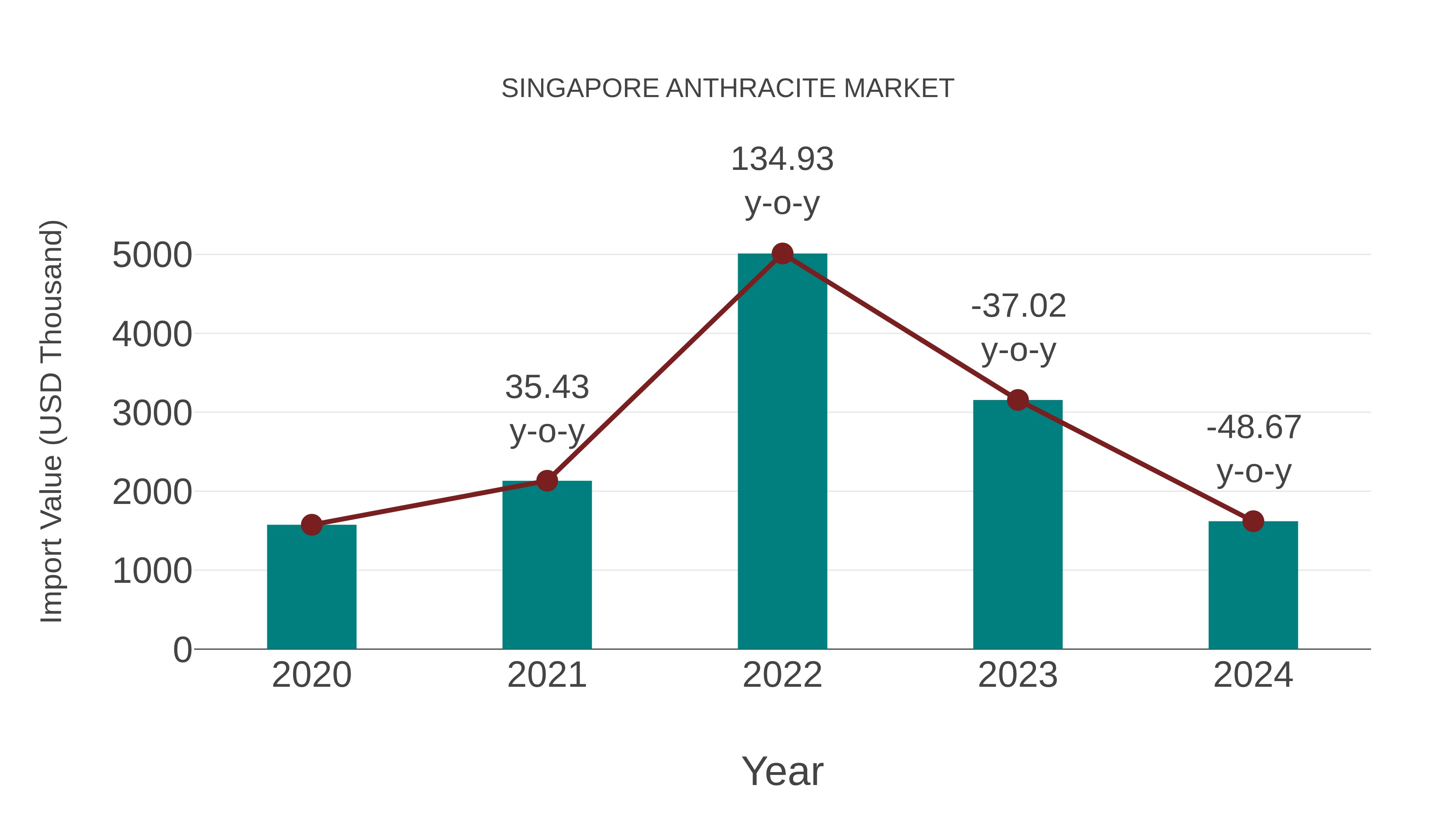
Singapore`s import trend for anthracite in 2024 showed a -48.67% decrease from the previous year, with a compound annual growth rate (CAGR) of 0.71% from 2020 to 2024. This decline could be attributed to shifting demand patterns or changes in market dynamics impacting import momentum.
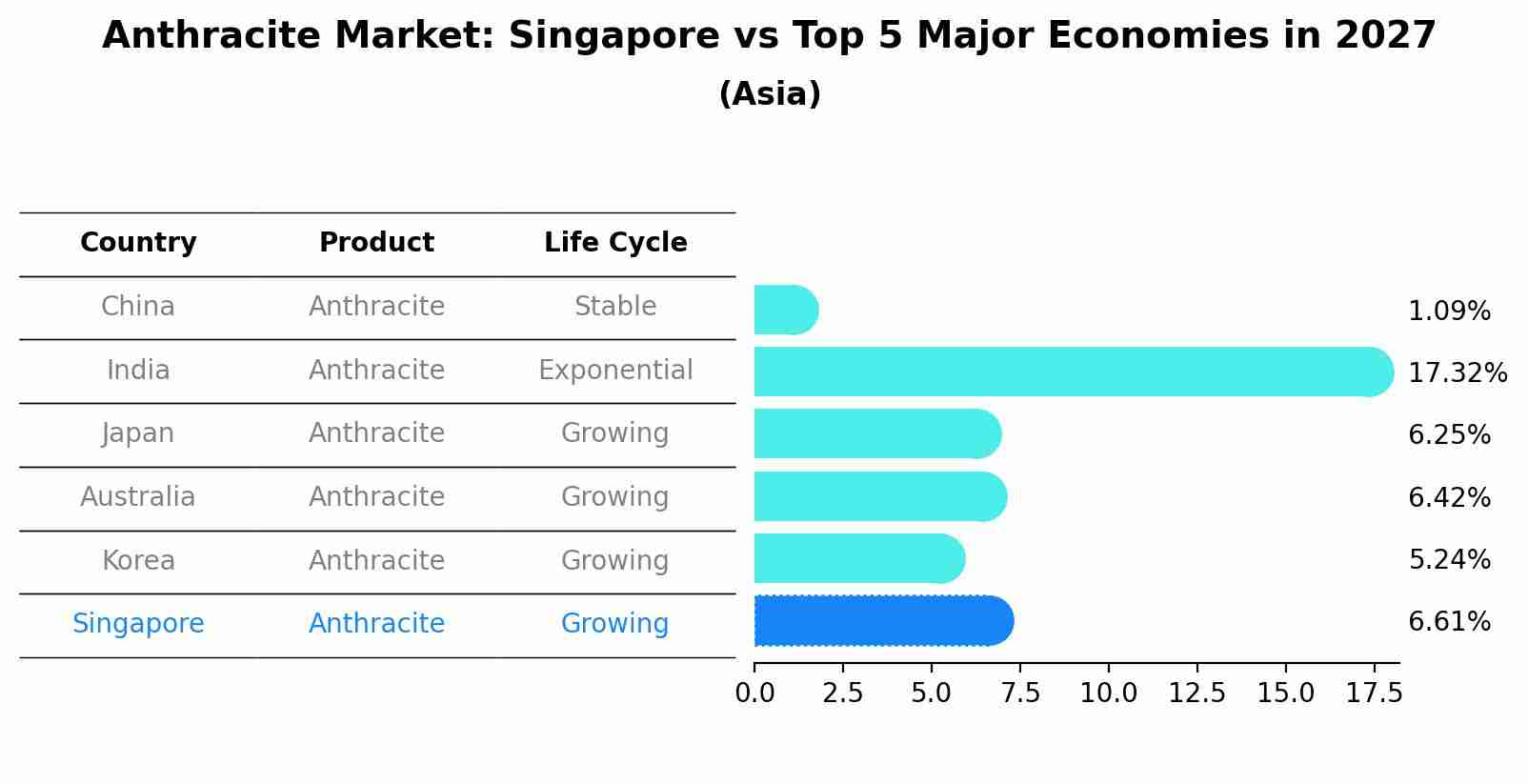
Anthracite Market: Singapore vs Top 5 Major Economies in 2027 (Asia)
In the Asia region, the Anthracite market in Singapore is projected to expand at a growing growth rate of 6.61% by 2027. The largest economy is China, followed by India, Japan, Australia and South Korea.
Singapore Anthracite Market Synopsis
The Singapore anthracite market is a subset of the broader energy and fuel industry. Anthracite, a type of coal known for its high carbon content and energy density, finds application in industrial processes and power generation. The market`s dynamics are influenced by factors such as energy demand, environmental regulations, and shifts in the energy mix. While the global trend leans towards cleaner and renewable energy sources, anthracite`s role as a stable energy source in specific industrial applications remains significant. The market`s outlook is subject to changes in energy policies, technological advancements in coal utilization, and the overall transition to more sustainable energy alternatives.
Drivers of the Market
The Singapore Anthracite market has grown due to its vital role in the steel and energy sectors. Anthracite coal is known for its high carbon content and low impurities, making it a preferred choice in steel manufacturing. As Singapore continues to invest in infrastructure development and industrial expansion, the demand for anthracite as an energy source and raw material for steel production has increased. Additionally, the market benefits from Singapore status as a global trading hub, facilitating the import and export of anthracite.
Challenges of the Market
The Singapore anthracite market faces challenges related to the declining use of coal for energy generation due to environmental concerns. The shift towards cleaner energy sources and carbon reduction goals can reduce the demand for anthracite. Moreover, sourcing high-quality anthracite can be challenging, and competition from alternative energy sources like natural gas and renewables adds complexity to the market.
COVID-19 Impact on the Market
The Singapore anthracite market has experienced a significant impact from the COVID-19 pandemic. With restrictions on industrial activities and disruptions in the global supply chain, demand for anthracite, a key component in various industrial processes, saw fluctuations. During the initial phases of the pandemic, the market witnessed a decline in demand as industries scaled down operations. However, as the economy gradually reopened, there was a resurgence in demand, driven by sectors such as power generation and steel production. Market players adapted to new safety protocols and supply chain challenges. The market is expected to continue recovering as Singapore economy stabilizes and global demand for anthracite rebounds.
Key Players in the Market
Anthracite, a type of coal, is mainly supplied by larger international mining companies in Singapore. Some key players in the Singapore Anthracite market include Glencore International AG, Peabody Energy Corporation, and BHP Group. These companies are involved in coal mining and distribution on a global scale, serving both industrial and energy sectors.
Key Highlights of the Report:
- Singapore Anthracite Market Outlook
- Market Size of Singapore Anthracite Market, 2025
- Forecast of Singapore Anthracite Market, 2032
- Historical Data and Forecast of Singapore Anthracite Revenues & Volume for the Period 2022-2032F
- Singapore Anthracite Market Trend Evolution
- Singapore Anthracite Market Drivers and Challenges
- Singapore Anthracite Price Trends
- Singapore Anthracite Porter's Five Forces
- Singapore Anthracite Industry Life Cycle
- Historical Data and Forecast of Singapore Anthracite Market Revenues & Volume By Application for the Period 2022-2032F
- Historical Data and Forecast of Singapore Anthracite Market Revenues & Volume By Fuel for the Period 2022-2032F
- Historical Data and Forecast of Singapore Anthracite Market Revenues & Volume By Steel Making for the Period 2022-2032F
- Historical Data and Forecast of Singapore Anthracite Market Revenues & Volume By Sinter Plants for the Period 2022-2032F
- Historical Data and Forecast of Singapore Anthracite Market Revenues & Volume By Indurating Furnaces for the Period 2022-2032F
- Historical Data and Forecast of Singapore Anthracite Market Revenues & Volume By Furnace Coal Replacement for the Period 2022-2032F
- Historical Data and Forecast of Singapore Anthracite Market Revenues & Volume By Others for the Period 2022-2032F
- Historical Data and Forecast of Singapore Anthracite Market Revenues & Volume By End-user for the Period 2022-2032F
- Historical Data and Forecast of Singapore Anthracite Market Revenues & Volume By Steel for the Period 2022-2032F
- Historical Data and Forecast of Singapore Anthracite Market Revenues & Volume By Energy & Power for the Period 2022-2032F
- Historical Data and Forecast of Singapore Anthracite Market Revenues & Volume By Bricks for the Period 2022-2032F
- Historical Data and Forecast of Singapore Anthracite Market Revenues & Volume By Silicon & Glass for the Period 2022-2032F
- Historical Data and Forecast of Singapore Anthracite Market Revenues & Volume By Synthetic Fuels for the Period 2022-2032F
- Historical Data and Forecast of Singapore Anthracite Market Revenues & Volume By Others for the Period 2022-2032F
- Singapore Anthracite Import Export Trade Statistics
- Market Opportunity Assessment By Application
- Market Opportunity Assessment By End-user
- Singapore Anthracite Top Companies Market Share
- Singapore Anthracite Competitive Benchmarking By Technical and Operational Parameters
- Singapore Anthracite Company Profiles
- Singapore Anthracite Key Strategic Recommendations






































