Singapore Anti-money Laundering Market Size & Growth Rate (2026-2032)
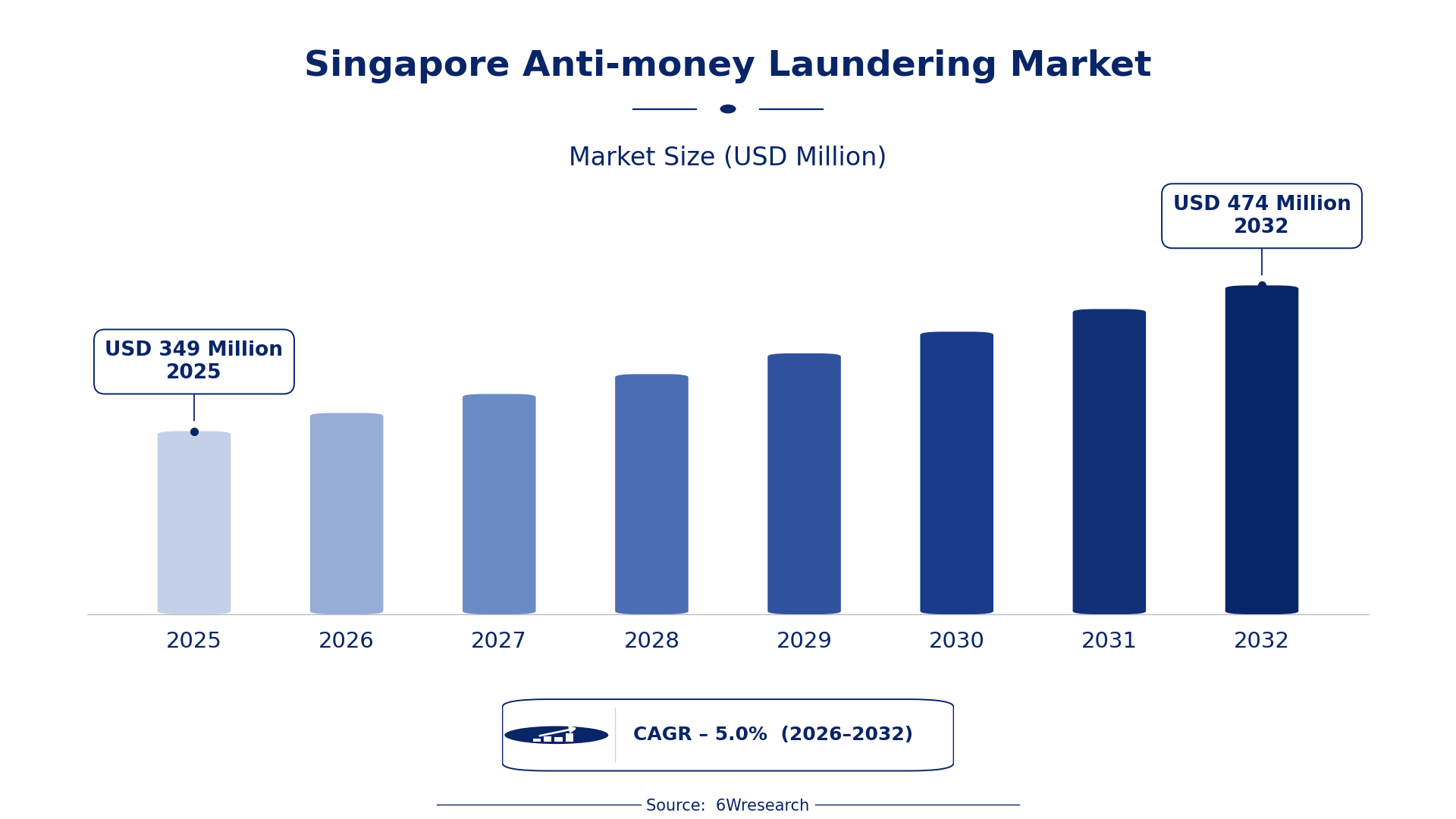
The Singapore Anti-money Laundering Market was estimated at USD 349 Million in 2025 and is projected to reach USD 474 Million by 2032, growing at a CAGR of 5.0% from 2026 to 2032.
Singapore Anti-money Laundering Market Synopsis
Regulatory compliance is the strongest force shaping the Singapore Anti-money Laundering Market today. The Monetary Authority of Singapore's rigorous AML/CFT regulations push financial institutions to invest in advanced compliance technologies, ensuring that they can effectively mitigate risks associated with financial crimes.
As Singapore continues to solidify its status as a global financial hub, the need for robust anti-money laundering measures has never been more critical. With increased scrutiny from global regulatory bodies, businesses are prompted to enhance their AML solutions to stay ahead of emerging threats and maintain their operational integrity.
Singapore Anti-money Laundering Market Year-wise Growth Rate and Key Drivers
This graph illustrates the annual growth rates of the Singapore Anti-money Laundering Market from 2021 to 2032, highlighting a steady upward trajectory and projected expansion over the forecast period.
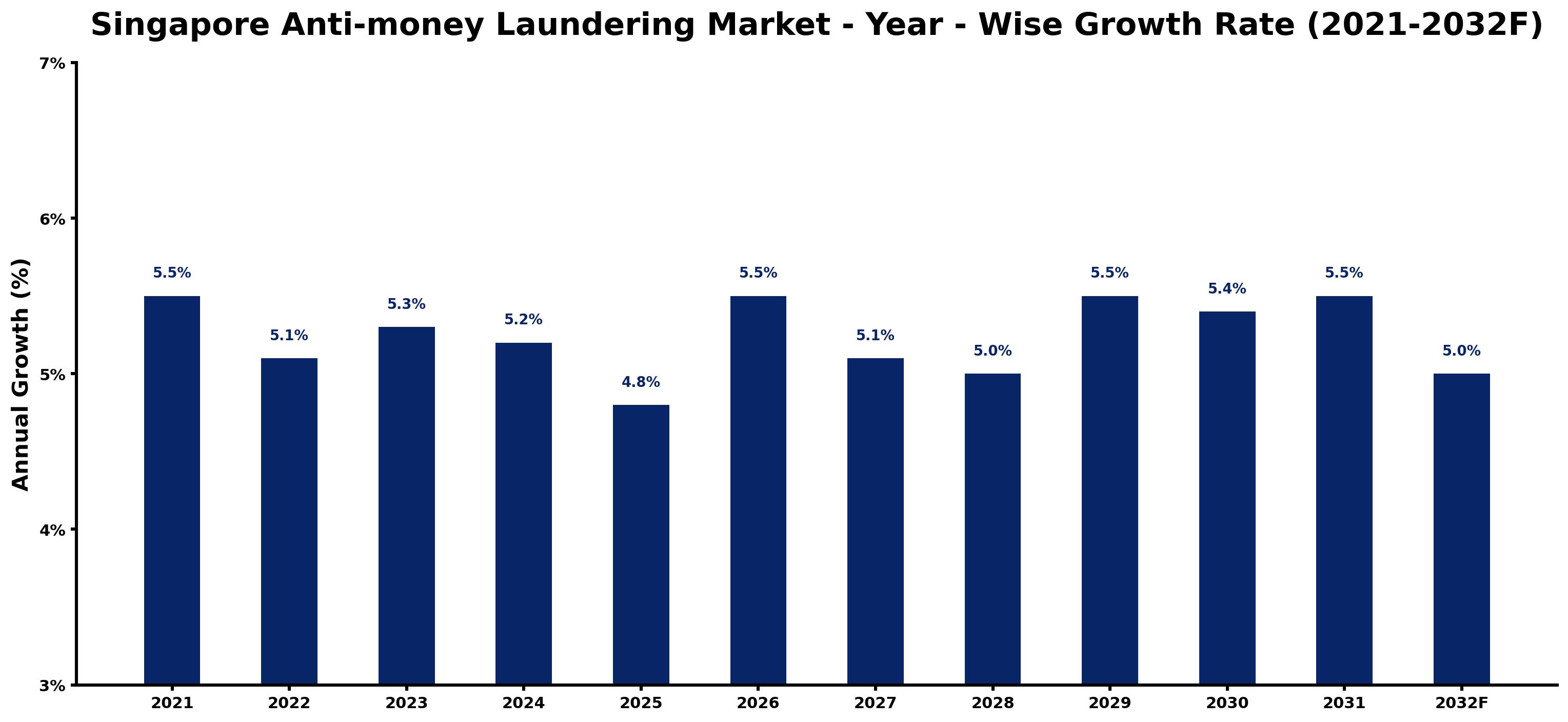
The table below presents the year‑wise growth rates along with the key drivers influencing the market
| Year | Growth Rate | Major Drivers |
| 2021 | 5.5% | Enhanced regulatory scrutiny by the Monetary Authority of Singapore. |
| 2022 | 5.1% | Introduction of the AML/CFT Risk Assessment Framework. |
| 2023 | 5.3% | Increased corporate compliance due to global AML standards. |
| 2024 | 5.2% | Rising fintech solutions prioritizing KYC and transaction monitoring. |
| 2025 | 4.8% | Growing public awareness of financial crime impacts. |
| 2026 | 5.5% | Strengthened public-private sector collaboration on AML initiatives. |
| 2027 | 5.1% | Implementation of greater data sharing among financial entities. |
| 2028 | 5.0% | Launch of national campaigns against money laundering activities. |
| 2029 | 5.5% | Upgrades in digital identity verification technologies for banks. |
| 2030 | 5.4% | Tighter regulations impacting foreign investments and remittances. |
| 2031 | 5.5% | Significant growth in digital banking driving compliance needs. |
| 2032 | 5.0% | Continued focus on sanctions compliance in regional trade. |
Note: Market size estimations and growth projections presented in this report are based on 6Wresearch's proprietary forecasting methodology, utilizing the latest available industry data, government publications, and primary research inputs.
Singapore Anti-money Laundering Market Key Takeaways
Below are some of the specific key takeaways from the market, including:
- The demand for anti-money laundering solutions is heavily influenced by stringent regulatory requirements.
- Recent global financial events have intensified the focus on combatting illicit financial activities.
- Financial institutions are increasingly investing in advanced technologies to bolster compliance efforts.
- The complexities of modern financial transactions, including cryptocurrency, heighten the need for effective AML strategies.
- There’s a growing emphasis on enhancing customer due diligence processes to prevent financial crimes.
Evaluation of Restraints in Singapore Anti-money Laundering Market
Despite the market's growth, several restraints continue to limit its potential. The rapidly evolving nature of money laundering tactics poses a significant challenge for compliance teams tasked with keeping up-to-date with these schemes. Moreover, the need for extensive customer verification can hinder efficient onboarding processes for businesses, leading to potential loss of clientele. This balancing act between diligence and operational efficiency remains a persistent challenge in the AML landscape.
Singapore Anti-money Laundering Market Trends
A number of trends are emerging within the Singapore Anti-money Laundering Market. First, the integration of artificial intelligence and machine learning technologies is revolutionizing transaction monitoring systems, allowing for more precise detection of suspicious activities. Secondly, the increasing utilization of blockchain technology among financial institutions is helping to enhance transparency and traceability, providing a dual benefit in both compliance and security. Lastly, remote customer verification methods are being adopted more frequently, largely in response to the shifts caused by the COVID-19 pandemic, which have fundamentally altered how financial transactions are conducted.
Singapore Anti-money Laundering Market Opportunities
Growth opportunities are abundant in the Singapore Anti-money Laundering Market. Financial institutions can benefit significantly from investing in automated compliance solutions that enhance efficiency while reducing human error. Additionally, the rise of fintech companies presents a unique opportunity for partnerships that leverage cutting-edge technology to combat money laundering. Lastly, as global regulations tighten, companies offering niche services tailored to specific sectors, such as cryptocurrency or e-commerce, will find themselves in high demand.
Government Initiatives in the Singapore Anti-money Laundering Market
The Singapore government actively prioritizes anti-money laundering efforts, aiming to enhance regulatory frameworks that support financial integrity. With a clear commitment to align with international standards, the government’s initiatives are crucial for maintaining Singapore’s reputation as a secure financial hub. Policy measures are being strengthened to ensure that financial institutions not only comply but also exceed minimum standards in detecting and preventing financial crimes.
- A regulatory framework recently introduced mandates enhanced reporting requirements for financial institutions to improve transparency and accountability.
- Current initiatives focus on educating financial sector stakeholders about new money laundering techniques and compliance measures.
- A public-private partnership program underway is aimed at developing a national AML data-sharing platform, expected to be operational by mid-2026.
- Upcoming legislation is anticipated to tighten regulations around cryptocurrency transactions, emphasizing the need for enhanced due diligence.
- Ongoing collaborations with international bodies enhance Singapore's capability to combat cross-border money laundering activities.
Future Insights of the Singapore Anti-money Laundering Market
Looking ahead to 2026-2032, the Singapore Anti-money Laundering Market is expected to experience steady growth driven by continuous advancements in technology and heightened regulatory scrutiny. Financial institutions will be compelled to adopt more sophisticated solutions, incorporating AI and analytics to streamline compliance processes. The increasing complexity of financial transactions will further drive demand for robust AML frameworks, ensuring that Singapore remains a leader in combating financial crimes.
Singapore Anti-money Laundering Market Latest Developments
The past year has seen dynamic shifts within the Singapore Anti-money Laundering Market, with an increased focus on implementing advanced technologies and strengthening regulatory compliance. As institutions adapt to changing environments, numerous initiatives have been launched to enhance effectiveness in combating financial crime.
- A new AML compliance software was rolled out in early 2023, providing financial institutions with enhanced analytics capabilities.
- An ongoing initiative launched in Q2 2023 aims to develop a centralized database for transaction monitoring, streamlining compliance processes across the sector.
- A leading technology vendor is planning to introduce an AI-driven transaction screening tool expected to be available by late 2024.
- A recent partnership was announced in mid-2023 between local banks and fintech startups to foster innovative solutions for AML compliance.
- By Q1 2024, a pilot program for blockchain-based transaction tracking will be initiated, focusing on improving AML practices for digital assets.
Singapore Anti-money Laundering Market - Key Attractiveness of the Report
- 10 Years of Market Numbers
- Historical Data Starting from 2022 to 2025
- Base Year: 2025
- Forecast Data until 2032
- Key Performance Indicators Impacting the Market
- Major Upcoming Developments and Projects
Key Highlights of the Report:
- Singapore Anti-money Laundering Market Outlook
- Market Size of Singapore Anti-money Laundering Market, 2025
- Forecast of Singapore Anti-money Laundering Market, 2032
- Historical Data and Forecast of Singapore Anti-money Laundering Revenues & Volume for the Period 2022-2032F
- Singapore Anti-money Laundering Market Trend Evolution
- Singapore Anti-money Laundering Market Drivers and Challenges
- Singapore Anti-money Laundering Price Trends
- Singapore Anti-money Laundering Porter's Five Forces
- Singapore Anti-money Laundering Industry Life Cycle
- Historical Data and Forecast of Singapore Anti-money Laundering Market Revenues & Volume By Component for the Period 2022-2032F
- Historical Data and Forecast of Singapore Anti-money Laundering Market Revenues & Volume By Services for the Period 2022-2032F
- Historical Data and Forecast of Singapore Anti-money Laundering Market Revenues & Volume By Solutions for the Period 2022-2032F
- Historical Data and Forecast of Singapore Anti-money Laundering Market Revenues & Volume By Deployment Mode for the Period 2022-2032F
- Historical Data and Forecast of Singapore Anti-money Laundering Market Revenues & Volume By On-Premises for the Period 2022-2032F
- Historical Data and Forecast of Singapore Anti-money Laundering Market Revenues & Volume By Cloud for the Period 2022-2032F
- Historical Data and Forecast of Singapore Anti-money Laundering Market Revenues & Volume By End User for the Period 2022-2032F
- Historical Data and Forecast of Singapore Anti-money Laundering Market Revenues & Volume By Banking & Financial Institutes for the Period 2022-2032F
- Historical Data and Forecast of Singapore Anti-money Laundering Market Revenues & Volume By Insurance for the Period 2022-2032F
- Historical Data and Forecast of Singapore Anti-money Laundering Market Revenues & Volume By Gaming & Gambling for the Period 2022-2032F
- Historical Data and Forecast of Singapore Anti-money Laundering Market Revenues & Volume By Organization Size for the Period 2022-2032F
- Historical Data and Forecast of Singapore Anti-money Laundering Market Revenues & Volume By Large Enterprises for the Period 2022-2032F
- Historical Data and Forecast of Singapore Anti-money Laundering Market Revenues & Volume By SMEs for the Period 2022-2032F
- Singapore Anti-money Laundering Import Export Trade Statistics
- Market Opportunity Assessment By Component
- Market Opportunity Assessment By Deployment Mode
- Market Opportunity Assessment By End User
- Market Opportunity Assessment By Organization Size
- Singapore Anti-money Laundering Top Companies Market Share
- Singapore Anti-money Laundering Competitive Benchmarking By Technical and Operational Parameters
- Singapore Anti-money Laundering Company Profiles
- Singapore Anti-money Laundering Key Strategic Recommendations






































