Singapore Aquaculture Market Size, Share & Growth Rate
The Singapore Aquaculture Market was estimated at USD 179 Million in 2025 and is projected to reach USD 249 Million by 2032, growing at a CAGR of 4.8% from 2026 to 2032. This growth trajectory is largely fueled by the increasing consumer demand for sustainably sourced seafood, along with innovations in aquaculture technologies that enhance production efficiency. As the industry adapts to meet both local and global seafood demands, a shift towards eco-friendly practices is expected to further propel market expansion.
Singapore Aquaculture Market Year-wise Growth Rate and Key Drivers
This graph highlights how the Singapore Aquaculture Market has steadily grown over the years, supported by major growth factors.
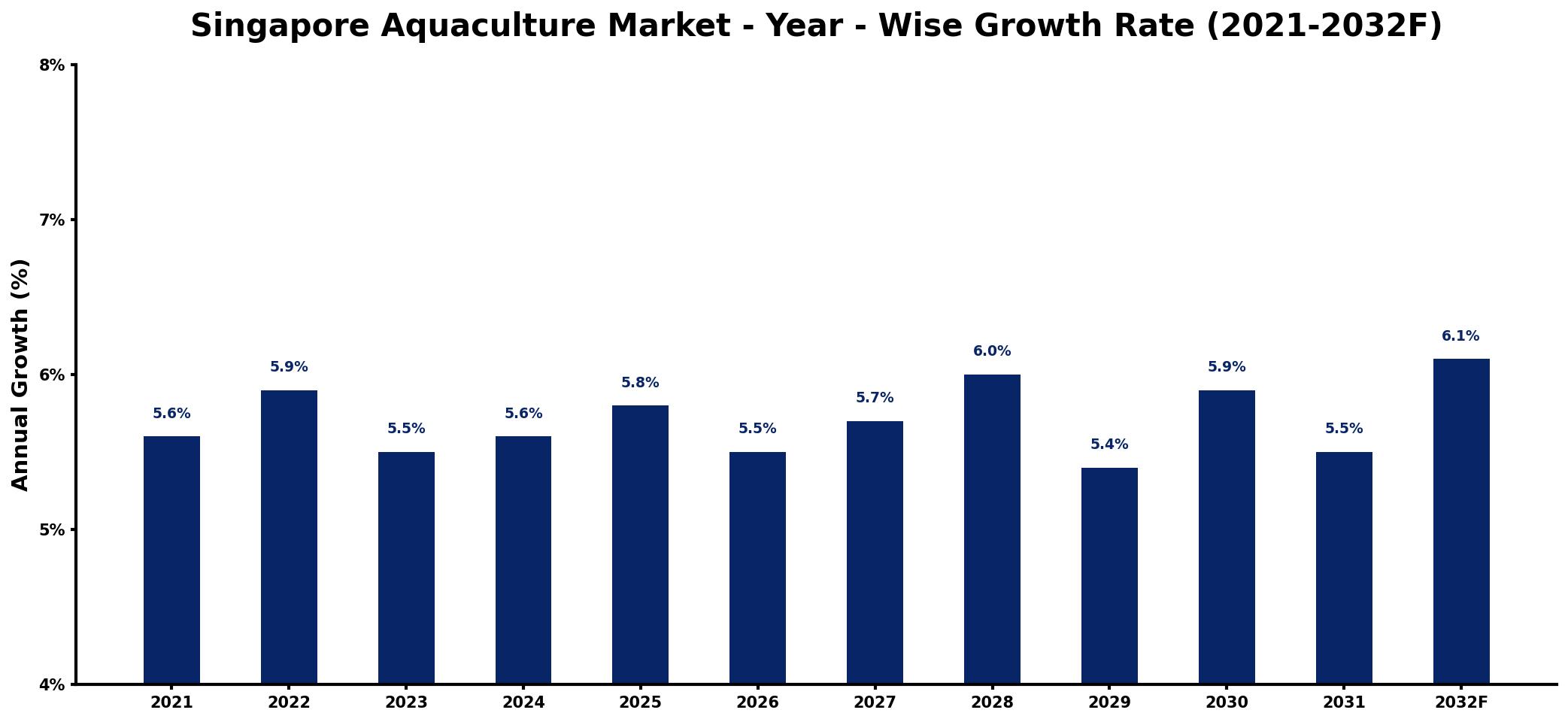
The table below presents the year‑wise growth rates along with the key drivers influencing the market
| Year | Growth Rate | Major Drivers |
| 2021 | 5.6% | Rising consumer health consciousness |
| 2022 | 5.9% | Increased investment in technology |
| 2023 | 5.5% | Growing demand for sustainable practices |
| 2024 | 5.6% | Expansion of export markets |
| 2025 | 5.8% | Enhanced supply chain efficiency |
| 2026 | 5.5% | Development of new species |
| 2027 | 5.7% | Collaborations with research institutions |
| 2028 | 6.0% | Increased focus on biosecurity measures |
| 2029 | 5.4% | Emergence of alternative protein sources |
| 2030 | 5.9% | Growth in urban farming initiatives |
| 2031 | 5.5% | Strengthening of regulatory frameworks |
| 2032 | 6.1% | Advancements in breeding techniques |
Note: Market size estimations and growth projections presented in this report are based on 6Wresearch's proprietary forecasting methodology, utilizing the latest available industry data, government publications, and primary research inputs.
Singapore Aquaculture Market Synopsis
The Singapore aquaculture market is currently at a pivotal juncture, where sustainable practices are becoming essential. This shift is not merely a trend; it reflects a growing consumer consciousness regarding the environmental impact of food production, particularly in urban settings like Singapore.
As the nation strives to bolster its local seafood production amidst rising demands, aquaculture has emerged as a key solution. Innovative technologies, combined with stringent quality standards and regulatory measures, are reshaping the industry, ensuring that seafood remains a vital part of the Singaporean diet while aligning with global sustainability goals.
Singapore Aquaculture Market Key Takeaways
- Growing consumer demand for sustainable seafood is reshaping aquaculture practices.
- Technological advancements are enhancing production efficiency and reducing environmental impact.
- The COVID-19 pandemic has accelerated the focus on local food sourcing.
- Environmental regulations are influencing market dynamics and competitive strategies.
- Key players are increasingly committed to responsible seafood farming practices.
Evaluation of Restraints in Singapore Aquaculture Market
Despite the positive growth outlook, the Singapore aquaculture market faces significant restraints. The challenges of maintaining sustainable practices while managing operational costs create tension within the industry. Environmental concerns, such as waste management and habitat preservation, remain pressing issues that require ongoing attention. Additionally, the threat of disease outbreaks in aquaculture systems can impact production consistency and overall market stability. Stakeholders must navigate these complexities carefully to ensure a sustainable future for aquaculture in Singapore.
Singapore Aquaculture Market Trends
The market is witnessing a notable trend toward integrated aquaculture systems that optimize resource use and minimize waste. Innovations such as recirculating aquaculture systems (RAS) and aquaponics are gaining traction, allowing for environmentally friendly production methods. Furthermore, increased collaboration between public and private sectors is facilitating research and development initiatives aimed at enhancing sustainability. These trends point to a future where aquaculture not only meets local seafood demands but also sets a benchmark for responsible farming practices globally.
Singapore Aquaculture Market Opportunities
Significant growth and investment opportunities lie in the development of advanced aquaculture technologies and the expansion of local production capabilities. As consumer preferences increasingly lean towards sustainable seafood, businesses that innovate in farming practices and supply chain transparency stand to gain a competitive advantage. Furthermore, emerging markets for premium aquaculture products, such as organic seafood and functional foods, present lucrative opportunities for stakeholders willing to explore niche segments.
Government Initiatives in the Singapore Aquaculture Market
The Singaporean government plays an integral role in the development of the aquaculture sector through various initiatives aimed at promoting sustainable practices. Public spending on research and innovation is designed to enhance the efficiency and sustainability of aquaculture operations. Additionally, policies encouraging responsible seafood sourcing and environmental conservation are shaping the market landscape. These government efforts serve to strengthen the local aquaculture industry while aligning with national food security goals.
Future Insights of the Singapore Aquaculture Market
Looking ahead to 2026-2032, the Singapore aquaculture market is poised for robust growth, driven by an increasing emphasis on sustainability and technological advancements. As consumer awareness around food origins expands, demand for locally farmed seafood is expected to rise, prompting further investments in innovative aquaculture practices. The combination of regulatory support and market-driven sustainability will likely solidify Singapore's position as a leader in responsible seafood production in the Asia-Pacific region.
Singapore Aquaculture Market Latest Developments (2025 - 2026)
In the latest industry developments, there has been a notable increase in partnerships between research institutions and aquaculture companies aimed at improving farming technologies. These collaborations focus on enhancing biosecurity measures and exploring new feed alternatives to support sustainable production. Additionally, consumer education campaigns are being launched to increase awareness of the benefits of locally sourced seafood, further driving demand. The industry is adapting to these shifts, aligning operational strategies with evolving market expectations.
Singapore Aquaculture Market - Key Attractiveness of the Report
- 10 Years of Market Numbers
- Historical Data Starting from 2022 to 2025
- Base Year: 2025
- Forecast Data until 2032
- Key Performance Indicators Impacting the Market
- Major Upcoming Developments and Projects
Key Highlights of the Report:
- Singapore Aquaculture Market Outlook
- Market Size of Singapore Aquaculture Market, 2025
- Forecast of Singapore Aquaculture Market, 2032
- Historical Data and Forecast of Singapore Aquaculture Revenues & Volume for the Period 2022-2032F
- Singapore Aquaculture Market Trend Evolution
- Singapore Aquaculture Market Drivers and Challenges
- Singapore Aquaculture Price Trends
- Singapore Aquaculture Porter's Five Forces
- Singapore Aquaculture Industry Life Cycle
- Historical Data and Forecast of Singapore Aquaculture Market Revenues & Volume By Environment for the Period 2022-2032F
- Historical Data and Forecast of Singapore Aquaculture Market Revenues & Volume By Marine Water for the Period 2022-2032F
- Historical Data and Forecast of Singapore Aquaculture Market Revenues & Volume By Fresh Water for the Period 2022-2032F
- Historical Data and Forecast of Singapore Aquaculture Market Revenues & Volume By Brackish Water for the Period 2022-2032F
- Historical Data and Forecast of Singapore Aquaculture Market Revenues & Volume By Fish Type for the Period 2022-2032F
- Historical Data and Forecast of Singapore Aquaculture Market Revenues & Volume By Carps for the Period 2022-2032F
- Historical Data and Forecast of Singapore Aquaculture Market Revenues & Volume By Mollusks for the Period 2022-2032F
- Historical Data and Forecast of Singapore Aquaculture Market Revenues & Volume By Crustaceans for the Period 2022-2032F
- Historical Data and Forecast of Singapore Aquaculture Market Revenues & Volume By Mackerel for the Period 2022-2032F
- Historical Data and Forecast of Singapore Aquaculture Market Revenues & Volume By Sea bream for the Period 2022-2032F
- Historical Data and Forecast of Singapore Aquaculture Market Revenues & Volume By Others for the Period 2022-2032F
- Singapore Aquaculture Import Export Trade Statistics
- Market Opportunity Assessment By Environment
- Market Opportunity Assessment By Fish Type
- Singapore Aquaculture Top Companies Market Share
- Singapore Aquaculture Competitive Benchmarking By Technical and Operational Parameters
- Singapore Aquaculture Company Profiles
- Singapore Aquaculture Key Strategic Recommendations






































