Singapore Aquarium Fish Market Size, Share & Growth Rate
The Singapore Aquarium Fish Market was estimated at USD 229 Million in 2025 and is projected to reach USD 323 Million by 2032, growing at a CAGR of 5.0% from 2026 to 2032. This impressive growth trajectory is primarily driven by the rising popularity of ornamental fishkeeping and aquascaping among local enthusiasts. Moreover, an increasing number of households adopting pets enhances demand for a diverse range of unique and vibrant fish species.
Singapore Aquarium Fish Market Year-wise Growth Rate and Key Drivers
This graph highlights how the Singapore Aquarium Fish Market has steadily grown over the years, supported by major growth factors.
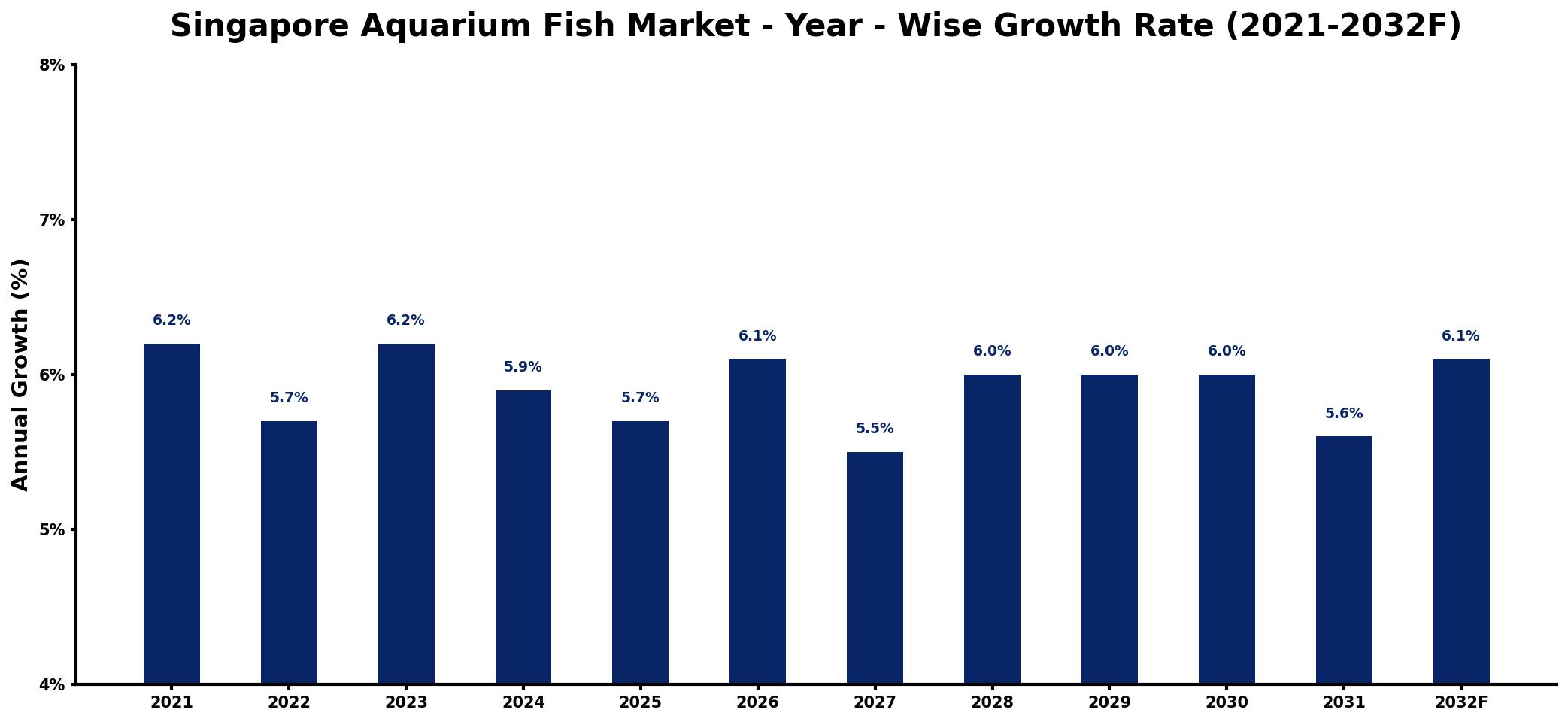
The table below presents the year‑wise growth rates along with the key drivers influencing the market
| Year | Growth Rate | Major Drivers |
| 2021 | 6.2% | Rising interest in home hobbies |
| 2022 | 5.7% | Increased disposable income levels |
| 2023 | 6.2% | Expansion of e-commerce platforms |
| 2024 | 5.9% | Growth in urban gardening trends |
| 2025 | 5.7% | Surge in pet ownership rates |
| 2026 | 6.1% | Enhanced focus on sustainability practices |
| 2027 | 5.5% | Development of new supply chains |
| 2028 | 6.0% | Emergence of niche market segments |
| 2029 | 6.0% | Investment in eco-friendly technologies |
| 2030 | 6.0% | Growth of educational programs |
| 2031 | 5.6% | Increase in community engagement initiatives |
| 2032 | 6.1% | increased capital investment inflows |
Note: Market size estimations and growth projections presented in this report are based on 6Wresearch's proprietary forecasting methodology, utilizing the latest available industry data, government publications, and primary research inputs.
Singapore Aquarium Fish Market Synopsis
The Singapore aquarium fish market has demonstrated robust resilience amidst fluctuating economic conditions, supported by a strong base of devoted hobbyists. Increasing urbanization and interest in home aquariums have placed ornamental fish at the forefront of leisure activities in Singapore.
Moreover, the emphasis on sustainability is becoming crucial as consumers grow more aware of environmental impacts. The need for sustainable sourcing and adherence to international trade regulations is reshaping market dynamics, ensuring the continued success of this vibrant sector.
Singapore Aquarium Fish Market Key Takeaways
- The market is projected to grow significantly, influenced by the popularity of aquarium hobbyists.
- Innovations in fish breeding techniques are enhancing species diversity available in the market.
- Focus on sustainable practices is reshaping supplier strategies to meet consumer preferences.
- Public aquariums and aquascaping trends are driving demand for exotic fish species.
- The local pet ownership trend continues to support robust market growth.
Evaluation of Restraints in Singapore Aquarium Fish Market
Despite its growth potential, the Singapore aquarium fish market contends with significant restraints. A major challenge lies in its dependency on imports, rendering it vulnerable to supply chain disruptions that can affect product availability and pricing. Additionally, the pressure to maintain species diversity while adhering to conservation efforts poses another hurdle. Ensuring compliance with sustainability practices is essential, as todays eco-conscious consumers demand transparency and responsible sourcing from their suppliers.
Singapore Aquarium Fish Market Trends
The aquarium fish market is currently experiencing several key trends. An increasing number of hobbyists are venturing into aquascaping, blending artistry with fishkeeping to create visually stunning aquatic environments. Furthermore, advancements in breeding technology are resulting in a broader selection of exotic fish, catering to the niche market. Another notable trend is the rise of online platforms for purchasing aquarium fish, which offers convenience and a wider variety of choices for consumers.
Singapore Aquarium Fish Market Opportunities
Significant growth and investment opportunities exist in the Singapore aquarium fish market, particularly in areas like sustainable fish farming and eco-friendly aquarium products. Innovations in breeding programs that emphasize biodiversity can open new revenue streams. Additionally, the development of community initiatives and educational programs about responsible fishkeeping can foster a deeper appreciation for the hobby and drive consumer engagement.
Government Initiatives in the Singapore Aquarium Fish Market
The Singapore government plays a pivotal role in supporting the aquarium fish market through various initiatives aimed at promoting sustainability and conservation. Policies focused on enhancing regulatory frameworks for imports, along with programs that encourage sustainable aquaculture practices, are designed to protect marine biodiversity. Additionally, public spending on environmental education and conservation awareness is crucial for fostering responsible consumer behavior within the market.
Future Insights of the Singapore Aquarium Fish Market
Looking ahead to 2026-2032, the Singapore aquarium fish market is anticipated to undergo further evolution, driven by an increasingly discerning consumer base. The ongoing demand for sustainable practices will shape business strategies as suppliers work to enhance transparency in sourcing and breeding. Furthermore, technological advancements in online retail and fish farming will streamline operations and improve accessibility for hobbyists. Ultimately, the market's future will hinge on balancing consumer desires with environmental responsibilities.
Singapore Aquarium Fish Market Latest Developments (2025 - 2026)
Recent developments in the Singapore aquarium fish market indicate a shift towards sustainability and ethical sourcing. Industry players are increasingly adopting eco-friendly practices while enhancing the quality and diversity of available species. Additionally, there is a noticeable rise in consumer engagement through educational programs and community initiatives that promote responsible fishkeeping and conservation efforts.
Singapore Aquarium Fish Market - Key Attractiveness of the Report
- 10 Years of Market Numbers
- Historical Data Starting from 2022 to 2025
- Base Year: 2025
- Forecast Data until 2032
- Key Performance Indicators Impacting the Market
- Major Upcoming Developments and Projects
Key Highlights of the Report:
- Singapore Aquarium Fish Market Outlook
- Market Size of Singapore Aquarium Fish Market, 2025
- Forecast of Singapore Aquarium Fish Market, 2032
- Historical Data and Forecast of Singapore Aquarium Fish Revenues & Volume for the Period 2022-2032F
- Singapore Aquarium Fish Market Trend Evolution
- Singapore Aquarium Fish Market Drivers and Challenges
- Singapore Aquarium Fish Price Trends
- Singapore Aquarium Fish Porter's Five Forces
- Singapore Aquarium Fish Industry Life Cycle
- Historical Data and Forecast of Singapore Aquarium Fish Market Revenues & Volume By Type for the Period 2022-2032F
- Historical Data and Forecast of Singapore Aquarium Fish Market Revenues & Volume By Freshwater Fish for the Period 2022-2032F
- Historical Data and Forecast of Singapore Aquarium Fish Market Revenues & Volume By Saltwater Fish for the Period 2022-2032F
- Historical Data and Forecast of Singapore Aquarium Fish Market Revenues & Volume By Application for the Period 2022-2032F
- Historical Data and Forecast of Singapore Aquarium Fish Market Revenues & Volume By Commercial Aquarium for the Period 2022-2032F
- Historical Data and Forecast of Singapore Aquarium Fish Market Revenues & Volume By Home Aquarium for the Period 2022-2032F
- Singapore Aquarium Fish Import Export Trade Statistics
- Market Opportunity Assessment By Type
- Market Opportunity Assessment By Application
- Singapore Aquarium Fish Top Companies Market Share
- Singapore Aquarium Fish Competitive Benchmarking By Technical and Operational Parameters
- Singapore Aquarium Fish Company Profiles
- Singapore Aquarium Fish Key Strategic Recommendations






































