Singapore Artificial Flowers Market: Import Trend Analysis
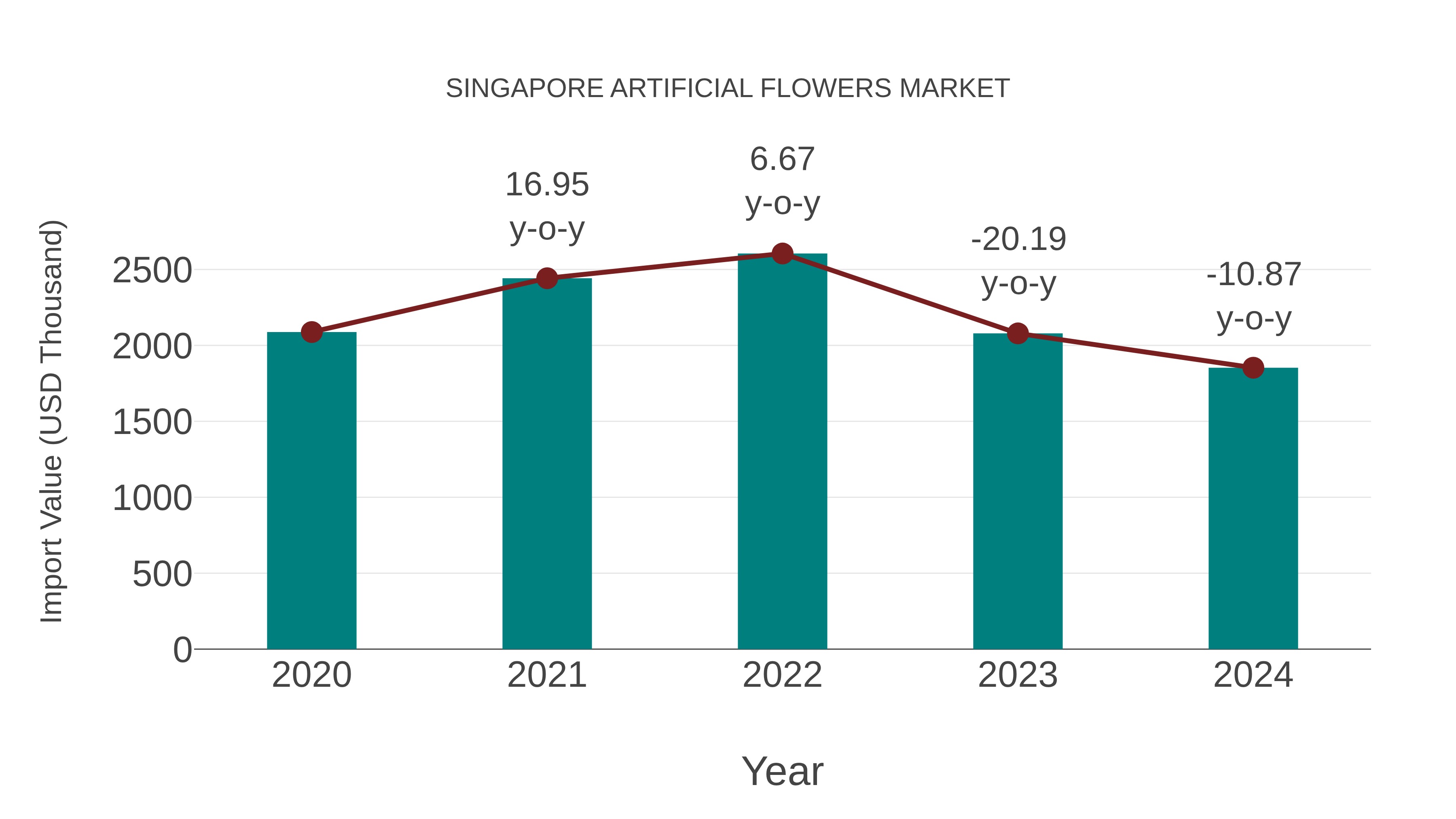
Singapore`s artificial flowers market witnessed a declining import trend from 2023 to 2024, with a growth rate of -10.87% during this period. The compound annual growth rate (CAGR) for imports from 2020 to 2024 stood at -2.94%. This decline could be attributed to shifting consumer preferences, changes in trade policies, or market saturation impacting demand dynamics.
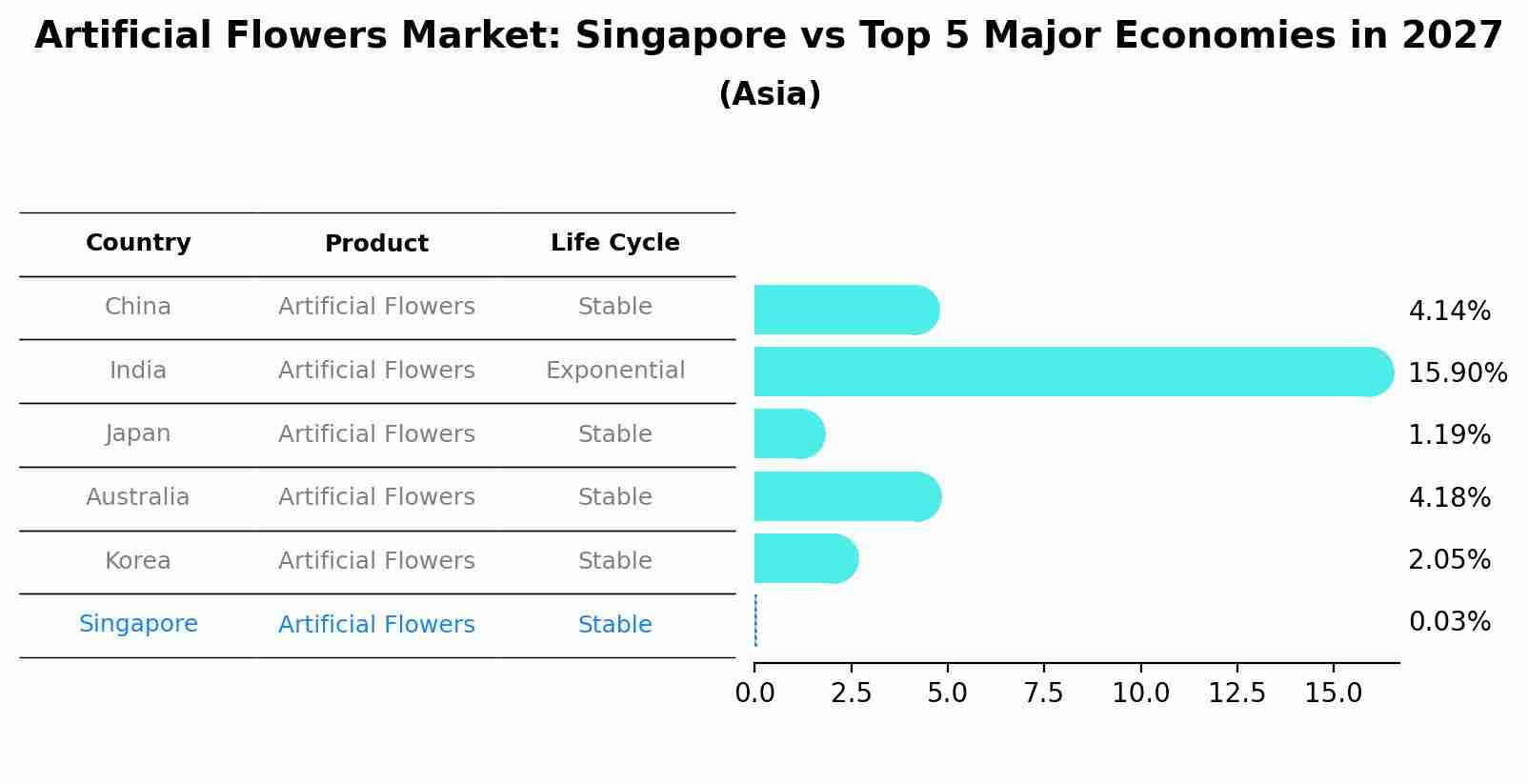
Artificial Flowers Market: Singapore vs Top 5 Major Economies in 2027 (Asia)
In the Asia region, the Artificial Flowers market in Singapore is projected to expand at a stable growth rate of 0.03% by 2027. The largest economy is China, followed by India, Japan, Australia and South Korea.
Singapore Artificial Flowers Market Synopsis
The artificial flowers market in Singapore is expected to experience growth as consumers and businesses seek decorative and low-maintenance floral arrangements for various occasions and interior decor. Artificial flowers offer long-lasting beauty without the need for watering or maintenance. The market`s expansion is driven by the desire for aesthetically pleasing and durable floral solutions.
Drivers of the Market
The growth of the Singapore artificial flowers market is driven by factors such as home decor, event planning, and floral arrangements. Artificial flowers offer a lasting and low-maintenance alternative to fresh flowers for various occasions and decor. Growth drivers encompass the demand for lifelike and customizable artificial flower designs, innovations in materials for realism and durability, and applications in home decoration, weddings, and event styling. As consumers seek floral solutions that require no maintenance, the artificial flowers market is expected to grow, providing essential decorative elements for diverse settings.
Challenges of the Market
The artificial flowers market in Singapore encounters challenges concerning design trends and material sustainability. Consumers seek artificial flowers that offer aesthetic appeal and long-lasting beauty. Staying up-to-date with design trends and providing sustainable artificial flower options is crucial for market competitiveness.
COVID-19 Impact on the Market
The artificial flowers market in Singapore experienced changes during the COVID-19 pandemic. With a focus on home decor and aesthetics, there was increased demand for artificial floral arrangements. Manufacturers adapted by offering lifelike and customizable artificial flower products. The pandemic accelerated the trend of interior design and home improvement, influencing market strategies.
Key Players in the Market
Key players in the Singapore artificial flowers market, including Nearly Natural, Inc., Winward International, Inc., and The Creative Branch, specialize in manufacturing and distributing artificial flowers and floral arrangements for decorative purposes. Their commitment to floral design and quality craftsmanship positions them as major contributors to this sector.
Key Highlights of the Report:
- Singapore Artificial Flowers Market Outlook
- Market Size of Singapore Artificial Flowers Market, 2025
- Forecast of Singapore Artificial Flowers Market, 2032
- Historical Data and Forecast of Singapore Artificial Flowers Revenues & Volume for the Period 2022-2032F
- Singapore Artificial Flowers Market Trend Evolution
- Singapore Artificial Flowers Market Drivers and Challenges
- Singapore Artificial Flowers Price Trends
- Singapore Artificial Flowers Porter's Five Forces
- Singapore Artificial Flowers Industry Life Cycle
- Historical Data and Forecast of Singapore Artificial Flowers Market Revenues & Volume By Material Type for the Period 2022-2032F
- Historical Data and Forecast of Singapore Artificial Flowers Market Revenues & Volume By Clay & Porcelain for the Period 2022-2032F
- Historical Data and Forecast of Singapore Artificial Flowers Market Revenues & Volume By Cotton & Silk for the Period 2022-2032F
- Historical Data and Forecast of Singapore Artificial Flowers Market Revenues & Volume By Leather & Nylon for the Period 2022-2032F
- Historical Data and Forecast of Singapore Artificial Flowers Market Revenues & Volume By Paper & Wax for the Period 2022-2032F
- Historical Data and Forecast of Singapore Artificial Flowers Market Revenues & Volume By Plastic & Polyester for the Period 2022-2032F
- Historical Data and Forecast of Singapore Artificial Flowers Market Revenues & Volume By Application for the Period 2022-2032F
- Historical Data and Forecast of Singapore Artificial Flowers Market Revenues & Volume By Commercial for the Period 2022-2032F
- Historical Data and Forecast of Singapore Artificial Flowers Market Revenues & Volume By Residential for the Period 2022-2032F
- Singapore Artificial Flowers Import Export Trade Statistics
- Market Opportunity Assessment By Material Type
- Market Opportunity Assessment By Application
- Singapore Artificial Flowers Top Companies Market Share
- Singapore Artificial Flowers Competitive Benchmarking By Technical and Operational Parameters
- Singapore Artificial Flowers Company Profiles
- Singapore Artificial Flowers Key Strategic Recommendations






































