Singapore Artificial Intelligence in Accounting Market Size & Growth Rate (2026-2032)
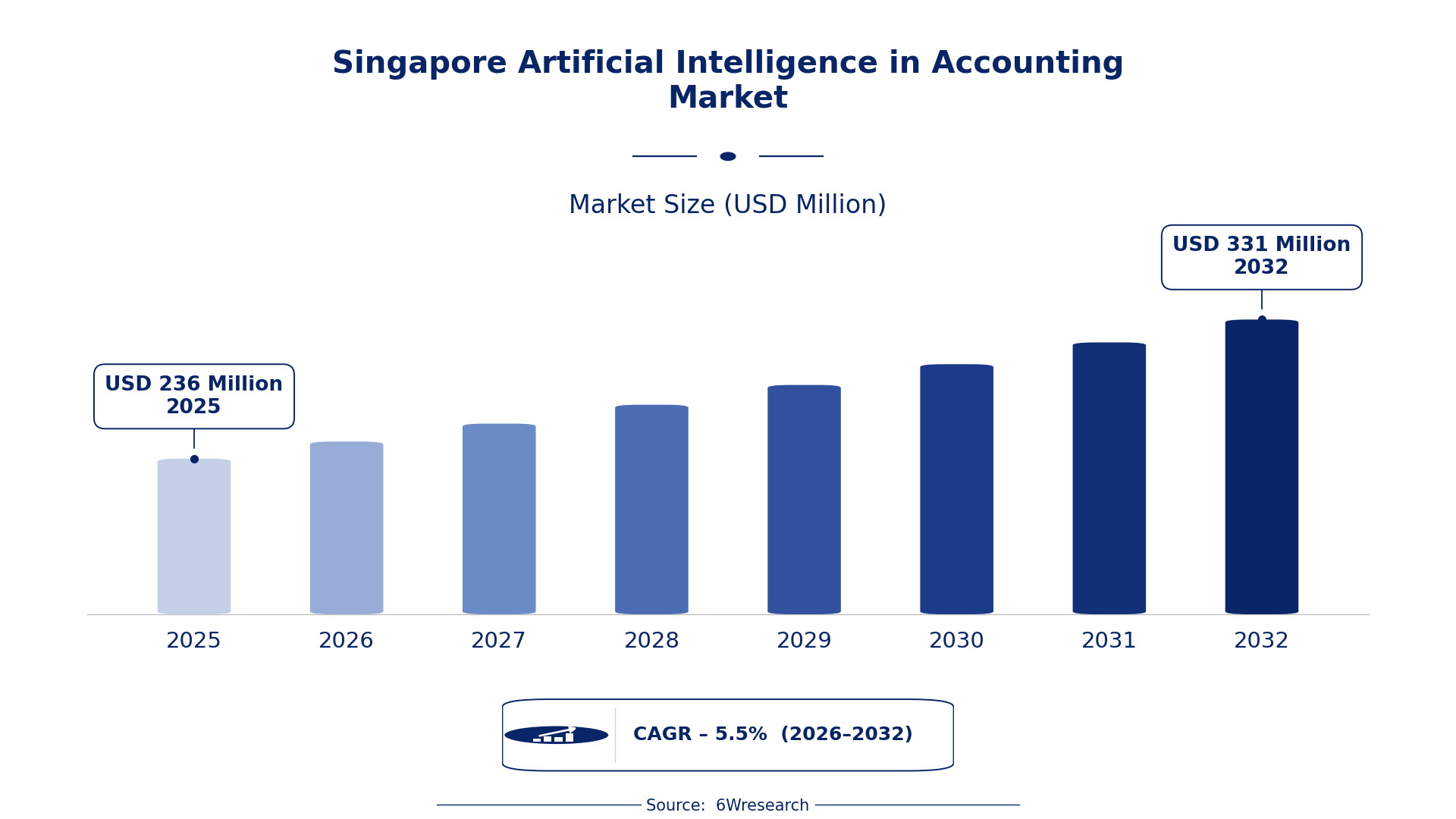
The Singapore Artificial Intelligence in Accounting Market was estimated at USD 236 Million in 2025 and is projected to reach USD 331 Million by 2032, growing at a CAGR of 5.5% from 2026 to 2032.
Singapore Artificial Intelligence in Accounting Market Synopsis
The demand for automation within financial practices has surged in Singapore, as organizations strive for efficiency and accuracy in their accounting processes. Artificial intelligence tools are transforming traditional accounting, enabling firms to automate tedious tasks like data entry and reconciliation, thereby reducing the risk of human error.
In this competitive financial landscape, AI in accounting is not just an option but a necessity. Companies recognize that implementing AI-driven solutions enhances compliance and facilitates better decision-making, crucial for navigating the highly regulated environment of Singapore.
Singapore Artificial Intelligence in Accounting Market Year-wise Growth Rate and Key Drivers
This graph illustrates the annual growth rates of the Singapore Artificial Intelligence in Accounting Market from 2021 to 2032, highlighting a steady upward trajectory and projected expansion over the forecast period.
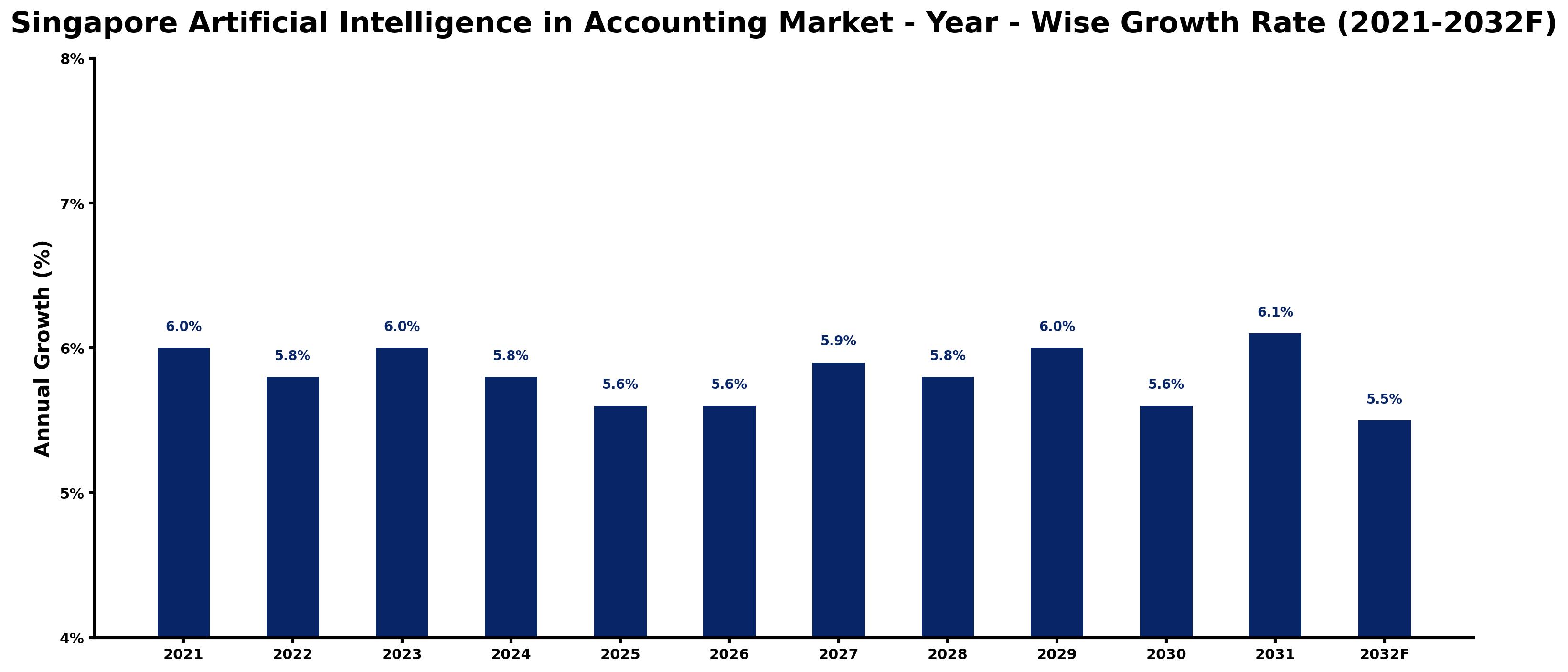
The table below presents the year‑wise growth rates along with the key drivers influencing the market
| Year | Growth Rate | Major Drivers |
| 2021 | 6.0% | MAS supports AI innovation in accounting sector advancements. |
| 2022 | 5.8% | Increased adoption of XBRL standards by local firms. |
| 2023 | 6.0% | Government grants boost AI integration in accounting practices. |
| 2024 | 5.8% | Surge in freelance accountants utilizing AI tools. |
| 2025 | 5.6% | Growing emphasis on digital transformation in accounting firms. |
| 2026 | 5.6% | UOB fosters AI adoption through local fintech partnerships. |
| 2027 | 5.9% | Intensified training programs for AI skills in finance. |
| 2028 | 5.8% | Tax incentives for companies integrating AI technologies. |
| 2029 | 6.0% | Rising venture capital investments in AI accounting startups. |
| 2030 | 5.6% | Public sector projects enhance AI capabilities in finance. |
| 2031 | 6.1% | Ongoing collaboration between universities and fintech in AI. |
| 2032 | 5.5% | Increased client demand for AI-driven audit efficiencies. |
Note: Market size estimations and growth projections presented in this report are based on 6Wresearch's proprietary forecasting methodology, utilizing the latest available industry data, government publications, and primary research inputs.
Singapore Artificial Intelligence in Accounting Market Key Takeaways
Below are some of the specific key takeaways from the market, including:
- The market is rapidly expanding due to the increasing need for financial automation.
- AI tools are significantly enhancing accuracy and compliance in accounting tasks.
- Professionals face challenges in adapting to new AI technologies.
- COVID-19 accelerated the adoption of AI in accounting practices.
- Key players are innovating to meet the growing demand for AI-driven solutions.
Evaluation of Restraints in Singapore Artificial Intelligence in Accounting Market
Despite the market's growth potential, several restraints impede its advancement. Chief among them is the regulatory landscape that governs financial practices in Singapore. Organizations must navigate complex compliance requirements while integrating AI technologies, which can be cumbersome. Additionally, concerns around data security pose significant challenges as firms grapple with safeguarding sensitive financial information against cyber threats. The transition for accounting professionals to embrace AI solutions also requires a commitment to training and adaptation, which can slow down the overall market momentum.
Singapore Artificial Intelligence in Accounting Market Trends
Key trends influencing the market include a shift towards cloud-based accounting solutions, which allow for greater scalability and accessibility. Organizations are increasingly seeking AI tools that not only automate but also provide predictive analytics, enabling better financial forecasting. Additionally, there is a growing emphasis on ethical AI use, as businesses strive for transparency in how AI algorithms operate within financial contexts.
Singapore Artificial Intelligence in Accounting Market Opportunities
The market presents substantial growth opportunities, particularly in sectors that are traditionally slower to adopt technology. Small and medium-sized enterprises (SMEs) are increasingly recognizing the benefits of AI, creating a fertile ground for vendors offering tailored solutions. on top of that, advancements in natural language processing are paving the way for more intuitive AI interfaces, making it easier for non-technical users to engage with accounting tools.
Government Initiatives in the Singapore Artificial Intelligence in Accounting Market
The Singapore government is actively promoting the integration of AI technologies across various sectors, including accounting. By establishing a clear regulatory framework and offering support for digital transformation, the government is facilitating an environment conducive to innovation. This support is crucial as businesses seek to leverage AI for enhanced financial management amidst stringent compliance requirements.
- A national initiative launched in 2022 focused on upskilling professionals in AI technologies, ensuring that the workforce is equipped to handle new tools in accounting.
- Currently ongoing is a regulatory review aimed at updating compliance guidelines to incorporate AI-driven solutions in financial practices.
- Planned for 2026 is a public-private partnership designed to encourage the development of AI startups in the accounting sector, fostering innovation and collaboration.
- A completed framework introduced in late 2023 mandates the use of AI for specific compliance-related tasks within the accounting sector.
- In 2024, the government initiated an awareness campaign to highlight the benefits of AI in accounting, targeting small businesses.
Future Insights of the Singapore Artificial Intelligence in Accounting Market
Looking ahead to 2026-2032, the Singapore Artificial Intelligence in Accounting market is expected to evolve significantly. As AI technologies advance, firms will not only enhance their operational efficiencies but also gain deeper insights into their financial health. The integration of AI with blockchain technology may also emerge, offering enhanced security and transparency in financial transactions. Ultimately, organizations that adopt these innovations will likely maintain a competitive edge in the rapidly changing financial environment.
Singapore Artificial Intelligence in Accounting Market Latest Developments
Recent industry activity in the Singapore Artificial Intelligence in Accounting market has centered around the adoption of advanced AI solutions. Companies are increasingly investing in technology that streamlines accounting processes and enhances accuracy. The push for remote capabilities, accelerated by the pandemic, has further fueled this trend.
- A major technology vendor announced a partnership in early 2025 with local firms to develop AI-driven tools tailored for the Singapore accounting sector.
- A leading regional operator launched an AI-powered financial forecasting tool in late 2024, enhancing predictive analytics capabilities for businesses.
- An initiative that began in mid-2025 is currently underway, focusing on integrating AI solutions into educational programs for accounting professionals.
- In Q3 2025, a new AI-driven software suite designed to automate compliance reporting was introduced, aimed at easing the regulatory burden on firms.
- Upcoming in 2026 is a rollout of an AI-based auditing solution expected to improve accuracy and efficiency in financial audits.
Singapore Artificial Intelligence in Accounting Market - Key Attractiveness of the Report
- 10 Years of Market Numbers
- Historical Data Starting from 2022 to 2025
- Base Year: 2025
- Forecast Data until 2032
- Key Performance Indicators Impacting the Market
- Major Upcoming Developments and Projects
Key Highlights of the Report:
- Singapore Artificial Intelligence in Accounting Market Outlook
- Market Size of Singapore Artificial Intelligence in Accounting Market, 2025
- Forecast of Singapore Artificial Intelligence in Accounting Market, 2032
- Historical Data and Forecast of Singapore Artificial Intelligence in Accounting Revenues & Volume for the Period 2022-2032F
- Singapore Artificial Intelligence in Accounting Market Trend Evolution
- Singapore Artificial Intelligence in Accounting Market Drivers and Challenges
- Singapore Artificial Intelligence in Accounting Price Trends
- Singapore Artificial Intelligence in Accounting Porter's Five Forces
- Singapore Artificial Intelligence in Accounting Industry Life Cycle
- Historical Data and Forecast of Singapore Artificial Intelligence in Accounting Market Revenues & Volume By Application for the Period 2022-2032F
- Historical Data and Forecast of Singapore Artificial Intelligence in Accounting Market Revenues & Volume By Automated Bookkeeping for the Period 2022-2032F
- Historical Data and Forecast of Singapore Artificial Intelligence in Accounting Market Revenues & Volume By Invoice Classification and Approvals for the Period 2022-2032F
- Historical Data and Forecast of Singapore Artificial Intelligence in Accounting Market Revenues & Volume By Fraud and Risk Management for the Period 2022-2032F
- Historical Data and Forecast of Singapore Artificial Intelligence in Accounting Market Revenues & Volume By Reporting for the Period 2022-2032F
- Historical Data and Forecast of Singapore Artificial Intelligence in Accounting Market Revenues & Volume By Others for the Period 2022-2032F
- Historical Data and Forecast of Singapore Artificial Intelligence in Accounting Market Revenues & Volume By Component for the Period 2022-2032F
- Historical Data and Forecast of Singapore Artificial Intelligence in Accounting Market Revenues & Volume By Solutions for the Period 2022-2032F
- Historical Data and Forecast of Singapore Artificial Intelligence in Accounting Market Revenues & Volume By Services for the Period 2022-2032F
- Historical Data and Forecast of Singapore Artificial Intelligence in Accounting Market Revenues & Volume By Technology for the Period 2022-2032F
- Historical Data and Forecast of Singapore Artificial Intelligence in Accounting Market Revenues & Volume By Machine Learning (ML) and Deep Learning for the Period 2022-2032F
- Historical Data and Forecast of Singapore Artificial Intelligence in Accounting Market Revenues & Volume By NLP for the Period 2022-2032F
- Historical Data and Forecast of Singapore Artificial Intelligence in Accounting Market Revenues & Volume By Deployment Mode for the Period 2022-2032F
- Historical Data and Forecast of Singapore Artificial Intelligence in Accounting Market Revenues & Volume By On-premises for the Period 2022-2032F
- Historical Data and Forecast of Singapore Artificial Intelligence in Accounting Market Revenues & Volume By Cloud for the Period 2022-2032F
- Historical Data and Forecast of Singapore Artificial Intelligence in Accounting Market Revenues & Volume By Enterprise Size for the Period 2022-2032F
- Historical Data and Forecast of Singapore Artificial Intelligence in Accounting Market Revenues & Volume By Large Enterprises for the Period 2022-2032F
- Historical Data and Forecast of Singapore Artificial Intelligence in Accounting Market Revenues & Volume By Small and Medium-Sized Enterprises (SMEs) for the Period 2022-2032F
- Singapore Artificial Intelligence in Accounting Import Export Trade Statistics
- Market Opportunity Assessment By Application
- Market Opportunity Assessment By Component
- Market Opportunity Assessment By Technology
- Market Opportunity Assessment By Deployment Mode
- Market Opportunity Assessment By Enterprise Size
- Singapore Artificial Intelligence in Accounting Top Companies Market Share
- Singapore Artificial Intelligence in Accounting Competitive Benchmarking By Technical and Operational Parameters
- Singapore Artificial Intelligence in Accounting Company Profiles
- Singapore Artificial Intelligence in Accounting Key Strategic Recommendations






































