Singapore Artificial Wood Beams Market Size, Share & Growth Rate
The Singapore Artificial Wood Beams Market was estimated at USD 219 Million in 2025 and is projected to reach USD 301 Million by 2032, growing at a CAGR of 4.6% from 2026 to 2032. This growth is largely attributed to the ongoing urbanization and infrastructure expansion initiatives across Singapore, which have stimulated demand in both the construction and interior design sectors. Additionally, the rising preference for sustainable and cost-effective materials is driving builders and architects to increasingly opt for artificial wood beams over traditional options.
Singapore Artificial Wood Beams Market Year-wise Growth Rate and Key Drivers
This graph highlights how the Singapore Artificial Wood Beams Market has steadily grown over the years, supported by major growth factors.
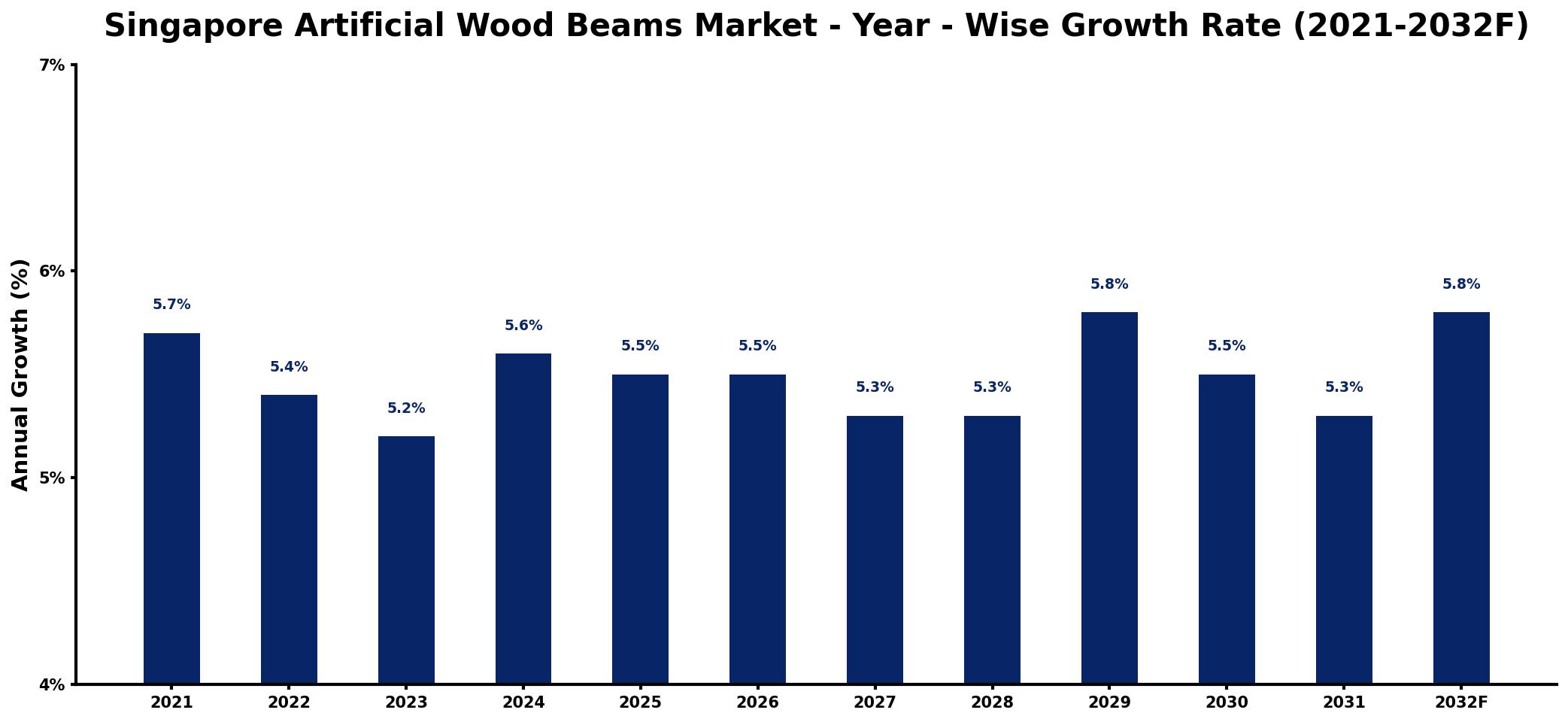
The table below presents the year‑wise growth rates along with the key drivers influencing the market
| Year | Growth Rate | Major Drivers |
| 2021 | 5.7% | increased construction activity nationwide |
| 2022 | 5.4% | growing popularity of sustainable materials |
| 2023 | 5.2% | rise in home renovation projects |
| 2024 | 5.6% | expansion of commercial real estate |
| 2025 | 5.5% | increased investments in infrastructure |
| 2026 | 5.5% | growing demand for eco-friendly solutions |
| 2027 | 5.3% | emergence of innovative building techniques |
| 2028 | 5.3% | surge in residential developments |
| 2029 | 5.8% | growth in green building certifications |
| 2030 | 5.5% | increased consumer awareness sustainability |
| 2031 | 5.3% | rising demand for aesthetic solutions |
| 2032 | 5.8% | growing commercial sector adoption |
Note: Market size estimations and growth projections presented in this report are based on 6Wresearch's proprietary forecasting methodology, utilizing the latest available industry data, government publications, and primary research inputs.
Singapore Artificial Wood Beams Market Synopsis
In Singapore, the use of artificial wood beams is becoming a popular choice among architects and builders, particularly for renovations and new construction projects aimed at blending modern aesthetics with classic designs. Their versatility allows for wide-ranging applications, from residential homes to commercial buildings, enhancing both functionality and visual appeal.
Moreover, with the rapid development of eco-friendly products, manufacturers are increasingly offering customizable solutions that cater to the specific design requirements of projects. This focus on sustainability and innovation is attracting significant interest from a variety of stakeholders in the construction industry.
Singapore Artificial Wood Beams Market Key Takeaways
- Demand in the artificial wood beams market is primarily driven by construction and interior design sectors.
- Growing preference for eco-friendly materials is shaping product offerings and innovations.
- Artificial wood beams provide an attractive blend of aesthetics and functionality, enhancing various building designs.
- Technological advancements are leading to the development of customizable and sustainable wood beam solutions.
- The market is witnessing a recovery post-COVID-19 as construction projects resume at scale.
Evaluation of Restraints in Singapore Artificial Wood Beams Market
Despite the promising growth trajectory, the Singapore Artificial Wood Beams Market faces several restraints that could hinder its full potential. One significant challenge is the increasing competition from alternative construction materials, such as steel and concrete, which are often perceived as more durable and versatile. As the market shifts towards greener building solutions, manufacturers of artificial wood beams must constantly innovate to meet changing regulatory standards and consumer preferences. Furthermore, fluctuations in raw material prices could also impact profitability and production capabilities, requiring careful management to maintain competitiveness in this evolving market.
Singapore Artificial Wood Beams Market Trends
Current trends in the Singapore Artificial Wood Beams Market reflect a growing inclination toward sustainability, with increasing emphasis on eco-friendly materials. The push for energy-efficient buildings is prompting more builders to explore artificial wood beams, which offer enhanced insulation properties compared to traditional materials. Additionally, a notable rise in demand for unique design aesthetics is encouraging manufacturers to introduce bespoke solutions, thus providing greater flexibility in architectural applications.
Singapore Artificial Wood Beams Market Opportunities
The Singapore Artificial Wood Beams Market presents numerous opportunities for growth and investment. Emerging trends such as smart home technologies and the integration of artificial wood beams into energy-efficient designs are paving the way for innovative product developments. Furthermore, the increasing focus on green certifications in building projects offers a fertile ground for manufacturers specializing in sustainable wood products. This evolving landscape is ripe for companies willing to invest in research and development, tailoring their offerings to meet future demands.
Government Initiatives in the Singapore Artificial Wood Beams Market
The Singaporean government is actively promoting sustainable building practices through various initiatives aimed at enhancing the adoption of eco-friendly materials in construction. Public spending on infrastructure projects includes incentives for builders to utilize sustainable products, which not only reduces environmental impact but also aligns with national goals for urban development. Additionally, regulatory frameworks are increasingly favoring innovative materials, supporting the growth of the artificial wood beams market.
Future Insights of the Singapore Artificial Wood Beams Market
Looking ahead to the 2026-2032 period, the Singapore Artificial Wood Beams Market is poised for substantial growth driven by continuous innovation and an unwavering focus on sustainability. As urban development projects increase, the demand for versatile, aesthetically pleasing, and environmentally friendly building materials will likely remain strong. Furthermore, advancements in manufacturing processes and materials technology will enable the production of high-quality artificial wood beams that meet the evolving needs of builders and architects, ensuring a robust and dynamic market environment.
Singapore Artificial Wood Beams Market Latest Developments (2025 - 2026)
In recent months, the industry has witnessed a significant shift towards innovation, with several companies launching new product lines featuring enhanced durability and eco-friendly materials. Additionally, collaborations between manufacturers and architectural firms are on the rise, fostering a creative environment that encourages the integration of artificial wood beams in diverse design projects. The recovery of construction activities post-pandemic has further fueled investments in new technologies and sustainable practices.
Singapore Artificial Wood Beams Market - Key Attractiveness of the Report
- 10 Years of Market Numbers
- Historical Data Starting from 2022 to 2025
- Base Year: 2025
- Forecast Data until 2032
- Key Performance Indicators Impacting the Market
- Major Upcoming Developments and Projects
Key Highlights of the Report:
- Singapore Artificial Wood Beams Market Outlook
- Market Size of Singapore Artificial Wood Beams Market, 2025
- Forecast of Singapore Artificial Wood Beams Market, 2032
- Historical Data and Forecast of Singapore Artificial Wood Beams Revenues & Volume for the Period 2022-2032F
- Singapore Artificial Wood Beams Market Trend Evolution
- Singapore Artificial Wood Beams Market Drivers and Challenges
- Singapore Artificial Wood Beams Price Trends
- Singapore Artificial Wood Beams Porter's Five Forces
- Singapore Artificial Wood Beams Industry Life Cycle
- Historical Data and Forecast of Singapore Artificial Wood Beams Market Revenues & Volume By Product Type for the Period 2022-2032F
- Historical Data and Forecast of Singapore Artificial Wood Beams Market Revenues & Volume By U-shaped Beams for the Period 2022-2032F
- Historical Data and Forecast of Singapore Artificial Wood Beams Market Revenues & Volume By Box Beams for the Period 2022-2032F
- Historical Data and Forecast of Singapore Artificial Wood Beams Market Revenues & Volume By Arched Beams for the Period 2022-2032F
- Historical Data and Forecast of Singapore Artificial Wood Beams Market Revenues & Volume By Decorative Beams for the Period 2022-2032F
- Historical Data and Forecast of Singapore Artificial Wood Beams Market Revenues & Volume By Others for the Period 2022-2032F
- Historical Data and Forecast of Singapore Artificial Wood Beams Market Revenues & Volume By Material Type for the Period 2022-2032F
- Historical Data and Forecast of Singapore Artificial Wood Beams Market Revenues & Volume By Thermoplastic for the Period 2022-2032F
- Historical Data and Forecast of Singapore Artificial Wood Beams Market Revenues & Volume By Thermosetting for the Period 2022-2032F
- Historical Data and Forecast of Singapore Artificial Wood Beams Market Revenues & Volume By Others for the Period 2022-2032F
- Historical Data and Forecast of Singapore Artificial Wood Beams Market Revenues & Volume By End Users for the Period 2022-2032F
- Historical Data and Forecast of Singapore Artificial Wood Beams Market Revenues & Volume By Residential for the Period 2022-2032F
- Historical Data and Forecast of Singapore Artificial Wood Beams Market Revenues & Volume By Commercial for the Period 2022-2032F
- Singapore Artificial Wood Beams Import Export Trade Statistics
- Market Opportunity Assessment By Product Type
- Market Opportunity Assessment By Material Type
- Market Opportunity Assessment By End Users
- Singapore Artificial Wood Beams Top Companies Market Share
- Singapore Artificial Wood Beams Competitive Benchmarking By Technical and Operational Parameters
- Singapore Artificial Wood Beams Company Profiles
- Singapore Artificial Wood Beams Key Strategic Recommendations






































