Singapore Automotive Brake Pads Market Size Growth Rate
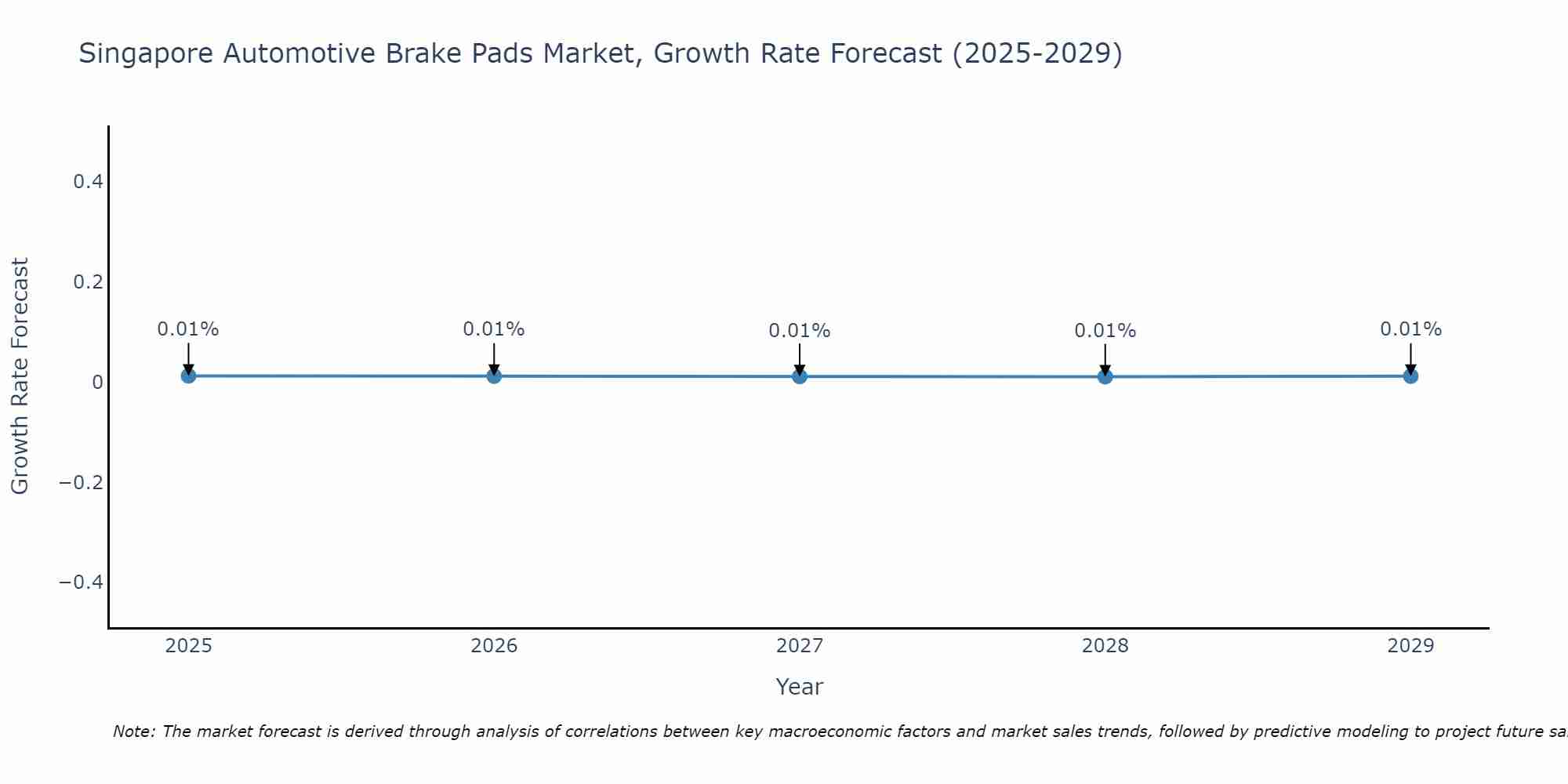
The Singapore Automotive Brake Pads Market is projected to witness mixed growth rate patterns during 2025 to 2029. Starting high at 0.01% in 2025, the market steadily declines to 0.01% by 2029.
Automotive Brake Pads Market: Singapore vs Top 5 Major Economies in 2027 (Asia)
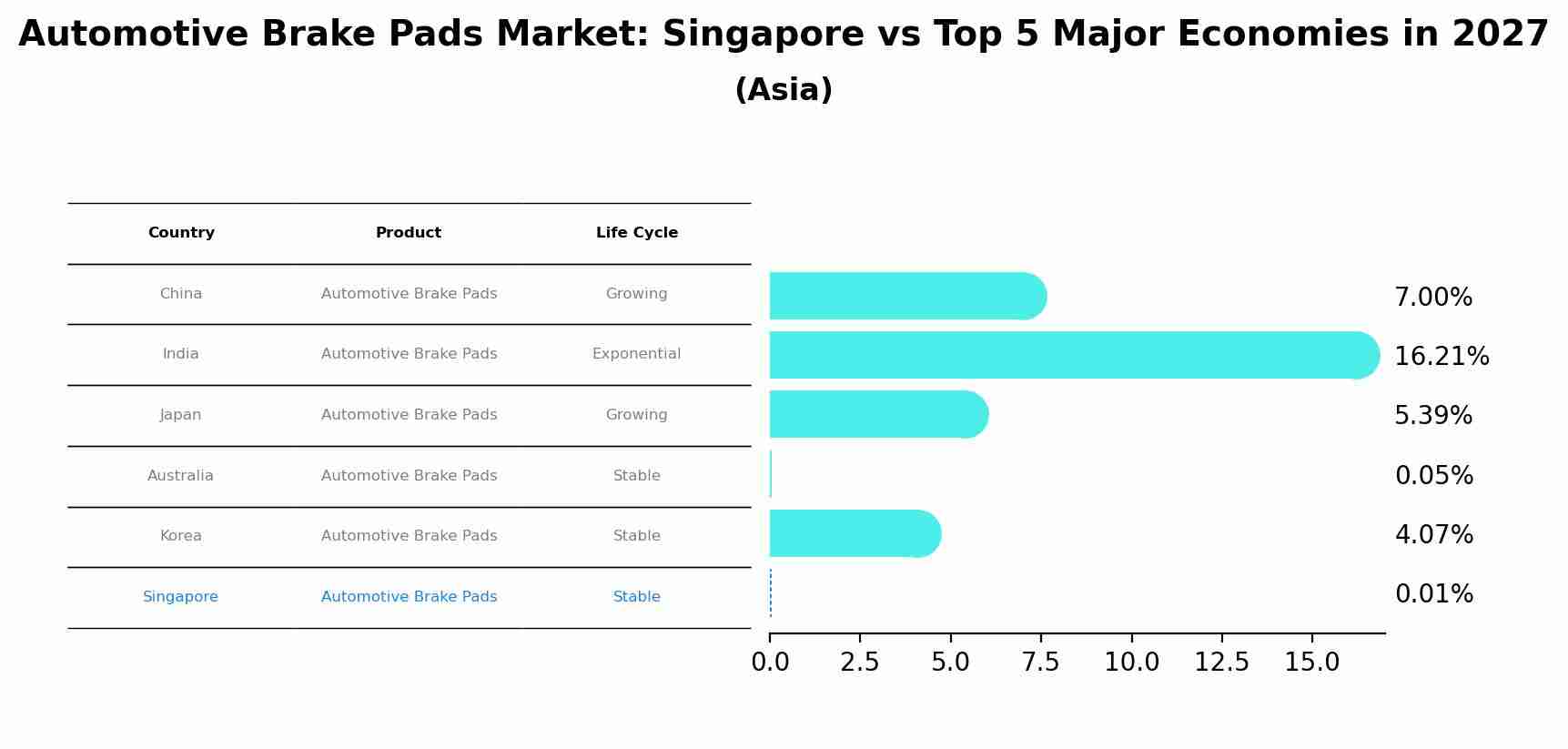
Singapore's Automotive Brake Pads market is anticipated to experience a stable growth rate of 0.01% by 2027, reflecting trends observed in the largest economy China, followed by India, Japan, Australia and South Korea.
Singapore Automotive Brake Pads Market Synopsis
The Singapore automotive brake pads market is influenced by the automotive industry`s trends and advancements. Brake pads are integral to ensuring safe and reliable braking performance in vehicles. The market`s trajectory is driven by factors such as vehicle innovation, safety standards, and consumer preferences. With the growing emphasis on electric and hybrid vehicles, brake pad manufacturers are adapting their products to suit the unique braking characteristics of these vehicles. Market trends include the development of low-noise, low-dust, and high-performance brake pads that meet the demands of modern vehicles and enhance overall driving experience.
Drivers of the Market
The Singapore automotive brake pads market is experiencing robust growth, driven by various factors. Firstly, the increasing urbanization and population density in Singapore have led to a higher number of vehicles on the road, resulting in greater demand for brake pads. Secondly, strict government regulations and safety standards have heightened the emphasis on the quality and performance of brake pads, pushing manufacturers to innovate and develop advanced braking technologies. The shift towards electric and hybrid vehicles, known for their regenerative braking systems, has also fueled the demand for specialized brake pads designed to work seamlessly with these systems. Furthermore, rising environmental concerns have encouraged the adoption of eco-friendly brake pad materials that generate less dust and reduce wear on brake components. All these factors collectively contribute to the growth and evolution of the automotive brake pads market in Singapore.
Challenges of the Market
The automotive brake pads market faces challenges similar to brake linings, including evolving vehicle technology and regulatory changes. Manufacturers in this segment need to stay abreast of technological advancements in braking systems and adapt their products accordingly. Regulatory changes may also impact the composition and production of brake pads, requiring a flexible approach to manufacturing and materials sourcing.
COVID-19 Impact on the Market
The Singapore automotive brake pads market faced a downturn during the early stages of the COVID-19 pandemic. Reduced consumer spending and disrupted supply chains impacted the automotive industry, leading to a decline in new vehicle sales and aftermarket demand for brake pads. The market also faced production challenges due to lockdowns and social distancing measures. However, with the government`s efforts to revive the economy and the gradual return to normalcy, the automotive brake pads market in Singapore saw a recovery, particularly as vehicle owners resumed maintenance and replacement activities.
Key Players in the Market
In the Singapore automotive brake pads market, notable players include Jurid Brake Pads, Akebono Brake Corporation, and Wagner Brake Asia. They supply brake pads that meet safety and performance standards for different vehicle types.
Key Highlights of the Report:
- Singapore Automotive Brake Pads Market Outlook
- Market Size of Singapore Automotive Brake Pads Market, 2024
- Forecast of Singapore Automotive Brake Pads Market, 2031
- Historical Data and Forecast of Singapore Automotive Brake Pads Revenues & Volume for the Period 2021-2031
- Singapore Automotive Brake Pads Market Trend Evolution
- Singapore Automotive Brake Pads Market Drivers and Challenges
- Singapore Automotive Brake Pads Price Trends
- Singapore Automotive Brake Pads Porter's Five Forces
- Singapore Automotive Brake Pads Industry Life Cycle
- Historical Data and Forecast of Singapore Automotive Brake Pads Market Revenues & Volume By Vehicle for the Period 2021-2031
- Historical Data and Forecast of Singapore Automotive Brake Pads Market Revenues & Volume By Passenger Car for the Period 2021-2031
- Historical Data and Forecast of Singapore Automotive Brake Pads Market Revenues & Volume By LCV for the Period 2021-2031
- Historical Data and Forecast of Singapore Automotive Brake Pads Market Revenues & Volume By HCV for the Period 2021-2031
- Historical Data and Forecast of Singapore Automotive Brake Pads Market Revenues & Volume By Two-wheelers for the Period 2021-2031
- Historical Data and Forecast of Singapore Automotive Brake Pads Market Revenues & Volume By Material for the Period 2021-2031
- Historical Data and Forecast of Singapore Automotive Brake Pads Market Revenues & Volume By Semi-metallic for the Period 2021-2031
- Historical Data and Forecast of Singapore Automotive Brake Pads Market Revenues & Volume By Non-asbestos Organic (NAO) for the Period 2021-2031
- Historical Data and Forecast of Singapore Automotive Brake Pads Market Revenues & Volume By Low-metallic NAO for the Period 2021-2031
- Historical Data and Forecast of Singapore Automotive Brake Pads Market Revenues & Volume By Ceramic for the Period 2021-2031
- Historical Data and Forecast of Singapore Automotive Brake Pads Market Revenues & Volume By Sales Outlet for the Period 2021-2031
- Historical Data and Forecast of Singapore Automotive Brake Pads Market Revenues & Volume By OEM for the Period 2021-2031
- Historical Data and Forecast of Singapore Automotive Brake Pads Market Revenues & Volume By Aftermarket for the Period 2021-2031
- Historical Data and Forecast of Singapore Automotive Brake Pads Market Revenues & Volume By Position for the Period 2021-2031
- Historical Data and Forecast of Singapore Automotive Brake Pads Market Revenues & Volume By Front for the Period 2021-2031
- Historical Data and Forecast of Singapore Automotive Brake Pads Market Revenues & Volume By Front & Rear for the Period 2021-2031
- Singapore Automotive Brake Pads Import Export Trade Statistics
- Market Opportunity Assessment By Vehicle
- Market Opportunity Assessment By Material
- Market Opportunity Assessment By Sales Outlet
- Market Opportunity Assessment By Position
- Singapore Automotive Brake Pads Top Companies Market Share
- Singapore Automotive Brake Pads Competitive Benchmarking By Technical and Operational Parameters
- Singapore Automotive Brake Pads Company Profiles
- Singapore Automotive Brake Pads Key Strategic Recommendations






































