Singapore Automotive Seat Belts Market Size, Share & Growth Rate
The Singapore Automotive Seat Belts Market was estimated at USD 393 Million in 2025 and is projected to reach USD 534 Million by 2032, growing at a CAGR of 4.5% from 2026 to 2032. This growth trajectory is fundamentally supported by stringent safety regulations mandating the installation and use of seat belts, which sustains a robust demand for both new and replacement products. Additionally, increasing consumer consciousness regarding road safety is driving the adoption of advanced seat belt technologies, contributing significantly to market expansion.
Singapore Automotive Seat Belts Market Growth Rate Analysis (2021-2032)
The Singapore automotive seat belts market has exhibited stable growth, with annual increases ranging from 5.2% to 5.5% over the next decade. In 2021, the growth rate reached 5.4%, driven primarily by rising consumer safety awareness and stringent regulatory standards. A slight dip to 5.2% in 2022 was attributed to supply chain disruptions but soon rebounded to 5.5% in 2023, as manufacturers adapted to changing market demands. Continued investments in technology and infrastructure have fostered innovation in seat belt designs, enhancing safety features. Looking ahead, the growth is expected to maintain a steady pace, reflecting sustained consumer demand and an ongoing commitment to transportation safety and modernization.
Singapore Automotive Seat Belts Market Year-wise Growth Rate and Key Drivers
This graph highlights how the Singapore Automotive Seat Belts Market has steadily grown over the past five years, supported by major growth factors.
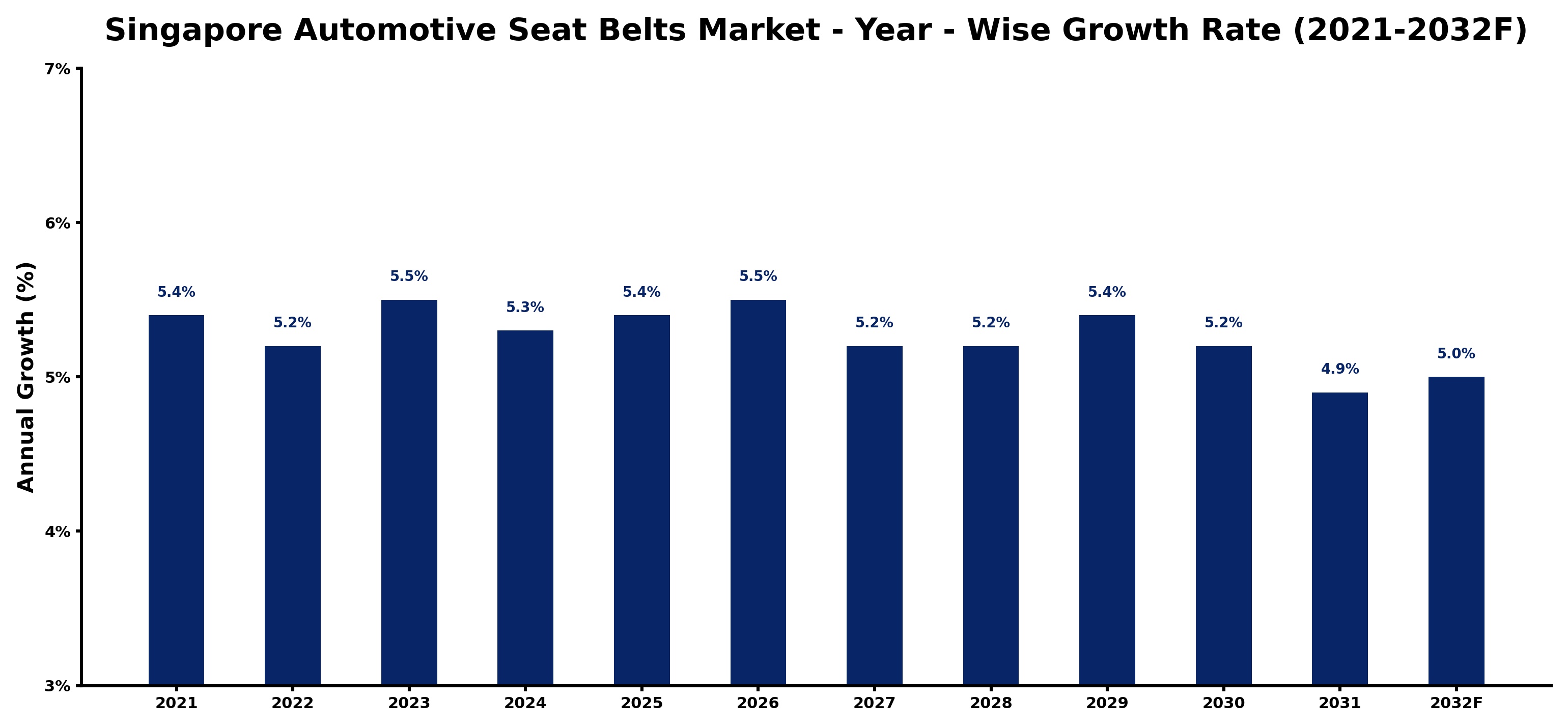
The table below presents the year‑wise growth rates along with the key drivers influencing the market
| Year | Growth Rate | Major Drivers |
| 2021 | 5.4% | Increased vehicle safety regulations |
| 2022 | 5.2% | Rising consumer safety awareness |
| 2023 | 5.5% | Technological advancements in safety |
| 2024 | 5.3% | Growing automotive production capacity |
| 2025 | 5.4% | Expansion of electric vehicle market |
| 2026 | 5.5% | Enhanced manufacturing processes adopted |
| 2027 | 5.2% | Increased demand for luxury vehicles |
| 2028 | 5.2% | Focus on sustainability in manufacturing |
| 2029 | 5.4% | Integration of smart technologies |
| 2030 | 5.2% | Rising demand for aftermarket products |
| 2031 | 4.9% | Growth in automotive repair services |
| 2032 | 5.0% | Emerging markets driving innovation |
Note - Market size estimations and growth projections presented in this report are based on 6Wresearch’s advanced forecasting approach, validated with industry datasets as of June 2026.
Singapore Automotive Seat Belts Market Synopsis
In Singapore, automotive seat belts are not merely an accessory but a mandatory safety feature integral to every vehicle. With the government's firm stance on road safety, manufacturers are under constant pressure to innovate, ensuring that seat belt systems meet evolving safety standards and consumer expectations.
The market is experiencing a notable shift from traditional designs to innovative solutions featuring smart technologies. This evolution includes advancements such as pre-tensioners, force-limiting mechanisms, and integrated airbags, which collectively enhance passenger safety and comfort, thereby boosting market attractiveness.
Singapore Automotive Seat Belts Market Key Takeaways
- Consistent regulatory mandates drive ongoing demand for automotive seat belts.
- Consumer awareness of road safety directly influences market growth and technology adoption.
- Innovations in seat belt technology are reshaping product offerings and market dynamics.
- Counterfeit products pose a significant risk, challenging market integrity and safety.
- The transition to electric vehicles is shaping future seat belt system requirements.
Evaluation of Restraints in Singapore Automotive Seat Belts Market
Despite the market's promising growth, several factors may inhibit progress. The proliferation of counterfeit seat belt products undermines safety and compliance, raising concerns among both consumers and regulators. Moreover, pricing pressures affect manufacturers' ability to invest in research and development, which is crucial for keeping pace with evolving safety standards. As technologies advance, the need for constant innovation becomes vital, yet budget constraints may limit manufacturers' capabilities.
Singapore Automotive Seat Belts Market Trends
The automotive seat belts market is witnessing several key trends. The integration of smart technology into seat belt designs is becoming increasingly prevalent, enhancing safety through features such as automatic pre-tensioning. Furthermore, the growing popularity of electric vehicles is prompting a re-evaluation of seat belt systems to accommodate new vehicle architectures. Additionally, sustainability is emerging as a concern, leading manufacturers to explore eco-friendly materials for production, aligning with broader environmental goals.
Singapore Automotive Seat Belts Market Opportunities
The Singapore Automotive Seat Belts Market presents numerous opportunities for growth and investment. As safety regulations continue to evolve, manufacturers who prioritize innovative safety technologies can position themselves at the forefront of the market. Furthermore, collaboration with electric vehicle manufacturers to develop tailored seat belt solutions can enhance market presence. There is also room for expansion into aftermarket solutions, catering to a growing demand for high-quality replacement seat belts among consumers.
Government Initiatives in the Singapore Automotive Seat Belts Market
The Singaporean government is actively promoting road safety through stringent regulations concerning seat belt usage. Public campaigns focused on the importance of seat belts and compliance with safety laws further reinforce the government's commitment to reducing road traffic injuries. These initiatives not only drive market demand but also create a conducive environment for manufacturers to innovate and comply with safety standards.
Future Insights of the Singapore Automotive Seat Belts Market
Looking ahead to 2026-2032, the Singapore Automotive Seat Belts Market is set to evolve significantly. The ongoing integration of technology into vehicle safety systems will likely dominate the landscape, with smart and adaptive seat belt systems becoming standard features. As electric vehicles gain traction, manufacturers will need to adapt their offerings to align with changing vehicle designs and consumer expectations. Overall, the focus on enhanced safety standards and consumer awareness will continue to drive market growth.
Singapore Automotive Seat Belts Market Latest Developments (May 2025 - June 2026)
Recent developments within the Singapore automotive seat belts market indicate a robust focus on technological advancements. Manufacturers are increasingly investing in R&D to enhance safety features, including integrating IoT technologies into seat belts. Additionally, there is a noticeable trend toward partnerships between seat belt manufacturers and automotive producers, aiming to develop customized solutions that meet the demands of next-generation vehicles.
Singapore Automotive Seat Belts Market - Key Attractiveness of the Report
- 10 Years of Market Numbers
- Historical Data Starting from 2022 to 2025
- Base Year: 2025
- Forecast Data until 2032
- Key Performance Indicators Impacting the Market
- Major Upcoming Developments and Projects
Key Highlights of the Report:
- Singapore Automotive Seat Belts Market Outlook
- Market Size of Singapore Automotive Seat Belts Market, 2025
- Forecast of Singapore Automotive Seat Belts Market, 2032F
- Historical Data and Forecast of Singapore Automotive Seat Belts Revenues & Volume for the Period 2022-2032F
- Singapore Automotive Seat Belts Market Trend Evolution
- Singapore Automotive Seat Belts Market Drivers and Challenges
- Singapore Automotive Seat Belts Price Trends
- Singapore Automotive Seat Belts Porter's Five Forces
- Singapore Automotive Seat Belts Industry Life Cycle
- Historical Data and Forecast of Singapore Automotive Seat Belts Market Revenues & Volume By Type for the Period 2022-2032F
- Historical Data and Forecast of Singapore Automotive Seat Belts Market Revenues & Volume By 2-point Seatbelt for the Period 2022-2032F
- Historical Data and Forecast of Singapore Automotive Seat Belts Market Revenues & Volume By 3-point Seatbelt for the Period 2022-2032F
- Historical Data and Forecast of Singapore Automotive Seat Belts Market Revenues & Volume By Vehicle for the Period 2022-2032F
- Historical Data and Forecast of Singapore Automotive Seat Belts Market Revenues & Volume By Passenger Cars for the Period 2022-2032F
- Historical Data and Forecast of Singapore Automotive Seat Belts Market Revenues & Volume By Light Commercial Vehicles for the Period 2022-2032F
- Historical Data and Forecast of Singapore Automotive Seat Belts Market Revenues & Volume By Heavy Commercial Vehicles for the Period 2022-2032F
- Historical Data and Forecast of Singapore Automotive Seat Belts Market Revenues & Volume By Component for the Period 2022-2032F
- Historical Data and Forecast of Singapore Automotive Seat Belts Market Revenues & Volume By Webbing strap for the Period 2022-2032F
- Historical Data and Forecast of Singapore Automotive Seat Belts Market Revenues & Volume By Retractor for the Period 2022-2032F
- Historical Data and Forecast of Singapore Automotive Seat Belts Market Revenues & Volume By Buckle for the Period 2022-2032F
- Historical Data and Forecast of Singapore Automotive Seat Belts Market Revenues & Volume By Tongue for the Period 2022-2032F
- Historical Data and Forecast of Singapore Automotive Seat Belts Market Revenues & Volume By Pillar Loop for the Period 2022-2032F
- Historical Data and Forecast of Singapore Automotive Seat Belts Market Revenues & Volume By Distribution Channels for the Period 2022-2032F
- Historical Data and Forecast of Singapore Automotive Seat Belts Market Revenues & Volume By OEM for the Period 2022-2032F
- Historical Data and Forecast of Singapore Automotive Seat Belts Market Revenues & Volume By Aftermarket for the Period 2022-2032F
- Singapore Automotive Seat Belts Import Export Trade Statistics
- Market Opportunity Assessment By Type
- Market Opportunity Assessment By Vehicle
- Market Opportunity Assessment By Component
- Market Opportunity Assessment By Distribution Channels
- Singapore Automotive Seat Belts Top Companies Market Share
- Singapore Automotive Seat Belts Competitive Benchmarking By Technical and Operational Parameters
- Singapore Automotive Seat Belts Company Profiles
- Singapore Automotive Seat Belts Key Strategic Recommendations






































