Singapore Autonomous Data Platform Market Size & Growth Rate (2026-2032)
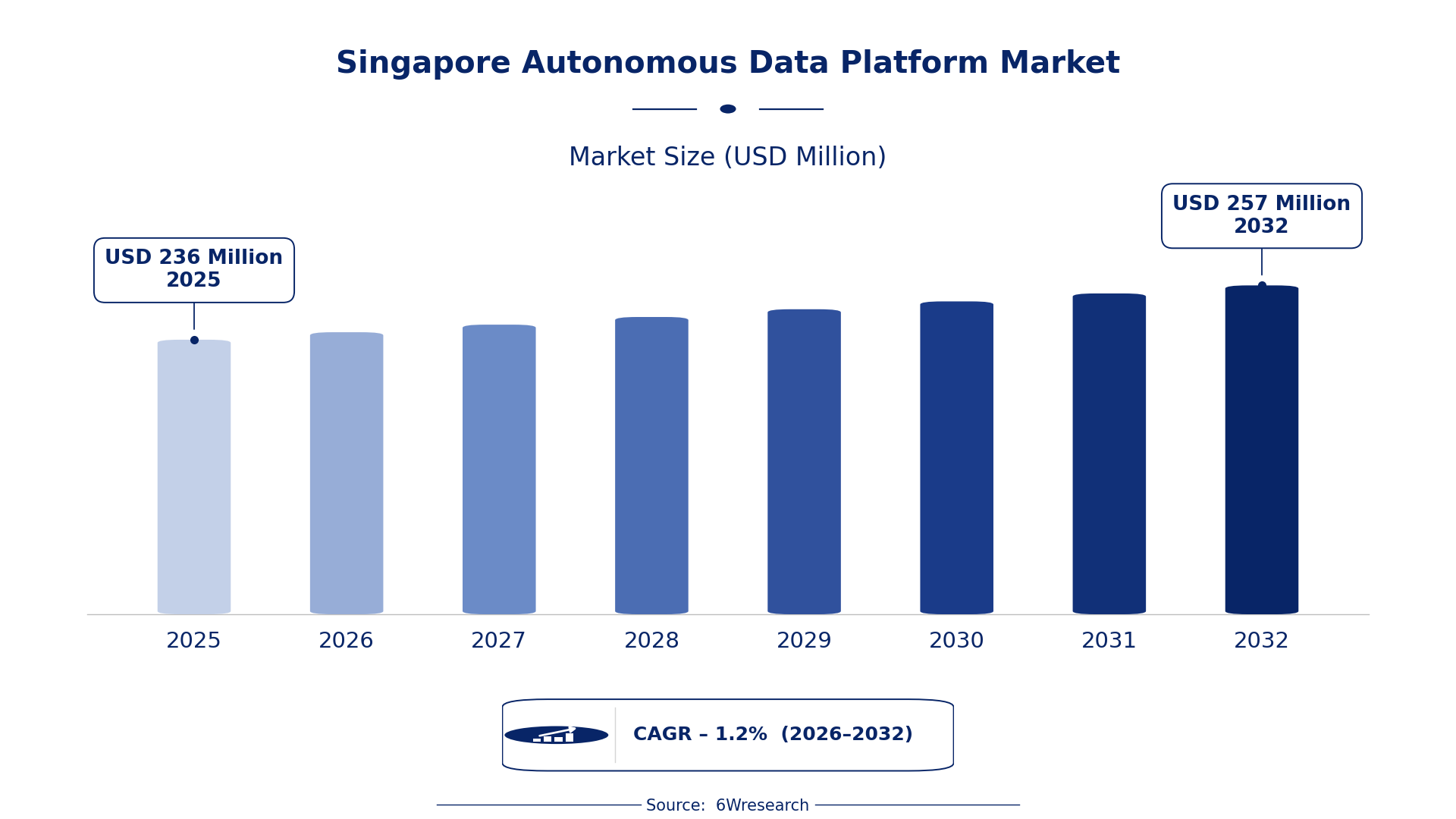
The Singapore Autonomous Data Platform Market was estimated at USD 236 Million in 2025 and is projected to reach USD 257 Million by 2032, growing at a CAGR of 1.2% from 2026 to 2032.
Singapore Autonomous Data Platform Market Synopsis
The Singapore autonomous data platform market is rapidly evolving as organizations grapple with the complexities of data management. Companies are increasingly recognizing the strategic importance of autonomous data platforms to automate tasks, optimize analytics, and derive actionable insights from their data. This growing awareness is pushing businesses to invest in solutions that enhance efficiency and competitiveness.
As data generation continues to surge, driven by digital transformation initiatives across industries, the demand for autonomous data management solutions in Singapore is expected to increase significantly. Organizations are seeking not only to manage data but also to extract intelligence that can drive decision-making processes. The market is thus characterized by a mix of local and global players, each striving to meet the evolving needs of enterprises.
Singapore Autonomous Data Platform Market Year-wise Growth Rate and Key Drivers
This graph illustrates the annual growth rates of the Singapore Autonomous Data Platform Market from 2021 to 2032, highlighting a steady upward trajectory and projected expansion over the forecast period.
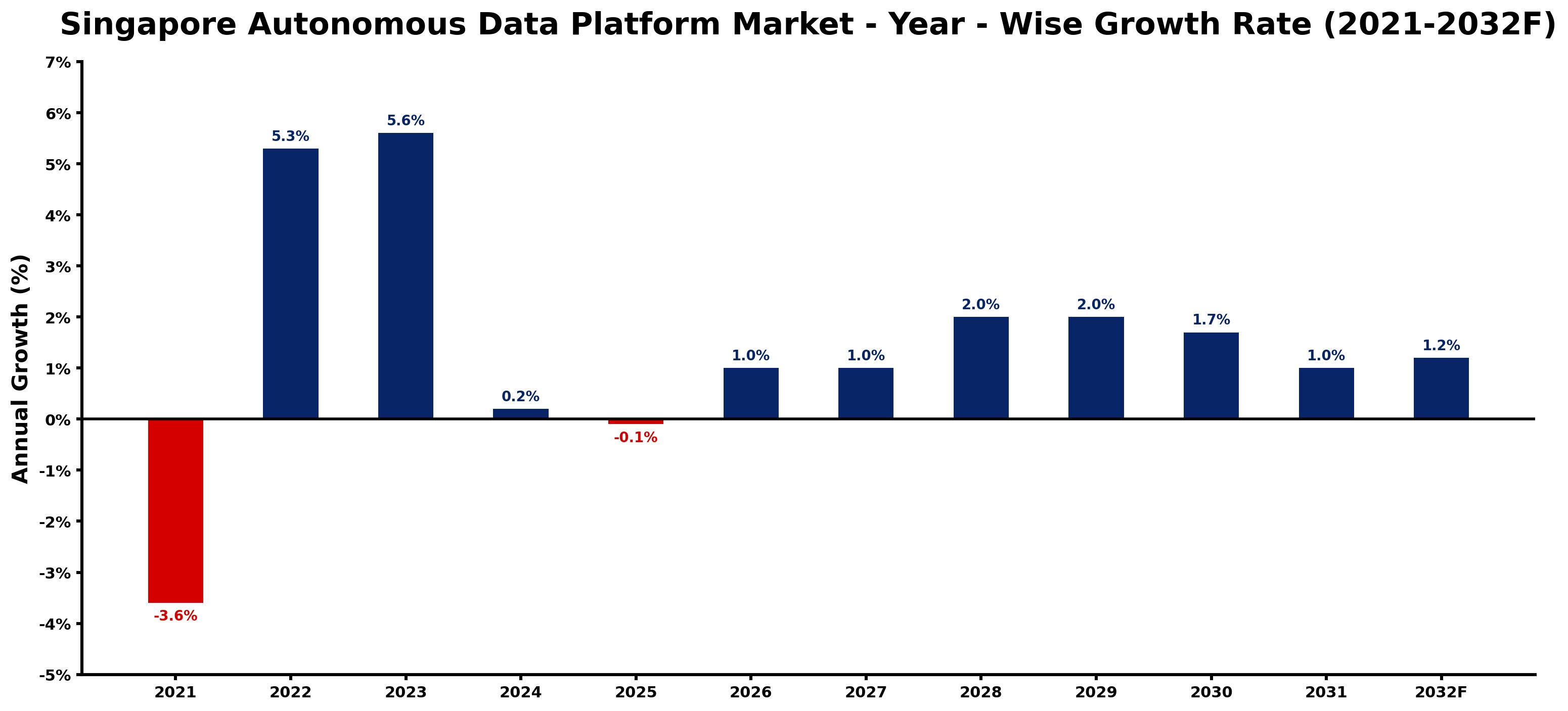
The table below presents the year‑wise growth rates along with the key drivers influencing the market
| Year | Growth Rate | Major Drivers |
| 2021 | -3.6% | Budget constraints from Singapore’s Smart Nation initiative cut funding. |
| 2022 | 5.3% | Government's Smart Nation initiative boosting data usage. |
| 2023 | 5.6% | Increased investment in AI-driven decision-making technologies. |
| 2024 | 0.2% | Emerging startups enhancing data-driven business solutions. |
| 2025 | -0.1% | Local talent shortage hampers adoption of new technologies. |
| 2026 | 1.0% | Strong focus on fintech innovation and data integration. |
| 2027 | 1.0% | Growing e-commerce sector driving data platform adoption. |
| 2028 | 2.0% | Increased demand for automated cloud data management. |
| 2029 | 2.0% | Rising emphasis on personalized customer experiences via data. |
| 2030 | 1.7% | Corporate partnerships enhancing data sharing ecosystems. |
| 2031 | 1.0% | Government incentives for digital transformation of businesses. |
| 2032 | 1.2% | Continuous upskilling initiatives to improve data literacy. |
Note: Market size estimations and growth projections presented in this report are based on 6Wresearch's proprietary forecasting methodology, utilizing the latest available industry data, government publications, and primary research inputs.
Singapore Autonomous Data Platform Market Key Takeaways
Below are some of the specific key takeaways from the market, including:
- The market is experiencing heightened investment as organizations look for innovative data management solutions.
- Advanced automation through AI and machine learning is a key driver for the adoption of autonomous data platforms.
- Data quality and governance challenges remain critical factors that businesses must address.
- The impact of COVID-19 accelerated the need for reliable and self-managing data solutions.
- Local and global players are intensifying competition to capture market share in Singapore.
Evaluation of Restraints in Singapore Autonomous Data Platform Market
The Singapore autonomous data platform market faces notable restraints that could hinder growth. One of the primary challenges is the issue of data quality; ensuring that autonomous platforms can maintain accurate and reliable data is essential for their effectiveness. Additionally, navigating the complexities of data privacy laws and regulatory compliance presents hurdles for businesses looking to fully embrace these platforms. Organizations must invest significant resources to ensure their systems meet legal standards while also delivering on the promise of automation.
Singapore Autonomous Data Platform Market Trends
Several trends are shaping the Singapore autonomous data platform market. First, there is a marked shift towards adopting AI-driven solutions that facilitate real-time data analytics. Companies are increasingly looking to harness predictive analytics to anticipate market trends and consumer behavior. Second, collaboration between technology providers and enterprises is becoming more prevalent as businesses seek tailored solutions to meet their specific needs. Lastly, the emphasis on data security and compliance is driving innovations in governance frameworks within autonomous platforms.
Singapore Autonomous Data Platform Market Opportunities
The opportunities within the Singapore autonomous data platform market are substantial. As businesses continue to digitize their operations, the demand for solutions that can integrate seamlessly with existing systems will grow. There is also significant potential for platforms that offer enhanced analytics capabilities, allowing organizations to derive deeper insights from their data. on top of that, as regulatory environments evolve, companies that can provide compliance-ready solutions will find a receptive market, paving the way for strategic partnerships and collaborations.
Government Initiatives in the Singapore Autonomous Data Platform Market
Government policy plays a crucial role in shaping the Singapore autonomous data platform market. The Singaporean government is actively promoting digital transformation initiatives and encouraging businesses to adopt advanced data management solutions. This supportive regulatory environment is fostering innovation and investment in the sector, making it vital for enterprises to align with public-sector priorities.
- A recently completed initiative focused on enhancing the national digital infrastructure to support data-driven businesses.
- Currently underway is a public-private partnership aimed at improving data governance frameworks across industries.
- A planned regulatory framework expected to roll out by 2027 will mandate enhanced data privacy measures for autonomous platforms.
- The government is promoting funding schemes to support SMEs in adopting autonomous data solutions, encouraging widespread adoption.
Future Insights of the Singapore Autonomous Data Platform Market
Looking ahead to 2026-2032, the Singapore autonomous data platform market is set for steady growth. Organizations are expected to increasingly prioritize automation as a means to enhance operational efficiency and data management capabilities. The convergence of AI and machine learning with data analytics will drive innovations, making these platforms even more integral to business strategies. As regulatory frameworks mature, compliance will also become a selling point, further shaping the competitive dynamics of the market.
Singapore Autonomous Data Platform Market Latest Developments
Recent activity in the Singapore autonomous data platform market indicates a strong push towards innovation and adoption. Over the past year, several initiatives have emerged aimed at enhancing data management capabilities for local enterprises. This period has seen a blend of technological advancements and strategic partnerships designed to streamline operations.
- A leading regional operator launched an upgraded version of its autonomous data platform in Q3 2025, enhancing data analytics features.
- A major technology vendor initiated a partnership with a local university to develop AI solutions for data management, currently underway since early 2025.
- Another company has announced plans for an upcoming service expansion that will introduce new features to automate data compliance processes by mid-2026.
- A collaboration between technology firms and government agencies aimed at creating a national data management framework is currently in progress, expected to conclude by late 2025.
Singapore Autonomous Data Platform Market - Key Attractiveness of the Report
- 10 Years of Market Numbers
- Historical Data Starting from 2022 to 2025
- Base Year: 2025
- Forecast Data until 2032
- Key Performance Indicators Impacting the Market
- Major Upcoming Developments and Projects
Key Highlights of the Report:
- Singapore Autonomous Data Platform Market Outlook
- Market Size of Singapore Autonomous Data Platform Market, 2025
- Forecast of Singapore Autonomous Data Platform Market, 2032
- Historical Data and Forecast of Singapore Autonomous Data Platform Revenues & Volume for the Period 2022-2032F
- Singapore Autonomous Data Platform Market Trend Evolution
- Singapore Autonomous Data Platform Market Drivers and Challenges
- Singapore Autonomous Data Platform Price Trends
- Singapore Autonomous Data Platform Porter's Five Forces
- Singapore Autonomous Data Platform Industry Life Cycle
- Historical Data and Forecast of Singapore Autonomous Data Platform Market Revenues & Volume By Component for the Period 2022-2032F
- Historical Data and Forecast of Singapore Autonomous Data Platform Market Revenues & Volume By Platform for the Period 2022-2032F
- Historical Data and Forecast of Singapore Autonomous Data Platform Market Revenues & Volume By Services for the Period 2022-2032F
- Historical Data and Forecast of Singapore Autonomous Data Platform Market Revenues & Volume By Advisory for the Period 2022-2032F
- Historical Data and Forecast of Singapore Autonomous Data Platform Market Revenues & Volume By Integration for the Period 2022-2032F
- Historical Data and Forecast of Singapore Autonomous Data Platform Market Revenues & Volume By Support and Maintenance for the Period 2022-2032F
- Historical Data and Forecast of Singapore Autonomous Data Platform Market Revenues & Volume By Deployment Type for the Period 2022-2032F
- Historical Data and Forecast of Singapore Autonomous Data Platform Market Revenues & Volume By On-Premises for the Period 2022-2032F
- Historical Data and Forecast of Singapore Autonomous Data Platform Market Revenues & Volume By Cloud for the Period 2022-2032F
- Historical Data and Forecast of Singapore Autonomous Data Platform Market Revenues & Volume By Organization Size for the Period 2022-2032F
- Historical Data and Forecast of Singapore Autonomous Data Platform Market Revenues & Volume By Large Enterprises for the Period 2022-2032F
- Historical Data and Forecast of Singapore Autonomous Data Platform Market Revenues & Volume By Small for the Period 2022-2032F
- Historical Data and Forecast of Singapore Autonomous Data Platform Market Revenues & Volume By Medium-Sized Enterprises for the Period 2022-2032F
- Historical Data and Forecast of Singapore Autonomous Data Platform Market Revenues & Volume By Vertical for the Period 2022-2032F
- Historical Data and Forecast of Singapore Autonomous Data Platform Market Revenues & Volume By BFSI for the Period 2022-2032F
- Historical Data and Forecast of Singapore Autonomous Data Platform Market Revenues & Volume By Healthcare and Life Sciences for the Period 2022-2032F
- Historical Data and Forecast of Singapore Autonomous Data Platform Market Revenues & Volume By Retail for the Period 2022-2032F
- Historical Data and Forecast of Singapore Autonomous Data Platform Market Revenues & Volume By Manufacturing for the Period 2022-2032F
- Historical Data and Forecast of Singapore Autonomous Data Platform Market Revenues & Volume By Telecommunication and Media for the Period 2022-2032F
- Historical Data and Forecast of Singapore Autonomous Data Platform Market Revenues & Volume By Government for the Period 2022-2032F
- Historical Data and Forecast of Singapore Autonomous Data Platform Market Revenues & Volume By Others for the Period 2022-2032F
- Singapore Autonomous Data Platform Import Export Trade Statistics
- Market Opportunity Assessment By Component
- Market Opportunity Assessment By Deployment Type
- Market Opportunity Assessment By Organization Size
- Market Opportunity Assessment By Vertical
- Singapore Autonomous Data Platform Top Companies Market Share
- Singapore Autonomous Data Platform Competitive Benchmarking By Technical and Operational Parameters
- Singapore Autonomous Data Platform Company Profiles
- Singapore Autonomous Data Platform Key Strategic Recommendations






































