Singapore Baby Prams and Strollers Market Size, Share & Growth Rate
The Singapore Baby Prams and Strollers Market was estimated at USD 345 Million in 2025 and is projected to reach USD 451 Million by 2032, growing at a CAGR of 3.9% from 2026 to 2032. This growth trajectory is primarily fueled by shifting parenting trends that prioritize convenience and safety, aligning with urban mobility needs in Singapore. As families adapt to a fast-paced lifestyle, lightweight and compact stroller designs are becoming increasingly appealing, driving demand across the market.
Singapore Baby Prams and Strollers Market Year-wise Growth Rate and Key Drivers
This graph highlights how the Singapore Baby Prams and Strollers Market has steadily grown over the years, supported by major growth factors.
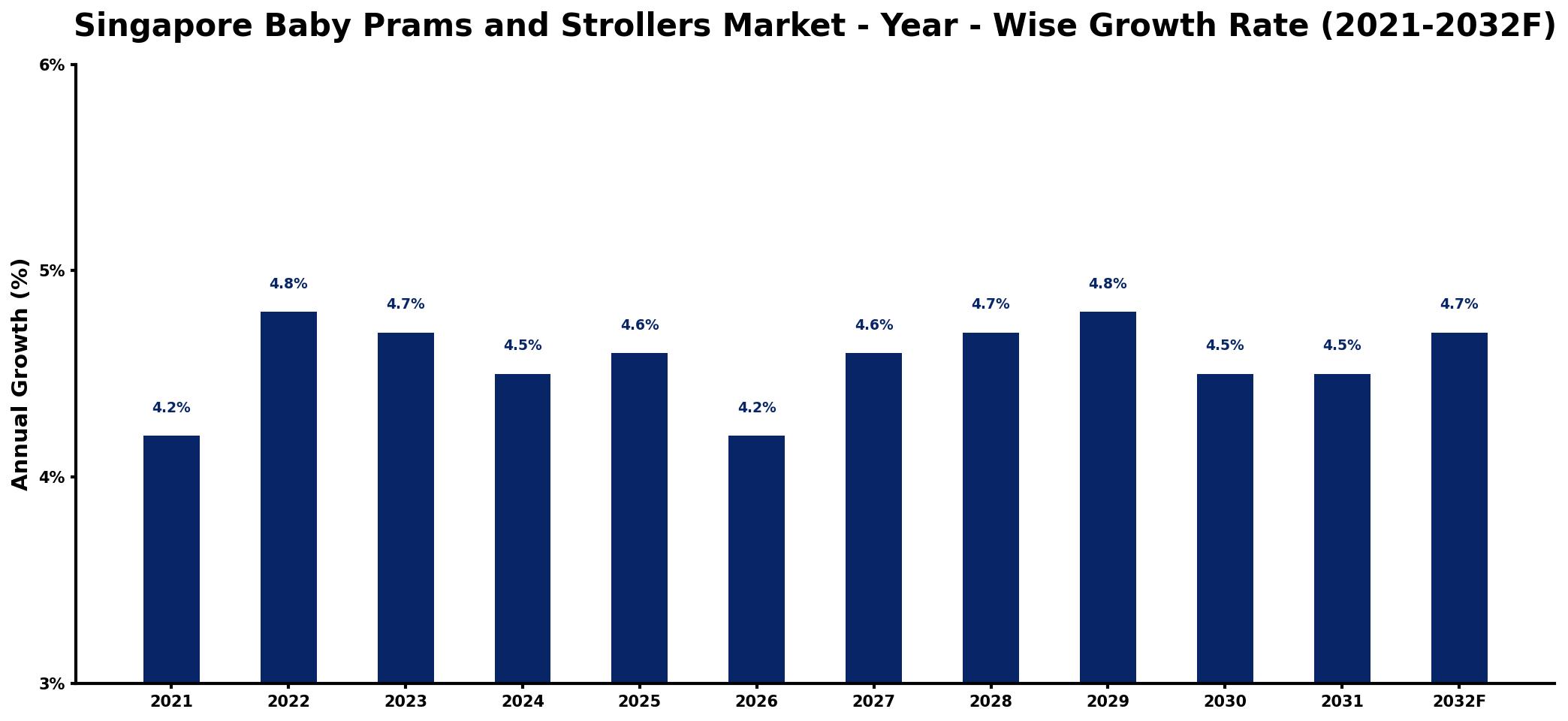
The table below presents the year‑wise growth rates along with the key drivers influencing the market
| Year | Growth Rate | Major Drivers |
| 2021 | 4.2% | Rising birth rates stimulate demand |
| 2022 | 4.8% | Increased disposable income levels |
| 2023 | 4.7% | Expansion of online retail channels |
| 2024 | 4.5% | Growing focus on child safety |
| 2025 | 4.6% | Increased urbanization driving sales |
| 2026 | 4.2% | Innovative designs attract consumers |
| 2027 | 4.6% | Sustainability trends influence purchases |
| 2028 | 4.7% | Technological advancements enhance offerings |
| 2029 | 4.8% | Expanding middle-class population base |
| 2030 | 4.5% | Rising health awareness among parents |
| 2031 | 4.5% | Growing influence of social media |
| 2032 | 4.7% | Increased investment in childcare products |
Note: Market size estimations and growth projections presented in this report are based on 6Wresearch's proprietary forecasting methodology, utilizing the latest available industry data, government publications, and primary research inputs.
Singapore Baby Prams and Strollers Market Synopsis
The most significant force shaping the Singapore Baby Prams and Strollers Market is the emphasis on safety and ergonomic design. Parents are becoming more discerning about the safety features incorporated in baby transportation solutions, seeking models that offer secure and comfortable rides for their infants and toddlers.
Additionally, the market is influenced by innovations in stroller technology, including enhanced maneuverability and portability. As urban living spaces become more compact, the demand for strollers that can easily navigate tight spaces and offer foldability is rising, further shaping the market landscape.
Singapore Baby Prams and Strollers Market Key Takeaways
- The market is driven by a growing emphasis on convenience and safety among parents.
- Lightweight and compact stroller designs are gaining traction in urban environments.
- Innovative safety features are increasingly prioritized by consumers.
- Parenting trends post-COVID-19 are expected to revitalize demand for outdoor family activities.
- Regulatory compliance remains critical for ensuring product safety and market competitiveness.
Evaluation of Restraints in Singapore Baby Prams and Strollers Market
Despite its promising growth, the Singapore Baby Prams and Strollers Market faces significant restraints. Stringent safety regulations pose challenges for manufacturers striving to comply with both local and international standards. These compliance demands can drive up costs and complicate product development timelines. Furthermore, parents often face a plethora of choices, creating a competitive landscape where differentiation becomes increasingly difficult. Consequently, brands must continually innovate while balancing affordability and safety to remain relevant in a crowded marketplace.
Singapore Baby Prams and Strollers Market Trends
Emerging trends in the Singapore Baby Prams and Strollers Market reflect a move toward greater functionality and user-friendliness. Parents are increasingly inclined to opt for strollers that integrate technology, such as smart features that track baby movements or provide real-time safety alerts. Additionally, a growing preference for eco-friendly materials is influencing product development, prompting brands to innovate sustainable designs that meet parental expectations without compromising quality. These trends not only resonate with modern parenting philosophies but also enhance the overall appeal of prams and strollers.
Singapore Baby Prams and Strollers Market Opportunities
The Singapore Baby Prams and Strollers Market presents numerous opportunities for growth and investment. Brands that focus on integrating technology into stroller designs, such as GPS tracking and automated features, may attract a tech-savvy consumer base. Additionally, collaborating with lifestyle brands to create trendy and versatile designs could appeal to millennial parents looking for fashionable yet functional solutions. Furthermore, targeting niche segments, such as travel-friendly prams or strollers designed for specific terrains, can capture a broader audience and enhance market penetration.
Government Initiatives in the Singapore Baby Prams and Strollers Market
The Singapore government has taken an active role in supporting child safety through regulatory frameworks that guide the design and manufacturing of childcare products, including baby prams and strollers. Initiatives aimed at public awareness on the importance of child safety in transportation also play a significant role in driving market dynamics. Additionally, various programs promoting family-friendly activities encourage parents to invest in quality prams and strollers, underscoring the government's commitment to supporting modern parenting.
Future Insights of the Singapore Baby Prams and Strollers Market
Looking ahead, the Singapore Baby Prams and Strollers Market is poised for significant advancement through 2026-2032. As parents increasingly prioritize safety and convenience, innovation will remain at the forefront of market development. The incorporation of advanced materials, smart technology, and sustainable practices will likely shape product offerings. Moreover, with rising consumer awareness around safety standards and product efficacy, companies that can efficiently navigate regulatory landscapes while pushing the envelope on design will stand to gain a competitive edge.
Singapore Baby Prams and Strollers Market Latest Developments (2025 - 2026)
Recent developments within the Singapore Baby Prams and Strollers Market indicate a shift towards innovative product launches that emphasize both safety and convenience. Several brands are investing in research and development to enhance stroller designs, focusing on features that cater specifically to urban lifestyles. Moreover, collaborations between manufacturers and tech companies are becoming more common, resulting in products that incorporate cutting-edge technology. This evolving landscape signals a proactive approach from the industry to meet changing consumer needs.
Singapore Baby Prams and Strollers Market - Key Attractiveness of the Report
- 10 Years of Market Numbers
- Historical Data Starting from 2022 to 2025
- Base Year: 2025
- Forecast Data until 2032
- Key Performance Indicators Impacting the Market
- Major Upcoming Developments and Projects
Key Highlights of the Report:
- Singapore Baby Prams and Strollers Market Outlook
- Market Size of Singapore Baby Prams and Strollers Market, 2025
- Forecast of Singapore Baby Prams and Strollers Market, 2032
- Historical Data and Forecast of Singapore Baby Prams and Strollers Revenues & Volume for the Period 2022-2032F
- Singapore Baby Prams and Strollers Market Trend Evolution
- Singapore Baby Prams and Strollers Market Drivers and Challenges
- Singapore Baby Prams and Strollers Price Trends
- Singapore Baby Prams and Strollers Porter's Five Forces
- Singapore Baby Prams and Strollers Industry Life Cycle
- Historical Data and Forecast of Singapore Baby Prams and Strollers Market Revenues & Volume By Product Type for the Period 2022-2032F
- Historical Data and Forecast of Singapore Baby Prams and Strollers Market Revenues & Volume By Lightweight Strollers for the Period 2022-2032F
- Historical Data and Forecast of Singapore Baby Prams and Strollers Market Revenues & Volume By Jogging Strollers for the Period 2022-2032F
- Historical Data and Forecast of Singapore Baby Prams and Strollers Market Revenues & Volume By Standard Strollers for the Period 2022-2032F
- Historical Data and Forecast of Singapore Baby Prams and Strollers Market Revenues & Volume By Double / Triple Strollers for the Period 2022-2032F
- Historical Data and Forecast of Singapore Baby Prams and Strollers Market Revenues & Volume By Multi-Optional System Strollers for the Period 2022-2032F
- Historical Data and Forecast of Singapore Baby Prams and Strollers Market Revenues & Volume By Age for the Period 2022-2032F
- Historical Data and Forecast of Singapore Baby Prams and Strollers Market Revenues & Volume By 0 - 6 months for the Period 2022-2032F
- Historical Data and Forecast of Singapore Baby Prams and Strollers Market Revenues & Volume By 6 - 12 months for the Period 2022-2032F
- Historical Data and Forecast of Singapore Baby Prams and Strollers Market Revenues & Volume By 12 - 36 months for the Period 2022-2032F
- Historical Data and Forecast of Singapore Baby Prams and Strollers Market Revenues & Volume By Sales Channel for the Period 2022-2032F
- Historical Data and Forecast of Singapore Baby Prams and Strollers Market Revenues & Volume By BaBoutiques for the Period 2022-2032F
- Historical Data and Forecast of Singapore Baby Prams and Strollers Market Revenues & Volume By Specialty Stores for the Period 2022-2032F
- Historical Data and Forecast of Singapore Baby Prams and Strollers Market Revenues & Volume By Modern Trade for the Period 2022-2032F
- Historical Data and Forecast of Singapore Baby Prams and Strollers Market Revenues & Volume By Departmental Stores for the Period 2022-2032F
- Historical Data and Forecast of Singapore Baby Prams and Strollers Market Revenues & Volume By Mono-brand Stores for the Period 2022-2032F
- Historical Data and Forecast of Singapore Baby Prams and Strollers Market Revenues & Volume By Online retailers for the Period 2022-2032F
- Historical Data and Forecast of Singapore Baby Prams and Strollers Market Revenues & Volume By Other Sales Channel for the Period 2022-2032F
- Singapore Baby Prams and Strollers Import Export Trade Statistics
- Market Opportunity Assessment By Product Type
- Market Opportunity Assessment By Age
- Market Opportunity Assessment By Sales Channel
- Singapore Baby Prams and Strollers Top Companies Market Share
- Singapore Baby Prams and Strollers Competitive Benchmarking By Technical and Operational Parameters
- Singapore Baby Prams and Strollers Company Profiles
- Singapore Baby Prams and Strollers Key Strategic Recommendations






































