Singapore Ballast Water Treatment Market Size, Share & Growth Rate
The Singapore Ballast Water Treatment Market was estimated at USD 466 Million in 2025 and is projected to reach USD 648 Million by 2032, growing at a CAGR of 4.8% from 2026 to 2032. This growth trajectory can be attributed to Singapores strategic position as a leading global shipping hub, coupled with increasingly stringent international maritime regulations aimed at preventing the spread of invasive species. Additionally, heightened awareness surrounding environmental sustainability in the maritime industry is further propelling the demand for advanced ballast water treatment solutions.
Singapore Ballast Water Treatment Market Year-wise Growth Rate and Key Drivers
This graph highlights how the Singapore Ballast Water Treatment Market has steadily grown over the years, supported by major growth factors.
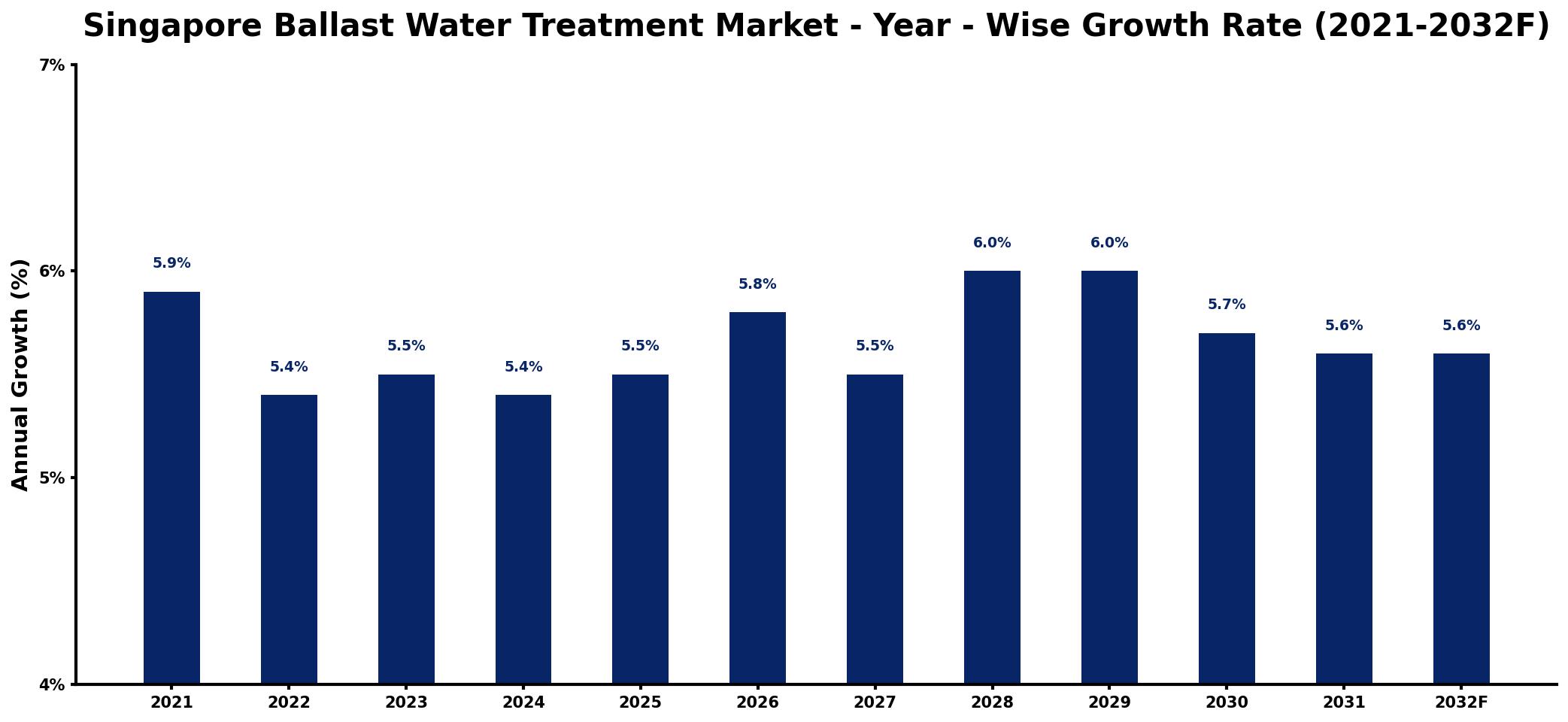
The table below presents the year‑wise growth rates along with the key drivers influencing the market
| Year | Growth Rate | Major Drivers |
| 2021 | 5.9% | Increased maritime environmental regulations |
| 2022 | 5.4% | Growing investment in eco-friendly technologies |
| 2023 | 5.5% | Rise in global shipping activities |
| 2024 | 5.4% | Expansion of marine conservation initiatives |
| 2025 | 5.5% | Heightened focus on sustainability practices |
| 2026 | 5.8% | Demand for compliance-driven solutions |
| 2027 | 5.5% | Emergence of new shipping routes |
| 2028 | 6.0% | Strengthened international trade agreements |
| 2029 | 6.0% | Adoption of innovative maritime solutions |
| 2030 | 5.7% | Enhanced public awareness campaigns |
| 2031 | 5.6% | Growth in regulatory compliance requirements |
| 2032 | 5.6% | Increased collaboration among stakeholders |
Note: Market size estimations and growth projections presented in this report are based on 6Wresearch's proprietary forecasting methodology, utilizing the latest available industry data, government publications, and primary research inputs.
Singapore Ballast Water Treatment Market Synopsis
The Singapore ballast water treatment market is currently positioned at the forefront of environmental conservation efforts within the shipping sector. With rigorous regulations mandating that vessels equipped with ballast water systems comply with international standards, the urgency to implement effective treatment solutions is paramount.
Given Singapore's significant role in global trade, the adoption of ballast water treatment systems is not just a regulatory necessity but also a reflection of the maritime industrys commitment to sustainability. The local market is increasingly populated with innovative manufacturers focused on developing efficient, compliant technologies that meet these pressing demands.
Singapore Ballast Water Treatment Market Key Takeaways
- Singapore's strategic maritime positioning enhances the demand for ballast water treatment systems.
- Stringent regulatory frameworks necessitate compliance with international standards for ballast water management.
- Technological advancements are driving the development of more efficient treatment solutions.
- The market is expected to witness continuous growth due to increasing environmental awareness in the shipping industry.
- COVID-19 has highlighted the importance of robust sanitation regulations in maritime operations.
Evaluation of Restraints in Singapore Ballast Water Treatment Market
Despite its growth potential, the Singapore ballast water treatment market faces significant restraints. The high capital investment required for advanced treatment systems can be a substantial barrier for shipowners, particularly small and mid-sized operators. Additionally, the complexity of maintaining compliance with international regulations, including performance standards, poses ongoing challenges. Continuous monitoring and maintenance are essential to ensure the efficacy of treatment systems, which can strain resources and operational capacities within the maritime industry. Moreover, the global nature of the shipping industry adds layers of complexity, as compliance varies across regions, necessitating adaptable solutions.
Singapore Ballast Water Treatment Market Trends
Current trends in the Singapore ballast water treatment market indicate a shift towards more innovative and cost-effective technologies. The rise of digital solutions that facilitate remote monitoring and management of treatment systems is gaining traction. Furthermore, the integration of artificial intelligence and machine learning into treatment protocols is becoming more common, enhancing system efficiency and compliance reporting. Additionally, partnerships and collaborations among stakeholders are emerging as vital strategies to optimize treatment solutions and leverage shared expertise in the field.
Singapore Ballast Water Treatment Market Opportunities
The Singapore ballast water treatment market presents substantial opportunities for growth, especially through the integration of next-generation technologies. Investment in research and development for advanced treatment methods can lead to the creation of more efficient systems that reduce operational costs. Additionally, as regulatory frameworks evolve, companies that can offer adaptable solutions will be well-positioned to capitalize on changing demands. Furthermore, the growing emphasis on sustainability and environmental protection can create new business avenues for companies focusing on eco-friendly solutions.
Government Initiatives in the Singapore Ballast Water Treatment Market
The Singapore government has demonstrated a strong commitment to enhancing maritime environmental sustainability through various initiatives. Policy frameworks are being established to enforce compliance with international maritime standards, while public spending on environmental protection programs is on the rise. Moreover, the government actively promotes research and development in ballast water treatment technologies, encouraging collaboration between industry stakeholders and academic institutions. Such initiatives are aimed at positioning Singapore as a leader in sustainable maritime practices.
Future Insights of the Singapore Ballast Water Treatment Market
Looking ahead to 2026-2032, the Singapore ballast water treatment market is poised for significant evolution. The ongoing tightening of international regulations will compel shipowners to enhance their treatment capabilities, fostering an environment ripe for innovation. As environmental concerns continue to mount, the demand for effective and sustainable treatment solutions is expected to escalate. Additionally, the shift towards digital technologies will likely transform operational efficiencies, paving the way for smarter, more compliant systems in the maritime industry.
Singapore Ballast Water Treatment Market Latest Developments (2025 - 2026)
The ballast water treatment market in Singapore has seen several notable developments recently. Companies are increasingly focusing on R&D efforts to introduce more efficient and compact treatment systems. Additionally, there has been a growing trend of partnerships between technology providers and shipping companies, aimed at enhancing compliance with emerging regulations. As the industry adapts to post-pandemic realities, a renewed emphasis on safety and environmental standards is shaping the future direction of the market.
Singapore Ballast Water Treatment Market - Key Attractiveness of the Report
- 10 Years of Market Numbers
- Historical Data Starting from 2022 to 2025
- Base Year: 2025
- Forecast Data until 2032
- Key Performance Indicators Impacting the Market
- Major Upcoming Developments and Projects
Key Highlights of the Report:
- Singapore Ballast Water Treatment Market Outlook
- Market Size of Singapore Ballast Water Treatment Market, 2025
- Forecast of Singapore Ballast Water Treatment Market, 2032
- Historical Data and Forecast of Singapore Ballast Water Treatment Revenues & Volume for the Period 2022-2032F
- Singapore Ballast Water Treatment Market Trend Evolution
- Singapore Ballast Water Treatment Market Drivers and Challenges
- Singapore Ballast Water Treatment Price Trends
- Singapore Ballast Water Treatment Porter's Five Forces
- Singapore Ballast Water Treatment Industry Life Cycle
- Historical Data and Forecast of Singapore Ballast Water Treatment Market Revenues & Volume By Technology for the Period 2022-2032F
- Historical Data and Forecast of Singapore Ballast Water Treatment Market Revenues & Volume By Physical Disinfection for the Period 2022-2032F
- Historical Data and Forecast of Singapore Ballast Water Treatment Market Revenues & Volume By Mechanical Method for the Period 2022-2032F
- Historical Data and Forecast of Singapore Ballast Water Treatment Market Revenues & Volume By Chemical Method for the Period 2022-2032F
- Historical Data and Forecast of Singapore Ballast Water Treatment Market Revenues & Volume By Service for the Period 2022-2032F
- Historical Data and Forecast of Singapore Ballast Water Treatment Market Revenues & Volume By Installation & Calibration for the Period 2022-2032F
- Historical Data and Forecast of Singapore Ballast Water Treatment Market Revenues & Volume By Performance Measurement for the Period 2022-2032F
- Historical Data and Forecast of Singapore Ballast Water Treatment Market Revenues & Volume By Recommissioning for the Period 2022-2032F
- Singapore Ballast Water Treatment Import Export Trade Statistics
- Market Opportunity Assessment By Technology
- Market Opportunity Assessment By Service
- Singapore Ballast Water Treatment Top Companies Market Share
- Singapore Ballast Water Treatment Competitive Benchmarking By Technical and Operational Parameters
- Singapore Ballast Water Treatment Company Profiles
- Singapore Ballast Water Treatment Key Strategic Recommendations






































