Singapore Base Oil Market: Import Trend Analysis
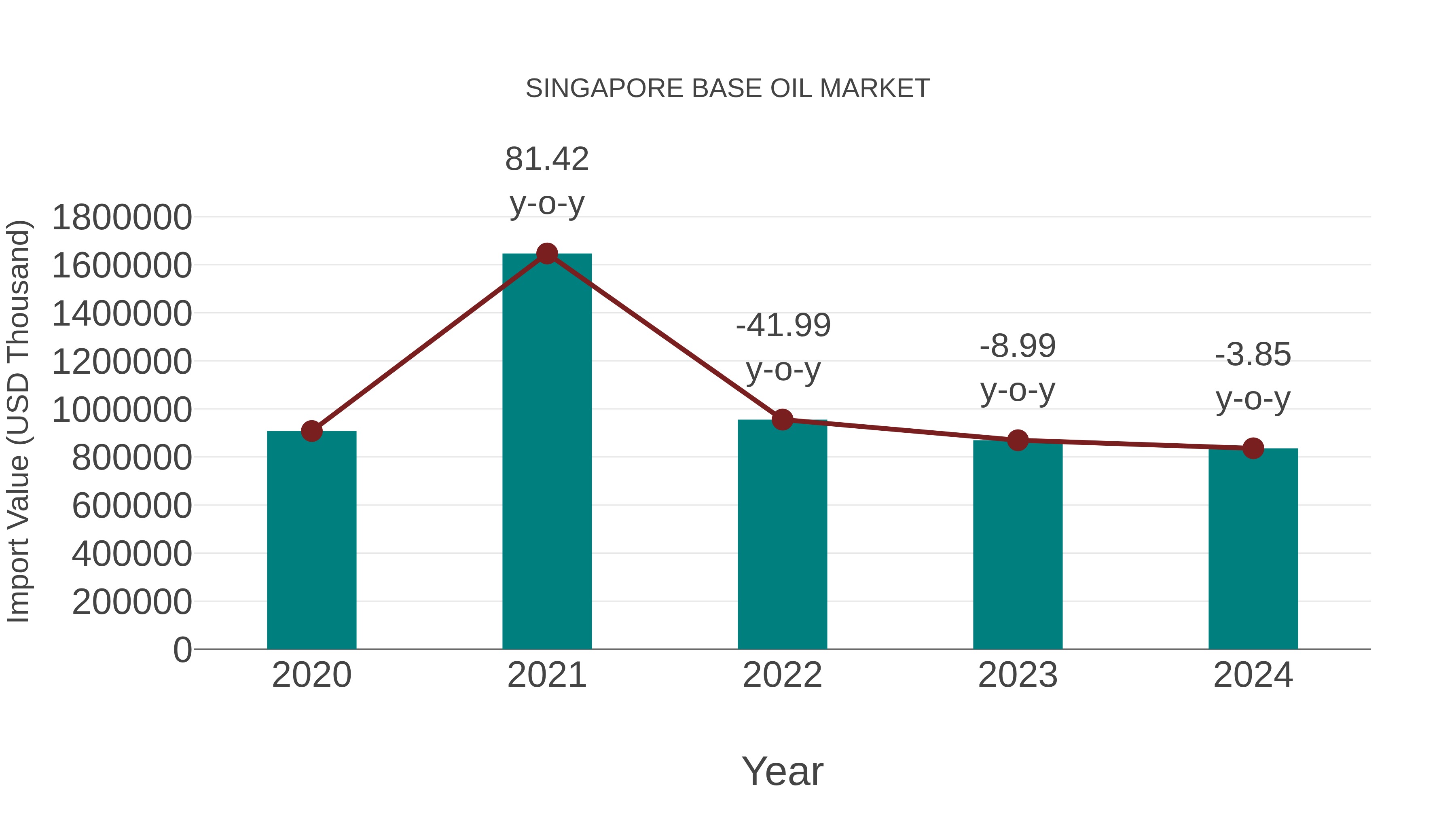
In the Singapore base oil market, the import trend experienced a decline from 2023 to 2024, with a growth rate of -3.85%. The compound annual growth rate (CAGR) for imports from 2020 to 2024 stood at -2.04%. This negative import momentum may have been influenced by shifts in demand patterns or market dynamics during the period.
Singapore Base Oil Market Overview
The Singapore base oil market has established itself as a key player in the global lubricants industry. Thanks to its strategic geographical location and well-developed infrastructure, Singapore serves as a major hub for base oil production and distribution in the Asia-Pacific region. The market has witnessed steady growth in recent years, driven by increasing demand for lubricants across various industries, including automotive, industrial machinery, and marine sectors. Singapore reputation for high-quality base oil production, along with stringent regulatory standards, has made it a preferred choice for both domestic consumption and international exports. The market is characterized by the presence of several key players and a competitive landscape, driving innovation and product diversification.
Drivers of the Market
The Singapore Base Oil market is primarily driven by its use in the production of lubricants and hydraulic fluids. Base oils serve as the primary components in formulating lubricants with different viscosities and performance properties. As industries rely on high-performance lubricants to ensure the smooth operation of machinery and equipment, the demand for base oils is expected to rise, supporting various industrial applications.
Challenges of the Market
The Singapore Base Oil Market faces challenges related to evolving automotive and industrial lubricant formulations, supply chain management, and sustainability. Base oils are fundamental components of lubricants, and market players must continually adapt to the changing formulations required by the automotive and industrial sectors. Ensuring a stable supply of high-quality base oils, which may be influenced by refinery operations and feedstock availability, is a constant challenge. Additionally, there is a growing emphasis on sustainable and environmentally friendly base oils, driven by regulatory standards and market demand. Balancing product performance, cost-efficiency, and sustainability is crucial for success in this market.
Covid-19 impact of the Market
The COVID-19 pandemic had a notable impact on the Singapore base oil market, with fluctuations in industrial activity and supply chain disruptions affecting demand. While certain sectors, like automotive and industrial lubricants, experienced reduced demand, others, such as pharmaceuticals and personal care products, maintained their need for high-quality base oils. The market adapted by focusing on product quality and sustainability, aligning with changing industry dynamics. As Singapore emerged from the pandemic, the base oil market continued to evolve to meet industry-specific requirements.
Leading Players of the Market
Prominent companies in the Singapore base oil market include Chevron, ExxonMobil, and Nynas, providing base oils used in the formulation of lubricants and various industrial applications.
Key Highlights of the Report:
- Singapore Base Oil Market Outlook
- Market Size of Singapore Base Oil Market, 2025
- Forecast of Singapore Base Oil Market, 2032
- Historical Data and Forecast of Singapore Base Oil Revenues & Volume for the Period 2022-2032F
- Singapore Base Oil Market Trend Evolution
- Singapore Base Oil Market Drivers and Challenges
- Singapore Base Oil Price Trends
- Singapore Base Oil Porter's Five Forces
- Singapore Base Oil Industry Life Cycle
- Historical Data and Forecast of Singapore Base Oil Market Revenues & Volume By Group for the Period 2022-2032F
- Historical Data and Forecast of Singapore Base Oil Market Revenues & Volume By Group I for the Period 2022-2032F
- Historical Data and Forecast of Singapore Base Oil Market Revenues & Volume By Group II for the Period 2022-2032F
- Historical Data and Forecast of Singapore Base Oil Market Revenues & Volume By Group III for the Period 2022-2032F
- Historical Data and Forecast of Singapore Base Oil Market Revenues & Volume By Group IV for the Period 2022-2032F
- Historical Data and Forecast of Singapore Base Oil Market Revenues & Volume By Group V for the Period 2022-2032F
- Historical Data and Forecast of Singapore Base Oil Market Revenues & Volume By Application for the Period 2022-2032F
- Historical Data and Forecast of Singapore Base Oil Market Revenues & Volume By Automotive Oil for the Period 2022-2032F
- Historical Data and Forecast of Singapore Base Oil Market Revenues & Volume By Industrial Oil for the Period 2022-2032F
- Historical Data and Forecast of Singapore Base Oil Market Revenues & Volume By Hydraulic Oil for the Period 2022-2032F
- Historical Data and Forecast of Singapore Base Oil Market Revenues & Volume By Grease for the Period 2022-2032F
- Historical Data and Forecast of Singapore Base Oil Market Revenues & Volume By Metalworking Fluid for the Period 2022-2032F
- Singapore Base Oil Import Export Trade Statistics
- Market Opportunity Assessment By Group
- Market Opportunity Assessment By Application
- Singapore Base Oil Top Companies Market Share
- Singapore Base Oil Competitive Benchmarking By Technical and Operational Parameters
- Singapore Base Oil Company Profiles
- Singapore Base Oil Key Strategic Recommendations






































