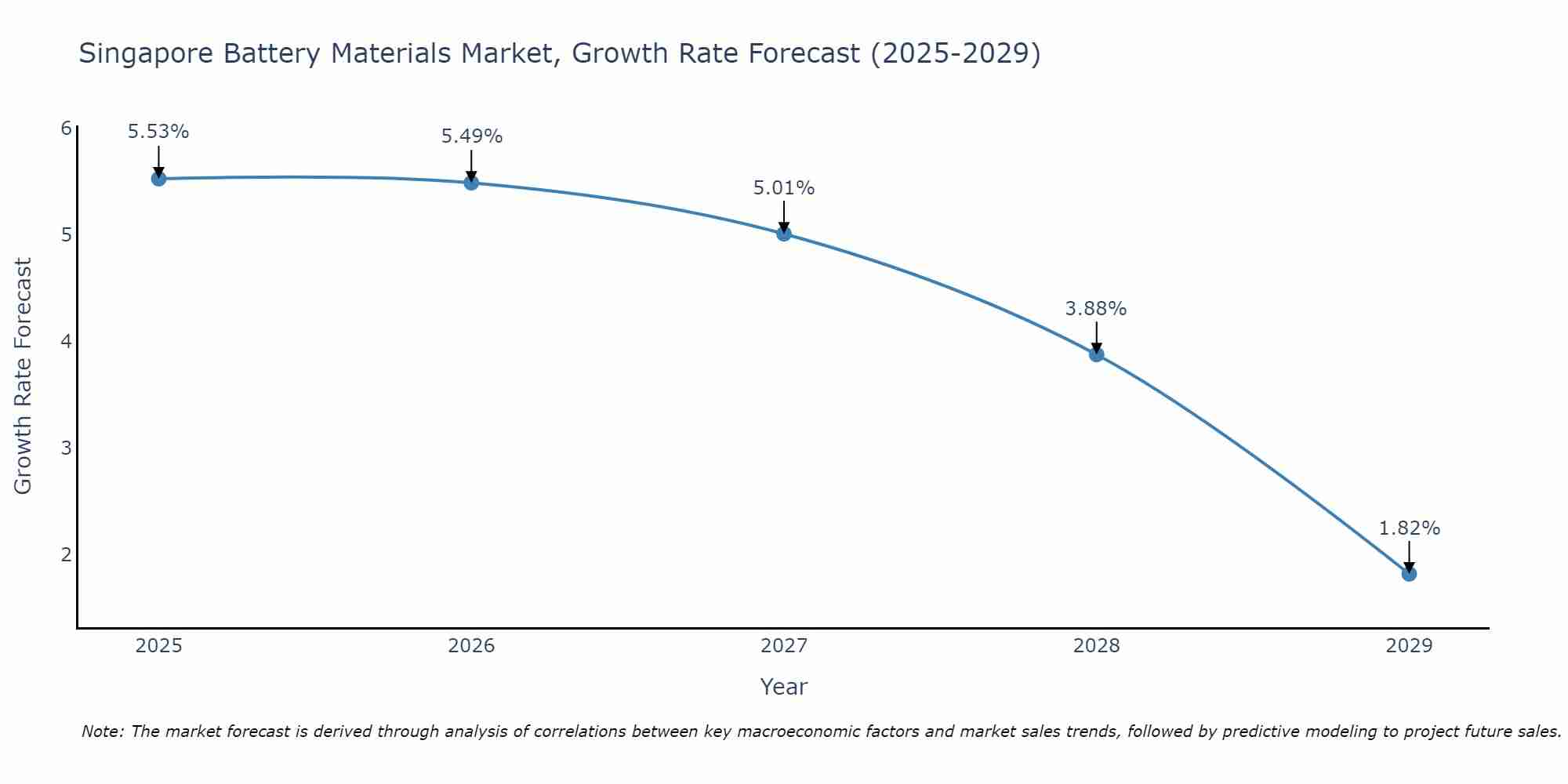
Singapore Battery Materials Market Size Growth Rate
The Singapore Battery Materials Market could see a tapering of growth rates over 2025 to 2029. Although the growth rate starts strong at 5.53% in 2025, it steadily loses momentum, ending at 1.82% by 2029.
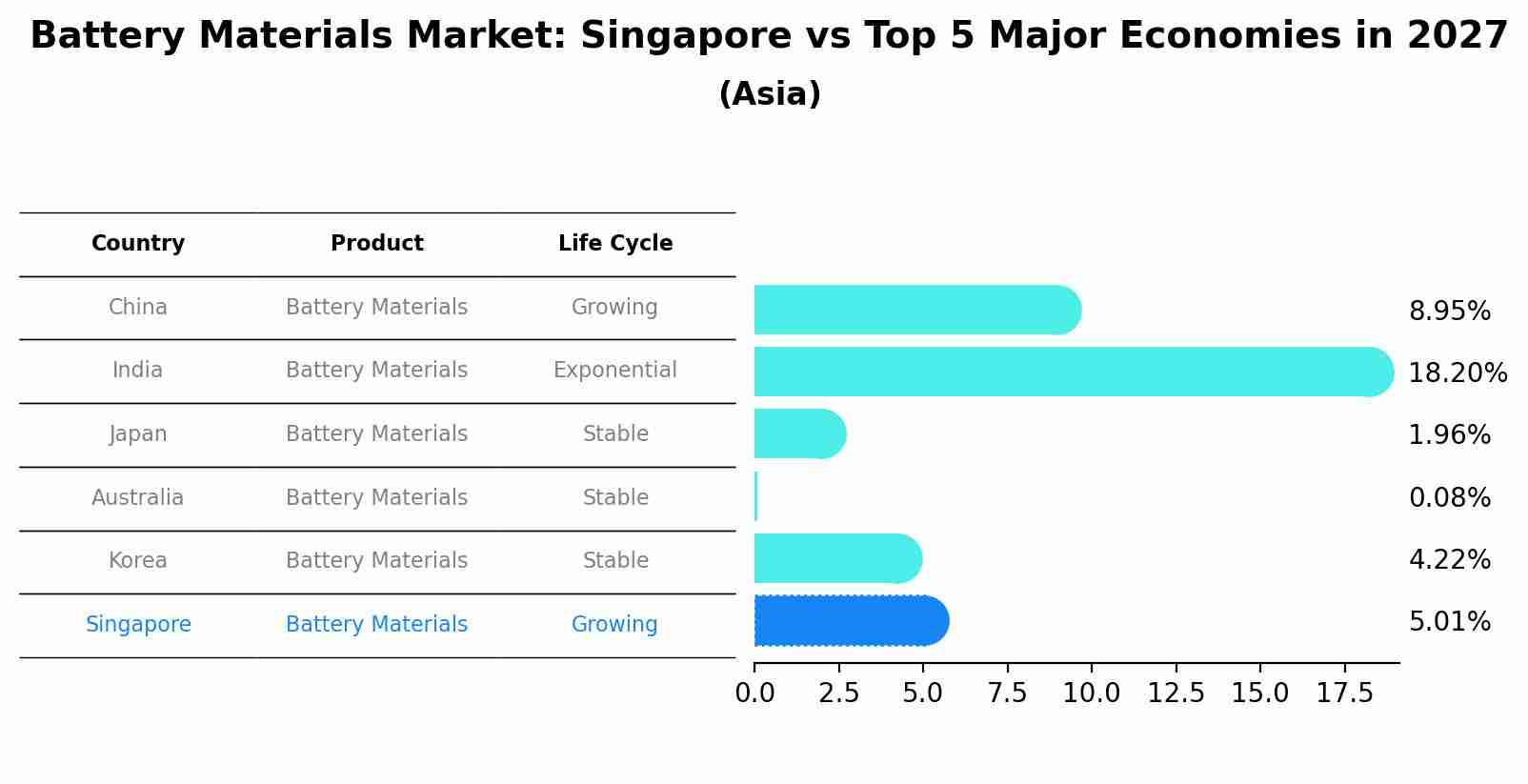
Battery Materials Market: Singapore vs Top 5 Major Economies in 2027 (Asia)
Singapore's Battery Materials market is anticipated to experience a growing growth rate of 5.01% by 2027, reflecting trends observed in the largest economy China, followed by India, Japan, Australia and South Korea.
Singapore Battery Materials Market Synopsis
The Singapore battery materials market is evolving in response to the global shift towards electric vehicles (EVs) and renewable energy storage. Battery materials include metals such as lithium, cobalt, and nickel, as well as materials for separators and electrolytes. The market`s growth is closely linked to the demand for energy storage solutions that support the transition to cleaner transportation and renewable energy sources. As technology advances, battery materials are being optimized for higher energy density, longer lifespans, and improved safety. Singapore strategic location and focus on innovation position it as a potential hub for battery materials research, production, and distribution in the Asia-Pacific region.
Drivers of the Market
The Singapore battery materials market is witnessing significant growth, primarily due to the rapid expansion of the electric vehicle (EV) industry. As the world shifts towards sustainable transportation, EVs are becoming increasingly popular, and this trend has spurred demand for advanced battery materials. Factors driving this market include government incentives and subsidies for EV adoption, environmental concerns related to traditional internal combustion engines, and advancements in battery technologies, such as lithium-ion and solid-state batteries. Additionally, the growing consumer preference for longer battery life and faster charging capabilities has encouraged research and development in battery materials. The market is also influenced by the need for energy storage solutions in various sectors, including renewable energy and grid stabilization. Overall, these factors are contributing to the robust growth of the battery materials market in Singapore.
Challenges of the Market
The Singapore battery materials market faces several challenges. Firstly, the industry is heavily reliant on the global supply chain for critical materials like lithium, cobalt, and nickel, making it vulnerable to price fluctuations and supply disruptions. Additionally, the fast-paced technological advancements in battery chemistry require continuous research and development investments, which can strain smaller players in the market. Environmental concerns regarding the disposal of lithium-ion batteries also pose regulatory and sustainability challenges.
COVID-19 Impact on the Market
The battery materials market in Singapore experienced challenges during the pandemic due to disruptions in global supply chains for battery components. The demand for batteries for electric vehicles and energy storage systems remained strong, but production was hampered by supply chain disruptions. As the economy stabilizes and industries recover, the market is likely to see growth, particularly in the electric vehicle and renewable energy sectors.
Key Players in the Market
The Singapore battery materials market features prominent names like Tanaka Chemical Singapore, Nippon Denko Battery Materials, and Umicore Singapore. These companies specialize in producing materials essential for battery manufacturing, supporting the growing demand for electric vehicles.
Key Highlights of the Report:
- Singapore Battery Materials Market Outlook
- Market Size of Singapore Battery Materials Market, 2024
- Forecast of Singapore Battery Materials Market, 2031
- Historical Data and Forecast of Singapore Battery Materials Revenues & Volume for the Period 2021-2031
- Singapore Battery Materials Market Trend Evolution
- Singapore Battery Materials Market Drivers and Challenges
- Singapore Battery Materials Price Trends
- Singapore Battery Materials Porter's Five Forces
- Singapore Battery Materials Industry Life Cycle
- Historical Data and Forecast of Singapore Battery Materials Market Revenues & Volume By Battery Type for the Period 2021-2031
- Historical Data and Forecast of Singapore Battery Materials Market Revenues & Volume By Lithium-Ion for the Period 2021-2031
- Historical Data and Forecast of Singapore Battery Materials Market Revenues & Volume By Lead Acid for the Period 2021-2031
- Historical Data and Forecast of Singapore Battery Materials Market Revenues & Volume By Others for the Period 2021-2031
- Historical Data and Forecast of Singapore Battery Materials Market Revenues & Volume By Material for the Period 2021-2031
- Historical Data and Forecast of Singapore Battery Materials Market Revenues & Volume By Lithium-Ion for the Period 2021-2031
- Historical Data and Forecast of Singapore Battery Materials Market Revenues & Volume By Lead Acid for the Period 2021-2031
- Singapore Battery Materials Import Export Trade Statistics
- Market Opportunity Assessment By Battery Type
- Market Opportunity Assessment By Material
- Singapore Battery Materials Top Companies Market Share
- Singapore Battery Materials Competitive Benchmarking By Technical and Operational Parameters
- Singapore Battery Materials Company Profiles
- Singapore Battery Materials Key Strategic Recommendations






































