Singapore Benzoic Acid Market: Import Trend Analysis
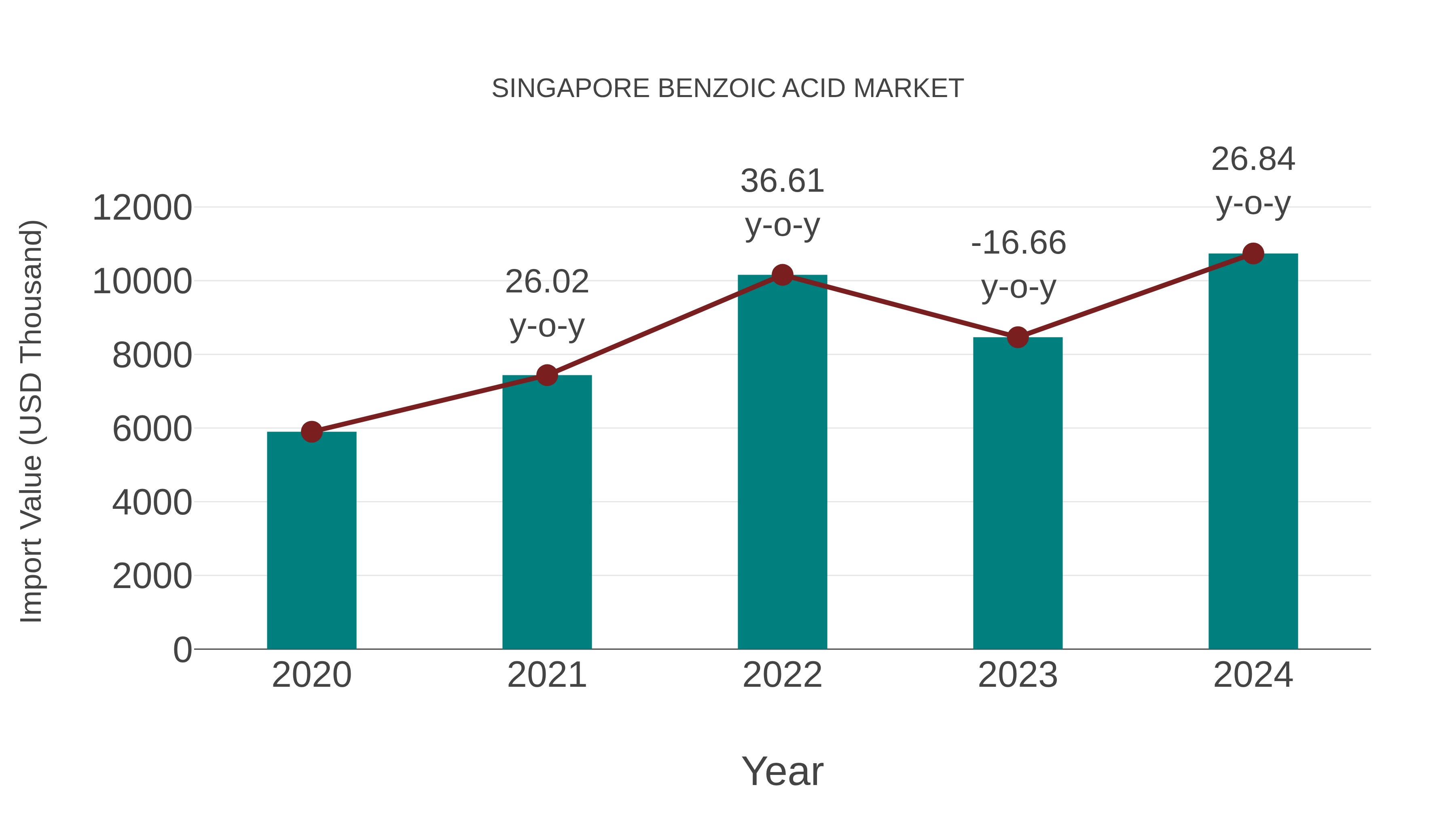
In the Singapore benzoic acid market, the import trend showed a notable growth rate of 26.84% from 2023 to 2024, with a compound annual growth rate (CAGR) of 16.15% for the period 2020-2024. This surge in imports can be attributed to a significant demand shift towards benzoic acid-based products in various industries, indicating a strong import momentum driven by evolving market dynamics.
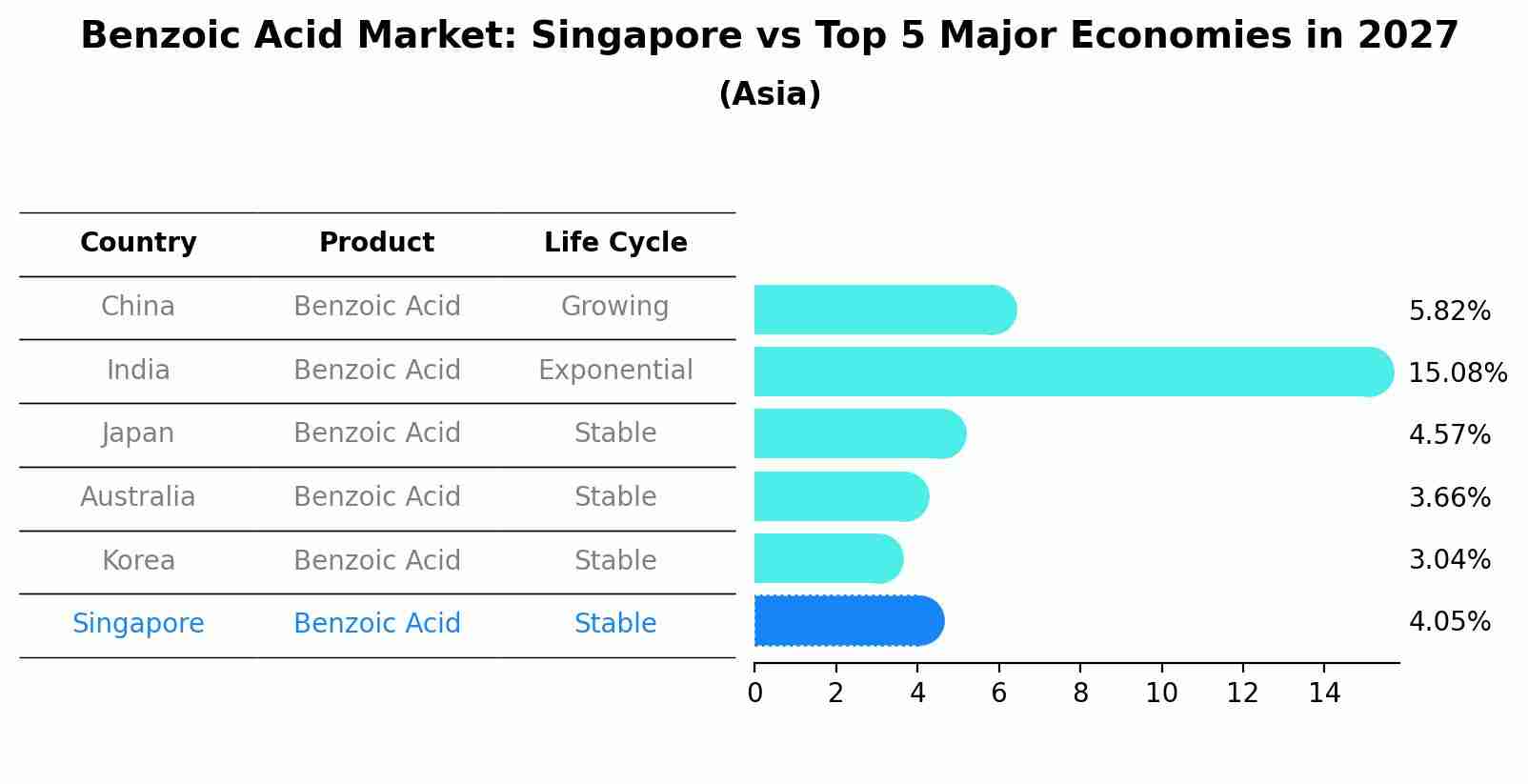
Benzoic Acid Market: Singapore vs Top 5 Major Economies in 2027 (Asia)
Singapore's Benzoic Acid market is anticipated to experience a stable growth rate of 4.05% by 2027, reflecting trends observed in the largest economy China, followed by India, Japan, Australia and South Korea.
Singapore Benzoic Acid Market Synopsis
Benzoic acid is used as a preservative in the food and beverage industry and as a precursor in the production of various chemicals. Its market in Singapore is influenced by the food processing industry`s need for preservatives and the chemical industry`s demand for intermediates. As consumer preferences shift toward natural preservatives, the market may witness changes in product formulations.
Drivers of the Market
The Singapore benzoic acid market is poised for growth due to its applications in the food and beverage industry. Benzoic acid is a common food preservative, and its use is driven by the increasing demand for processed and packaged foods. As consumers seek products with longer shelf lives and greater convenience, the demand for benzoic acid as a preservative is expected to rise in Singapore. Additionally, it is used in the production of various chemicals, further contributing to market growth.
Challenges of the Market
The Singapore benzoic acid market confronts challenges linked to the availability and cost of raw materials, especially toluene and phthalic anhydride. Fluctuations in the prices of these feedstocks can affect production costs. Stringent regulations on food and beverage additives, where benzoic acid is commonly used as a preservative, require manufacturers to meet strict quality and safety standards. Additionally, the market faces competition from alternative preservatives and antimicrobial agents.
COVID-19 Impact on the Market
Benzoic acid, used in the food and pharmaceutical industries, faced supply chain disruptions during the pandemic. However, as these sectors adapt to changing consumer preferences and regulatory requirements, the demand for benzoic acid is expected to rebound. Singapore role as a regional hub for food and pharmaceutical industries may contribute to the recovery of the benzoic acid market.
Key Players in the Market
The Singapore benzoic acid market is seeing growth due to its applications in food preservation and pharmaceuticals. Key players in this market segment include Emerald Kalama Chemical, LLC, Jiangsu Suyan Technology Co., Ltd., Eastman Chemical Company, and Merck KGaA.
Key Highlights of the Report:
- Singapore Benzoic Acid Market Outlook
- Market Size of Singapore Benzoic Acid Market, 2025
- Forecast of Singapore Benzoic Acid Market, 2032
- Historical Data and Forecast of Singapore Benzoic Acid Revenues & Volume for the Period 2022-2032F
- Singapore Benzoic Acid Market Trend Evolution
- Singapore Benzoic Acid Market Drivers and Challenges
- Singapore Benzoic Acid Price Trends
- Singapore Benzoic Acid Porter's Five Forces
- Singapore Benzoic Acid Industry Life Cycle
- Historical Data and Forecast of Singapore Benzoic Acid Market Revenues & Volume By End-use Industry for the Period 2022-2032F
- Historical Data and Forecast of Singapore Benzoic Acid Market Revenues & Volume By Food & Beverages for the Period 2022-2032F
- Historical Data and Forecast of Singapore Benzoic Acid Market Revenues & Volume By Chemical for the Period 2022-2032F
- Historical Data and Forecast of Singapore Benzoic Acid Market Revenues & Volume By Pharmaceutical for the Period 2022-2032F
- Historical Data and Forecast of Singapore Benzoic Acid Market Revenues & Volume By Application for the Period 2022-2032F
- Historical Data and Forecast of Singapore Benzoic Acid Market Revenues & Volume By Benzoates for the Period 2022-2032F
- Historical Data and Forecast of Singapore Benzoic Acid Market Revenues & Volume By Benzoate plasticizers for the Period 2022-2032F
- Historical Data and Forecast of Singapore Benzoic Acid Market Revenues & Volume By Benzoyl Chloride for the Period 2022-2032F
- Historical Data and Forecast of Singapore Benzoic Acid Market Revenues & Volume By Alkyd Resins for the Period 2022-2032F
- Historical Data and Forecast of Singapore Benzoic Acid Market Revenues & Volume By Animal Feed Additive for the Period 2022-2032F
- Singapore Benzoic Acid Import Export Trade Statistics
- Market Opportunity Assessment By End-use Industry
- Market Opportunity Assessment By Application
- Singapore Benzoic Acid Top Companies Market Share
- Singapore Benzoic Acid Competitive Benchmarking By Technical and Operational Parameters
- Singapore Benzoic Acid Company Profiles
- Singapore Benzoic Acid Key Strategic Recommendations






































