Singapore Brewery Plant and Equipment Market Summary
The singapore brewery plant and equipment market was estimated at USD 380 Million in 2025 and is projected to reach USD 516 Million by 2032, growing at a CAGR of 5.0% from 2026 to 2032.
Singapore Brewery Plant and Equipment Market Year-wise Growth Rate and Key Drivers
This graph highlights how the Singapore Brewery Plant and Equipment Market has steadily grown over the past five years, supported by major growth factors.
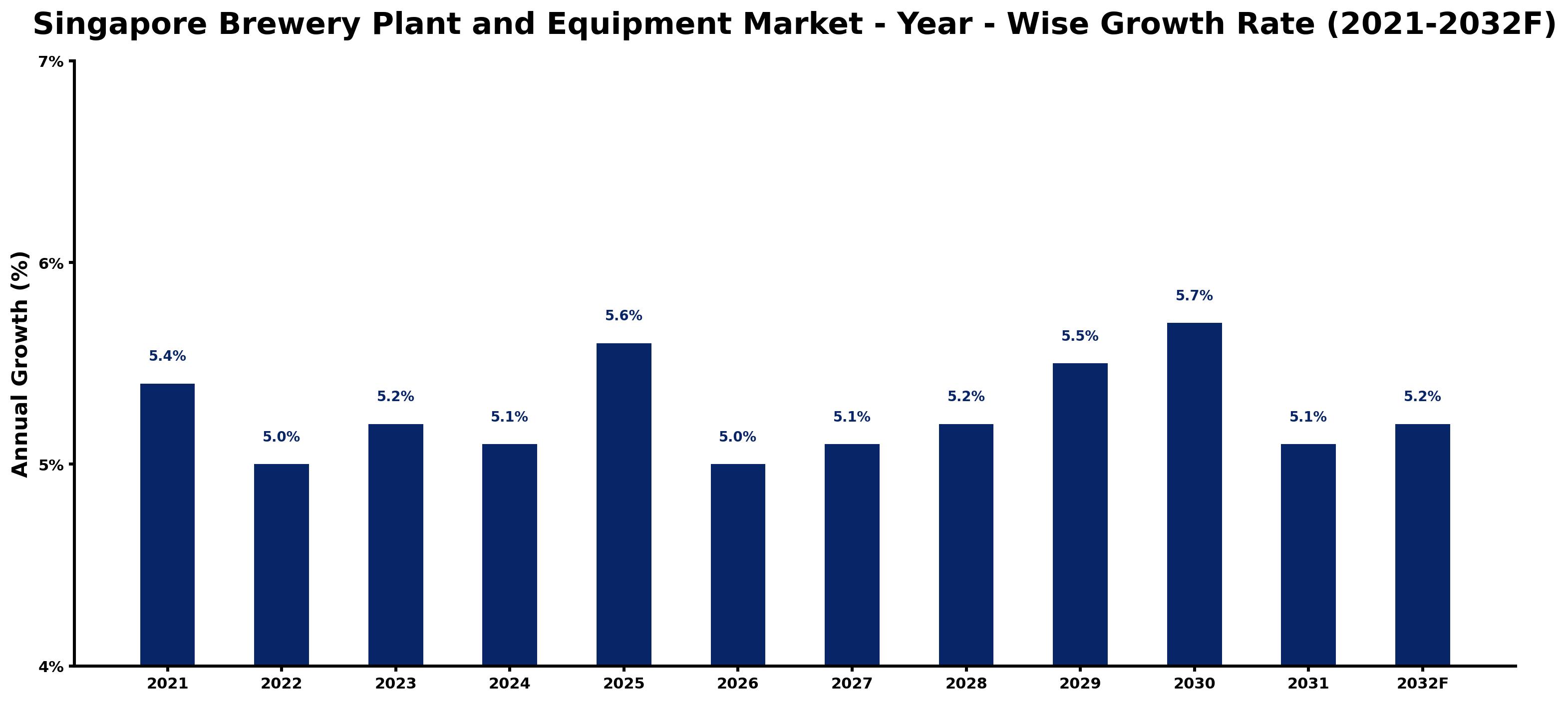
The table below presents the year wise growth rates along with the key drivers influencing the market
| Year | Growth Rate | Major Drivers |
| 2021 | 5.4% | Supply chain disruptions impacted equipment sourcing and manufacturing timelines across the market. |
| 2022 | 5.0% | Local brewery startups emerged, enhancing competition and diversifying the product landscape in Singapore. |
| 2023 | 5.2% | Consumer preferences shifted towards artisanal beers, prompting equipment upgrades for local breweries. |
| 2024 | 5.1% | Technological innovations in brewing processes necessitated investments in more efficient equipment. |
| 2025 | 5.6% | Sustainability practices gained traction, encouraging breweries to adopt eco-friendly production technologies. |
| 2026 | 5.0% | Collaborations between local brewers and technology firms expanded capabilities in brewing efficiency. |
| 2027 | 5.1% | Increased tourism boosted demand for unique, locally produced beers across various establishments. |
| 2028 | 5.2% | Export potential grew as breweries sought to penetrate Southeast Asian markets for craft beers. |
| 2029 | 5.5% | Investment in automation led to significant cost reductions and improved production scalability. |
| 2030 | 5.7% | Consumer education about beer quality influenced purchasing habits, driving equipment upgrades. |
| 2031 | 5.1% | Emerging trends in health-conscious beverages prompted diversification in brewing equipment offerings. |
| 2032 | 5.2% | Regulatory changes favored smaller breweries, leading to a surge in equipment demand and innovation. |
Note - Market size estimations and growth projections presented in this report are based on 6Wresearch's advanced forecasting approach, validated with industry datasets as of June 2026.
Singapore Brewery Plant and Equipment Market Synopsis
The Singapore Brewery Plant and Equipment Market is projected to reach 5.0% and witness significant growth during the forecast period (2026-2032). In 2020, the market was valued at US$ 8.6 million and is expected to grow at a compound annual growth rate (CAGR) of 8.6%. This anticipated expansion is largely driven by several interrelated factors, including the increasing demand for craft beer, rising disposable incomes, and ongoing technological innovations within brewing processes.
Singapore Brewery Plant and Equipment Market Growth Drivers
The notable growth of the Singapore brewery plant and equipment market can be attributed to various influential drivers:
- The increasing demand for craft beer signifies a shift in consumer preference towards unique flavors and locally sourced ingredients, prompting brewers to invest in advanced plant and equipment for production.
- Rising disposable incomes across Singapore have led to changes in lifestyle and spending habits, encouraging consumers to indulge in premium alcoholic beverages, thereby boosting production capacities.
- Technological advancements in brewing processes have streamlined operations through automation, resulting in reduced labor costs and improved product quality, which are attractive to new entrants and established players alike.
- The growing popularity of alcoholic beverages among younger demographics compels brewers to innovate and diversify their offerings, further promoting investment in sophisticated brewing technologies.
- Low entry barriers for new breweries, alongside supportive consumer trends, have created opportunities for small and medium-sized enterprises to enter the market, driving demand for modern equipment and facilities.
Singapore Brewery Plant and Equipment Market Challenges and Restraints
Despite the promising growth trajectory, the Singapore brewery plant and equipment market encounters several challenges and restraints that could affect its scalability:
- Stringent regulations regarding licensing laws can pose significant hurdles for new entrants looking to establish breweries, limiting market competition and innovation.
- A lack of skilled workforce within specialized production lines may hinder overall industry growth, as it restricts operational efficiency and quality control.
- High capital requirements for setting up brewery plants act as a deterrent for many potential investors, restricting expansion opportunities for existing players.
- Volatility in raw material prices can significantly reduce profit margins for manufacturers, complicating long-term financial planning and sustainability.
- Unfavorable taxation policies imposed on alcoholic beverages may negatively influence sales prospects, affecting overall revenue generation within the sector.
Singapore Brewery Plant and Equipment Market Government Investment and Initiatives
The Singapore government has recognized the brewing industry as a critical sector for economic growth. Through various initiatives, it aims to support domestic producers:
- The government is investing in infrastructure improvements that enhance the logistics and supply chain operations critical for brewery establishments.
- Public spending has been directed towards technological advancements and research in sustainable brewing practices, promoting environmentally friendly production methods.
- Programs aimed at skill development have been implemented to address the skilled labor shortage within the brewing industry, ensuring that the workforce is equipped with necessary expertise.
- Incentives for startups in the brewing sector include tax breaks and grants, encouraging innovation and entrepreneurship in the marketplace.
- Regulatory bodies are working towards simplifying licensing processes, making it easier for new players to enter the market and thus fostering a competitive environment.
Singapore Brewery Plant and Equipment Market Latest Developments (May 2025 - June 2026)
Recent developments in the Singapore brewery plant and equipment market indicate a shift towards more sustainable practices. Breweries are increasingly adopting technologies that reduce water usage and energy consumption. Additionally, there has been a marked increase in collaboration between local brewers and technology firms to enhance brewing efficiency. The focus on craft beer continues to grow, with more breweries experimenting with unique flavor profiles, leading to a diversification of product offerings.
Singapore Brewery Plant and Equipment Market - Key Attractiveness of the Report
- 10 Years of Market Numbers
- Historical Data Starting from 2022 to 2025
- Base Year: 2025
- Forecast Data until 2032
- Key Performance Indicators Impacting the Market
- Major Upcoming Developments and Projects
Key Highlights of the Report:
- Singapore Brewery Plant and Equipment Market Outlook
- Market Size of Singapore Brewery Plant and Equipment Market, 2025
- Forecast of Singapore Brewery Plant and Equipment Market, 2032F
- Historical Data and Forecast of Singapore Brewery Plant and Equipment Revenues & Volume for the Period 2022-2032F
- Singapore Brewery Plant and Equipment Market Trend Evolution
- Singapore Brewery Plant and Equipment Market Drivers and Challenges
- Singapore Brewery Plant and Equipment Price Trends
- Singapore Brewery Plant and Equipment Porter's Five Forces
- Singapore Brewery Plant and Equipment Industry Life Cycle
- Historical Data and Forecast of Singapore Brewery Plant and Equipment Market Revenues & Volume By Type for the Period 2022-2032F
- Historical Data and Forecast of Singapore Brewery Plant and Equipment Market Revenues & Volume By Brewery Plant for the Period 2022-2032F
- Historical Data and Forecast of Singapore Brewery Plant and Equipment Market Revenues & Volume By Brewery Equipments for the Period 2022-2032F
- Historical Data and Forecast of Singapore Brewery Plant and Equipment Market Revenues & Volume By Mode of Operation for the Period 2022-2032F
- Historical Data and Forecast of Singapore Brewery Plant and Equipment Market Revenues & Volume By Automatic for the Period 2022-2032F
- Historical Data and Forecast of Singapore Brewery Plant and Equipment Market Revenues & Volume By Semi-automatic for the Period 2022-2032F
- Historical Data and Forecast of Singapore Brewery Plant and Equipment Market Revenues & Volume By Manual for the Period 2022-2032F
- Historical Data and Forecast of Singapore Brewery Plant and Equipment Market Revenues & Volume By End-users for the Period 2022-2032F
- Historical Data and Forecast of Singapore Brewery Plant and Equipment Market Revenues & Volume By Macro Brewery for the Period 2022-2032F
- Historical Data and Forecast of Singapore Brewery Plant and Equipment Market Revenues & Volume By Craft Brewery for the Period 2022-2032F
- Historical Data and Forecast of Singapore Brewery Plant and Equipment Market Revenues & Volume By Microbrewery for the Period 2022-2032F
- Historical Data and Forecast of Singapore Brewery Plant and Equipment Market Revenues & Volume By Brewpub for the Period 2022-2032F
- Historical Data and Forecast of Singapore Brewery Plant and Equipment Market Revenues & Volume By Others for the Period 2022-2032F
- Singapore Brewery Plant and Equipment Import Export Trade Statistics
- Market Opportunity Assessment By Type
- Market Opportunity Assessment By Mode of Operation
- Market Opportunity Assessment By End-users
- Singapore Brewery Plant and Equipment Top Companies Market Share
- Singapore Brewery Plant and Equipment Competitive Benchmarking By Technical and Operational Parameters
- Singapore Brewery Plant and Equipment Company Profiles
- Singapore Brewery Plant and Equipment Key Strategic Recommendations






































