Singapore Business Analytics Market Size & Growth Rate (2026-2032)
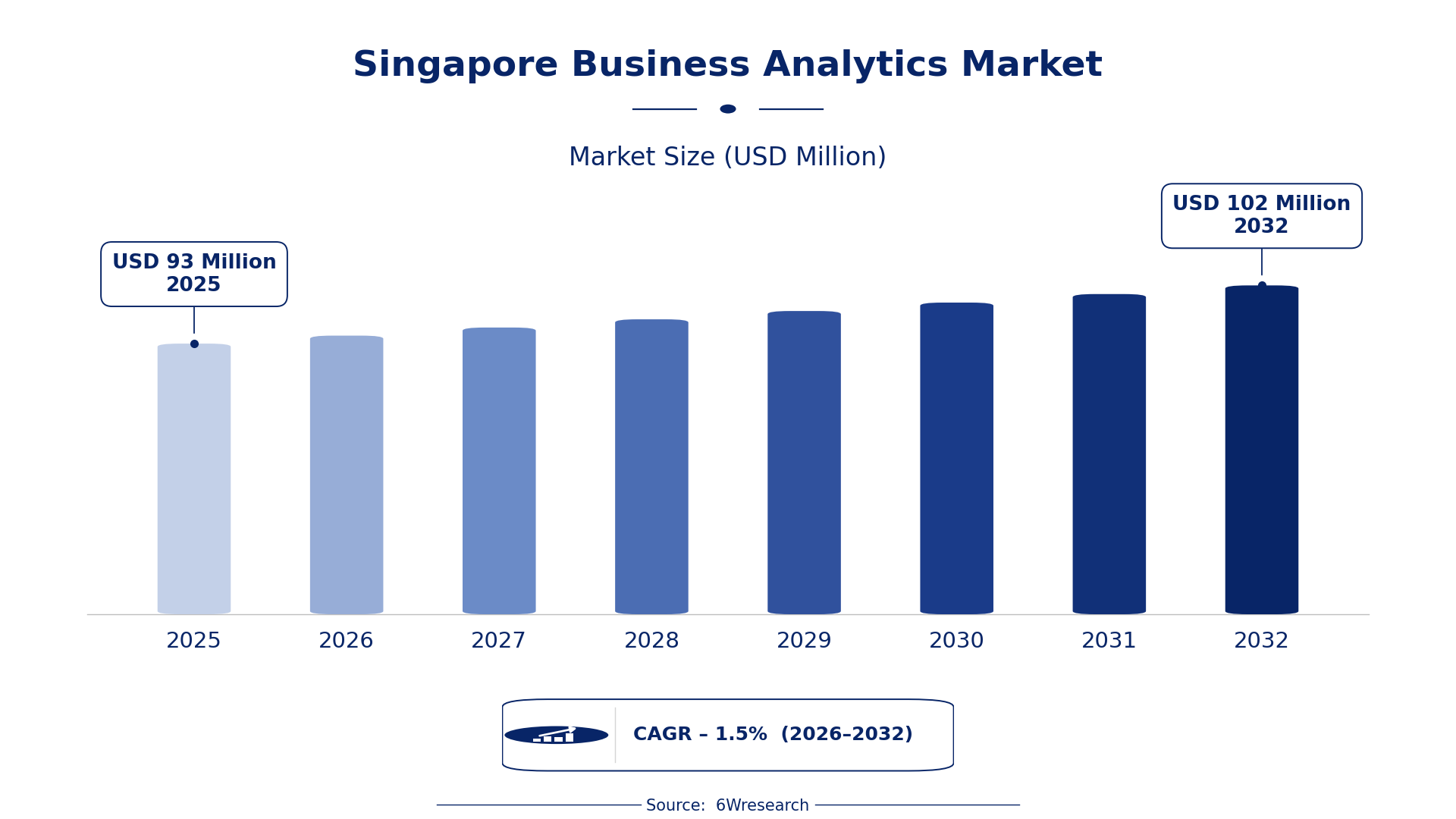
The Singapore Business Analytics Market was estimated at USD 93 Million in 2025 and is projected to reach USD 102 Million by 2032, growing at a CAGR of 1.5% from 2026 to 2032.
Singapore Business Analytics Market Synopsis
Recent momentum in the Singapore Business Analytics Market reflects a surge in demand as businesses increasingly depend on data-driven insights. As organizations recognize the critical role of analytics in enhancing operational efficiency, the market is transitioning towards more advanced and integrated solutions that foster agility and adaptability.
Looking ahead, the trajectory is clear: businesses will not only continue to invest in analytics but will also prioritize tools that provide real-time insights. This shift will be crucial for remaining competitive as Singapore’s market dynamics evolve rapidly, especially in the face of economic uncertainties.
Singapore Business Analytics Market Year-wise Growth Rate and Key Drivers
This graph illustrates the annual growth rates of the Singapore Business Analytics Market from 2021 to 2032, highlighting a steady upward trajectory and projected expansion over the forecast period.
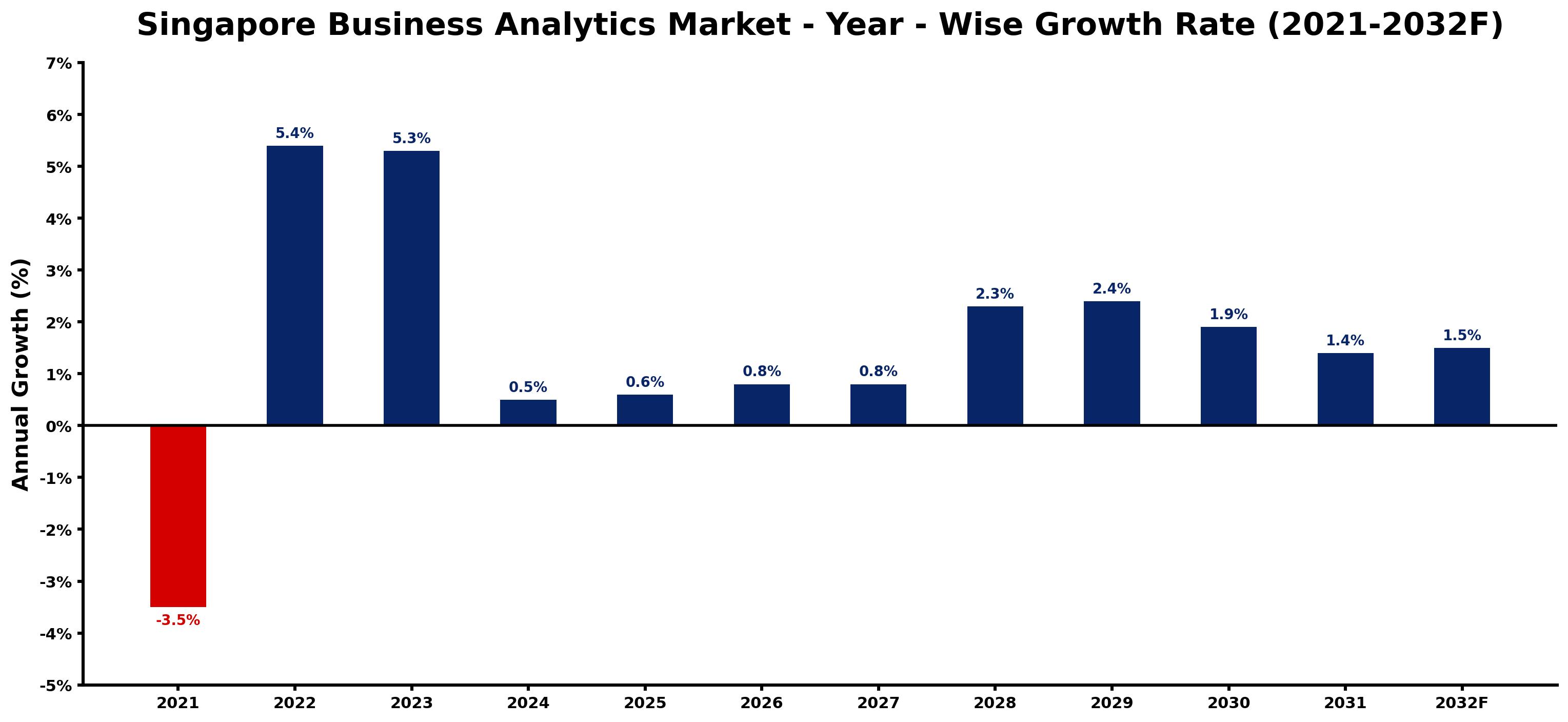
The table below presents the year‑wise growth rates along with the key drivers influencing the market
| Year | Growth Rate | Major Drivers |
| 2021 | -3.5% | COVID-19 lockdowns decreased demand for analytics services. |
| 2022 | 5.4% | Singapore's Smart Nation initiative drives data analytics adoption. |
| 2023 | 5.3% | Increased demand for data visualization in local SMEs. |
| 2024 | 0.5% | Government incentives for tech startups boost analytics investment. |
| 2025 | 0.6% | Rise of AI applications in the finance sector. |
| 2026 | 0.8% | Enhanced regulatory frameworks support data-driven decision-making. |
| 2027 | 0.8% | Growing e-commerce sector fuels analytics needs in logistics. |
| 2028 | 2.3% | Focus on enterprise digital transformation in local businesses. |
| 2029 | 2.4% | Partnerships between universities and firms enhance analytics capabilities. |
| 2030 | 1.9% | Regulatory push for data protection spurs analytics compliance solutions. |
| 2031 | 1.4% | Shift to hybrid work increases demand for business insights. |
| 2032 | 1.5% | Local fintech innovation boosts analytics demand in banking. |
Note: Market size estimations and growth projections presented in this report are based on 6Wresearch's proprietary forecasting methodology, utilizing the latest available industry data, government publications, and primary research inputs.
Singapore Business Analytics Market Key Takeaways
Below are some of the specific key takeaways from the market, including:
- Organizations are increasingly prioritizing data-driven decision-making processes.
- Real-time analytics demand is rising due to the proliferation of data sources.
- Data governance and literacy are significant barriers that must be addressed.
- The impact of COVID-19 has accelerated the adoption of analytics tools across sectors.
- Leading players are introducing innovative solutions tailored to local market needs.
Evaluation of Restraints in Singapore Business Analytics Market
The Singapore Business Analytics Market faces several constraints that inhibit its growth potential. A primary concern is the challenge of data governance, which can affect the quality and security of data. Organizations struggle to implement effective policies that ensure compliance and maintain data integrity. on top of that, fostering data literacy within the workforce remains a challenge, as many employees lack the necessary skills to utilize analytics tools effectively. These obstacles hinder the ability of companies to translate insights into actionable strategies, thereby limiting the market's overall growth.
Singapore Business Analytics Market Trends
A few trends are shaping the demand for business analytics in Singapore. The integration of artificial intelligence and machine learning into analytics tools is gaining traction, as businesses seek more sophisticated ways to interpret complex data. Additionally, the move towards cloud-based analytics solutions is becoming more prevalent, allowing for greater scalability and flexibility. The emphasis on predictive analytics is also noteworthy, as companies strive to anticipate market changes and customer behavior more accurately.
Singapore Business Analytics Market Opportunities
Significant growth opportunities exist for businesses operating within the Singapore Business Analytics Market. As companies increasingly adopt digital transformation strategies, the demand for advanced analytics tools will rise. Investments in training programs aimed at improving data literacy can enhance workforce capabilities and create a more data-savvy environment. on top of that, sectors such as healthcare and finance are ripe for innovation, as they require tailored analytics solutions to address specific challenges and opportunities.
Government Initiatives in the Singapore Business Analytics Market
Government policy is playing a crucial role in shaping the Singapore Business Analytics Market. With an emphasis on enhancing digital capabilities, public sector initiatives are focused on promoting data usage and improving analytics infrastructure across various industries. These efforts are crucial for encouraging innovation and ensuring that businesses can compete effectively on a global scale.
- A national digital infrastructure upgrade programme launched in early 2025 aims to improve connectivity and data accessibility for businesses.
- A current initiative promotes public-private partnerships to foster innovation in data analytics, which is underway and expected to yield results by late 2026.
- A regulatory framework established in 2025 is designed to enhance data governance standards across industries.
- Plans for an upcoming grant scheme are set to be introduced in 2027 to support SMEs in adopting business analytics solutions.
Future Insights of the Singapore Business Analytics Market
Looking forward to 2026-2032, the Singapore Business Analytics Market is expected to experience steady growth driven by a combination of evolving technologies and increasing business demands. The integration of advanced analytics capabilities will likely become a standard practice as organizations seek to optimize their operations. As businesses adapt to a data-centric approach, the market will see heightened investment in analytics tools and training, ultimately leading to improved efficiency and competitiveness in the global marketplace.
Singapore Business Analytics Market Latest Developments
Recent industry activity in the Singapore Business Analytics Market has showcased a push towards innovation and enhanced service offerings. Companies are actively exploring partnerships and developing new solutions to meet the growing demands for data analytics. This trend reflects a broader commitment to integrating advanced technologies into business operations.
- A leading technology vendor launched a new analytics platform in Q2 2025 that incorporates AI-driven features to enhance data processing capabilities.
- An initiative that began in early 2025 focuses on providing training programs for employees to improve data literacy, with ongoing sessions planned throughout 2026.
- By mid-2026, a major regional operator is expected to roll out an expanded analytics service tailored for the financial sector.
- A partnership between public institutions and private firms was established in late 2025 to support the development of analytics solutions for small businesses.
Singapore Business Analytics Market - Key Attractiveness of the Report
- 10 Years of Market Numbers
- Historical Data Starting from 2022 to 2025
- Base Year: 2025
- Forecast Data until 2032
- Key Performance Indicators Impacting the Market
- Major Upcoming Developments and Projects
Key Highlights of the Report:
- Singapore Business Analytics Market Outlook
- Market Size of Singapore Business Analytics Market, 2025
- Forecast of Singapore Business Analytics Market, 2032
- Historical Data and Forecast of Singapore Business Analytics Revenues & Volume for the Period 2022-2032F
- Singapore Business Analytics Market Trend Evolution
- Singapore Business Analytics Market Drivers and Challenges
- Singapore Business Analytics Price Trends
- Singapore Business Analytics Porter's Five Forces
- Singapore Business Analytics Industry Life Cycle
- Historical Data and Forecast of Singapore Business Analytics Market Revenues & Volume By Software for the Period 2022-2032F
- Historical Data and Forecast of Singapore Business Analytics Market Revenues & Volume By Query, Reporting and Analysis Tools for the Period 2022-2032F
- Historical Data and Forecast of Singapore Business Analytics Market Revenues & Volume By Advanced and Predictive Analytics for the Period 2022-2032F
- Historical Data and Forecast of Singapore Business Analytics Market Revenues & Volume By Location Intelligence for the Period 2022-2032F
- Historical Data and Forecast of Singapore Business Analytics Market Revenues & Volume By Content Analytics for the Period 2022-2032F
- Historical Data and Forecast of Singapore Business Analytics Market Revenues & Volume By Data Warehousing Platform for the Period 2022-2032F
- Historical Data and Forecast of Singapore Business Analytics Market Revenues & Volume By Enterprise Performance Management for the Period 2022-2032F
- Historical Data and Forecast of Singapore Business Analytics Market Revenues & Volume By Deployment Type for the Period 2022-2032F
- Historical Data and Forecast of Singapore Business Analytics Market Revenues & Volume By Cloud for the Period 2022-2032F
- Historical Data and Forecast of Singapore Business Analytics Market Revenues & Volume By On-Premises for the Period 2022-2032F
- Historical Data and Forecast of Singapore Business Analytics Market Revenues & Volume By User Type for the Period 2022-2032F
- Historical Data and Forecast of Singapore Business Analytics Market Revenues & Volume By Large Enterprises for the Period 2022-2032F
- Historical Data and Forecast of Singapore Business Analytics Market Revenues & Volume By SMBs for the Period 2022-2032F
- Historical Data and Forecast of Singapore Business Analytics Market Revenues & Volume By Vertical for the Period 2022-2032F
- Historical Data and Forecast of Singapore Business Analytics Market Revenues & Volume By Banking, Financial Services, and Insurance (BFSI) for the Period 2022-2032F
- Historical Data and Forecast of Singapore Business Analytics Market Revenues & Volume By Energy and power for the Period 2022-2032F
- Historical Data and Forecast of Singapore Business Analytics Market Revenues & Volume By Education for the Period 2022-2032F
- Historical Data and Forecast of Singapore Business Analytics Market Revenues & Volume By Government for the Period 2022-2032F
- Historical Data and Forecast of Singapore Business Analytics Market Revenues & Volume By Retail for the Period 2022-2032F
- Historical Data and Forecast of Singapore Business Analytics Market Revenues & Volume By Healthcare for the Period 2022-2032F
- Historical Data and Forecast of Singapore Business Analytics Market Revenues & Volume By Media and Entertainment for the Period 2022-2032F
- Historical Data and Forecast of Singapore Business Analytics Market Revenues & Volume By Manufacturing for the Period 2022-2032F
- Singapore Business Analytics Import Export Trade Statistics
- Market Opportunity Assessment By Software
- Market Opportunity Assessment By Deployment Type
- Market Opportunity Assessment By User Type
- Market Opportunity Assessment By Vertical
- Singapore Business Analytics Top Companies Market Share
- Singapore Business Analytics Competitive Benchmarking By Technical and Operational Parameters
- Singapore Business Analytics Company Profiles
- Singapore Business Analytics Key Strategic Recommendations






































