Singapore Business Intelligence Market Size & Growth Rate (2026-2032)
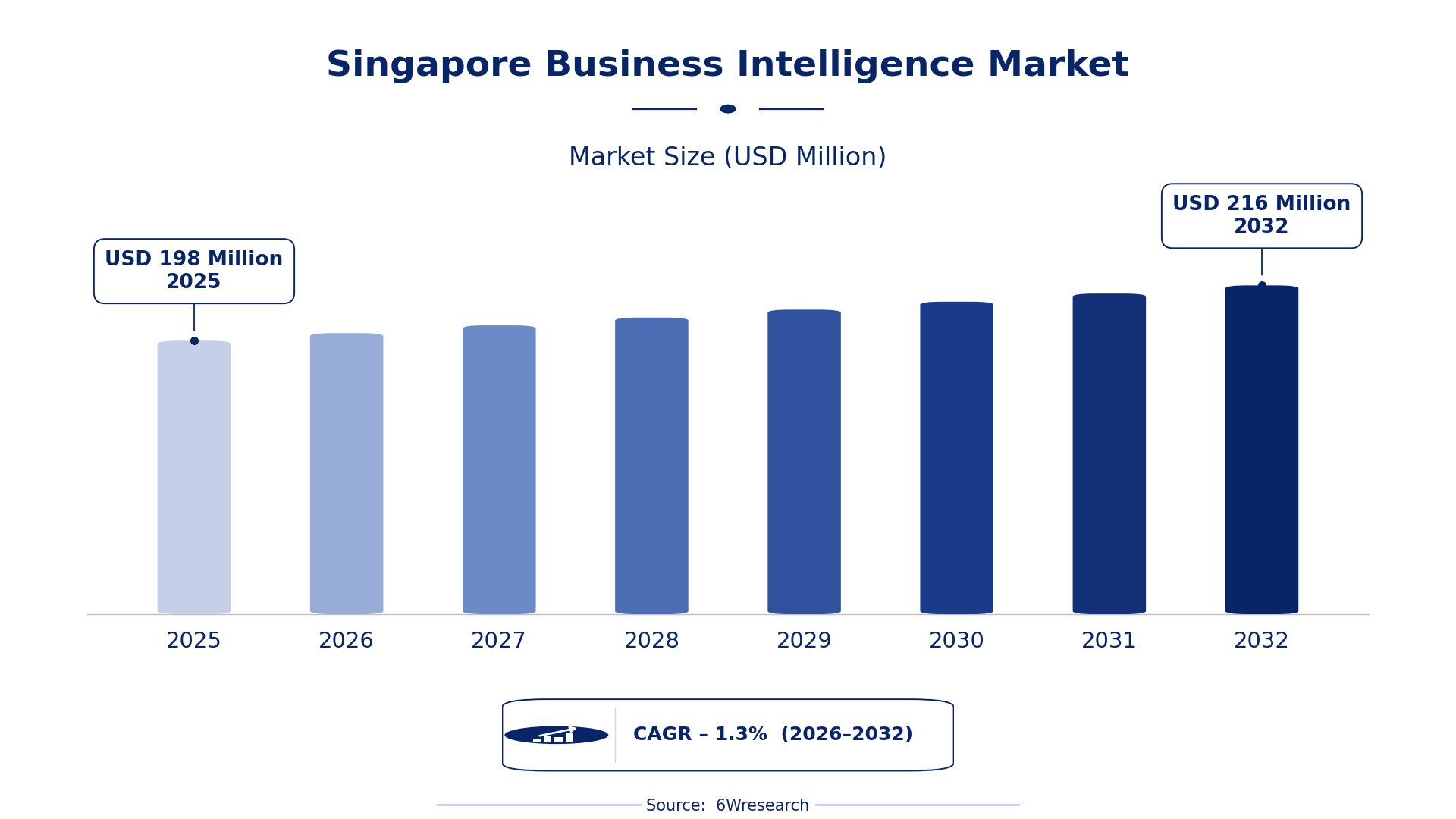
The Singapore Business Intelligence Market was estimated at USD 198 Million in 2025 and is projected to reach USD 216 Million by 2032, growing at a CAGR of 1.3% from 2026 to 2032.
Singapore Business Intelligence Market Synopsis
The Singapore Business Intelligence market is gaining momentum as organizations increasingly prioritize data-driven strategies. Companies across various sectors recognize that effective data analysis is essential for making informed decisions that enhance operational efficiency and foster growth.
In a competitive environment, the demand for robust analytics tools has surged, enabling businesses to visualize data trends and gain actionable insights. This trend is evident in sectors such as finance, healthcare, and government, where data utilization directly impacts performance and strategic planning.
Singapore Business Intelligence Market Year-wise Growth Rate and Key Drivers
This graph illustrates the annual growth rates of the Singapore Business Intelligence Market from 2021 to 2032, highlighting a steady upward trajectory and projected expansion over the forecast period.
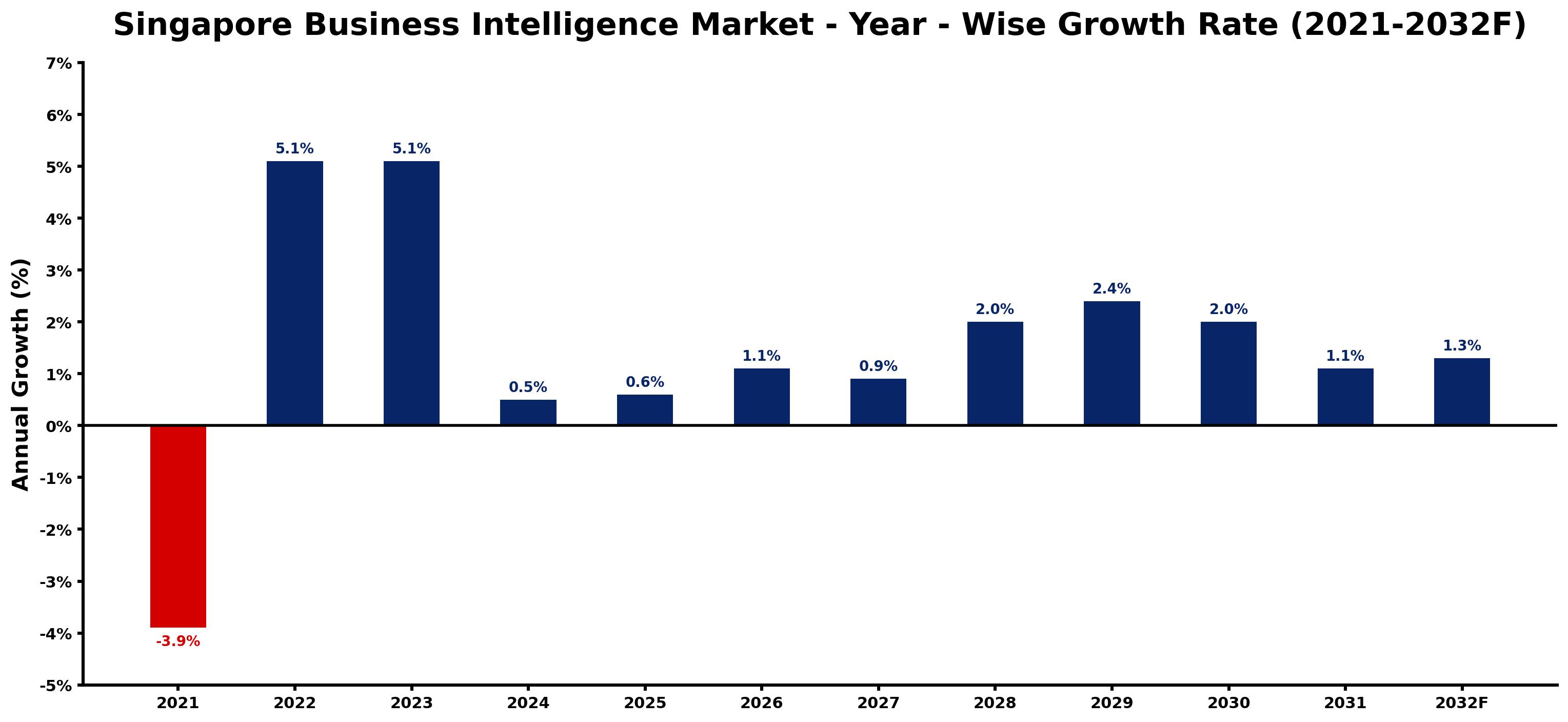
The table below presents the year‑wise growth rates along with the key drivers influencing the market
| Year | Growth Rate | Major Drivers |
| 2021 | -3.9% | Delayed digital transformation initiatives amidst COVID-19 impact. |
| 2022 | 5.1% | Government's Smart Nation initiative boosting data utilization. |
| 2023 | 5.1% | Increased adoption of AI-driven analytics solutions nationwide. |
| 2024 | 0.5% | Growing number of digital banks leveraging business intelligence. |
| 2025 | 0.6% | Emerging need for compliance with data protection regulations. |
| 2026 | 1.1% | Rise in e-commerce expanding demand for analytics services. |
| 2027 | 0.9% | Local industries integrating data-driven decision-making practices. |
| 2028 | 2.0% | Investment in data literacy programs to enhance workforce skills. |
| 2029 | 2.4% | Increased focus on sustainability driving data transparency. |
| 2030 | 2.0% | Growing importance of data storytelling in business strategy. |
| 2031 | 1.1% | Local businesses leveraging insights for competitive advantage. |
| 2032 | 1.3% | Rising importance of customer data privacy regulations. |
Note: Market size estimations and growth projections presented in this report are based on 6Wresearch's proprietary forecasting methodology, utilizing the latest available industry data, government publications, and primary research inputs.
Singapore Business Intelligence Market Key Takeaways
Below are some of the specific key takeaways from the market, including:
- The market is projected to reach USD 216 Million by 2032, indicating steady growth.
- Demand for business intelligence tools is driven by the need for enhanced data-driven decision-making.
- Organizations face challenges related to data quality and integration, impacting the efficiency of BI solutions.
- The COVID-19 pandemic has accelerated the adoption of business intelligence tools across various sectors.
- Government initiatives are actively promoting the digital transformation of businesses in Singapore.
Evaluation of Restraints in Singapore Business Intelligence Market
Despite the promising outlook, the Singapore Business Intelligence market grapples with several restraints. One of the most pressing issues is the challenge of data quality. Organizations often contend with disparate data sources that complicate the aggregation and analysis processes. Integrating these varied data formats requires significant time and resources, which many companies struggle to allocate.
on top of that, scalability remains a concern. As businesses grow, their data needs evolve, and ensuring that business intelligence solutions can adapt to both large enterprises and smaller firms presents a significant hurdle. The ability to translate complex analytics into straightforward, actionable insights is a continual challenge that organizations must address to maximize the utility of their data.
Singapore Business Intelligence Market Trends
Several trends are shaping the Singapore Business Intelligence market. One prominent trend is the increasing integration of artificial intelligence and machine learning into BI tools. These technologies enhance predictive analytics capabilities, allowing organizations to forecast trends and behaviors more accurately.
Another trend is the rise of cloud-based business intelligence solutions, which offer flexibility and scalability. Companies are increasingly moving away from traditional on-premises systems, opting for cloud solutions that provide real-time data access and collaboration across teams.
Singapore Business Intelligence Market Opportunities
Opportunities abound in the Singapore Business Intelligence market, particularly in sectors that are undergoing digital transformation. The healthcare sector, for instance, is looking for innovative solutions to analyze patient data and improve care delivery. Similarly, the financial services industry is seeking advanced analytics to enhance risk assessment and customer insights.
As businesses continue to invest in digital infrastructure, there is a growing need for tailored BI solutions that cater to specific industry requirements. This presents a ripe opportunity for vendors to develop niche products and services that meet the unique demands of various sectors.
Government Initiatives in the Singapore Business Intelligence Market
The Singapore government plays a crucial role in shaping the Business Intelligence market through strategic initiatives aimed at enhancing data capabilities across industries. Public policy is increasingly focused on fostering innovation and ensuring that businesses can effectively harness data to drive decision-making processes. This regulatory environment is vital for the growth of the market.
- A national digital infrastructure upgrade programme recently completed aimed to enhance data accessibility for businesses.
- Current initiatives include a public-private partnership designed to promote the adoption of AI-driven BI solutions across various sectors.
- A regulatory framework introduced in 2025 mandates improved data transparency and governance for organizations handling sensitive information.
- Plans for a comprehensive digital skills training programme are expected to roll out by 2026, enhancing workforce capabilities in data analytics.
- An upcoming initiative focuses on developing a centralized data exchange platform to facilitate better data sharing among government agencies and businesses.
Future Insights of the Singapore Business Intelligence Market
Looking ahead to 2026-2032, the Singapore Business Intelligence market is likely to witness significant evolution. As organizations continue to prioritize data-driven strategies, the demand for advanced analytics tools will expand. Companies that can effectively leverage emerging technologies, such as AI and machine learning, will gain a competitive advantage.
on top of that, the growing emphasis on data privacy and governance will drive the need for solutions that not only provide insights but also ensure compliance with regulatory standards. As the business environment becomes increasingly complex, organizations that invest in robust business intelligence capabilities will position themselves for success.
Singapore Business Intelligence Market Latest Developments
Recent activity in the Singapore Business Intelligence market reflects a dynamic shift toward innovation and enhanced data utilization. Over the past year, organizations have made strides in integrating advanced analytics into their operations, driven by the need for real-time insights and competitive agility.
- A major technology vendor launched a new cloud-based BI platform in early 2025, offering advanced analytics features tailored for small to medium-sized enterprises.
- An initiative that began in late 2024 aims to develop a nationwide data literacy programme to empower employees with data skills, and it remains underway.
- A partnership between a leading analytics firm and a regional bank was established in mid-2025 to develop predictive analytics solutions for enhanced customer insights.
- A rollout of AI-enhanced data visualization tools is expected to begin in Q3 2025, aimed at improving user engagement and decision-making capabilities.
- Plans for a comprehensive upgrade of data management systems across public agencies are projected to commence in early 2026, enhancing data interoperability.
Singapore Business Intelligence Market - Key Attractiveness of the Report
- 10 Years of Market Numbers
- Historical Data Starting from 2022 to 2025
- Base Year: 2025
- Forecast Data until 2032
- Key Performance Indicators Impacting the Market
- Major Upcoming Developments and Projects
Key Highlights of the Report:
- Singapore Business Intelligence Market Outlook
- Market Size of Singapore Business Intelligence Market, 2025
- Forecast of Singapore Business Intelligence Market, 2032
- Historical Data and Forecast of Singapore Business Intelligence Revenues & Volume for the Period 2022-2032F
- Singapore Business Intelligence Market Trend Evolution
- Singapore Business Intelligence Market Drivers and Challenges
- Singapore Business Intelligence Price Trends
- Singapore Business Intelligence Porter's Five Forces
- Singapore Business Intelligence Industry Life Cycle
- Historical Data and Forecast of Singapore Business Intelligence Market Revenues & Volume By Component for the Period 2022-2032F
- Historical Data and Forecast of Singapore Business Intelligence Market Revenues & Volume By Solutions for the Period 2022-2032F
- Historical Data and Forecast of Singapore Business Intelligence Market Revenues & Volume By Services for the Period 2022-2032F
- Historical Data and Forecast of Singapore Business Intelligence Market Revenues & Volume By Business Function for the Period 2022-2032F
- Historical Data and Forecast of Singapore Business Intelligence Market Revenues & Volume By Human Resource for the Period 2022-2032F
- Historical Data and Forecast of Singapore Business Intelligence Market Revenues & Volume By Finance for the Period 2022-2032F
- Historical Data and Forecast of Singapore Business Intelligence Market Revenues & Volume By Operations for the Period 2022-2032F
- Historical Data and Forecast of Singapore Business Intelligence Market Revenues & Volume By Sales and Marketing for the Period 2022-2032F
- Historical Data and Forecast of Singapore Business Intelligence Market Revenues & Volume By Deployment Mode for the Period 2022-2032F
- Historical Data and Forecast of Singapore Business Intelligence Market Revenues & Volume By On-premises for the Period 2022-2032F
- Historical Data and Forecast of Singapore Business Intelligence Market Revenues & Volume By Cloud for the Period 2022-2032F
- Historical Data and Forecast of Singapore Business Intelligence Market Revenues & Volume By Organization Size for the Period 2022-2032F
- Historical Data and Forecast of Singapore Business Intelligence Market Revenues & Volume By SMEs for the Period 2022-2032F
- Historical Data and Forecast of Singapore Business Intelligence Market Revenues & Volume By Large Enterprises for the Period 2022-2032F
- Historical Data and Forecast of Singapore Business Intelligence Market Revenues & Volume By Vertical for the Period 2022-2032F
- Historical Data and Forecast of Singapore Business Intelligence Market Revenues & Volume By Retail for the Period 2022-2032F
- Historical Data and Forecast of Singapore Business Intelligence Market Revenues & Volume By Manufacturing for the Period 2022-2032F
- Historical Data and Forecast of Singapore Business Intelligence Market Revenues & Volume By Government and Public Services for the Period 2022-2032F
- Historical Data and Forecast of Singapore Business Intelligence Market Revenues & Volume By Media and Entertainment for the Period 2022-2032F
- Historical Data and Forecast of Singapore Business Intelligence Market Revenues & Volume By Transportation and Logistics for the Period 2022-2032F
- Historical Data and Forecast of Singapore Business Intelligence Market Revenues & Volume By BFSI for the Period 2022-2032F
- Historical Data and Forecast of Singapore Business Intelligence Market Revenues & Volume By Telecom and IT for the Period 2022-2032F
- Historical Data and Forecast of Singapore Business Intelligence Market Revenues & Volume By Healthcare and Life Sciences for the Period 2022-2032F
- Singapore Business Intelligence Import Export Trade Statistics
- Market Opportunity Assessment By Component
- Market Opportunity Assessment By Business Function
- Market Opportunity Assessment By Deployment Mode
- Market Opportunity Assessment By Organization Size
- Market Opportunity Assessment By Vertical
- Singapore Business Intelligence Top Companies Market Share
- Singapore Business Intelligence Competitive Benchmarking By Technical and Operational Parameters
- Singapore Business Intelligence Company Profiles
- Singapore Business Intelligence Key Strategic Recommendations






































