Singapore Cameras Market Summary
The singapore cameras market was estimated at USD 203 Million in 2025 and is projected to reach USD 271 Million by 2032, growing at a CAGR of 4.9% from 2026 to 2032.
Singapore Cameras Market Year-wise Growth Rate and Key Drivers
This graph highlights how the Singapore Cameras Market has steadily grown over the past five years, supported by major growth factors.
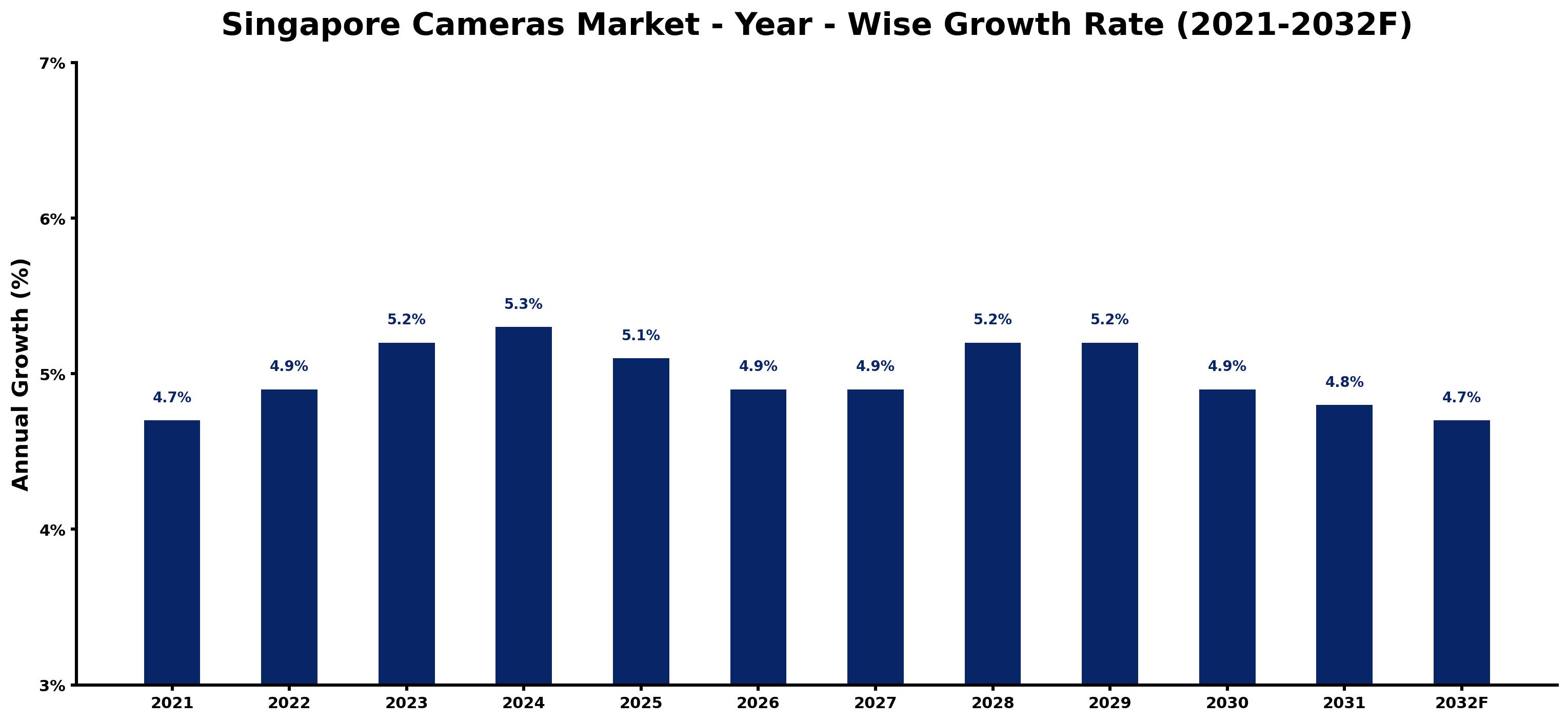
The table below presents the year wise growth rates along with the key drivers influencing the market
| Year | Growth Rate | Major Drivers |
| 2021 | 4.7% | Post-lockdown retail projects saw a renewed interest among photography enthusiasts. |
| 2022 | 4.9% | Emerging influencers showcased unique photography styles, boosting the local camera market. |
| 2023 | 5.2% | Event tourism surged, increasing demand for high-quality cameras among local vendors. |
| 2024 | 5.3% | Hybrid work arrangements encouraged individuals to explore personal photography interests. |
| 2025 | 5.1% | Innovative camera technology attracted tech-savvy millennials eager for advanced features. |
| 2026 | 4.9% | Social media platforms highlighted the importance of photography, enhancing consumer engagement. |
| 2027 | 4.9% | Increased disposable incomes allowed consumers to invest more in premium camera gear. |
| 2028 | 5.2% | Urban exploration trends motivated young photographers to capture cityscapes creatively. |
| 2029 | 5.2% | Collaborations between local artists and camera brands expanded market reach significantly. |
| 2030 | 4.9% | Sustainability-focused brands gained traction, appealing to environmentally conscious consumers. |
| 2031 | 4.8% | Virtual reality photography experiences captivated tech enthusiasts, broadening the audience base. |
| 2032 | 4.7% | Smartphone camera advancements prompted traditional brands to innovate and stay competitive. |
Note - Market size estimations and growth projections presented in this report are based on 6Wresearch's advanced forecasting approach, validated with industry datasets as of June 2026.
Singapore Cameras Market Synopsis
The Singapore Cameras Market is projected to reach 4.9% and witness significant growth during the forecast period (2026-2032). The market is expected to expand at a compound annual growth rate (CAGR) of 4.9%, driven by a surge in the popularity of digital photography and the advent of advanced camera technology. With consumers increasingly seeking innovative photographic solutions, the demand for high-quality cameras featuring enhanced specifications such as improved resolution, extended zoom ranges, and faster autofocus systems is on the rise.
Singapore Cameras Market Growth Drivers
The growth of the Singapore Cameras Market is largely influenced by several key factors, including:
- The escalating demand for smart cameras, driven by the desire for advanced features in compact designs. These cameras provide enthusiasts and professionals with a combination of portability and performance that was previously unattainable.
- The adoption of augmented reality (AR) technologies in various sectors, such as healthcare and retail, has created opportunities for camera manufacturers. These innovations enable the capture of high-quality images, facilitating enhanced user experiences.
- The ongoing development of integrated software that complements camera hardware, allowing users to leverage advanced functionalities like image editing, sharing, and cloud storage directly from their devices.
- Growing consumer interest in social media platforms, which emphasize high-quality imagery and video content. This trend drives individuals and businesses to invest in better camera equipment to enhance their digital presence.
- Increased marketing and promotional activities by manufacturers to raise awareness about the advantages of new camera technologies, thus contributing to a broader consumer base.
Singapore Cameras Market Challenges and Restraints
Despite the promising growth trajectory of the Singapore Cameras Market, several challenges persist:
- The high cost associated with professional camera equipment remains a significant barrier. While advancements have led to more cost-effective options, the price point for high-end products can deter potential buyers.
- Slow adoption rates of Digital Single Lens Reflex (DSLR) cameras among the general public hinder market growth. Although these devices are favored by enthusiasts, broader acceptance has not materialized, limiting sales opportunities.
- The competitive landscape, marked by rapid technological advancements, demands continuous product innovation. Manufacturers must invest heavily in research and development to remain relevant, which can strain resources.
- Economic uncertainty can influence consumer spending habits, making individuals more cautious about investing in high-value technical products like cameras.
- The potential emergence of alternative imaging technologies may disrupt traditional camera markets. As smartphone photography advances, consumers may opt for multifunctional mobile devices over standalone cameras.
Singapore Cameras Market Trends and Opportunities
As the market evolves, several trends and opportunities are shaping the future of the Singapore Cameras Market:
- Increased focus on sustainability, with manufacturers developing eco-friendly camera options and packaging, aligning with global consumer demand for environmentally responsible products.
- Integration of AI technology into cameras to enhance user experience, such as automated settings adjustments and advanced image processing capabilities.
- The rise of social media influencers and content creators is driving demand for high-quality portable cameras and equipment tailored for on-the-go content creation.
- Expansion of online and e-commerce platforms for camera sales, providing consumers with broader access to a variety of products and driving competitive pricing.
- Collaboration between technology firms and camera manufacturers to create hybrid devices that combine the functionalities of cameras with other smart technologies, fostering innovation and market growth.
Singapore Cameras Market Government Investment and Initiatives
The Singapore government has been proactive in supporting the development of the local cameras market through various initiatives and investments. This includes funding for technology innovation and research programs aimed at enhancing imaging technology. Additionally, public grants and incentives are available for companies that focus on developing sustainable and advanced camera technologies. Collaborative projects between the government and academic institutions promote the exchange of knowledge and technology, thereby fostering a conducive environment for growth in the cameras sector. Such strategic investments underline the government's commitment to transforming Singapore into a hub for cutting-edge technology.
Singapore Cameras Market Latest Developments (May 2025 - June 2026)
In the recent period between May 2025 and June 2026, the Singapore Cameras Market has witnessed several pivotal developments. Manufacturers are increasingly focusing on the integration of smart technology into their products, including connectivity features that enhance user interaction. Additionally, there has been a notable increase in collaborations among tech and camera companies aimed at enhancing product offerings. The proliferation of augmented reality applications in photography further emphasizes the shifting landscape, leading to a demand for cameras that can accommodate these new capabilities. Furthermore, industry-wide efforts to promote sustainability have gained momentum, with numerous manufacturers announcing initiatives to reduce their carbon footprint by implementing environmentally friendly practices in production.
Singapore Cameras Market - Key Attractiveness of the Report
- 10 Years of Market Numbers
- Historical Data Starting from 2022 to 2025
- Base Year: 2025
- Forecast Data until 2032
- Key Performance Indicators Impacting the Market
- Major Upcoming Developments and Projects
Key Highlights of the Report:
- Singapore Cameras Market Outlook
- Market Size of Singapore Cameras Market, 2025
- Forecast of Singapore Cameras Market, 2032F
- Historical Data and Forecast of Singapore Cameras Revenues & Volume for the Period 2022-2032F
- Singapore Cameras Market Trend Evolution
- Singapore Cameras Market Drivers and Challenges
- Singapore Cameras Price Trends
- Singapore Cameras Porter's Five Forces
- Singapore Cameras Industry Life Cycle
- Historical Data and Forecast of Singapore Cameras Market Revenues & Volume By Product Type for the Period 2022-2032F
- Historical Data and Forecast of Singapore Cameras Market Revenues & Volume By Built-in Lens Camera for the Period 2022-2032F
- Historical Data and Forecast of Singapore Cameras Market Revenues & Volume By Interchangeable Lens Camera for the Period 2022-2032F
- Historical Data and Forecast of Singapore Cameras Market Revenues & Volume By DSLR for the Period 2022-2032F
- Historical Data and Forecast of Singapore Cameras Market Revenues & Volume By Non-reflex for the Period 2022-2032F
- Historical Data and Forecast of Singapore Cameras Market Revenues & Volume By Application for the Period 2022-2032F
- Historical Data and Forecast of Singapore Cameras Market Revenues & Volume By Commercial for the Period 2022-2032F
- Historical Data and Forecast of Singapore Cameras Market Revenues & Volume By Residential for the Period 2022-2032F
- Historical Data and Forecast of Singapore Cameras Market Revenues & Volume By Distribution Channel for the Period 2022-2032F
- Historical Data and Forecast of Singapore Cameras Market Revenues & Volume By Online for the Period 2022-2032F
- Historical Data and Forecast of Singapore Cameras Market Revenues & Volume By Offline for the Period 2022-2032F
- Singapore Cameras Import Export Trade Statistics
- Market Opportunity Assessment By Product Type
- Market Opportunity Assessment By Application
- Market Opportunity Assessment By Distribution Channel
- Singapore Cameras Top Companies Market Share
- Singapore Cameras Competitive Benchmarking By Technical and Operational Parameters
- Singapore Cameras Company Profiles
- Singapore Cameras Key Strategic Recommendations






































