Singapore Camping Tent Market: Import Trend Analysis
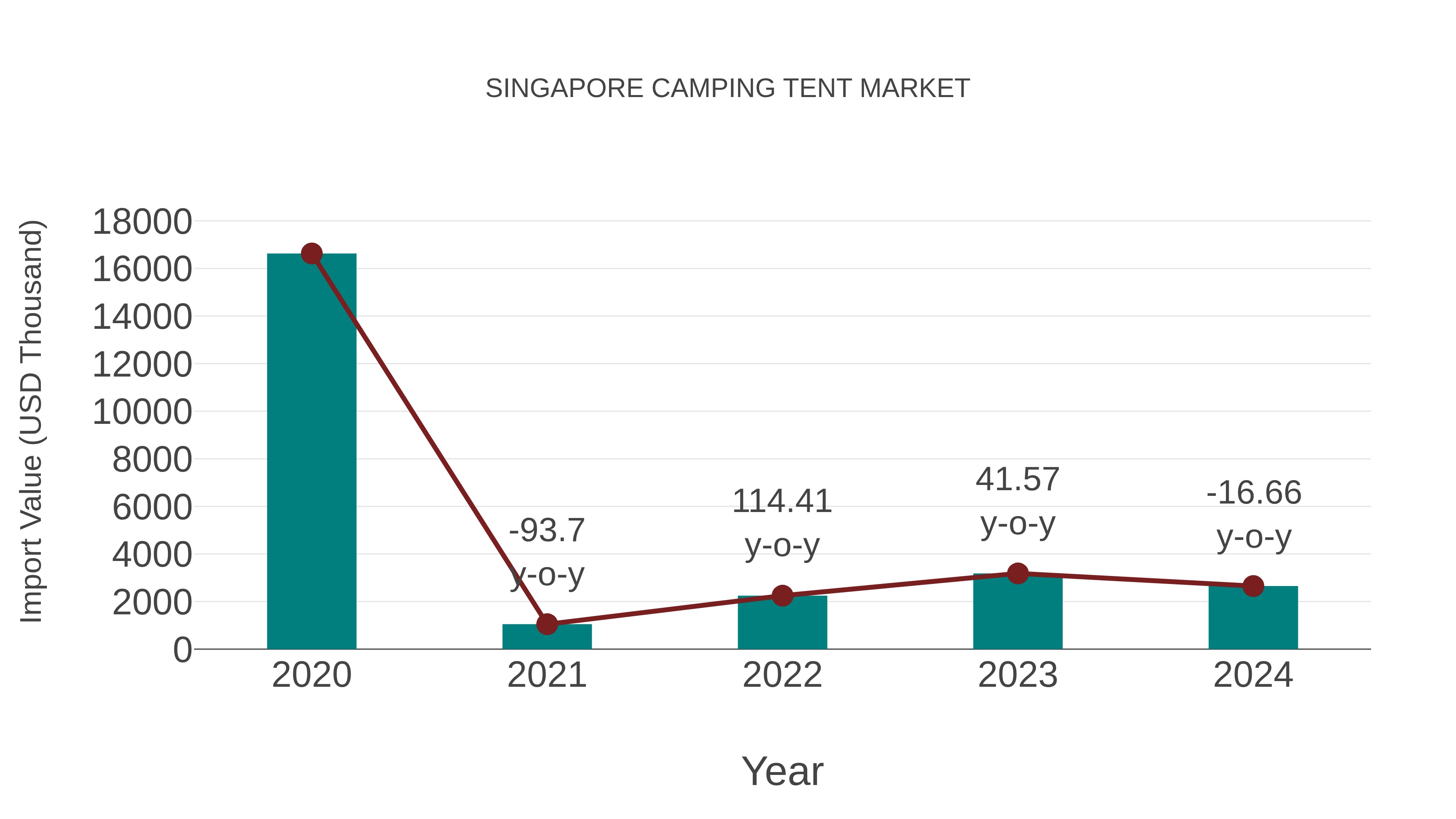
In 2024, Singapore`s import trend for camping tents experienced a decline, with a growth rate of -16.66% compared to the previous year. The compound annual growth rate (CAGR) for the period 2020-2024 stood at -36.81%. This significant decrease in imports could be attributed to shifting consumer preferences or changes in trade policies impacting the market`s stability.
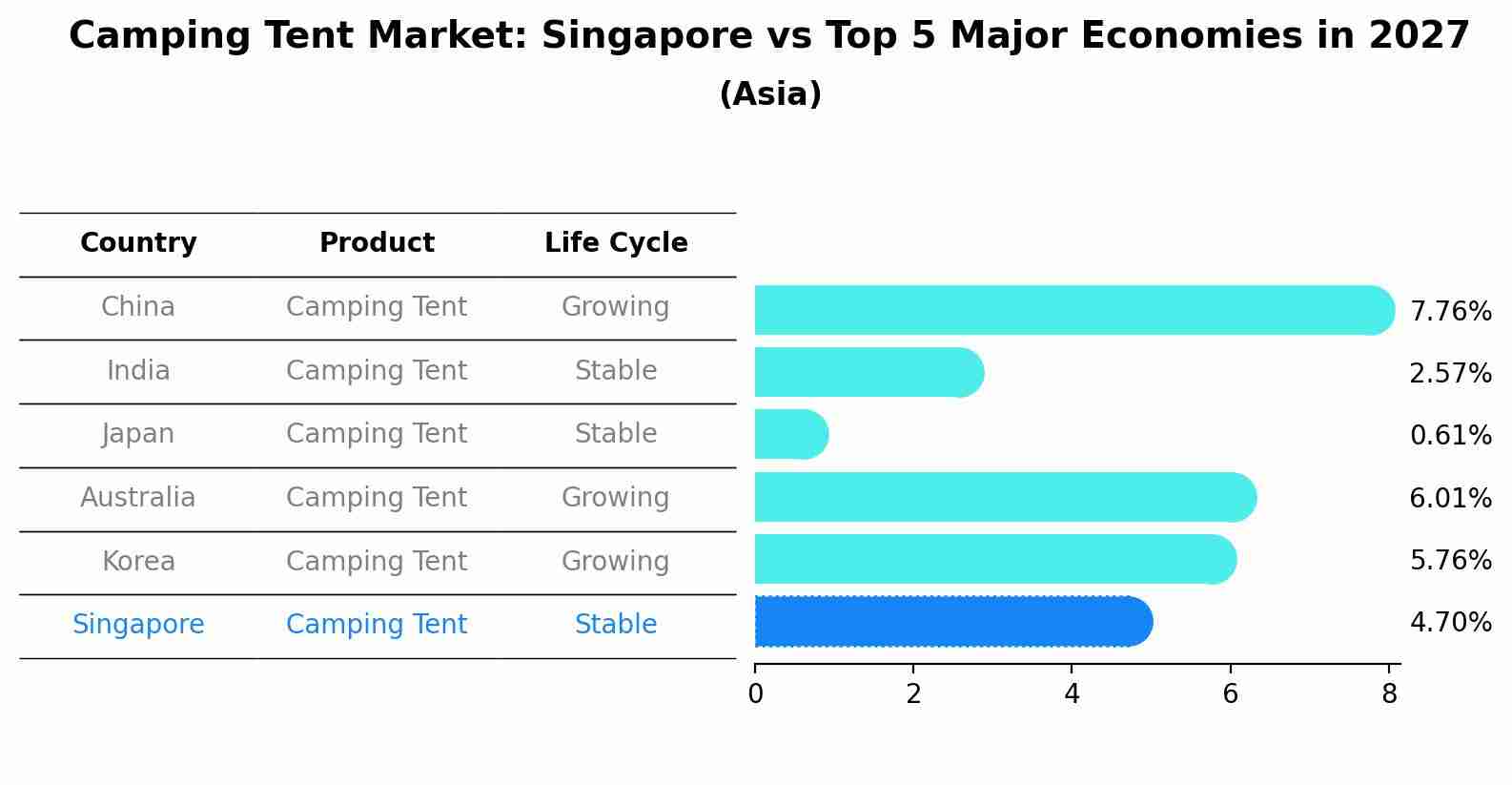
Camping Tent Market: Singapore vs Top 5 Major Economies in 2027 (Asia)
Singapore's Camping Tent market is anticipated to experience a stable growth rate of 4.70% by 2027, reflecting trends observed in the largest economy China, followed by India, Japan, Australia and South Korea.
Singapore Camping Tent Market Synopsis
The camping tent market in Singapore is expected to register a CAGR of 4.11% over the forecast period from 2020 to 2026. The increasing outdoor tourism activities has been one of the major drivers for growth of this market in Singapore, as camping tents are essential products needed while engaging in such activities. Additionally, technological advancements, including solar-powered camping tents and other advanced features are likely to boost sales further during the forecast period.
Market Drivers
Increasing Outdoor Tourism Activities: With infrastructure development and improved safety standards coupled with growing interest among people towards adventure sports and travel experiences, there has been an increase in outdoor tourism activities across Singapore. This is creating demand for related equipment like tents which can be used by travelers when undertaking such trips or these trips organized by tour operators. This is one of the major drivers for the market???s growth over the forecast period.Technological Advancements: In recent years manufacturers have come up with several innovative technologies that make camping easier and more efficient than it was ever before ??? ranging from solar powered lights to auto-inflating air mattresses designed specifically for campers convenience. Such innovations are driving additional sales within this industry segment due to their enhanced functionalities compared with traditional products offered earlier on the market providing a significant opportunity for key players operating within this space.
Market challenges
High Cost Associated With Camping Tents : Due to its technical complexity & several components involved - cost associated with purchasing a high quality camping tent can be relatively high which often leads customers away from investing into them particularly if they plan on using them infrequently or rarely i which fails potential buyers who may not necessarily want commit large sums upfront limited usage scenarios.
Key players
Some of prominent players operating within he Singapore Camping Tent Market include Black Diamond Equipment, Coleman Company Inc, MSR (Mountain Safety Research), Hilleberg AB (Hilleberg Group), Grand Trunk Goods LLC alongside various others
Covid-19 Impact
The COVID 19 pandemic has caused disruption throughout many industries however it also created new opportunities notably within consumer goods sector as restrictions were imposed upon movement leading consumers spending more time at home & looking into recreational options available nearby.Thus, demand significantly surged hike especially amongst low priced alternatives like pop up tents making them attractive options given their affordability & easy setup process.
Key Highlights of the Report:
- Singapore Camping Tent Market Outlook
- Market Size of Singapore Camping Tent Market, 2023
- Forecast of Singapore Camping Tent Market, 2030
- Historical Data and Forecast of Singapore Camping Tent Revenues & Volume for the Period 2020-2030
- Singapore Camping Tent Market Trend Evolution
- Singapore Camping Tent Market Drivers and Challenges
- Singapore Camping Tent Price Trends
- Singapore Camping Tent Porter's Five Forces
- Singapore Camping Tent Industry Life Cycle
- Historical Data and Forecast of Singapore Camping Tent Market Revenues & Volume By Product Type for the Period 2020-2030
- Historical Data and Forecast of Singapore Camping Tent Market Revenues & Volume By Tunnel for the Period 2020-2030
- Historical Data and Forecast of Singapore Camping Tent Market Revenues & Volume By Dome for the Period 2020-2030
- Historical Data and Forecast of Singapore Camping Tent Market Revenues & Volume By Geodesic for the Period 2020-2030
- Historical Data and Forecast of Singapore Camping Tent Market Revenues & Volume By Applications for the Period 2020-2030
- Historical Data and Forecast of Singapore Camping Tent Market Revenues & Volume By Commercial for the Period 2020-2030
- Historical Data and Forecast of Singapore Camping Tent Market Revenues & Volume By Individual for the Period 2020-2030
- Historical Data and Forecast of Singapore Camping Tent Market Revenues & Volume By Distribution Channel for the Period 2020-2030
- Historical Data and Forecast of Singapore Camping Tent Market Revenues & Volume By Offline for the Period 2020-2030
- Historical Data and Forecast of Singapore Camping Tent Market Revenues & Volume By Online for the Period 2020-2030
- Singapore Camping Tent Import Export Trade Statistics
- Market Opportunity Assessment By Product Type
- Market Opportunity Assessment By Applications
- Market Opportunity Assessment By Distribution Channel
- Singapore Camping Tent Top Companies Market Share
- Singapore Camping Tent Competitive Benchmarking By Technical and Operational Parameters
- Singapore Camping Tent Company Profiles
- Singapore Camping Tent Key Strategic Recommendations






































