Singapore Candied Fruit Market Summary
The singapore candied fruit market was estimated at USD 161 Million in 2025 and is projected to reach USD 211 Million by 2032, growing at a CAGR of 5.0% from 2026 to 2032.
Singapore Candied Fruit Market Year-wise Growth Rate and Key Drivers
This graph highlights how the Singapore Candied Fruit Market has steadily grown over the past five years, supported by major growth factors.
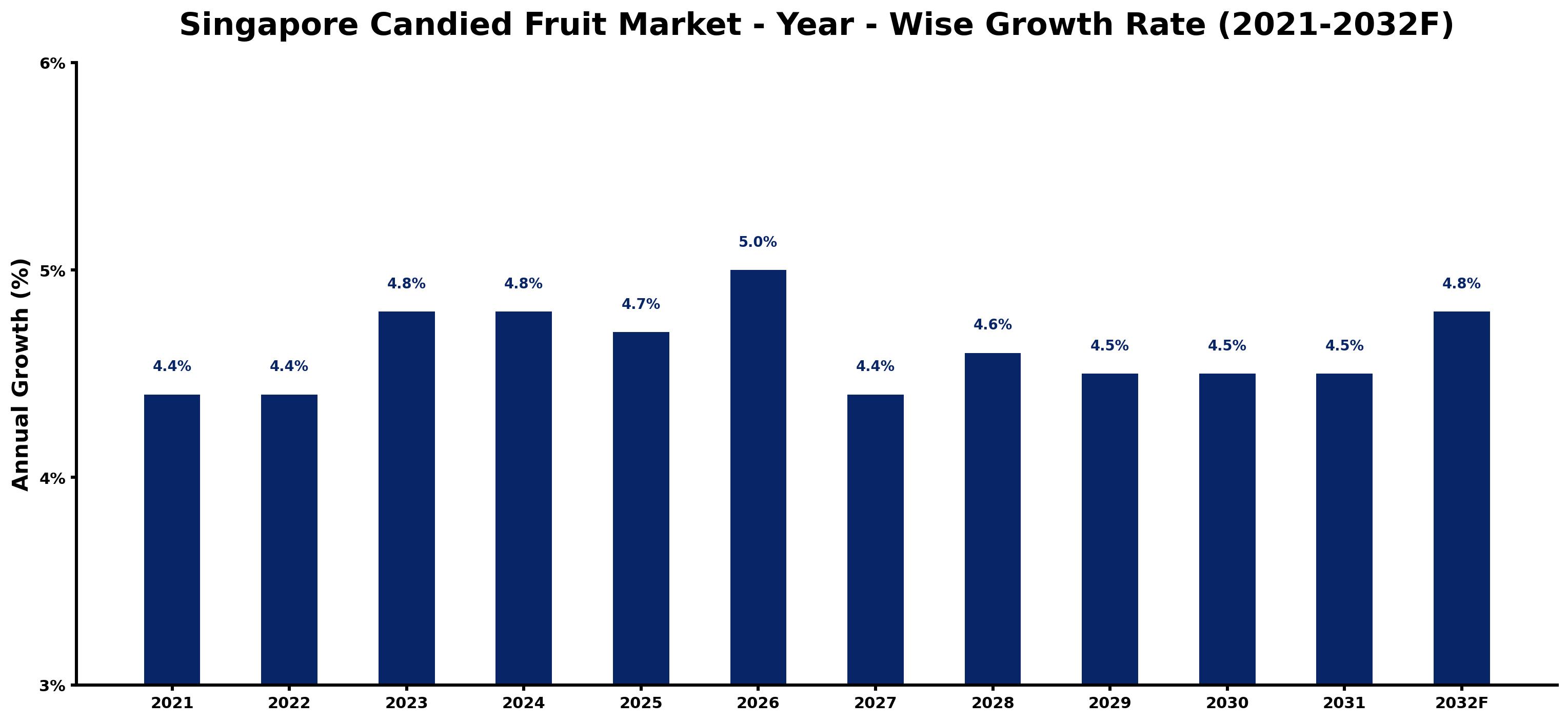
The table below presents the year wise growth rates along with the key drivers influencing the market
| Year | Growth Rate | Major Drivers |
| 2021 | 4.4% | Increased consumer interest in healthy snacks fuels the candied fruit niche. |
| 2022 | 4.4% | Innovative flavors and exotic fruit varieties capture the attention of local consumers. |
| 2023 | 4.8% | E-commerce platforms expand accessibility, enhancing candied fruit market visibility and sales. |
| 2024 | 4.8% | Collaborations with local cafes promote candied fruits in trendy dessert offerings. |
| 2025 | 4.7% | Sustainability concerns shift focus towards organic and natural production methods. |
| 2026 | 5.0% | Rising disposable incomes enable more consumers to indulge in premium candied options. |
| 2027 | 4.4% | Cultural festivals showcase traditional candied fruits, driving seasonal spikes in purchases. |
| 2028 | 4.6% | Health trends emphasize natural sweetness, boosting demand for fruit-based snacks. |
| 2029 | 4.5% | Increased social media marketing enhances brand engagement and product awareness. |
| 2030 | 4.5% | Local artisans begin crafting unique candied fruit products, attracting niche markets. |
| 2031 | 4.5% | Emerging health-conscious consumers increasingly prioritize low-sugar and nutritious alternatives. |
| 2032 | 4.8% | International trade agreements expand import opportunities, diversifying available candied fruit selections. |
Note - Market size estimations and growth projections presented in this report are based on 6Wresearch's advanced forecasting approach, validated with industry datasets as of June 2026.
Singapore Candied Fruit Market Synopsis
The Singapore Candied Fruit Market is projected to reach 5.0% and witness significant growth during the forecast period (2026-2032). This expansion is largely driven by a growing health consciousness among consumers and an increasing preference for natural over processed foods. The rise in demand for candied fruits in confectionery applications, alongside higher disposable incomes, further supports this trend. Innovative flavors introduced by manufacturers also resonate well with consumer tastes, enhancing market dynamics.
Singapore Candied Fruit Market Growth Drivers
The growth of the Singapore Candied Fruit Market can be attributed to several influential factors that shape consumer behavior and market dynamics:
- The heightened awareness regarding health issues has propelled consumers towards natural products, steering them away from highly processed options.
- Consumers are increasingly opting for candied fruits with fewer artificial additives, which aligns with the trend towards cleaner labels in food products.
- Increasing disposable incomes have allowed consumers to spend more on premium food items, contributing to a surge in demand for high-quality candied fruits.
- The integration of unique flavor profiles by manufacturers has increased product appeal, capturing the interest of a broader consumer base.
- Promotional activities and collaborations with health-focused brands have raised awareness of candied fruits as a healthier snack alternative.
Singapore Candied Fruit Market Challenges and Restraints
Despite its promising growth trajectory, the Singapore Candied Fruit Market faces numerous challenges that could hinder its progress:
- The escalating costs associated with raw materials, such as sugarcane jaggery and natural syrups, pose a significant challenge for producers looking to maintain competitive pricing.
- Regulatory requirements concerning the use of certain artificial additives can constrain product formulation and limit profit margins.
- The presence of local vendors offering similar products at lower prices affects brand loyalty and complicates the market landscape for established brands.
- Shifts in consumer preferences towards more convenient snack options may divert demand away from candied fruit products.
- The ongoing economic fluctuations may impact consumer spending behaviors, especially in premium segments of the market.
Singapore Candied Fruit Market Trends and Opportunities
The Singapore Candied Fruit Market is witnessing several trends that present opportunities for growth:
- Health and wellness trends are influencing consumers to seek snacks that not only satisfy their sweet cravings but also offer nutritional benefits, creating a niche for healthier candied fruit alternatives.
- There is a growing interest in sustainable sourcing, prompting manufacturers to adopt ethical supply chain practices that appeal to environmentally conscious consumers.
- Online and e-commerce platforms are becoming increasingly significant, enabling manufacturers to enhance their market reach and cater to a tech-savvy consumer base.
- Innovative packaging solutions that emphasize product freshness and shelf-life are being adopted, improving consumer perception and overall product experience.
- Consumer demand for artisanal and locally-produced products is creating opportunities for small-scale producers to carve out a market share within the premium segment.
Singapore Candied Fruit Market Government Investment and Initiatives
Government support and initiatives play a crucial role in shaping the Singapore Candied Fruit Market. Various public spending initiatives focus on promoting healthy eating and the consumption of natural products. The government has implemented policies aimed at encouraging local food production, which include grants and subsidies for local producers. Moreover, efforts to enhance food safety regulations and standards have been prioritized to ensure consumer confidence in local food products. These initiatives not only stimulate the market but also contribute to the broader objective of achieving food security in Singapore. Additionally, the government actively promotes innovation in the food sector through funding for research and development, fostering an environment conducive to product innovation in candied fruits.
Singapore Candied Fruit Market Latest Developments (May 2025 - June 2026)
In the period from May 2025 to June 2026, the Singapore Candied Fruit Market has seen notable developments. The industry has been actively adapting to changing consumer preferences, with an increasing number of manufacturers focusing on introducing organic and naturally flavored options. The market has also experienced a surge in collaborations between health-focused brands and candied fruit producers, aimed at catering to health-conscious consumers. Innovations in packaging have been evident, with new designs that prioritize product freshness and convenience gaining traction. Furthermore, distribution channels have expanded, with online platforms becoming more integral to market strategies, allowing for a broader reach among diverse consumer demographics. Supply chain resilience has been under focus, with efforts made to mitigate previous disruptions caused by the pandemic, thereby enhancing overall market stability.
Singapore Candied Fruit Market - Key Attractiveness of the Report
- 10 Years of Market Numbers
- Historical Data Starting from 2022 to 2025
- Base Year: 2025
- Forecast Data until 2032
- Key Performance Indicators Impacting the Market
- Major Upcoming Developments and Projects
Key Highlights of the Report:
- Singapore Candied Fruit Market Outlook
- Market Size of Singapore Candied Fruit Market, 2025
- Forecast of Singapore Candied Fruit Market, 2032F
- Historical Data and Forecast of Singapore Candied Fruit Revenues & Volume for the Period 2022-2032F
- Singapore Candied Fruit Market Trend Evolution
- Singapore Candied Fruit Market Drivers and Challenges
- Singapore Candied Fruit Price Trends
- Singapore Candied Fruit Porter's Five Forces
- Singapore Candied Fruit Industry Life Cycle
- Historical Data and Forecast of Singapore Candied Fruit Market Revenues & Volume By Type for the Period 2022-2032F
- Historical Data and Forecast of Singapore Candied Fruit Market Revenues & Volume By Hard Type for the Period 2022-2032F
- Historical Data and Forecast of Singapore Candied Fruit Market Revenues & Volume By Chewing Type for the Period 2022-2032F
- Historical Data and Forecast of Singapore Candied Fruit Market Revenues & Volume By Distribution Channel for the Period 2022-2032F
- Historical Data and Forecast of Singapore Candied Fruit Market Revenues & Volume By Convenience Stores for the Period 2022-2032F
- Historical Data and Forecast of Singapore Candied Fruit Market Revenues & Volume By Traditional Grocery Stores for the Period 2022-2032F
- Historical Data and Forecast of Singapore Candied Fruit Market Revenues & Volume By Supermarkets/Hypermarkets for the Period 2022-2032F
- Historical Data and Forecast of Singapore Candied Fruit Market Revenues & Volume By Online Sales Channel for the Period 2022-2032F
- Historical Data and Forecast of Singapore Candied Fruit Market Revenues & Volume By Others for the Period 2022-2032F
- Singapore Candied Fruit Import Export Trade Statistics
- Market Opportunity Assessment By Type
- Market Opportunity Assessment By Distribution Channel
- Singapore Candied Fruit Top Companies Market Share
- Singapore Candied Fruit Competitive Benchmarking By Technical and Operational Parameters
- Singapore Candied Fruit Company Profiles
- Singapore Candied Fruit Key Strategic Recommendations






































