Singapore Carbon Credit Market Size, Share & Growth Rate
The Singapore Carbon Credit Market was estimated at USD 166 Million in 2025 and is projected to reach USD 216 Million by 2032, growing at a CAGR of 3.8% from 2026 to 2032. This growth trajectory is primarily driven by the increasing global emphasis on environmental sustainability and carbon neutrality. As Singapore positions itself as a regional leader in green finance, the demand for carbon credits is anticipated to expand significantly, propelled by both local and international market participants.
Singapore Carbon Credit Market Year-wise Growth Rate and Key Drivers
This graph highlights how the Singapore Carbon Credit Market has steadily grown over the years, supported by major growth factors.
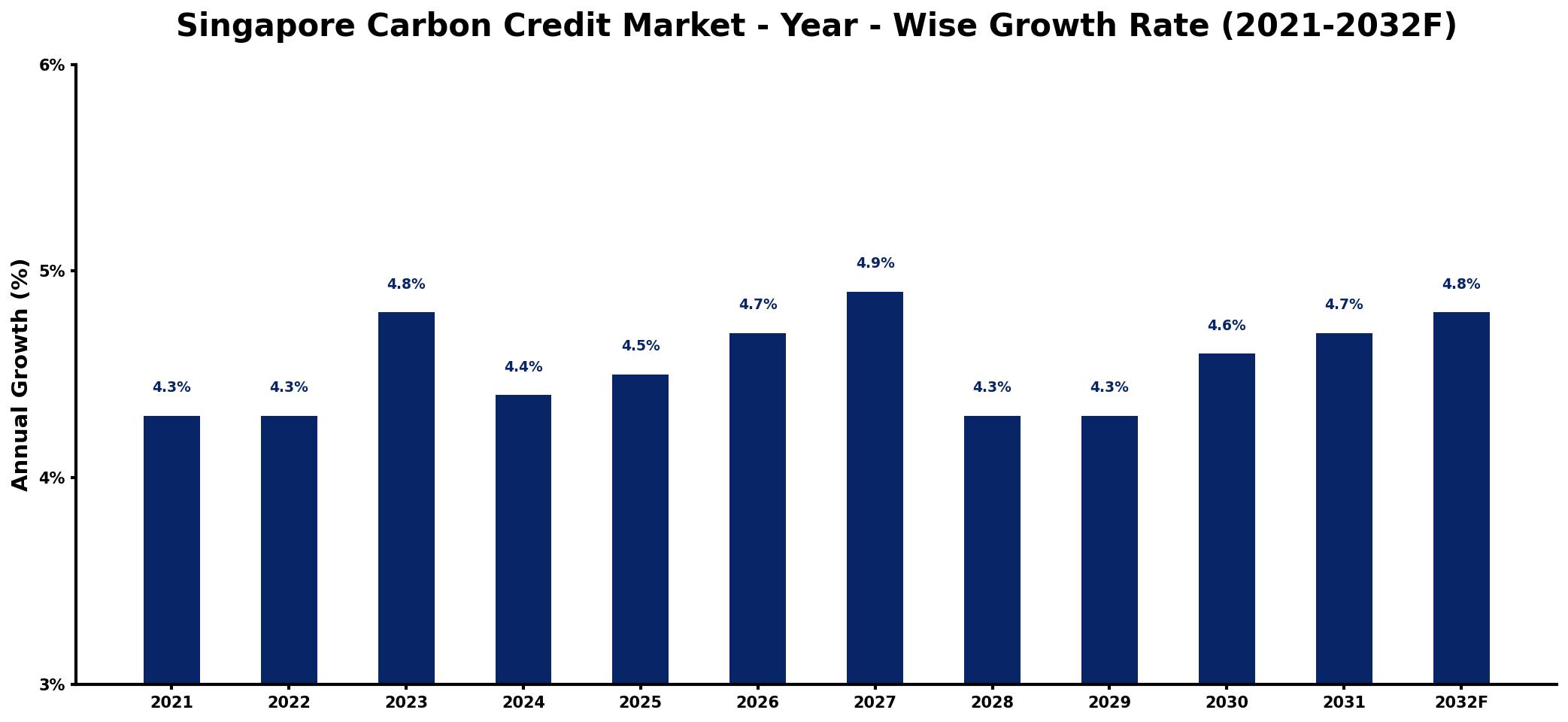
The table below presents the year‑wise growth rates along with the key drivers influencing the market
| Year | Growth Rate | Major Drivers |
| 2021 | 4.3% | Rising renewable energy investments |
| 2022 | 4.3% | Increased regulatory support initiatives |
| 2023 | 4.8% | Growing green technology adoption |
| 2024 | 4.4% | Enhanced corporate sustainability commitments |
| 2025 | 4.5% | Higher public awareness campaigns |
| 2026 | 4.7% | Expanding international partnerships formed |
| 2027 | 4.9% | Strengthened ESG investment strategies |
| 2028 | 4.3% | Boosted urban sustainability projects |
| 2029 | 4.3% | Wider adoption of clean technologies |
| 2030 | 4.6% | Growing demand for sustainable practices |
| 2031 | 4.7% | Increased participation in green finance |
| 2032 | 4.8% | improved processing technologies adoption |
Note: Market size estimations and growth projections presented in this report are based on 6Wresearch's proprietary forecasting methodology, utilizing the latest available industry data, government publications, and primary research inputs.
Singapore Carbon Credit Market Synopsis
In recent years, Singapore has emerged as a pivotal player in the carbon credit market, reflecting a growing recognition of the importance of sustainable practices. The nations robust financial infrastructure and trading expertise have positioned it as a hub for carbon credit transactions, facilitating investments in emission reduction projects.
As organizations increasingly seek ways to offset their carbon emissions, the Singapore market presents a compelling opportunity. The local regulatory framework encourages the development of credible carbon offset projects, reinforcing the market's role in supporting climate change mitigation strategies.
Singapore Carbon Credit Market Key Takeaways
- The market is driven by a strong demand for sustainable practices and investments in clean energy.
- Singapore's unique financial ecosystem enhances its attractiveness for carbon trading activities.
- Global commitments to reduce carbon footprints are contributing to rising demand for carbon credits.
- The market showcases resilience through its adaptability to challenges presented by changing regulations and technologies.
- Collaborative initiatives among businesses and stakeholders are crucial for developing credible carbon offset projects.
Evaluation of Restraints in Singapore Carbon Credit Market
Despite its promising outlook, the Singapore Carbon Credit Market faces several restraints that could hinder growth. One significant concern is the challenge of ensuring the credibility of carbon offset projects. Stakeholders must navigate complex regulatory frameworks, which can complicate the validation and verification processes for carbon credits. Furthermore, the effectiveness of emissions reduction strategies often depends on the ability to manage and measure outcomes consistently. Addressing these restraints is essential for building trust among market participants and enhancing the overall competitiveness of the Singapore carbon credit landscape.
Singapore Carbon Credit Market Trends
Several trends are shaping the Singapore Carbon Credit Market. First, the integration of advanced technologies, such as blockchain, is streamlining transactions and enhancing transparency in carbon credit trading. Additionally, there's a notable shift toward the development of innovative emission reduction projects, including blue carbon initiatives and nature-based solutions. Furthermore, as public awareness of climate issues rises, businesses are increasingly committing to sustainability goals, further driving demand for carbon credits. Collectively, these trends reflect a dynamic market landscape geared towards robust environmental stewardship.
Singapore Carbon Credit Market Opportunities
Significant growth and investment opportunities lie within the Singapore Carbon Credit Market. The increasing regulatory pressure on corporations to demonstrate sustainability can fuel the demand for carbon credits. Additionally, emerging sectors such as renewable energy and electric mobility present prospects for innovative carbon offset projects. As Singapore enhances its green financing initiatives, there is ample scope for businesses and investors to engage in the carbon credit market, making strategic investments that align with global climate goals.
Government Initiatives in the Singapore Carbon Credit Market
The Singapore government has initiated several key policies and programmes to bolster the carbon credit market. The introduction of the Green Plan 2030 emphasizes sustainable development and sets ambitious targets for reducing emissions. Furthermore, government-supported funding for innovative carbon offset projects aims to enhance market credibility. These initiatives reflect a commitment to fostering a conducive environment for carbon trading and underscore the role of public-private partnerships in achieving national sustainability goals.
Future Insights of the Singapore Carbon Credit Market
Looking ahead to 2026-2032, the Singapore Carbon Credit Market is poised for significant evolution. As more companies integrate sustainability into their core strategies, the demand for carbon credits will likely accelerate. Moreover, ongoing advancements in measurement and verification methodologies will enhance the integrity of carbon offset projects, thus building greater trust in the market. The convergence of technology and sustainability will also drive innovation, positioning Singapore as a leader in the regional and global carbon trading landscape.
Singapore Carbon Credit Market Latest Developments (2025 - 2026)
Recent developments in the Singapore Carbon Credit Market reflect a growing commitment to enhancing sustainability initiatives. During this period, various partnerships have emerged between local companies and international organizations focused on developing carbon offset projects. Additionally, new regulatory frameworks have been introduced to streamline the certification process for carbon credits, making it easier for companies to participate. As the emphasis on corporate sustainability continues, the market is adapting to align with evolving expectations.
Singapore Carbon Credit Market - Key Attractiveness of the Report
- 10 Years of Market Numbers
- Historical Data Starting from 2022 to 2025
- Base Year: 2025
- Forecast Data until 2032
- Key Performance Indicators Impacting the Market
- Major Upcoming Developments and Projects
Key Highlights of the Report:
- Singapore Carbon Credit Market Outlook
- Market Size of Singapore Carbon Credit Market, 2025
- Forecast of Singapore Carbon Credit Market, 2032
- Historical Data and Forecast of Singapore Carbon Credit Revenues & Volume for the Period 2022-2032F
- Singapore Carbon Credit Market Trend Evolution
- Singapore Carbon Credit Market Drivers and Challenges
- Singapore Carbon Credit Price Trends
- Singapore Carbon Credit Porter's Five Forces
- Singapore Carbon Credit Industry Life Cycle
- Historical Data and Forecast of Singapore Carbon Credit Market Revenues & Volume By Sector for the Period 2022-2032F
- Historical Data and Forecast of Singapore Carbon Credit Market Revenues & Volume By Energy for the Period 2022-2032F
- Historical Data and Forecast of Singapore Carbon Credit Market Revenues & Volume By Transportation for the Period 2022-2032F
- Historical Data and Forecast of Singapore Carbon Credit Market Revenues & Volume By Residential And Commercial Buildings for the Period 2022-2032F
- Historical Data and Forecast of Singapore Carbon Credit Market Revenues & Volume By Industry for the Period 2022-2032F
- Historical Data and Forecast of Singapore Carbon Credit Market Revenues & Volume By Agriculture for the Period 2022-2032F
- Historical Data and Forecast of Singapore Carbon Credit Market Revenues & Volume By Forestry for the Period 2022-2032F
- Historical Data and Forecast of Singapore Carbon Credit Market Revenues & Volume By Water And Wastewater for the Period 2022-2032F
- Singapore Carbon Credit Import Export Trade Statistics
- Market Opportunity Assessment By Sector
- Singapore Carbon Credit Top Companies Market Share
- Singapore Carbon Credit Competitive Benchmarking By Technical and Operational Parameters
- Singapore Carbon Credit Company Profiles
- Singapore Carbon Credit Key Strategic Recommendations






































