Singapore Cashmere Yarn Market Size, Share & Growth Rate
The Singapore Cashmere Yarn Market was estimated at USD 366 Million in 2025 and is projected to reach USD 507 Million by 2032, growing at a CAGR of 4.8% from 2026 to 2032. This trajectory is driven primarily by the sustained demand from the luxury textiles sector, fueled by Singapores status as a major hub for high-end fashion. Increased consumer interest in premium quality, along with a rise in disposable income levels, has created a fertile environment for cashmere yarn producers.
Singapore Cashmere Yarn Market Year-wise Growth Rate and Key Drivers
This graph highlights how the Singapore Cashmere Yarn Market has steadily grown over the years, supported by major growth factors.
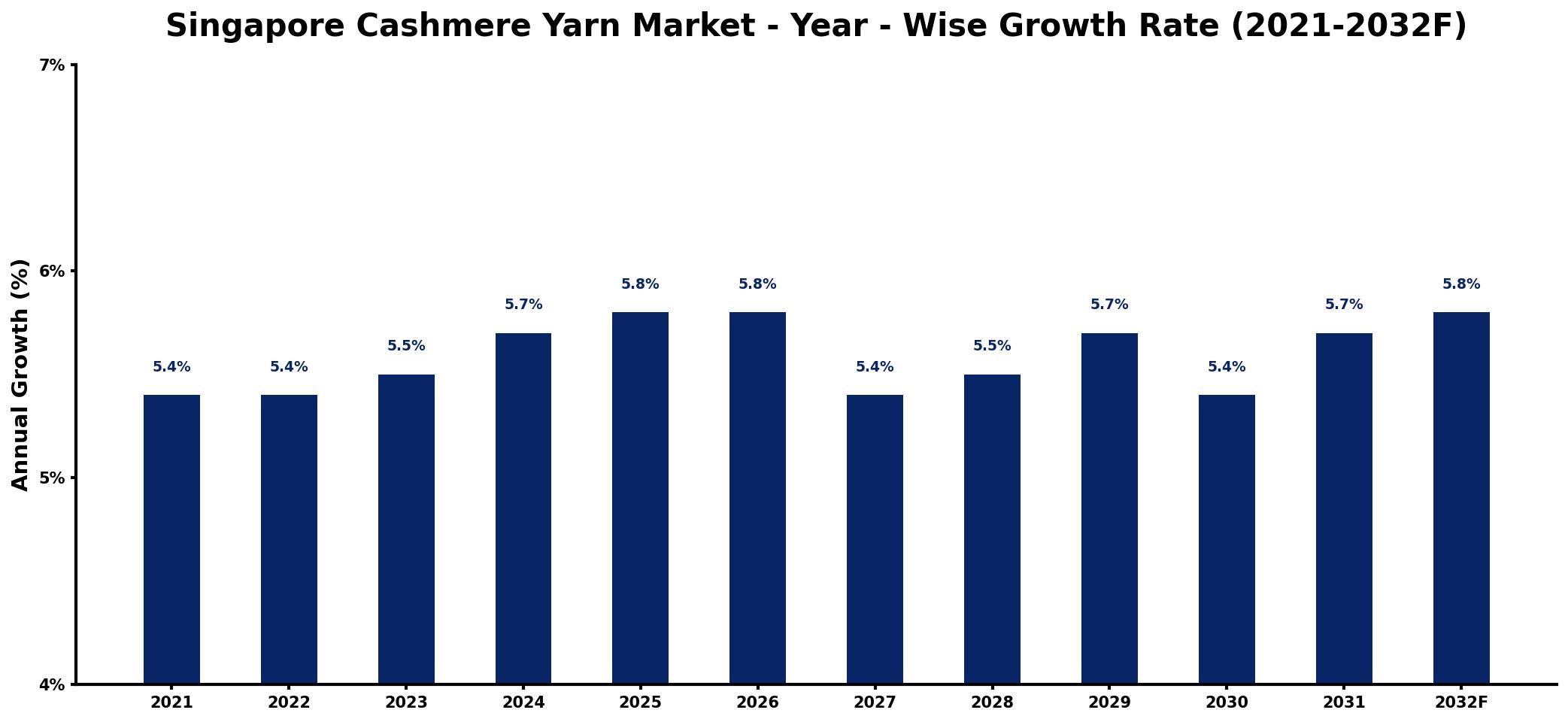
The table below presents the year‑wise growth rates along with the key drivers influencing the market
| Year | Growth Rate | Major Drivers |
| 2021 | 5.4% | Rising luxury apparel demand |
| 2022 | 5.4% | Increased online retail presence |
| 2023 | 5.5% | Expansion of sustainable fashion initiatives |
| 2024 | 5.7% | Growth in textile innovation investments |
| 2025 | 5.8% | Surge in high-end fashion collaborations |
| 2026 | 5.8% | Emergence of eco-friendly materials |
| 2027 | 5.4% | Diversification of fashion supply chains |
| 2028 | 5.5% | Strengthening of fashion export markets |
| 2029 | 5.7% | Increase in premium lifestyle brands |
| 2030 | 5.4% | Adoption of advanced manufacturing technologies |
| 2031 | 5.7% | Growing interest in artisanal craftsmanship |
| 2032 | 5.8% | improved processing technologies adoption |
Note: Market size estimations and growth projections presented in this report are based on 6Wresearch's proprietary forecasting methodology, utilizing the latest available industry data, government publications, and primary research inputs.
Singapore Cashmere Yarn Market Synopsis
The strongest force currently shaping the Singapore cashmere yarn market is the rising consumer demand for high-quality, sustainable materials. As the luxury fashion industry increasingly turns to cashmere for its superior softness and warmth, manufacturers are responding by sourcing ethically produced fibers. This shift is not just a trend; it reflects a fundamental change in consumer preferences towards environmentally responsible products.
Additionally, the vibrant fashion landscape in Singapore, combined with its status as a global retail center, continues to influence market dynamics. Designers are increasingly incorporating cashmere into their collections, which not only meets consumer demand but also aligns with the broader trend of prioritizing luxury and quality in textile choices. As such, the market is likely to experience sustained growth in the coming years.
Singapore Cashmere Yarn Market Key Takeaways
- The market's growth is significantly attributed to the increasing consumer preference for luxury and high-quality cashmere products.
- Sustainability and ethical sourcing are becoming vital components of cashmere yarn production.
- Rising disposable incomes in Singapore play a crucial role in driving demand for premium textiles.
- The market has shown resilience post-COVID-19, with a shift towards online shopping and sustainable fashion options.
- Key players are continually adapting to the evolving market landscape by focusing on innovative and eco-friendly production methods.
Evaluation of Restraints in Singapore Cashmere Yarn Market
Despite the optimistic outlook, the Singapore cashmere yarn market is not without its challenges. A significant restraint is the volatility associated with cashmere wool sourcing, which is often affected by climatic conditions in production regions. This unpredictability can lead to fluctuations in supply and pricing, impacting overall market stability. Furthermore, consumer awareness around ethical sourcing can pose a challenge for manufacturers who need to balance quality with animal welfare concerns. These factors necessitate strategic planning and responsiveness to changes in both the environment and consumer sentiment.
Singapore Cashmere Yarn Market Trends
Several trends are currently influencing the Singapore cashmere yarn market. Firstly, there is a marked shift towards sustainability, with a growing number of consumers opting for brands that prioritize eco-friendly practices. This trend is prompting manufacturers to explore innovative processes that reduce environmental impact. Secondly, the integration of technology in the production of cashmere yarn is on the rise, enhancing efficiency and quality. Lastly, customization is gaining traction as consumers seek unique, personalized cashmere products that reflect their individual styles.
Singapore Cashmere Yarn Market Opportunities
The Singapore cashmere yarn market presents numerous growth opportunities for stakeholders. With the rise in demand for sustainable luxury fashion, companies can invest in innovative production methods that meet eco-friendly standards. Additionally, tapping into the burgeoning online retail space can further expand market reach, allowing for better consumer engagement. Collaborations with local designers and brands could also open new avenues, particularly in creating limited-edition collections that appeal to niche markets.
Government Initiatives in the Singapore Cashmere Yarn Market
The Singaporean government has initiated several programs aimed at promoting sustainable practices within the textile industry. These include funding opportunities for companies that implement eco-friendly manufacturing processes and policies that encourage responsible sourcing of raw materials. Moreover, through various trade agreements and partnerships, Singapore aims to enhance its position as a global luxury retail hub, further benefiting the cashmere yarn market.
Future Insights of the Singapore Cashmere Yarn Market
Looking ahead to 2026-2032, the Singapore cashmere yarn market is poised for significant growth. The shift toward sustainability will continue to be a driving factor, with consumers increasingly seeking ethically sourced and produced cashmere products. Furthermore, as online retailing becomes more prevalent, brands will have the opportunity to reach a broader audience. The luxury fashion industry's resilience in the face of challenges also suggests a steady demand for cashmere, setting a strong foundation for continued market expansion.
Singapore Cashmere Yarn Market Latest Developments (2025 - 2026)
Recent developments in the Singapore cashmere yarn market indicate a growing focus on sustainable sourcing and production practices. Companies are increasingly adopting innovative technologies to enhance the quality of their cashmere offerings while reducing environmental footprints. Additionally, collaborations between local fashion houses and international cashmere producers are becoming more common, showcasing unique designs and limited-edition products that cater to the luxury segment.
Singapore Cashmere Yarn Market - Key Attractiveness of the Report
- 10 Years of Market Numbers
- Historical Data Starting from 2022 to 2025
- Base Year: 2025
- Forecast Data until 2032
- Key Performance Indicators Impacting the Market
- Major Upcoming Developments and Projects
Key Highlights of the Report:
- Singapore Cashmere Yarn Market Outlook
- Market Size of Singapore Cashmere Yarn Market, 2025
- Forecast of Singapore Cashmere Yarn Market, 2032
- Historical Data and Forecast of Singapore Cashmere Yarn Revenues & Volume for the Period 2022-2032F
- Singapore Cashmere Yarn Market Trend Evolution
- Singapore Cashmere Yarn Market Drivers and Challenges
- Singapore Cashmere Yarn Price Trends
- Singapore Cashmere Yarn Porter's Five Forces
- Singapore Cashmere Yarn Industry Life Cycle
- Historical Data and Forecast of Singapore Cashmere Yarn Market Revenues & Volume By Type for the Period 2022-2032F
- Historical Data and Forecast of Singapore Cashmere Yarn Market Revenues & Volume By Natural Cashmere Yarn for the Period 2022-2032F
- Historical Data and Forecast of Singapore Cashmere Yarn Market Revenues & Volume By Processed Cashmere Yarn for the Period 2022-2032F
- Historical Data and Forecast of Singapore Cashmere Yarn Market Revenues & Volume By Others for the Period 2022-2032F
- Historical Data and Forecast of Singapore Cashmere Yarn Market Revenues & Volume By Application for the Period 2022-2032F
- Historical Data and Forecast of Singapore Cashmere Yarn Market Revenues & Volume By Sweaters for the Period 2022-2032F
- Historical Data and Forecast of Singapore Cashmere Yarn Market Revenues & Volume By Shawls for the Period 2022-2032F
- Historical Data and Forecast of Singapore Cashmere Yarn Market Revenues & Volume By Suits for the Period 2022-2032F
- Historical Data and Forecast of Singapore Cashmere Yarn Market Revenues & Volume By Socks for the Period 2022-2032F
- Historical Data and Forecast of Singapore Cashmere Yarn Market Revenues & Volume By Others for the Period 2022-2032F
- Singapore Cashmere Yarn Import Export Trade Statistics
- Market Opportunity Assessment By Type
- Market Opportunity Assessment By Application
- Singapore Cashmere Yarn Top Companies Market Share
- Singapore Cashmere Yarn Competitive Benchmarking By Technical and Operational Parameters
- Singapore Cashmere Yarn Company Profiles
- Singapore Cashmere Yarn Key Strategic Recommendations






































