Singapore Cellulose Fiber Market: Import Trend Analysis
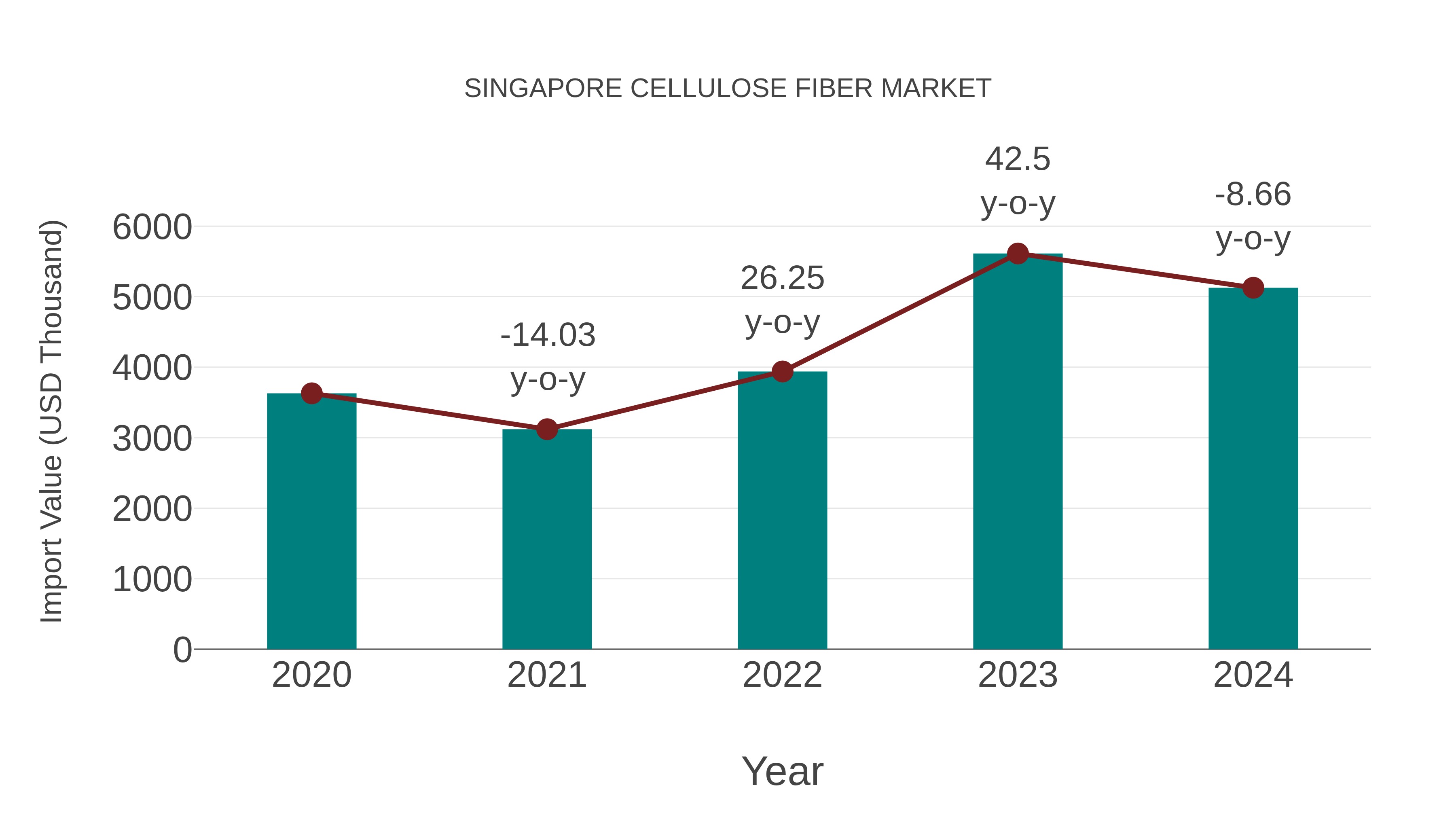
In the Singapore cellulose fiber market, the import trend experienced a decline from 2023 to 2024, with a growth rate of -8.66%. However, the compound annual growth rate (CAGR) for the period 2020-2024 stood at 9.02%. This decline in import momentum could be attributed to shifts in demand dynamics or changes in trade policies impacting market stability.
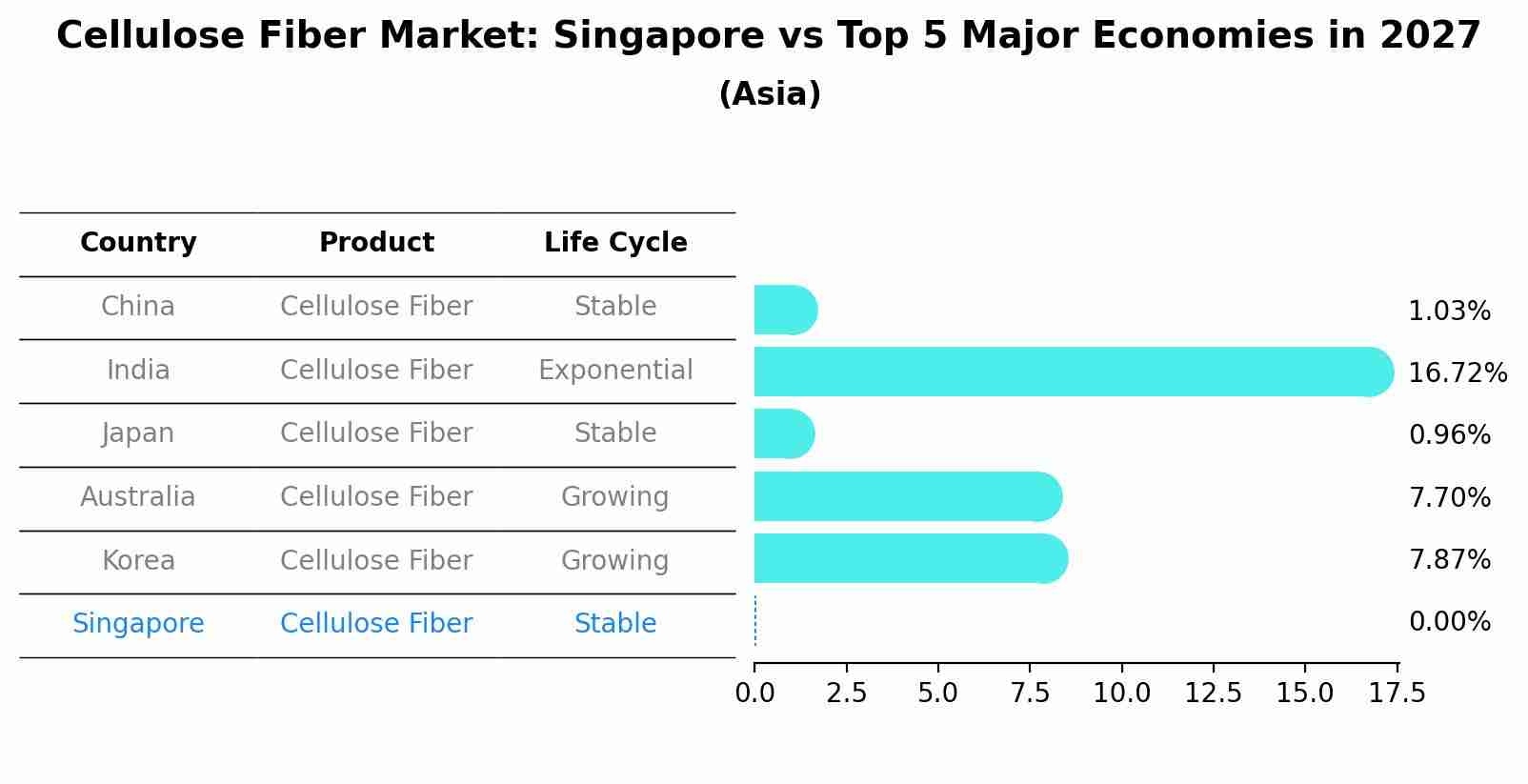
Cellulose Fiber Market: Singapore vs Top 5 Major Economies in 2027 (Asia)
By 2027, the Cellulose Fiber market in Singapore is anticipated to reach a growth rate of 0.00%, as part of an increasingly competitive Asia region, where China remains at the forefront, supported by India, Japan, Australia and South Korea, driving innovations and market adoption across sectors.
Singapore Cellulose Fiber Market Synopsis
The cellulose fiber market in Singapore is poised for expansion due to the growing demand for sustainable and eco-friendly materials across various industries. Cellulose fibers, derived from renewable sources such as wood pulp, find applications in textiles, paper, packaging, and more. With a rising emphasis on reducing environmental impact, industries are shifting towards cellulose-based solutions to replace traditional materials. This shift is expected to drive the demand for cellulose fibers in Singapore, fostering technological advancements and collaborations within the industry to meet evolving market needs.
Drivers of the Market
The Singapore cellulose fiber market is experiencing significant growth due to the increasing emphasis on sustainability and eco-friendly materials in various industries. Cellulose fibers are derived from renewable sources like wood pulp and cotton, making them a preferred choice for textile, paper, and packaging applications. The market`s expansion is driven by the fashion industry`s shift towards sustainable and biodegradable textiles, with cellulose fibers being a key component in eco-friendly fabrics. Additionally, the demand for cellulose fibers in the packaging industry is rising as companies seek environmentally responsible alternatives to traditional plastics. Singapore commitment to green initiatives and sustainability practices has further boosted the market, with manufacturers investing in research and development to improve the performance and versatility of cellulose fibers. As sustainability remains a key focus, the Singapore cellulose fiber market is expected to continue its growth trajectory.
Challenges of the Market
Challenges in the Singapore cellulose fiber market include competition from synthetic fibers and sustainable sourcing concerns. The market demand for eco-friendly and biodegradable materials is increasing, but cellulose fiber faces competition from synthetic alternatives. Sourcing sustainable raw materials and adhering to environmentally friendly production practices are essential to meet consumer demands. Additionally, fluctuations in pulp prices and supply chain disruptions can impact the cost and availability of cellulose fiber.
COVID-19 Impact on the Market
The cellulose fiber market experienced shifts in demand during the pandemic. While there was a surge in demand for hygiene products like masks and wipes made from cellulose fibers, the textile industry, a major consumer of these fibers, saw a decline. Supply chain disruptions also affected the availability of raw materials. Companies in this market had to adapt by adjusting their production mix to cater to changing demands and ensuring a resilient supply chain.
Key Players in the Market
Major players in the cellulose fiber market include Lenzing AG, Aditya Birla Group, and Sateri Holdings. They are leading producers of sustainable cellulose fibers used in textiles and nonwoven applications.
Key Highlights of the Report:
- Singapore Cellulose Fiber Market Outlook
- Market Size of Singapore Cellulose Fiber Market, 2025
- Forecast of Singapore Cellulose Fiber Market, 2032
- Historical Data and Forecast of Singapore Cellulose Fiber Revenues & Volume for the Period 2022-2032F
- Singapore Cellulose Fiber Market Trend Evolution
- Singapore Cellulose Fiber Market Drivers and Challenges
- Singapore Cellulose Fiber Price Trends
- Singapore Cellulose Fiber Porter's Five Forces
- Singapore Cellulose Fiber Industry Life Cycle
- Historical Data and Forecast of Singapore Cellulose Fiber Market Revenues & Volume By Fiber Type for the Period 2022-2032F
- Historical Data and Forecast of Singapore Cellulose Fiber Market Revenues & Volume By Introduction for the Period 2022-2032F
- Historical Data and Forecast of Singapore Cellulose Fiber Market Revenues & Volume By Natural Cellulose Fibers for the Period 2022-2032F
- Historical Data and Forecast of Singapore Cellulose Fiber Market Revenues & Volume By Man-made Cellulose Fibers for the Period 2022-2032F
- Historical Data and Forecast of Singapore Cellulose Fiber Market Revenues & Volume By Others for the Period 2022-2032F
- Historical Data and Forecast of Singapore Cellulose Fiber Market Revenues & Volume By Applications for the Period 2022-2032F
- Historical Data and Forecast of Singapore Cellulose Fiber Market Revenues & Volume By Introduction for the Period 2022-2032F
- Historical Data and Forecast of Singapore Cellulose Fiber Market Revenues & Volume By Apparel for the Period 2022-2032F
- Historical Data and Forecast of Singapore Cellulose Fiber Market Revenues & Volume By Home Textile for the Period 2022-2032F
- Historical Data and Forecast of Singapore Cellulose Fiber Market Revenues & Volume By Industrial for the Period 2022-2032F
- Historical Data and Forecast of Singapore Cellulose Fiber Market Revenues & Volume By Others for the Period 2022-2032F
- Singapore Cellulose Fiber Import Export Trade Statistics
- Market Opportunity Assessment By Fiber Type
- Market Opportunity Assessment By Applications
- Singapore Cellulose Fiber Top Companies Market Share
- Singapore Cellulose Fiber Competitive Benchmarking By Technical and Operational Parameters
- Singapore Cellulose Fiber Company Profiles
- Singapore Cellulose Fiber Key Strategic Recommendations






































