Singapore Chandeliers & Pendant Lights Market Summary
The singapore chandeliers & pendant lights market was estimated at USD 1077 Million in 2025 and is projected to reach USD 1535 Million by 2032, growing at a CAGR of 6.4% from 2026 to 2032.
Singapore Chandeliers & Pendant Lights Market Year-wise Growth Rate and Key Drivers
This graph highlights how the Singapore Chandeliers & Pendant Lights Market has steadily grown over the past five years, supported by major growth factors.
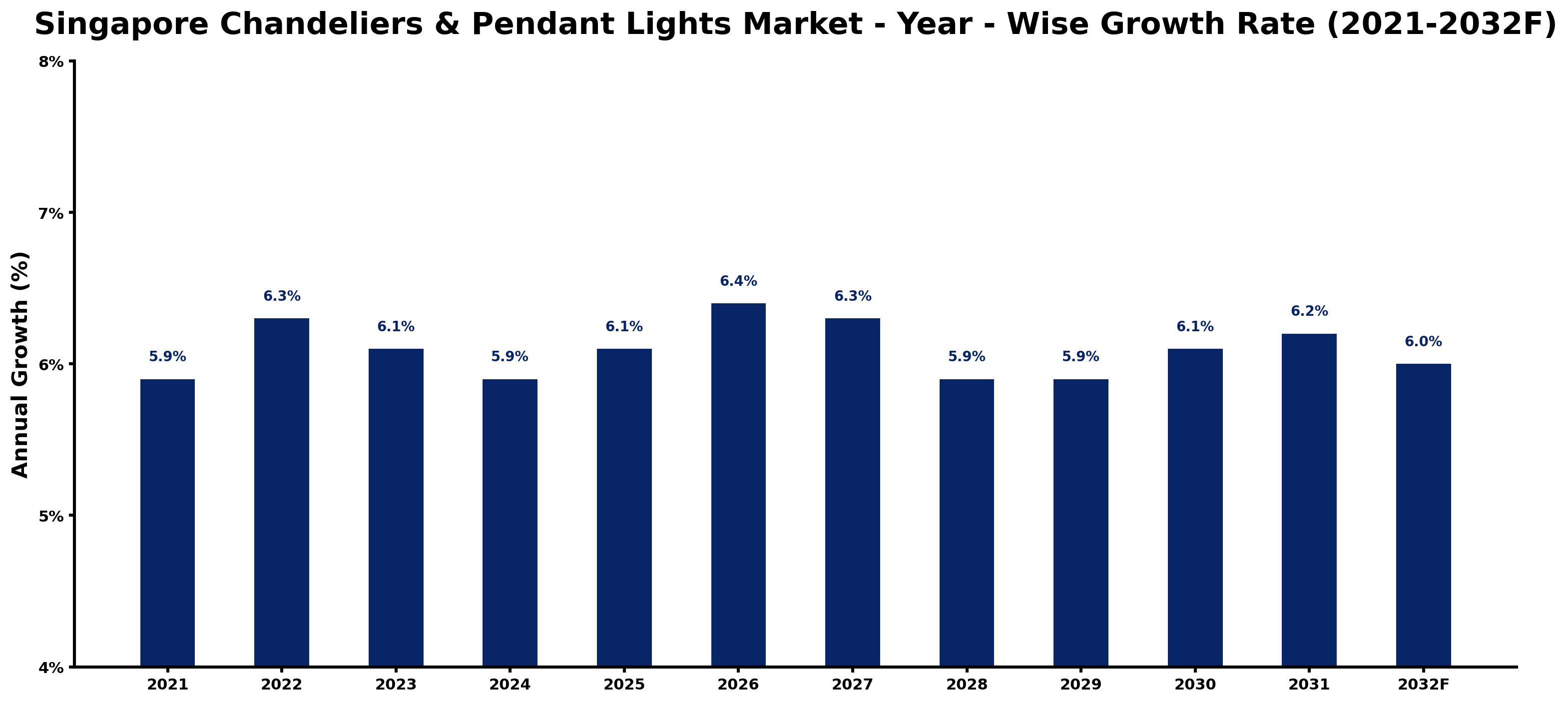
The table below presents the year wise growth rates along with the key drivers influencing the market
| Year | Growth Rate | Major Drivers |
| 2021 | 5.9% | Post-lockdown retail projects triggered renewed interest in luxury home lighting solutions. |
| 2022 | 6.3% | Aesthetic preferences shifted towards contemporary designs, enhancing chandelier market appeal. |
| 2023 | 6.1% | Sustainable materials gained traction, reflecting consumer consciousness about environmental impact. |
| 2024 | 5.9% | Urbanization trends increased demand for customized lighting fixtures in high-rise apartments. |
| 2025 | 6.1% | Technological integration in lighting systems improved energy efficiency for residential use. |
| 2026 | 6.4% | A burgeoning hospitality sector fueled demand for elegant pendant lighting options. |
| 2027 | 6.3% | Home renovation projects expanded, highlighting a preference for statement chandeliers. |
| 2028 | 5.9% | The rise of online retailers diversified purchasing channels for consumers seeking luxury. |
| 2029 | 5.9% | Architectural trends favored open spaces, increasing the appeal of pendant lighting designs. |
| 2030 | 6.1% | Integration of smart home technology led to innovative lighting solutions for urban dwellers. |
| 2031 | 6.2% | Cultural events and festivals inspired unique chandelier designs reflecting local artistry. |
| 2032 | 6.0% | Increased disposable income allowed consumers to invest in high-end decorative lighting. |
Note - Market size estimations and growth projections presented in this report are based on 6Wresearch's advanced forecasting approach, validated with industry datasets as of June 2026.
Singapore Chandeliers & Pendant Lights Market Synopsis
The Singapore Chandeliers Pendant Lights Market is projected to reach 6.4% and witness significant growth during the forecast period (2026-2032). This growth can be attributed to a variety of factors, including the ongoing economic expansion in Singapore, which is fostering increased consumer spending on interior aesthetics. As disposable incomes rise, consumers are becoming more inclined to invest in high-quality lighting fixtures that enhance their living and working environments. With the growing trend towards sophisticated interior designs, the demand for chandeliers and pendant lights is expected to escalate, positioning this market for a robust trajectory in the coming years.
Singapore Chandeliers & Pendant Lights Market Growth Drivers
Several key factors are driving the growth of the Singapore Chandeliers & Pendant Lights Market. Firstly, the robust economic growth in Singapore has created a conducive environment for increased disposable incomes, allowing consumers to prioritize interior design. Secondly, there is a marked preference for designer lighting fixtures that not only serve functional purposes but also act as statement pieces in homes and businesses. Thirdly, the availability of innovative designs featuring energy-efficient technology continues to attract environmentally conscious consumers. Furthermore, government initiatives, such as LED replacement schemes, are promoting the adoption of energy-efficient lighting solutions. Finally, advancements in smart lighting technology are paving the way for sophisticated lighting solutions that appeal to tech-savvy consumers.
Singapore Chandeliers & Pendant Lights Market Trends and Opportunities
The Singapore Chandeliers & Pendant Lights Market is witnessing several notable trends that present lucrative opportunities for industry stakeholders. The integration of smart lighting technology is transforming traditional lighting into intelligent systems that can be controlled remotely. This trend aligns with the growing consumer preference for convenience and energy savings. Additionally, the increasing popularity of minimalist and contemporary design aesthetics is prompting manufacturers to offer sleek and understated lighting solutions, catering to modern interior design preferences. Sustainable practices are also gaining traction, with a focus on using eco-friendly materials and energy-efficient manufacturing processes. As consumers continue to seek unique, customizable lighting solutions, there is a burgeoning opportunity for companies to differentiate themselves through innovative designs.
Singapore Chandeliers & Pendant Lights Market Challenges and Restraints
Despite the growth potential in the Singapore Chandeliers & Pendant Lights Market, several challenges persist that could hinder progress. High pricing related to luxury lighting fixtures may deter lower-income households from making such investments, limiting market accessibility. Moreover, a lack of awareness and education about the benefits and functionalities of modern lighting solutions among certain demographic groups can impede market penetration. Competition from international markets offering more cost-effective alternatives further complicates the landscape for local manufacturers. Additionally, the growing complexity of lighting technologies necessitates a skilled labor force for installation and maintenance, which is presently limited in availability. These factors collectively present hurdles that could affect market performance throughout the forecast period.
Singapore Chandeliers & Pendant Lights Market Government Investment and Initiatives
The Singapore government has implemented various initiatives aimed at enhancing the sustainability and energy efficiency of the lighting sector, directly benefiting the Chandeliers & Pendant Lights Market. These initiatives include public spending on smart city projects, which often emphasize energy-efficient lighting solutions as part of urban development plans. The government's commitment to combating climate change has led to the introduction of specific policies that encourage the installation of LED lighting in both commercial and residential sectors. Additionally, various subsidy schemes are available for consumers looking to upgrade to energy-saving lighting technologies, thus stimulating market growth. The promotion of green building standards also encourages the use of advanced lighting solutions, creating a favorable environment for the chandeliers and pendant lights market.
Singapore Chandeliers & Pendant Lights Market Latest Developments (May 2025 - June 2026)
In the period spanning from May 2025 to June 2026, the Singapore Chandeliers & Pendant Lights Market has experienced a notable shift towards sustainability and technological innovation. Manufacturers are increasingly focusing on the development of energy-efficient lighting products, aligning with government policies promoting environmental responsibility. The introduction of smart lighting systems has gained traction, with consumers becoming more receptive to the convenience that these technologies offer. Furthermore, collaborations among stakeholders in the interior design and lighting sectors have been on the rise, fostering the creation of tailored solutions that meet specific market demands. The period has also seen a significant push towards enhancing customer education regarding the benefits of modern lighting technologies, which is expected to drive demand in the coming years.
Singapore Chandeliers & Pendant Lights Market - Key Attractiveness of the Report
- 10 Years of Market Numbers
- Historical Data Starting from 2022 to 2025
- Base Year: 2025
- Forecast Data until 2032
- Key Performance Indicators Impacting the Market
- Major Upcoming Developments and Projects
Key Highlights of the Report:
- Singapore Chandeliers & Pendant Lights Market Outlook
- Market Size of Singapore Chandeliers & Pendant Lights Market, 2025
- Forecast of Singapore Chandeliers & Pendant Lights Market, 2032
- Historical Data and Forecast of Singapore Chandeliers & Pendant Lights Revenues & Volume for the Period 2022-2032
- Singapore Chandeliers & Pendant Lights Market Trend Evolution
- Singapore Chandeliers & Pendant Lights Market Drivers and Challenges
- Singapore Chandeliers & Pendant Lights Price Trends
- Singapore Chandeliers & Pendant Lights Porter's Five Forces
- Singapore Chandeliers & Pendant Lights Industry Life Cycle
- Historical Data and Forecast of Singapore Chandeliers & Pendant Lights Market Revenues & Volume By Product Type for the Period 2022-2032
- Historical Data and Forecast of Singapore Chandeliers & Pendant Lights Market Revenues & Volume By Traditional for the Period 2022-2032
- Historical Data and Forecast of Singapore Chandeliers & Pendant Lights Market Revenues & Volume By Transitional for the Period 2022-2032
- Historical Data and Forecast of Singapore Chandeliers & Pendant Lights Market Revenues & Volume By Modern for the Period 2022-2032
- Historical Data and Forecast of Singapore Chandeliers & Pendant Lights Market Revenues & Volume By Applications for the Period 2022-2032
- Historical Data and Forecast of Singapore Chandeliers & Pendant Lights Market Revenues & Volume By Commercial for the Period 2022-2032
- Historical Data and Forecast of Singapore Chandeliers & Pendant Lights Market Revenues & Volume By Residential for the Period 2022-2032
- Historical Data and Forecast of Singapore Chandeliers & Pendant Lights Market Revenues & Volume By Distribution Channel for the Period 2022-2032
- Historical Data and Forecast of Singapore Chandeliers & Pendant Lights Market Revenues & Volume By Online for the Period 2022-2032
- Historical Data and Forecast of Singapore Chandeliers & Pendant Lights Market Revenues & Volume By Offline for the Period 2022-2032
- Singapore Chandeliers & Pendant Lights Import Export Trade Statistics
- Market Opportunity Assessment By Product Type
- Market Opportunity Assessment By Applications
- Market Opportunity Assessment By Distribution Channel
- Singapore Chandeliers & Pendant Lights Top Companies Market Share
- Singapore Chandeliers & Pendant Lights Competitive Benchmarking By Technical and Operational Parameters
- Singapore Chandeliers & Pendant Lights Company Profiles
- Singapore Chandeliers & Pendant Lights Key Strategic Recommendations






































