Singapore Chromium Sulphate Market Size, Share & Growth Rate
The Singapore Chromium Sulphate Market was estimated at USD 646 Million in 2025 and is projected to reach USD 924 Million by 2032, growing at a CAGR of 5.2% from 2026 to 2032. This growth trajectory is primarily underpinned by robust demand from the leather tanning sector, which continues to expand as fashion trends evolve and consumer preferences for high-quality leather products increase. The need for sustainable practices also drives innovation, compelling companies to adopt eco-friendly methods, enhancing market viability.
Singapore Chromium Sulphate Market Year-wise Growth Rate and Key Drivers
This graph highlights how the Singapore Chromium Sulphate Market has steadily grown over the years, supported by major growth factors.
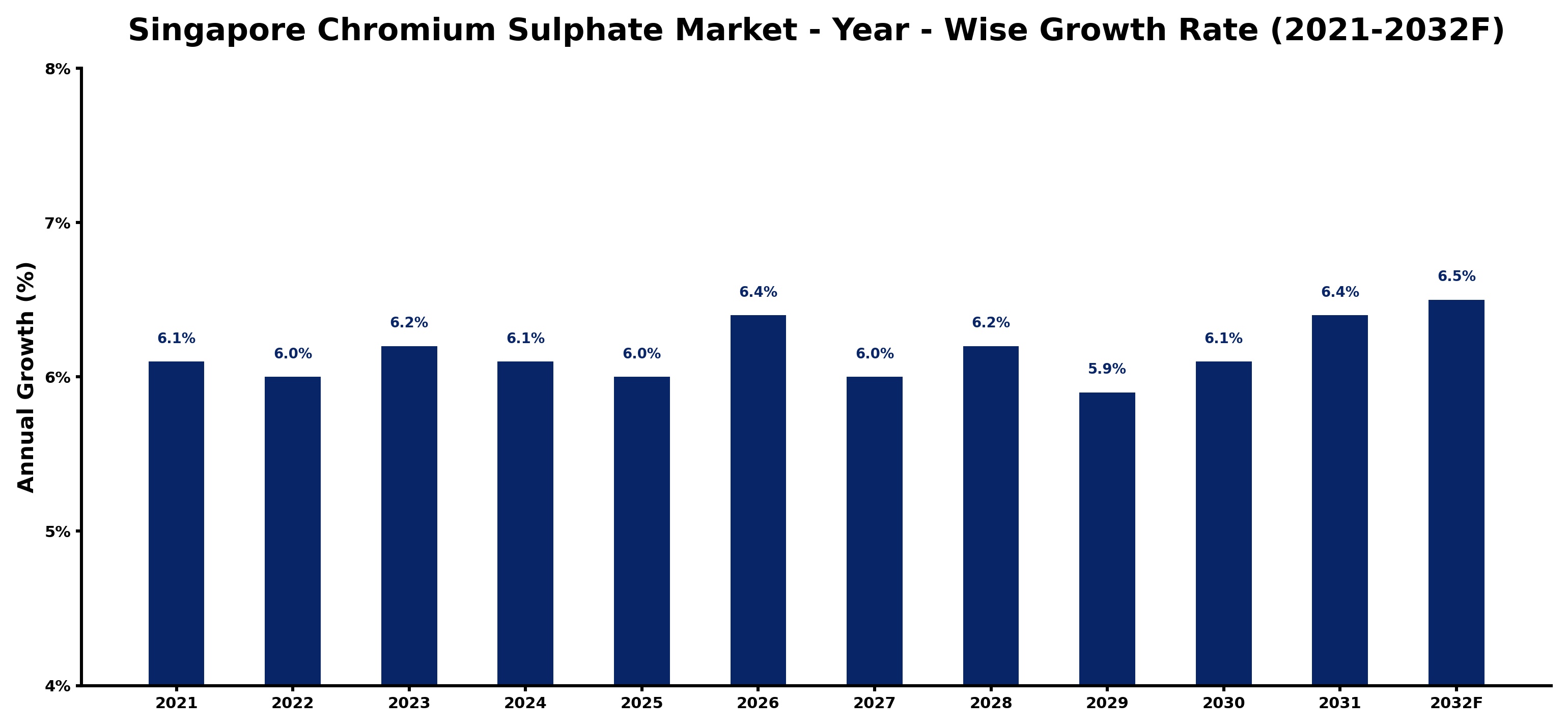
The table below presents the year‑wise growth rates along with the key drivers influencing the market
| Year | Growth Rate | Major Drivers |
| 2021 | 6.1% | Increased demand from leather industry |
| 2022 | 6.0% | Growth in textile manufacturing sector |
| 2023 | 6.2% | Rising adoption in food processing |
| 2024 | 6.1% | Expansion of chemical production facilities |
| 2025 | 6.0% | Industrial activity supported growth |
| 2026 | 6.4% | Surge in construction activities observed |
| 2027 | 6.0% | Emergence of new industrial applications |
| 2028 | 6.2% | Market expansion drove consumption |
| 2029 | 5.9% | Increased focus on sustainable practices |
| 2030 | 6.1% | Technological advancements in production |
| 2031 | 6.4% | Rising exports to regional markets |
| 2032 | 6.5% | Enhanced regulatory support for industries |
Note - Market size estimations and growth projections presented in this report are based on 6Wresearch’s advanced forecasting approach, validated with industry datasets as of June 2026.
Singapore Chromium Sulphate Market Synopsis
In Singapore, the demand for chromium sulfate is primarily fueled by its critical role in leather tanning, a sector that exhibits consistent growth. The need for quality leather products reinforces this demand, with chromium sulfate being a preferred tanning agent. Additionally, its applications extend to textile dyeing and water treatment, which further stabilizes market dynamics.
The market remains relatively stable despite growing environmental concerns and shifts towards sustainable materials. Local industries are increasingly mindful of eco-friendly practices, making it essential for companies to align their operations with stringent regulations. Exploring avenues for value-added products and improved waste management will be pivotal for long-term market resilience.
Singapore Chromium Sulphate Market Key Takeaways
- The leather tanning industry is the primary driver of chromium sulfate demand in Singapore.
- Environmental regulations are shaping the market landscape, necessitating sustainable practices.
- Adoption of eco-friendly alternatives is becoming increasingly important for market players.
- Strategic partnerships and export opportunities are essential for growth beyond local markets.
- Consumer preferences are leaning towards high-quality, sustainably produced leather goods.
Evaluation of Restraints in Singapore Chromium Sulphate Market
Despite the stable growth prospects, the Singapore chromium sulfate market faces several significant restraints. One of the most pressing challenges is the rising competition from alternative tanning agents, which may offer more sustainable or cost-effective solutions. Environmental concerns surrounding the disposal of chromium-laden wastewater also pose a challenge, prompting manufacturers to seek innovative treatment solutions. These factors, coupled with fluctuating global demand, necessitate ongoing adaptation and strategic planning to maintain competitive positioning.
Singapore Chromium Sulphate Market Trends
Current trends in the Singapore chromium sulfate market reflect a shift towards sustainable practices. There is a noticeable increase in investments aimed at developing eco-friendly alternatives and improving production processes. Additionally, technological advancements in waste management and treatment solutions are becoming pivotal in addressing environmental concerns. The intersection of fashion trends and sustainability is fostering a market environment that emphasizes quality and environmental responsibility.
Singapore Chromium Sulphate Market Opportunities
Opportunities for growth in the Singapore chromium sulfate market lie in innovation and strategic diversification. Companies are encouraged to explore the development of value-added products that cater to the eco-conscious consumer. Furthermore, tapping into international markets can provide avenues for expansion, particularly in regions where demand for high-quality leather goods is burgeoning. Collaborative efforts within the industry can also enhance resource efficiency and create more sustainable practices.
Government Initiatives in the Singapore Chromium Sulphate Market
The Singapore government has instituted several initiatives aimed at promoting sustainable industrial practices, which indirectly benefit the chromium sulfate market. Investments in public spending focused on environmental technology aim to reduce the ecological impact of industries. Moreover, the government is likely to support programs that encourage compliance with environmental regulations, promoting innovation within local enterprises and fostering a culture of sustainability across sectors.
Future Insights of the Singapore Chromium Sulphate Market
Looking ahead to the years 2026-2032, the Singapore chromium sulfate market is poised for a steady evolution. With increasing consumer awareness and demand for sustainable products, companies that invest in environmentally responsible practices will likely gain a competitive edge. The integration of innovative technologies for tanning and dyeing processes will further shape the industry's future, ensuring resilience against potential market disruptions.
Singapore Chromium Sulphate Market Latest Developments (May 2025 - June 2026)
Recent developments in the Singapore chromium sulfate market indicate a trend toward innovation and sustainability. Companies are actively investing in research and development to create eco-friendly alternatives to traditional tanning agents. Initiatives focusing on enhanced waste treatment processes have also gained traction, with firms collaborating on projects aimed at reducing environmental impacts. This strategic shift is expected to bolster the market's stability and responsiveness to global trends.
Singapore Chromium Sulphate Market - Key Attractiveness of the Report
- 10 Years of Market Numbers
- Historical Data Starting from 2022 to 2025
- Base Year: 2025
- Forecast Data until 2032
- Key Performance Indicators Impacting the Market
- Major Upcoming Developments and Projects
Key Highlights of the Report:
- Singapore Chromium Sulphate Market Outlook
- Market Size of Singapore Chromium Sulphate Market, 2025
- Forecast of Singapore Chromium Sulphate Market, 2032
- Historical Data and Forecast of Singapore Chromium Sulphate Revenues & Volume for the Period 2022-2032F
- Singapore Chromium Sulphate Market Trend Evolution
- Singapore Chromium Sulphate Market Drivers and Challenges
- Singapore Chromium Sulphate Price Trends
- Singapore Chromium Sulphate Porter's Five Forces
- Singapore Chromium Sulphate Industry Life Cycle
- Historical Data and Forecast of Singapore Chromium Sulphate Market Revenues & Volume By Products for the Period 2022-2032F
- Historical Data and Forecast of Singapore Chromium Sulphate Market Revenues & Volume By Basic Chromium Sulphate 21%-23% for the Period 2022-2032F
- Historical Data and Forecast of Singapore Chromium Sulphate Market Revenues & Volume By Basic Chromium Sulphate 24%-26% for the Period 2022-2032F
- Historical Data and Forecast of Singapore Chromium Sulphate Market Revenues & Volume By Applications for the Period 2022-2032F
- Historical Data and Forecast of Singapore Chromium Sulphate Market Revenues & Volume By Tanning Agent for the Period 2022-2032F
- Historical Data and Forecast of Singapore Chromium Sulphate Market Revenues & Volume By Dyeing for the Period 2022-2032F
- Historical Data and Forecast of Singapore Chromium Sulphate Market Revenues & Volume By Painting & Coating for the Period 2022-2032F
- Singapore Chromium Sulphate Import Export Trade Statistics
- Market Opportunity Assessment By Products
- Market Opportunity Assessment By Applications
- Singapore Chromium Sulphate Top Companies Market Share
- Singapore Chromium Sulphate Competitive Benchmarking By Technical and Operational Parameters
- Singapore Chromium Sulphate Company Profiles
- Singapore Chromium Sulphate Key Strategic Recommendations






































