Singapore Cleaning Products and Detergents Market Summary
The singapore cleaning products and detergents market was estimated at USD 439 Million in 2025 and is projected to reach USD 620 Million by 2032, growing at a CAGR of 6.0% from 2026 to 2032.
Singapore Cleaning Products and Detergents Market Year-wise Growth Rate and Key Drivers
This graph highlights how the Singapore Cleaning Products and Detergents Market has steadily grown over the past five years, supported by major growth factors.
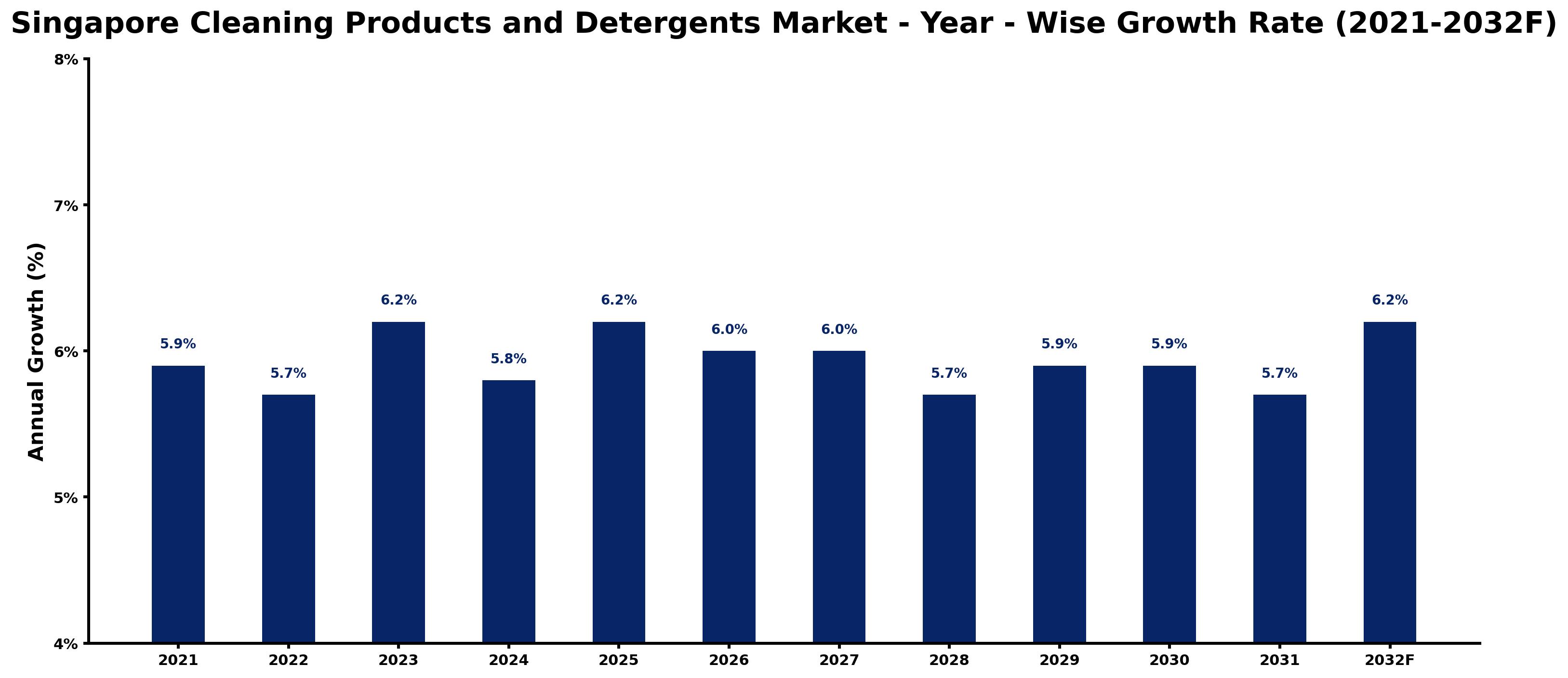
The table below presents the year wise growth rates along with the key drivers influencing the market
| Year | Growth Rate | Major Drivers |
| 2021 | 5.9% | Post-lockdown retail projects increasingly emphasize hygiene and cleanliness across all sectors. |
| 2022 | 5.7% | Consumer preferences shift toward eco-friendly cleaning solutions amid sustainability awareness initiatives. |
| 2023 | 6.2% | Urbanization trends lead to higher demand for cleaning products in densely populated areas. |
| 2024 | 5.8% | Emerging e-commerce platforms provide convenient access to a wider range of products. |
| 2025 | 6.2% | Pandemic-driven habits create sustained interest in disinfectants and sanitizing products. |
| 2026 | 6.0% | Corporate sustainability goals prompt firms to seek greener cleaning alternatives and solutions. |
| 2027 | 6.0% | Technological innovations boost the efficiency and effectiveness of modern cleaning products. |
| 2028 | 5.7% | Increased disposable incomes enable households to invest in premium cleaning brands. |
| 2029 | 5.9% | Local manufacturing capabilities enhance supply chains, reducing costs for consumers and businesses. |
| 2030 | 5.9% | Cultural shifts emphasize personal responsibility for cleanliness and hygiene in public spaces. |
| 2031 | 5.7% | Competitive pricing strategies from brands attract budget-conscious consumers in various segments. |
| 2032 | 6.2% | Expansion of retail channels, including online and offline, broadens market accessibility significantly. |
Note - Market size estimations and growth projections presented in this report are based on 6Wresearch's advanced forecasting approach, validated with industry datasets as of June 2026.
Singapore Cleaning Products and Detergents Market Synopsis
The Singapore Cleaning Products and Detergents Market is projected to reach 6.0% and witness significant growth during the forecast period (2026-2032). The market was valued at USD 1.23 billion in 2019 and is anticipated to grow to USD 1.80 billion by 2026, corresponding to a compound annual growth rate (CAGR) of 6.3%. This growth is primarily driven by the increasing demand for consumer hygiene products stemming from heightened awareness regarding health and hygiene among the populace in Singapore.
Singapore Cleaning Products and Detergents Market Growth Drivers
Several factors contribute to the growth of the Singapore Cleaning Products and Detergents Market. The primary drivers include:
- Increasing demand from the residential sector fueled by higher disposable incomes and changing consumer lifestyles, which leads to enhanced spending on household cleaning products.
- The growing number of dual-income households translates to a demand for convenience, fostering a preference for ready-to-use cleaning solutions that save time and effort.
- The Covid-19 pandemic has significantly intensified the focus on hygiene, resulting in a sustained rise in the use of disinfectants and sanitizers, which bolsters market growth.
- The penetration of e-commerce platforms has simplified access to cleaning products, enabling consumers to compare prices and ingredients easily, stimulating market activity.
- Rising awareness of environmental sustainability is prompting manufacturers to develop eco-friendly cleaning solutions, further catalyzing market expansion.
Singapore Cleaning Products and Detergents Market Trends and Opportunities
The Singapore Cleaning Products and Detergents Market is observing notable trends that provide substantial opportunities for growth. Key trends include:
- Innovation in product formulations, driven by advancements in research and development aimed at enhancing effectiveness while maintaining safety standards.
- Increased consumer inclination towards organic and biodegradable products, reflecting a shift towards environmentally conscious purchasing behavior.
- The rise of smart cleaning solutions that leverage technology to improve the efficiency and effectiveness of cleaning processes.
- An expansion of product lines catering to specific consumer needs, such as hypoallergenic cleaners tailored for sensitive individuals.
- Collaborations between brands and retailers to create bundled offers, enhancing the visibility of cleaning products and appealing to a broader consumer base.
Singapore Cleaning Products and Detergents Market Challenges and Restraints
While the market presents several growth opportunities, it also faces challenges that could impede progress:
- Stringent government regulations concerning the use of certain chemicals in cleaning products pose a compliance challenge for manufacturers, requiring ongoing adaptation to new guidelines.
- The competitive landscape among manufacturers can lead to price wars, impacting profit margins and forcing companies to innovate constantly.
- Supply chain disruptions, particularly those triggered by global events, can affect the availability of raw materials essential for manufacturing cleaning products.
- Consumer skepticism regarding the efficacy and safety of new cleaning products can limit market penetration, necessitating robust marketing strategies.
- High customer expectations for product performance and sustainability may compel manufacturers to invest significantly in product research and development.
Singapore Cleaning Products and Detergents Market Government Investment and Initiatives
The Singapore government has implemented several initiatives aimed at fostering growth in the Cleaning Products and Detergents Market. These initiatives include policies promoting sustainability, encouraging manufacturers to adopt eco-friendly practices. Additionally, public spending on health and hygiene education has raised awareness and demand for cleaning products. Development plans focusing on technological advancements in manufacturing processes are also being prioritized, which may enhance product efficacy and safety. Furthermore, government support for research and development activities is likely to spur innovation in cleaning formulations, aligning with evolving consumer expectations and regulatory requirements.
Singapore Cleaning Products and Detergents Market Latest Developments (May 2025 - June 2026)
Recent developments in the Singapore Cleaning Products and Detergents Market from May 2025 to June 2026 indicate a continued emphasis on sustainability and innovation. Companies are increasingly launching new product lines that feature eco-friendly ingredients, responding to consumer demand for environmentally responsible alternatives. Additionally, there is a noticeable shift towards digital marketing strategies, as brands leverage social media to engage with consumers and promote their products effectively. The impact of the Covid-19 pandemic continues to influence product offerings, with a sustained focus on sanitization and disinfecting solutions as integral components of consumer cleaning routines. Market players are also exploring partnerships with technology firms to develop smart cleaning equipment that integrates IoT capabilities, fostering greater efficiency in cleaning practices.
Singapore Cleaning Products and Detergents Market - Key Attractiveness of the Report
- 10 Years of Market Numbers
- Historical Data Starting from 2022 to 2025
- Base Year: 2025
- Forecast Data until 2032
- Key Performance Indicators Impacting the Market
- Major Upcoming Developments and Projects
Key Highlights of the Report:
- Singapore Cleaning Products and Detergents Market Outlook
- Market Size of Singapore Cleaning Products and Detergents Market, 2025
- Forecast of Singapore Cleaning Products and Detergents Market, 2032F
- Historical Data and Forecast of Singapore Cleaning Products and Detergents Revenues & Volume for the Period 2022-2032F
- Singapore Cleaning Products and Detergents Market Trend Evolution
- Singapore Cleaning Products and Detergents Market Drivers and Challenges
- Singapore Cleaning Products and Detergents Price Trends
- Singapore Cleaning Products and Detergents Porter's Five Forces
- Singapore Cleaning Products and Detergents Industry Life Cycle
- Historical Data and Forecast of Singapore Cleaning Products and Detergents Market Revenues & Volume By Type for the Period 2022-2032F
- Historical Data and Forecast of Singapore Cleaning Products and Detergents Market Revenues & Volume By Anionic Detergents for the Period 2022-2032F
- Historical Data and Forecast of Singapore Cleaning Products and Detergents Market Revenues & Volume By Cationic Detergents for the Period 2022-2032F
- Historical Data and Forecast of Singapore Cleaning Products and Detergents Market Revenues & Volume By Non-ionic Detergents for the Period 2022-2032F
- Historical Data and Forecast of Singapore Cleaning Products and Detergents Market Revenues & Volume By Zwitterionic (Amphoteric) Detergents for the Period 2022-2032F
- Historical Data and Forecast of Singapore Cleaning Products and Detergents Market Revenues & Volume By Applications for the Period 2022-2032F
- Historical Data and Forecast of Singapore Cleaning Products and Detergents Market Revenues & Volume By Laundry Cleaning Products for the Period 2022-2032F
- Historical Data and Forecast of Singapore Cleaning Products and Detergents Market Revenues & Volume By Household Cleaning Products for the Period 2022-2032F
- Historical Data and Forecast of Singapore Cleaning Products and Detergents Market Revenues & Volume By Dishwashing Products for the Period 2022-2032F
- Historical Data and Forecast of Singapore Cleaning Products and Detergents Market Revenues & Volume By Fuel Additives for the Period 2022-2032F
- Historical Data and Forecast of Singapore Cleaning Products and Detergents Market Revenues & Volume By Biological Reagent for the Period 2022-2032F
- Historical Data and Forecast of Singapore Cleaning Products and Detergents Market Revenues & Volume By Others for the Period 2022-2032F
- Singapore Cleaning Products and Detergents Import Export Trade Statistics
- Market Opportunity Assessment By Type
- Market Opportunity Assessment By Applications
- Singapore Cleaning Products and Detergents Top Companies Market Share
- Singapore Cleaning Products and Detergents Competitive Benchmarking By Technical and Operational Parameters
- Singapore Cleaning Products and Detergents Company Profiles
- Singapore Cleaning Products and Detergents Key Strategic Recommendations






































