Singapore Cloud Database and DBaaS Market Size & Growth Rate (2026-2032)
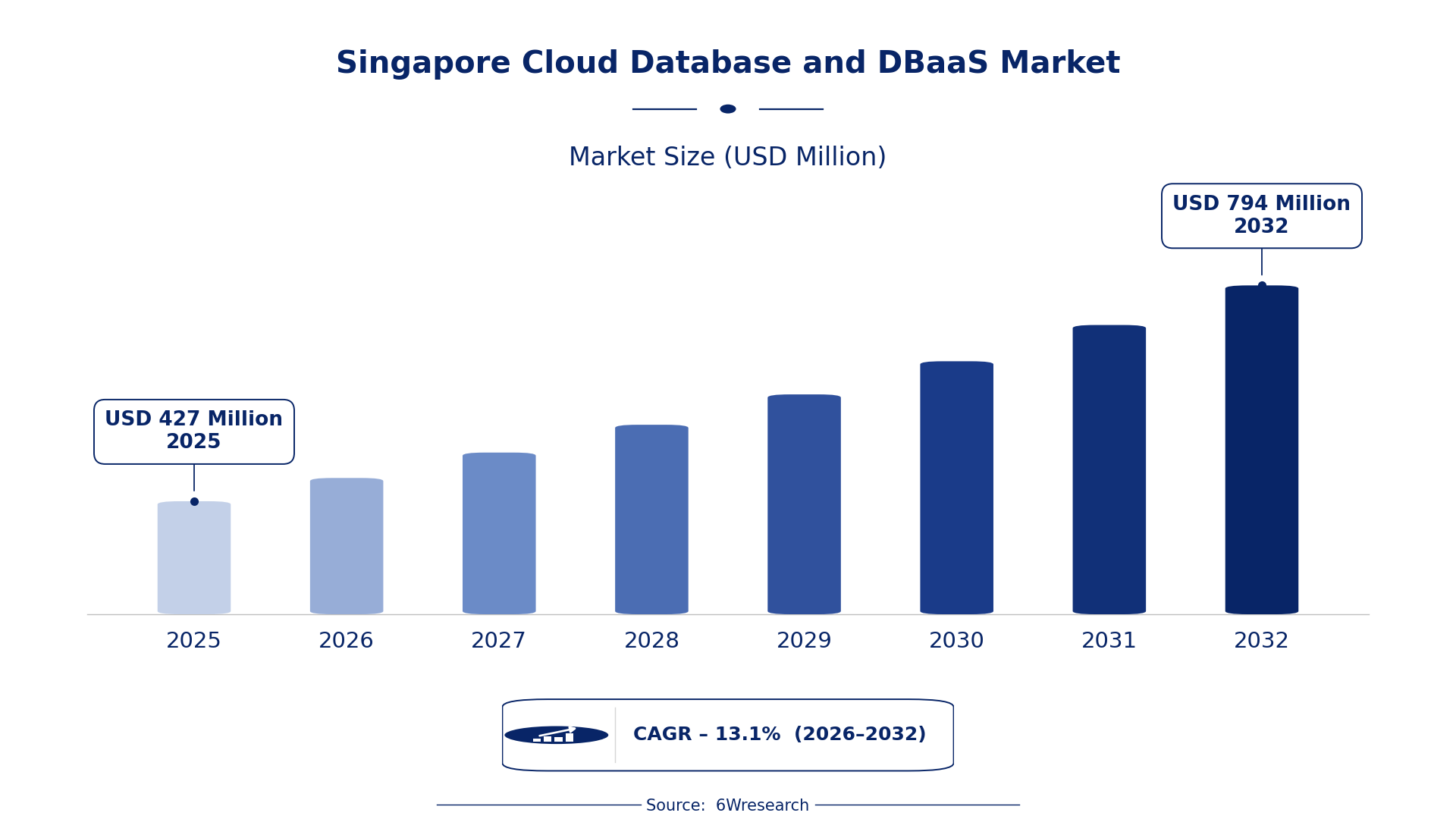
The Singapore Cloud Database and DBaaS Market was estimated at USD 427 Million in 2025 and is projected to reach USD 794 Million by 2032, growing at a CAGR of 13.1% from 2026 to 2032.
Singapore Cloud Database and DBaaS Market Synopsis
The surge in data generation is the foremost force driving the Singapore Cloud Database and DBaaS market. As businesses accumulate vast amounts of information, they are increasingly opting for cloud solutions to manage and store this data efficiently.
Organizations are recognizing that traditional database systems simply cannot keep pace with the scale, flexibility, and rapid deployment capabilities offered by cloud databases. This has intensified the competition among DBaaS providers, with companies eager to present their unique offerings to capture market share.
Singapore Cloud Database and DBaaS Market Year-wise Growth Rate and Key Drivers
This graph illustrates the annual growth rates of the Singapore Cloud Database and DBaaS Market from 2021 to 2032, highlighting a steady upward trajectory and projected expansion over the forecast period.
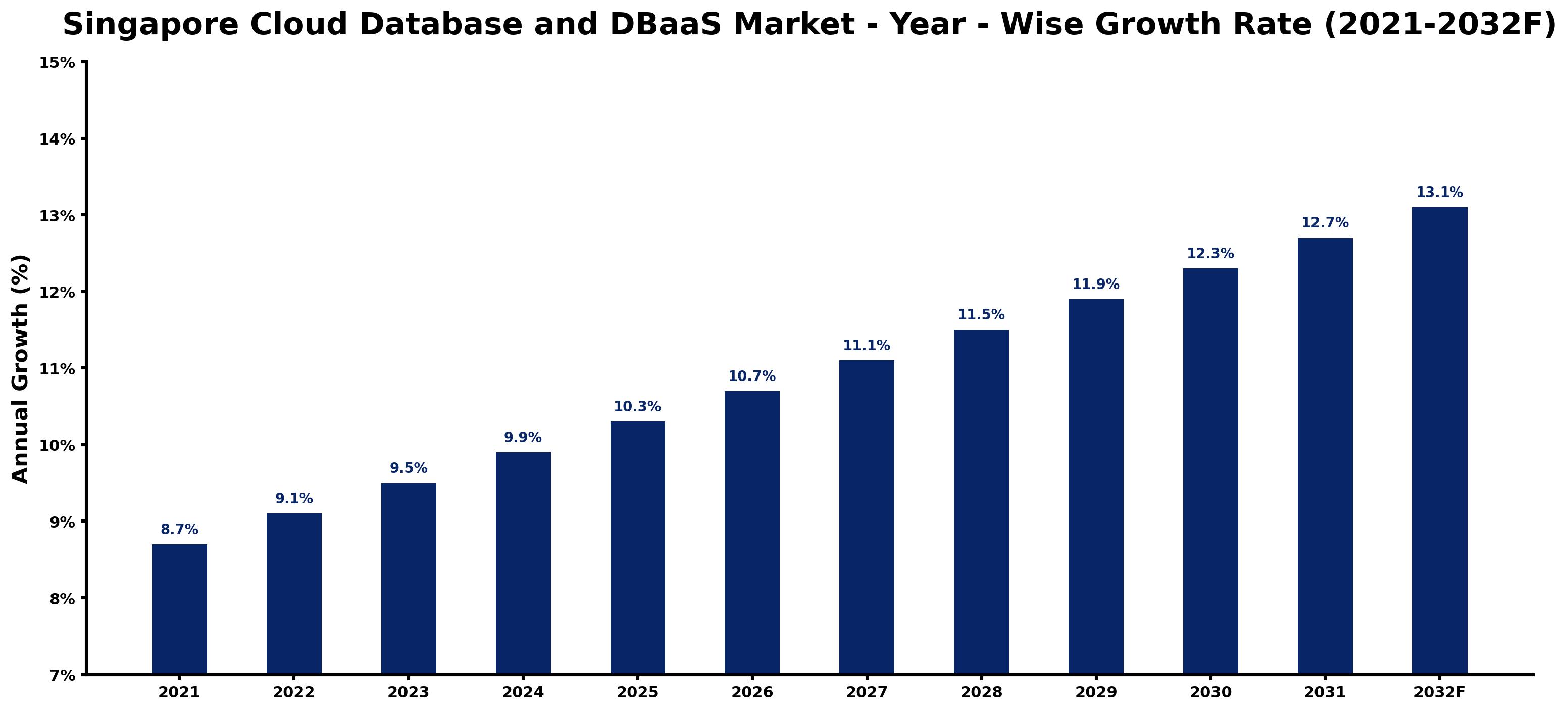
The table below presents the year‑wise growth rates along with the key drivers influencing the market
| Year | Growth Rate | Major Drivers |
| 2021 | 8.7% | Singapore's push for Smart Nation initiative drives cloud adoption. |
| 2022 | 9.1% | Rising e-commerce activity fuels database service demand. |
| 2023 | 9.5% | Data localization laws enhance local cloud database usage. |
| 2024 | 9.9% | Increased cybersecurity regulations heighten DBaaS requirements. |
| 2025 | 10.3% | Government's Green Plan encourages sustainable database solutions. |
| 2026 | 10.7% | Strong digital economy initiatives boost data-driven services. |
| 2027 | 11.1% | Growth in IoT applications necessitates robust cloud data storage. |
| 2028 | 11.5% | Local startups advancing cloud-native development drive consumption. |
| 2029 | 11.9% | Heightened regulatory focus on data protection influences DBaaS. |
| 2030 | 12.3% | Emergence of edge computing boosts demand for cloud databases. |
| 2031 | 12.7% | Healthcare digitization accelerates cloud database investments. |
| 2032 | 13.1% | Digital banking regulations drive secure database solutions. |
Note: Market size estimations and growth projections presented in this report are based on 6Wresearch's proprietary forecasting methodology, utilizing the latest available industry data, government publications, and primary research inputs.
Singapore Cloud Database and DBaaS Market Key Takeaways
Below are some of the specific key takeaways from the market, including:
- The market is driven by the increasing volume of data generated by businesses in Singapore.
- Cloud databases provide scalable solutions that facilitate agile data management.
- Cost-effectiveness and ease of use are significant factors attracting organizations to DBaaS offerings.
- Data security and compliance remain paramount concerns for businesses utilizing cloud solutions.
- The impact of COVID-19 has accelerated the adoption of cloud databases for mission-critical operations.
Evaluation of Restraints in Singapore Cloud Database and DBaaS Market
Despite the promising growth, the market faces critical constraints, primarily revolving around data security and compliance. Companies must navigate complex regulatory landscapes to protect sensitive information and adhere to stringent data protection laws. on top of that, the intricacies of scaling databases in cloud environments can create performance challenges, compelling organizations to invest in specialized skills and technologies.
Singapore Cloud Database and DBaaS Market Trends
Several trends are reshaping the Singapore Cloud Database and DBaaS market. The rise of artificial intelligence and machine learning is driving demand for advanced analytics capabilities, pushing businesses towards databases that support these technologies. on top of that, the shift towards hybrid cloud architectures is gaining traction, as organizations seek the flexibility to manage their data across multiple environments.
The emphasis on data governance and management is also notable, with enterprises increasingly prioritizing solutions that ensure data integrity and availability. As businesses recognize data as a critical asset, investments in cloud databases that provide comprehensive management features are becoming more common.
Singapore Cloud Database and DBaaS Market Opportunities
The potential for growth in the Singapore Cloud Database and DBaaS market is substantial. Organizations looking to modernize their infrastructure are actively seeking cloud solutions that offer enhanced scalability and flexibility. on top of that, as businesses increasingly rely on data-driven decision-making, there is a growing need for integrated database solutions that can support analytics and real-time data processing.
Opportunities also lie in niche markets, such as industry-specific databases tailored for sectors like healthcare and finance. The ongoing push for digital transformation across all sectors will continue to create avenues for DBaaS providers to innovate and expand their offerings.
Government Initiatives in the Singapore Cloud Database and DBaaS Market
The Singapore government is actively fostering a conducive environment for the Cloud Database and DBaaS market through various policies and initiatives. These efforts include regulatory frameworks aimed at enhancing data security, promoting digital innovation, and supporting the growth of a vibrant tech ecosystem. Such policies are crucial as they directly impact how organizations approach cloud adoption and data management.
- A national digital infrastructure upgrade program was recently completed, aimed at enhancing cloud service capabilities across sectors.
- Currently ongoing is a government initiative focused on establishing data protection regulations that ensure compliance for cloud database users.
- A planned public-private partnership is expected to enhance data accessibility and cloud infrastructure by 2028.
- In 2026, a regulatory framework mandating transparency in cloud billing practices is set to be introduced.
- An upcoming initiative in 2027 aims to provide grants to companies adopting cloud technologies for enhanced data management.
Future Insights of the Singapore Cloud Database and DBaaS Market
Looking ahead to 2026-2032, the Singapore Cloud Database and DBaaS market is expected to witness accelerated growth, driven by increasing digital transformation efforts across industries. The demand for data-centric applications will continue to rise, compelling organizations to adopt more sophisticated cloud database solutions. As companies strive for agility and efficiency in data management, investments in innovative technologies will likely intensify, paving the way for new entrants and service offerings.
Singapore Cloud Database and DBaaS Market Latest Developments
Recent developments in the Singapore Cloud Database and DBaaS market reflect a strong focus on innovation and customer-centric solutions. Over the last year, players in the market have been active in enhancing their service offerings to meet the growing demands of businesses.
- A leading technology vendor launched a new DBaaS solution in early 2025, designed specifically for real-time data analytics.
- An initiative aimed at improving cloud security protocols is currently underway, with several companies collaborating to enhance data protection measures.
- A major cloud provider is planning a significant upgrade to its DBaaS platform, set to begin in Q3 2025, which will introduce advanced AI capabilities.
- A partnership between two regional players was announced in late 2025 to integrate their cloud services and expand market reach.
- By mid-2026, a new regulatory compliance tool for cloud databases is expected to be launched, aiding businesses in adhering to local laws.
Singapore Cloud Database and DBaaS Market - Key Attractiveness of the Report
- 10 Years of Market Numbers
- Historical Data Starting from 2022 to 2025
- Base Year: 2025
- Forecast Data until 2032
- Key Performance Indicators Impacting the Market
- Major Upcoming Developments and Projects
Key Highlights of the Report:
- Singapore Cloud Database and DBaaS Market Outlook
- Market Size of Singapore Cloud Database and DBaaS Market, 2025
- Forecast of Singapore Cloud Database and DBaaS Market, 2032
- Historical Data and Forecast of Singapore Cloud Database and DBaaS Revenues & Volume for the Period 2022-2032F
- Singapore Cloud Database and DBaaS Market Trend Evolution
- Singapore Cloud Database and DBaaS Market Drivers and Challenges
- Singapore Cloud Database and DBaaS Price Trends
- Singapore Cloud Database and DBaaS Porter's Five Forces
- Singapore Cloud Database and DBaaS Industry Life Cycle
- Historical Data and Forecast of Singapore Cloud Database and DBaaS Market Revenues & Volume By Database Type for the Period 2022-2032F
- Historical Data and Forecast of Singapore Cloud Database and DBaaS Market Revenues & Volume By SQL for the Period 2022-2032F
- Historical Data and Forecast of Singapore Cloud Database and DBaaS Market Revenues & Volume By NoSQL for the Period 2022-2032F
- Historical Data and Forecast of Singapore Cloud Database and DBaaS Market Revenues & Volume By Service for the Period 2022-2032F
- Historical Data and Forecast of Singapore Cloud Database and DBaaS Market Revenues & Volume By Professional Services for the Period 2022-2032F
- Historical Data and Forecast of Singapore Cloud Database and DBaaS Market Revenues & Volume By Consulting for the Period 2022-2032F
- Historical Data and Forecast of Singapore Cloud Database and DBaaS Market Revenues & Volume By Implementation for the Period 2022-2032F
- Historical Data and Forecast of Singapore Cloud Database and DBaaS Market Revenues & Volume By Support and Maintenance for the Period 2022-2032F
- Historical Data and Forecast of Singapore Cloud Database and DBaaS Market Revenues & Volume By Managed Services for the Period 2022-2032F
- Historical Data and Forecast of Singapore Cloud Database and DBaaS Market Revenues & Volume By Vertical for the Period 2022-2032F
- Historical Data and Forecast of Singapore Cloud Database and DBaaS Market Revenues & Volume By Banking, Financial Services and Insurance (BFSI) for the Period 2022-2032F
- Historical Data and Forecast of Singapore Cloud Database and DBaaS Market Revenues & Volume By Telecom and Information Technology (IT) for the Period 2022-2032F
- Historical Data and Forecast of Singapore Cloud Database and DBaaS Market Revenues & Volume By Government for the Period 2022-2032F
- Historical Data and Forecast of Singapore Cloud Database and DBaaS Market Revenues & Volume By Consumer Goods and Retail for the Period 2022-2032F
- Historical Data and Forecast of Singapore Cloud Database and DBaaS Market Revenues & Volume By Manufacturing for the Period 2022-2032F
- Historical Data and Forecast of Singapore Cloud Database and DBaaS Market Revenues & Volume By Energy and Utilities for the Period 2022-2032F
- Historical Data and Forecast of Singapore Cloud Database and DBaaS Market Revenues & Volume By Media and Entertainment for the Period 2022-2032F
- Historical Data and Forecast of Singapore Cloud Database and DBaaS Market Revenues & Volume By Healthcare and Life Sciences for the Period 2022-2032F
- Historical Data and Forecast of Singapore Cloud Database and DBaaS Market Revenues & Volume By Component for the Period 2022-2032F
- Historical Data and Forecast of Singapore Cloud Database and DBaaS Market Revenues & Volume By Solution for the Period 2022-2032F
- Historical Data and Forecast of Singapore Cloud Database and DBaaS Market Revenues & Volume By Services for the Period 2022-2032F
- Historical Data and Forecast of Singapore Cloud Database and DBaaS Market Revenues & Volume By Deployment Model for the Period 2022-2032F
- Historical Data and Forecast of Singapore Cloud Database and DBaaS Market Revenues & Volume By Public Cloud for the Period 2022-2032F
- Historical Data and Forecast of Singapore Cloud Database and DBaaS Market Revenues & Volume By Private Cloud for the Period 2022-2032F
- Historical Data and Forecast of Singapore Cloud Database and DBaaS Market Revenues & Volume By Hybrid Cloud for the Period 2022-2032F
- Historical Data and Forecast of Singapore Cloud Database and DBaaS Market Revenues & Volume By Organization Size for the Period 2022-2032F
- Historical Data and Forecast of Singapore Cloud Database and DBaaS Market Revenues & Volume By Large Enterprises for the Period 2022-2032F
- Historical Data and Forecast of Singapore Cloud Database and DBaaS Market Revenues & Volume By Small and Medium-sized Enterprises (SMEs) for the Period 2022-2032F
- Singapore Cloud Database and DBaaS Import Export Trade Statistics
- Market Opportunity Assessment By Database Type
- Market Opportunity Assessment By Service
- Market Opportunity Assessment By Vertical
- Market Opportunity Assessment By Component
- Market Opportunity Assessment By Deployment Model
- Market Opportunity Assessment By Organization Size
- Singapore Cloud Database and DBaaS Top Companies Market Share
- Singapore Cloud Database and DBaaS Competitive Benchmarking By Technical and Operational Parameters
- Singapore Cloud Database and DBaaS Company Profiles
- Singapore Cloud Database and DBaaS Key Strategic Recommendations






































