Singapore Cloud Mobile Backend as a Service (BaaS) Market Size & Growth Rate (2026-2032)
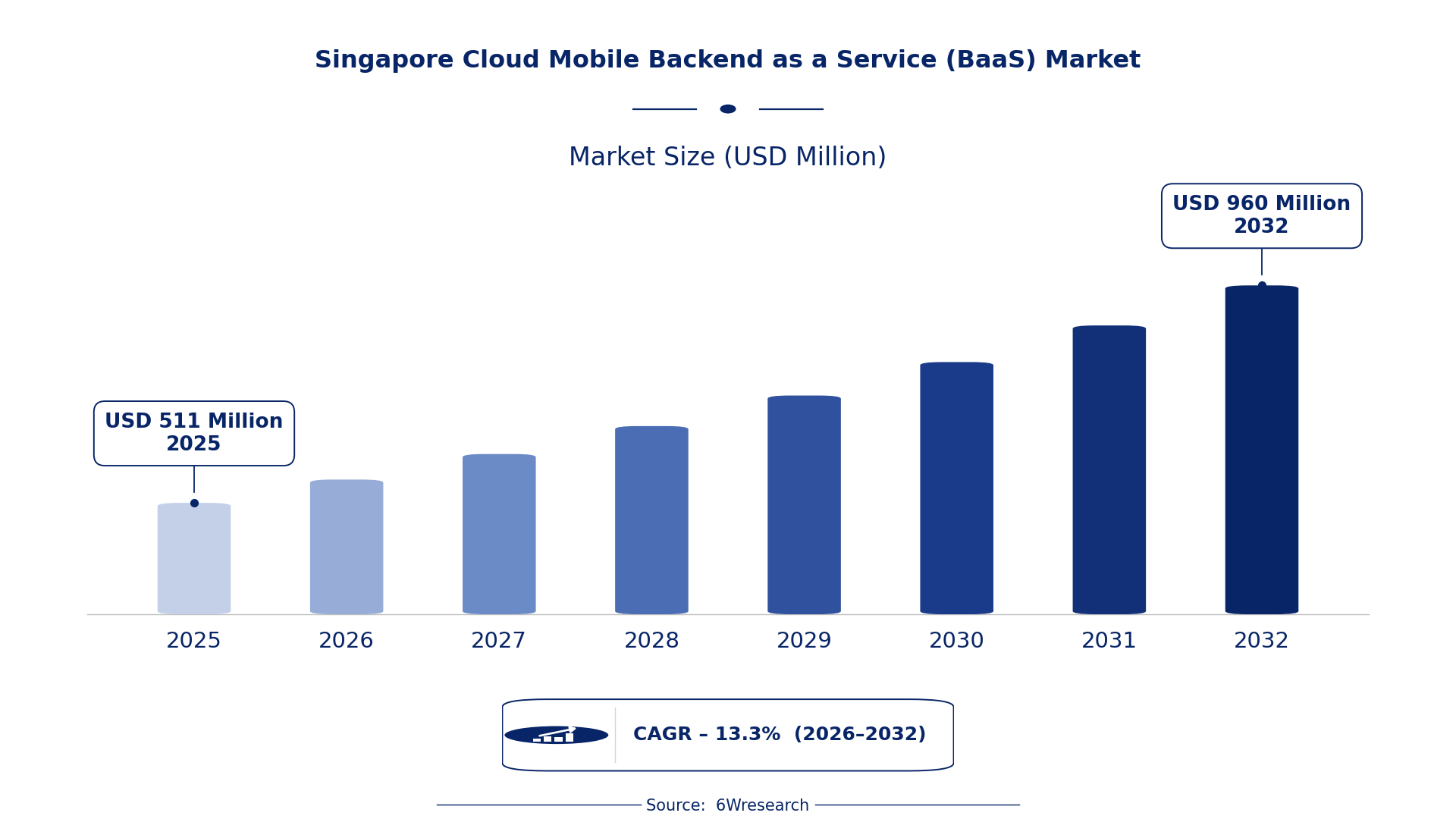
The Singapore Cloud Mobile Backend as a Service (BaaS) Market was estimated at USD 511 Million in 2025 and is projected to reach USD 960 Million by 2032, growing at a CAGR of 13.3% from 2026 to 2032.
Singapore Cloud Mobile Backend as a Service (BaaS) Market Synopsis
The demand for cloud mobile backend services in Singapore has surged, driven by the rapid growth of mobile applications. Companies seek to enhance their mobile presence, requiring scalable backend solutions that enable fast deployment and efficient management of applications.
As businesses focus on delivering feature-rich apps, BaaS providers are stepping up to meet these needs. They offer essential services such as data storage, user authentication, and push notifications, which are crucial for developers looking to streamline their workflows and enhance user experiences.
Singapore Cloud Mobile Backend as a Service (BaaS) Market Year-wise Growth Rate and Key Drivers
This graph illustrates the annual growth rates of the Singapore Cloud Mobile Backend as a Service (BaaS) Market from 2021 to 2032, highlighting a steady upward trajectory and projected expansion over the forecast period.
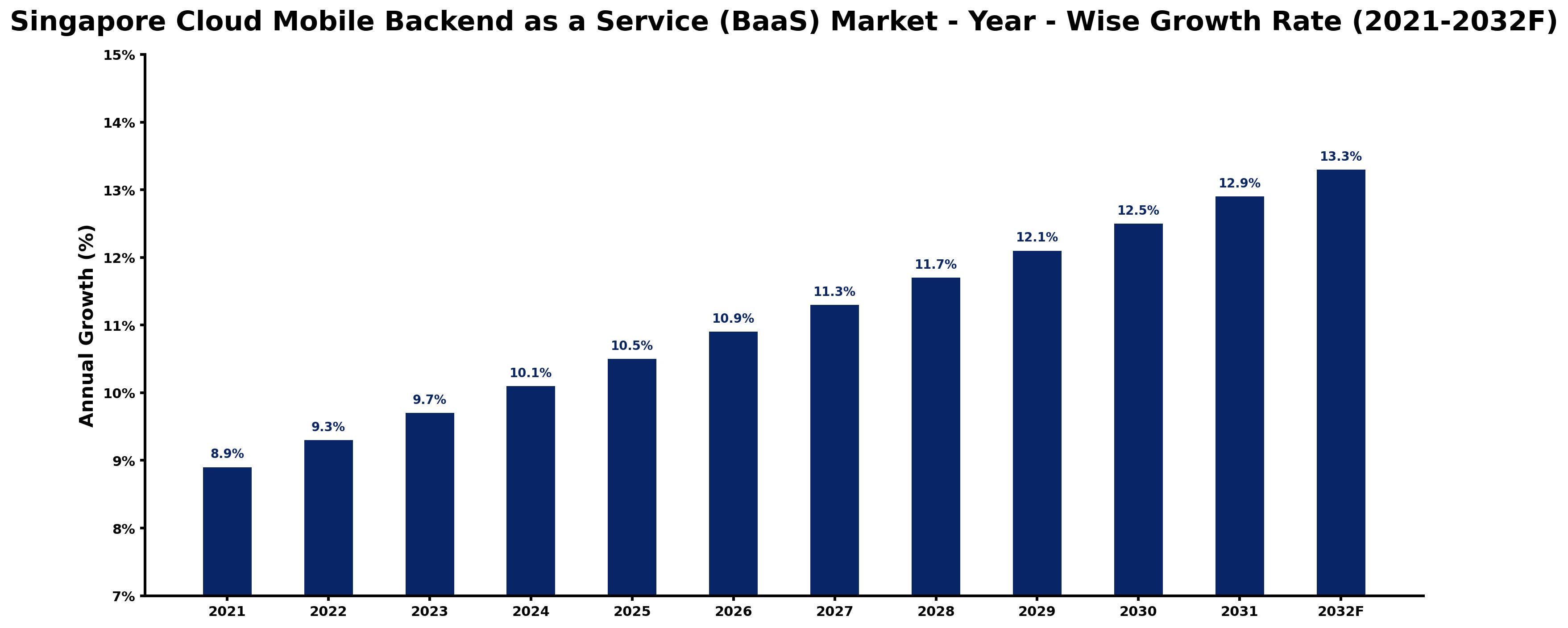
The table below presents the year‑wise growth rates along with the key drivers influencing the market
| Year | Growth Rate | Major Drivers |
| 2021 | 8.9% | Government grants for startups enhancing BaaS adoption. |
| 2022 | 9.3% | Rising e-commerce demands accelerating platform development needs. |
| 2023 | 9.7% | Increased focus on cybersecurity enhancing cloud service trust. |
| 2024 | 10.1% | Local startups driving mobile innovation with BaaS solutions. |
| 2025 | 10.5% | Adoption of AI in applications boosting backend services. |
| 2026 | 10.9% | Emergence of fintech companies leveraging cloud-based solutions. |
| 2027 | 11.3% | Government initiatives promoting digital marketing strategies for SMEs. |
| 2028 | 11.7% | Smart Nation initiative fostering digital solutions integration. |
| 2029 | 12.1% | Growing interest in IoT applications driving backend scalability demands. |
| 2030 | 12.5% | Heightened competition in app development spurring BaaS investments. |
| 2031 | 12.9% | Rise in remote work fueling demand for mobile solutions. |
| 2032 | 13.3% | Partnerships between local tech firms enhancing service offerings. |
Note: Market size estimations and growth projections presented in this report are based on 6Wresearch's proprietary forecasting methodology, utilizing the latest available industry data, government publications, and primary research inputs.
Singapore Cloud Mobile Backend as a Service (BaaS) Market Key Takeaways
Below are some of the specific key takeaways from the market, including:
- The market is experiencing strong growth, driven by increasing mobile app development.
- Demand for BaaS solutions is largely influenced by the need for quick and cost-effective app deployment.
- Security and performance remain critical concerns for businesses leveraging BaaS.
- Providers are continuously innovating to enhance service offerings and meet developer expectations.
- The COVID-19 pandemic has significantly accelerated the adoption of cloud-based mobile solutions.
Evaluation of Restraints in Singapore Cloud Mobile Backend as a Service (BaaS) Market
Despite its growth, the Singapore Cloud BaaS market faces notable restraints. Chief among these are the challenges related to maintaining consistent app performance. BaaS providers must ensure low-latency services and high availability, which can be complicated by fluctuating network conditions and diverse user demands.
Additionally, the sensitive nature of mobile app data raises significant security and privacy concerns. As businesses increasingly rely on cloud solutions, the pressure to comply with evolving regulations and ensure robust data protection protocols intensifies.
Singapore Cloud Mobile Backend as a Service (BaaS) Market Trends
The rise of artificial intelligence and machine learning is shaping the future of BaaS in Singapore. Providers are integrating advanced analytics to help businesses gain insights from user data, enhancing the development process. on top of that, the trend towards low-code and no-code platforms is democratizing app development, allowing non-developers to create applications more easily.
Sustainability is also becoming a focus, with providers exploring ways to minimize their environmental impact. As organizations increasingly prioritize eco-friendly practices, BaaS solutions that support green initiatives are likely to gain traction.
Singapore Cloud Mobile Backend as a Service (BaaS) Market Opportunities
The Singapore BaaS market presents substantial growth opportunities, especially for providers that can deliver tailored solutions. As businesses shift towards mobile-first strategies, there's an urgent need for BaaS that supports scalability and flexibility.
Investments in AI-driven tools and advanced security features will be crucial for gaining competitive advantages. Additionally, collaborations with enterprises to develop customized backend solutions can open new revenue streams for BaaS providers.
Government Initiatives in the Singapore Cloud Mobile Backend as a Service (BaaS) Market
The Singapore government is actively fostering the growth of the Cloud Mobile Backend as a Service (BaaS) market through various initiatives. Regulatory frameworks are being established to enhance digital infrastructure and ensure data security standards, vital for the evolving BaaS landscape. As public sector priorities align with technological advancements, policy measures play a crucial role in shaping market dynamics.
- A national digital infrastructure upgrade program aimed at enhancing connectivity and cloud service capabilities, launched in early 2023.
- Ongoing initiatives to develop stringent data protection regulations that safeguard user information and privacy.
- A public-private partnership to expand access to cloud services for small and medium enterprises, currently underway.
- Plans for a digital innovation fund to support startups in the BaaS space, expected to be introduced by late 2024.
Future Insights of the Singapore Cloud Mobile Backend as a Service (BaaS) Market
Looking ahead to 2026-2032, the Singapore BaaS market is set to evolve significantly. As the demand for mobile applications escalates, businesses will increasingly turn to BaaS providers for scalable, secure, and efficient backend solutions. Enhanced focus on data security and compliance will drive innovation among service providers, who must continuously adapt to shifting regulations.
on top of that, the integration of emerging technologies such as IoT and blockchain will open new avenues for BaaS applications. Companies that successfully leverage these technologies will likely gain a competitive edge, positioning themselves as leaders in the evolving mobile app development ecosystem.
Singapore Cloud Mobile Backend as a Service (BaaS) Market Latest Developments
In recent months, the Singapore Cloud Mobile Backend as a Service (BaaS) market has seen a flurry of activity. Providers are responding to the burgeoning demand for enhanced mobile solutions with innovative service offerings and strategic partnerships. This momentum suggests a vibrant future for the sector.
- A major technology vendor launched a new suite of AI-driven backend services in Q2 2023, enhancing app development capabilities.
- Partnerships between BaaS providers and local startups have emerged, aiming to develop niche applications tailored to specific industries, initiated in late 2022.
- Ongoing efforts to integrate advanced analytics into BaaS offerings are reshaping how businesses understand user engagement, with implementations underway since early 2023.
- Upcoming service upgrades to include enhanced security features are expected to roll out by mid-2024, responding to increasing data privacy concerns.
Singapore Cloud Mobile Backend as a Service (BaaS) Market - Key Attractiveness of the Report
- 10 Years of Market Numbers
- Historical Data Starting from 2022 to 2025
- Base Year: 2025
- Forecast Data until 2032
- Key Performance Indicators Impacting the Market
- Major Upcoming Developments and Projects
Key Highlights of the Report:
- Singapore Cloud Mobile Backend as a Service (BaaS) Market Outlook
- Market Size of Singapore Cloud Mobile Backend as a Service (BaaS) Market, 2025
- Forecast of Singapore Cloud Mobile Backend as a Service (BaaS) Market, 2032
- Historical Data and Forecast of Singapore Cloud Mobile Backend as a Service (BaaS) Revenues & Volume for the Period 2022-2032F
- Singapore Cloud Mobile Backend as a Service (BaaS) Market Trend Evolution
- Singapore Cloud Mobile Backend as a Service (BaaS) Market Drivers and Challenges
- Singapore Cloud Mobile Backend as a Service (BaaS) Price Trends
- Singapore Cloud Mobile Backend as a Service (BaaS) Porter's Five Forces
- Singapore Cloud Mobile Backend as a Service (BaaS) Industry Life Cycle
- Historical Data and Forecast of Singapore Cloud Mobile Backend as a Service (BaaS) Market Revenues & Volume By Application for the Period 2022-2032F
- Historical Data and Forecast of Singapore Cloud Mobile Backend as a Service (BaaS) Market Revenues & Volume By Cloud storage and Backup for the Period 2022-2032F
- Historical Data and Forecast of Singapore Cloud Mobile Backend as a Service (BaaS) Market Revenues & Volume By User authentication for the Period 2022-2032F
- Historical Data and Forecast of Singapore Cloud Mobile Backend as a Service (BaaS) Market Revenues & Volume By Database Management for the Period 2022-2032F
- Historical Data and Forecast of Singapore Cloud Mobile Backend as a Service (BaaS) Market Revenues & Volume By Push Notifications for the Period 2022-2032F
- Historical Data and Forecast of Singapore Cloud Mobile Backend as a Service (BaaS) Market Revenues & Volume By Others for the Period 2022-2032F
- Historical Data and Forecast of Singapore Cloud Mobile Backend as a Service (BaaS) Market Revenues & Volume By Platform for the Period 2022-2032F
- Historical Data and Forecast of Singapore Cloud Mobile Backend as a Service (BaaS) Market Revenues & Volume By Android for the Period 2022-2032F
- Historical Data and Forecast of Singapore Cloud Mobile Backend as a Service (BaaS) Market Revenues & Volume By iOS for the Period 2022-2032F
- Historical Data and Forecast of Singapore Cloud Mobile Backend as a Service (BaaS) Market Revenues & Volume By others for the Period 2022-2032F
- Historical Data and Forecast of Singapore Cloud Mobile Backend as a Service (BaaS) Market Revenues & Volume By Vertical for the Period 2022-2032F
- Historical Data and Forecast of Singapore Cloud Mobile Backend as a Service (BaaS) Market Revenues & Volume By BFSI for the Period 2022-2032F
- Historical Data and Forecast of Singapore Cloud Mobile Backend as a Service (BaaS) Market Revenues & Volume By IT and ITeS for the Period 2022-2032F
- Historical Data and Forecast of Singapore Cloud Mobile Backend as a Service (BaaS) Market Revenues & Volume By Manufacturing for the Period 2022-2032F
- Historical Data and Forecast of Singapore Cloud Mobile Backend as a Service (BaaS) Market Revenues & Volume By Healthcare and pharmaceuticals for the Period 2022-2032F
- Historical Data and Forecast of Singapore Cloud Mobile Backend as a Service (BaaS) Market Revenues & Volume By Retail and eCommerce for the Period 2022-2032F
- Historical Data and Forecast of Singapore Cloud Mobile Backend as a Service (BaaS) Market Revenues & Volume By Media, entertainment for the Period 2022-2032F
- Historical Data and Forecast of Singapore Cloud Mobile Backend as a Service (BaaS) Market Revenues & Volume By Gaming for the Period 2022-2032F
- Historical Data and Forecast of Singapore Cloud Mobile Backend as a Service (BaaS) Market Revenues & Volume By Telecommunications for the Period 2022-2032F
- Historical Data and Forecast of Singapore Cloud Mobile Backend as a Service (BaaS) Market Revenues & Volume By Enterprise Size for the Period 2022-2032F
- Historical Data and Forecast of Singapore Cloud Mobile Backend as a Service (BaaS) Market Revenues & Volume By Small and Medium-sized Enterprises (SMEs) for the Period 2022-2032F
- Historical Data and Forecast of Singapore Cloud Mobile Backend as a Service (BaaS) Market Revenues & Volume By Large Enterprises for the Period 2022-2032F
- Singapore Cloud Mobile Backend as a Service (BaaS) Import Export Trade Statistics
- Market Opportunity Assessment By Application
- Market Opportunity Assessment By Platform
- Market Opportunity Assessment By Vertical
- Market Opportunity Assessment By Enterprise Size
- Singapore Cloud Mobile Backend as a Service (BaaS) Top Companies Market Share
- Singapore Cloud Mobile Backend as a Service (BaaS) Competitive Benchmarking By Technical and Operational Parameters
- Singapore Cloud Mobile Backend as a Service (BaaS) Company Profiles
- Singapore Cloud Mobile Backend as a Service (BaaS) Key Strategic Recommendations






































