Singapore Cloud POS Market Size & Growth Rate (2026-2032)
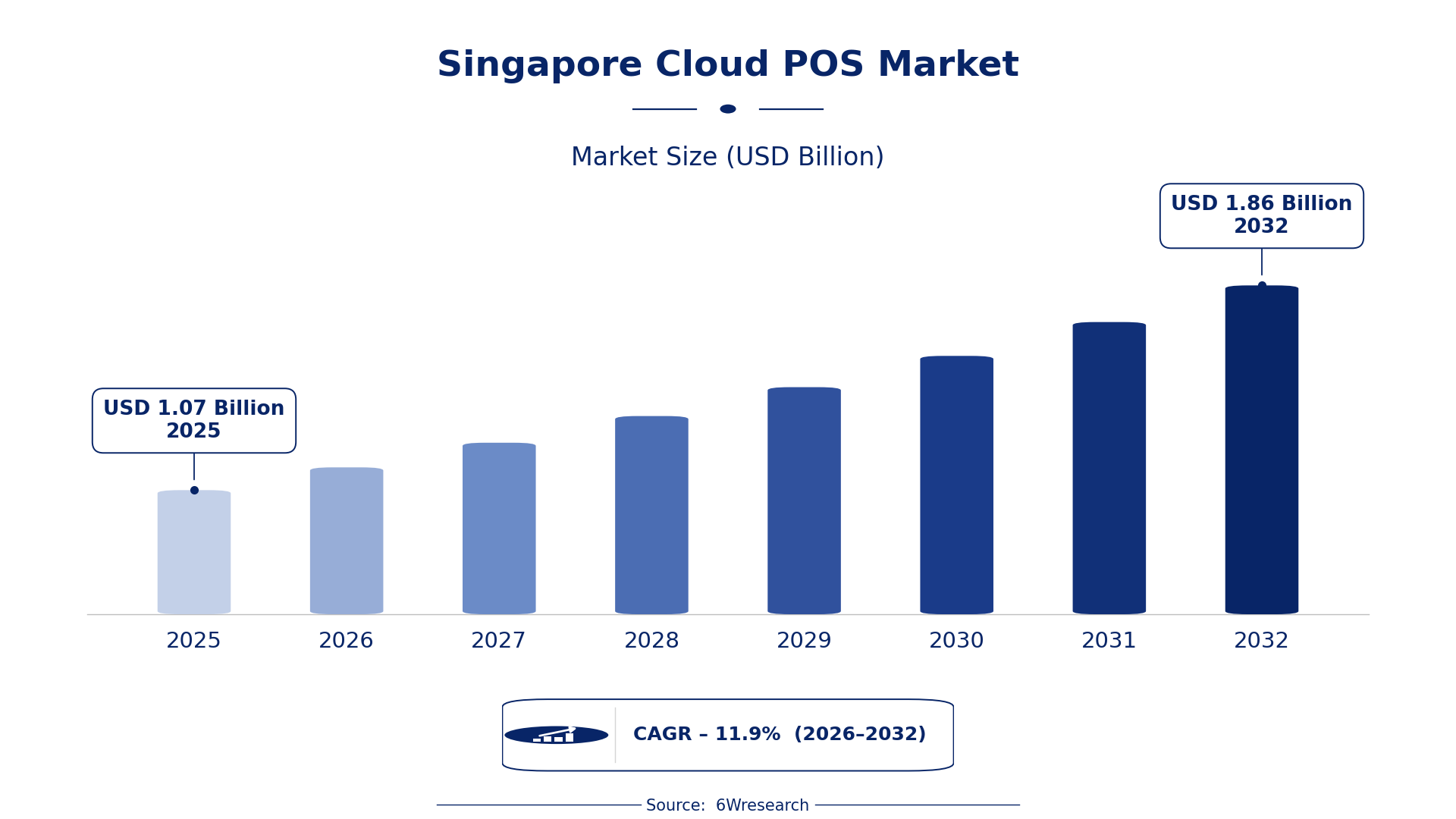
The Singapore Cloud POS Market was estimated at USD 1067 Million in 2025 and is projected to reach USD 1859 Million by 2032, growing at a CAGR of 11.9% from 2026 to 2032.
Singapore Cloud POS Market Synopsis
The Singapore Cloud POS market has seen a dynamic shift, moving from traditional systems to agile cloud-based solutions. As businesses seek to enhance operational efficiency and customer satisfaction, the demand for innovative POS technology has surged, reshaping the retail and hospitality sectors.
Looking ahead, the market is set to maintain its growth trajectory, fueled by the ongoing digital transformation initiatives across industries. With cloud POS systems offering real-time data analytics and contactless payment options, businesses are not just adapting; they are thriving in this new environment.
Singapore Cloud POS Market Year-wise Growth Rate and Key Drivers
This graph illustrates the annual growth rates of the Singapore Cloud POS Market from 2021 to 2032, highlighting a steady upward trajectory and projected expansion over the forecast period.
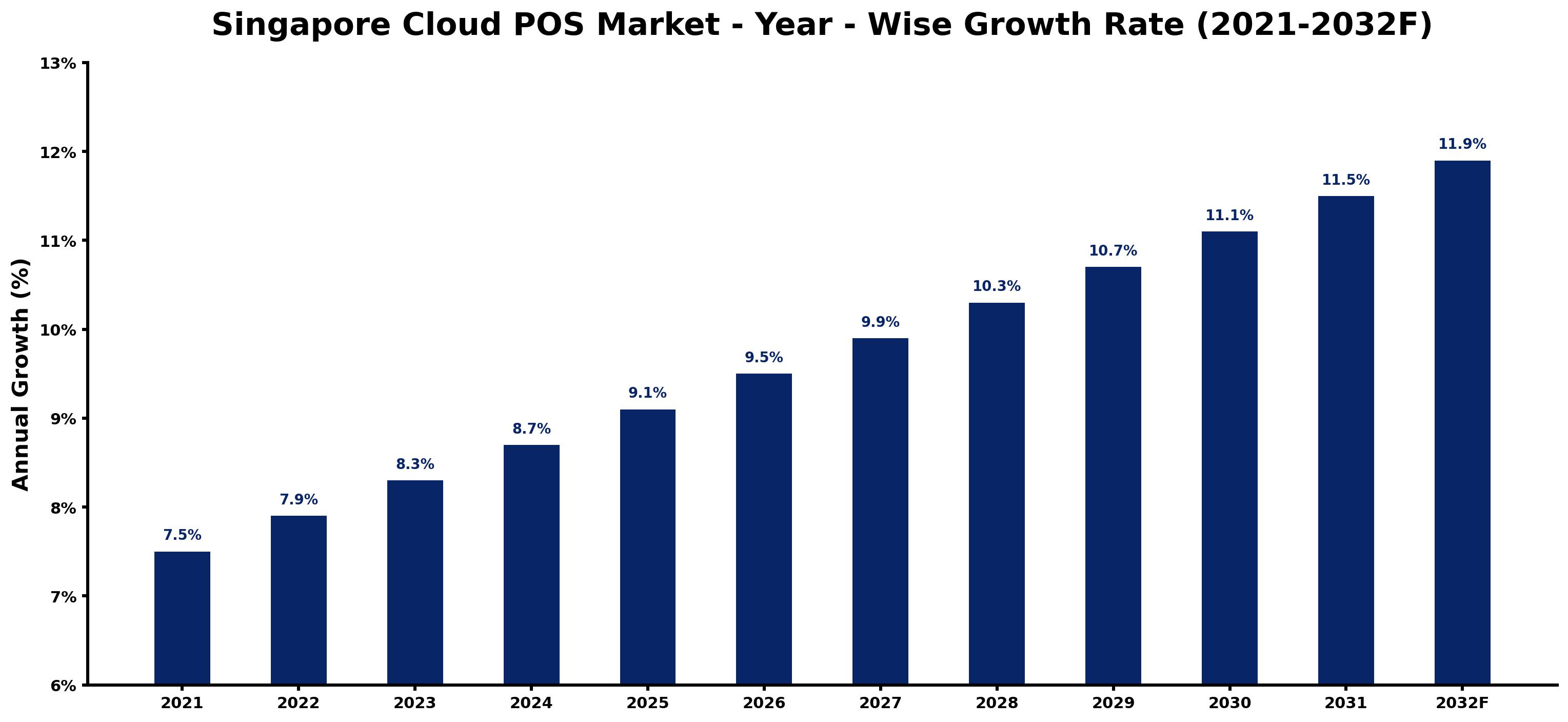
The table below presents the year‑wise growth rates along with the key drivers influencing the market
| Year | Growth Rate | Major Drivers |
| 2021 | 7.5% | Government support for digitalization in retail sector. |
| 2022 | 7.9% | Rise of FinTech solutions enhancing payment processing options. |
| 2023 | 8.3% | Increasing mobile payment adoption among consumers. |
| 2024 | 8.7% | Tax incentives for businesses adopting digital technologies. |
| 2025 | 9.1% | Collaboration with local tech startups fostering innovation. |
| 2026 | 9.5% | Growing necessity for contactless transactions post-COVID-19. |
| 2027 | 9.9% | Supportive regulatory environment for foreign investment in tech. |
| 2028 | 10.3% | High smartphone penetration encouraging mobile-based solutions. |
| 2029 | 10.7% | Consumer preference shift towards integrated POS systems. |
| 2030 | 11.1% | Investments in cybersecurity boosting trust in cloud solutions. |
| 2031 | 11.5% | Local businesses adopting sustainable practices through digitization. |
| 2032 | 11.9% | Smart nation initiatives enhancing digital infrastructure accessibility. |
Note: Market size estimations and growth projections presented in this report are based on 6Wresearch's proprietary forecasting methodology, utilizing the latest available industry data, government publications, and primary research inputs.
Singapore Cloud POS Market Key Takeaways
Below are some of the specific key takeaways from the market, including:
- The shift to cloud-based systems is significantly improving operational efficiency for businesses.
- SMEs are leading the charge in adopting cloud POS solutions to enhance customer experiences.
- Data security remains a critical concern, with businesses focusing on compliance and risk management.
- The COVID-19 pandemic has accelerated the demand for contactless transactions, solidifying the role of cloud POS.
- Key players are continuously innovating to meet the diverse needs of the market.
Evaluation of Restraints in Singapore Cloud POS Market
Several factors are holding back the Singapore Cloud POS market from reaching its full potential. Chief among these are concerns about data security and privacy, as businesses must safeguard sensitive customer and financial information when using third-party cloud services. Additionally, the reliability of these systems is critical; any downtime can disrupt operations and impact customer satisfaction. Addressing these issues is essential for fostering trust and encouraging broader adoption.
Singapore Cloud POS Market Trends
The Singapore Cloud POS market is currently influenced by several key trends. Firstly, there is a pronounced shift towards integrated solutions that combine POS functionality with inventory management and customer relationship management tools. Secondly, the demand for mobile POS systems is on the rise, allowing businesses to process transactions anywhere, enhancing customer convenience. Finally, the emphasis on data analytics is growing, with businesses leveraging insights for better decision-making and personalized marketing strategies.
Singapore Cloud POS Market Opportunities
Opportunities abound in the Singapore Cloud POS market, particularly in sectors like retail and food services where technology adoption is rapidly evolving. The increasing need for contactless payment solutions presents a lucrative avenue for growth. on top of that, as businesses continue to prioritize data-driven insights, companies that can offer advanced analytics capabilities within their POS systems will be well-positioned to capture market share.
Government Initiatives in the Singapore Cloud POS Market
Government policies play a significant role in shaping the Singapore Cloud POS market, as initiatives aimed at enhancing digital infrastructure and promoting secure payment systems are being prioritized. With a focus on fostering innovation and supporting SMEs, these initiatives are critical for driving the adoption of cloud-based technologies in the retail and hospitality sectors.
- A national digital infrastructure upgrade program, launched in early 2025, aims to enhance connectivity for businesses across Singapore.
- The Monetary Authority of Singapore is currently implementing a regulatory framework to ensure data privacy and security for cloud-based payment systems.
- A public-private partnership is planned for 2026, focusing on improving access to digital payment solutions for small businesses.
- A recently completed initiative encouraged SMEs to adopt cloud POS systems through grants and subsidies aimed at reducing initial costs.
Future Insights of the Singapore Cloud POS Market
From 2026 to 2032, the Singapore Cloud POS market is expected to evolve significantly. As businesses increasingly prioritize agility and customer-centric solutions, cloud POS systems will become a staple in operations. The integration of AI and machine learning for predictive analytics will further enhance the capabilities of these systems. Additionally, as the regulatory environment stabilizes, businesses will gain confidence in adopting cloud technologies, driving further growth.
Singapore Cloud POS Market Latest Developments
In the past year, the Singapore Cloud POS market has witnessed a flurry of activity, indicating a strong momentum towards digital transformation. Companies are actively enhancing their offerings to meet the evolving needs of businesses, especially in the wake of the COVID-19 pandemic.
- A major technology vendor launched a new cloud POS solution in Q2 2025, featuring enhanced data analytics and inventory management capabilities.
- An initiative to integrate AI-driven customer insights into POS systems began in early 2025 and is currently underway, aiming to personalize customer interactions.
- A regional operator announced plans for an upcoming partnership with local banks to provide better financing options for businesses adopting cloud POS systems, set to launch in late 2026.
- A leading service provider completed the rollout of a contactless payment feature in Q1 2025, catering to the increasing demand for secure transactions.
Singapore Cloud POS Market - Key Attractiveness of the Report
- 10 Years of Market Numbers
- Historical Data Starting from 2022 to 2025
- Base Year: 2025
- Forecast Data until 2032
- Key Performance Indicators Impacting the Market
- Major Upcoming Developments and Projects
Key Highlights of the Report:
- Singapore Cloud POS Market Outlook
- Market Size of Singapore Cloud POS Market, 2025
- Forecast of Singapore Cloud POS Market, 2032
- Historical Data and Forecast of Singapore Cloud POS Revenues & Volume for the Period 2022-2032F
- Singapore Cloud POS Market Trend Evolution
- Singapore Cloud POS Market Drivers and Challenges
- Singapore Cloud POS Price Trends
- Singapore Cloud POS Porter's Five Forces
- Singapore Cloud POS Industry Life Cycle
- Historical Data and Forecast of Singapore Cloud POS Market Revenues & Volume By Application Areas for the Period 2022-2032F
- Historical Data and Forecast of Singapore Cloud POS Market Revenues & Volume By Retail and Consumer Goods for the Period 2022-2032F
- Historical Data and Forecast of Singapore Cloud POS Market Revenues & Volume By Travel and Hospitality for the Period 2022-2032F
- Historical Data and Forecast of Singapore Cloud POS Market Revenues & Volume By Media and Entertainment for the Period 2022-2032F
- Historical Data and Forecast of Singapore Cloud POS Market Revenues & Volume By Transport and Logistics for the Period 2022-2032F
- Historical Data and Forecast of Singapore Cloud POS Market Revenues & Volume By Healthcare for the Period 2022-2032F
- Historical Data and Forecast of Singapore Cloud POS Market Revenues & Volume By Component for the Period 2022-2032F
- Historical Data and Forecast of Singapore Cloud POS Market Revenues & Volume By Solution for the Period 2022-2032F
- Historical Data and Forecast of Singapore Cloud POS Market Revenues & Volume By Services for the Period 2022-2032F
- Historical Data and Forecast of Singapore Cloud POS Market Revenues & Volume By Service for the Period 2022-2032F
- Historical Data and Forecast of Singapore Cloud POS Market Revenues & Volume By Training, Consulting, and Integration for the Period 2022-2032F
- Historical Data and Forecast of Singapore Cloud POS Market Revenues & Volume By Support and Maintenance for the Period 2022-2032F
- Historical Data and Forecast of Singapore Cloud POS Market Revenues & Volume By Organization Size for the Period 2022-2032F
- Historical Data and Forecast of Singapore Cloud POS Market Revenues & Volume By SMEs for the Period 2022-2032F
- Historical Data and Forecast of Singapore Cloud POS Market Revenues & Volume By Large Enterprises for the Period 2022-2032F
- Singapore Cloud POS Import Export Trade Statistics
- Market Opportunity Assessment By Application Areas
- Market Opportunity Assessment By Component
- Market Opportunity Assessment By Service
- Market Opportunity Assessment By Organization Size
- Singapore Cloud POS Top Companies Market Share
- Singapore Cloud POS Competitive Benchmarking By Technical and Operational Parameters
- Singapore Cloud POS Company Profiles
- Singapore Cloud POS Key Strategic Recommendations






































